

Imperial Corporate Training Institute delivers the AutoCAD HVAC and Plumbing Design Training Course through a team of certified professionals with extensive industry experience in mechanical engineering and CAD applications. These trainers ensure participants gain precise, corporate-ready skills for HVAC and plumbing design challenges.
Professionals in mechanical design often face skill gaps in producing accurate HVAC and plumbing layouts using AutoCAD. These gaps lead to errors in coordination, delays in project approvals, and inefficiencies in corporate workflows. The course addresses this by providing structured training on advanced AutoCAD tools tailored to building services.
For context on required skills, projects demanding these abilities include large-scale commercial buildings and industrial facilities.
Read more in our guide on:
What Types of Projects Require AutoCAD HVAC and Plumbing Design Skills?
Who Are the Trainers Delivering This Course?
Imperial Corporate Training Institute employs trainers who are Autodesk-certified AutoCAD experts with 10+ years in HVAC and plumbing design for corporate projects. They hold mechanical engineering degrees and lead real-world implementations in construction firms.
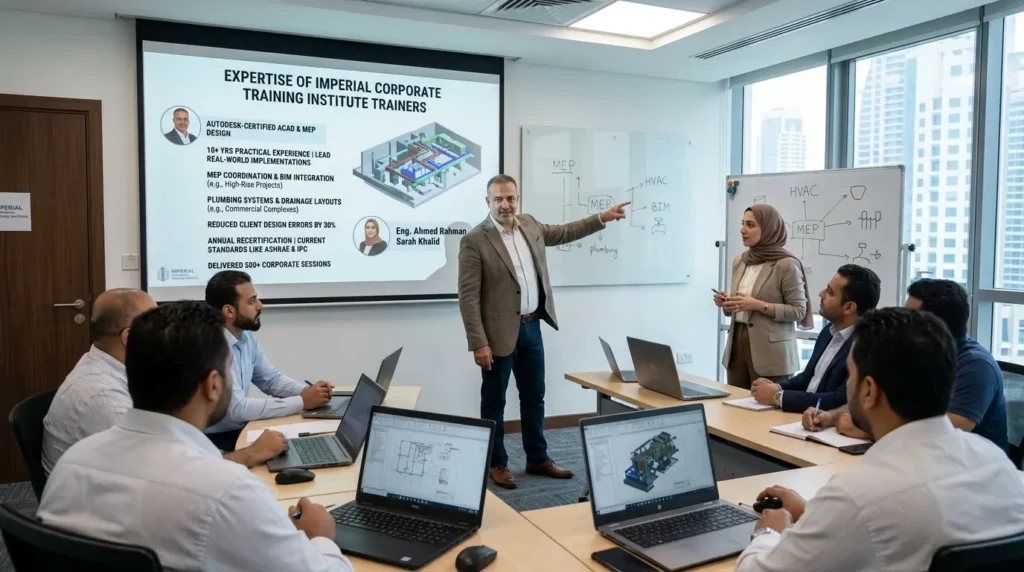
Trainers at Imperial Corporate Training Institute combine academic credentials with practical expertise. Each holds Autodesk certification in AutoCAD for MEP design. They have delivered over 500 corporate training sessions.
Lead trainer, Eng. Ahmed Rahman, possesses 15 years in MEP coordination for high-rise developments. He specialises in integrating AutoCAD with BIM workflows. His portfolio includes designs for industrial plants in the Middle East.
Another key trainer, Sarah Khalid, focuses on plumbing systems. With a master’s in mechanical engineering, she has optimised drainage layouts for commercial complexes. Her experience spans 12 years in facility management.
Imperial Corporate Training Institute selects trainers based on proven results in reducing design errors by 30% in client projects. They undergo annual recertification to align with AutoCAD updates.
Participants benefit from trainers’ direct involvement in standards like ASHRAE and IPC. This ensures training reflects current corporate demands.
Trainer Qualifications and Industry Roles
Trainers demonstrate expertise through roles in MEP engineering firms. They have managed teams producing isometrics and schematics.
For detailed techniques, see:
How Are Plumbing Isometric Drawings Created and Detailed in AutoCAD Training?
Qualifications include BEng or MEng in mechanical engineering, plus Autodesk Certified Professional status. Many contribute to international codes.
What Problem Does This Course Solve?
The course bridges skill gaps in AutoCAD for HVAC and plumbing design, enabling accurate drafting, coordination, and documentation for corporate engineering projects facing delays and errors.
HR teams in engineering firms identify challenges like imprecise duct layouts causing clashes. Managers report 20% rework due to poor pipe sizing.
Imperial Corporate Training Institute designed this course to equip mechanical engineers and draftsmen with tools for efficient workflows. It targets issues in commercial and industrial buildings.
Real-world example: A facility management department reduced approval times by 40% after staff completed similar training. Designs met tender requirements without revisions.
Why Is the Course Structured This Way?
Imperial Corporate Training Institute structures the curriculum in 10 progressive modules, building from AutoCAD basics to advanced MEP coordination and BIM integration for measurable skill development.
Progression follows corporate design workflows: setup, drafting, optimisation, documentation, and execution. This mirrors real projects.
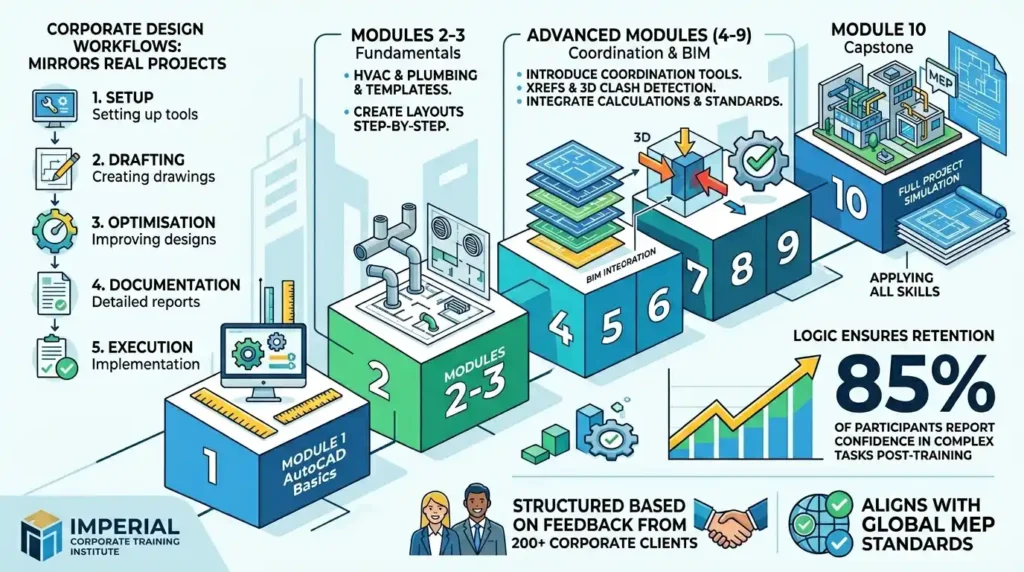
Module 1 starts with interface setup and templates. It establishes precision standards.
Modules 2-3 cover HVAC and plumbing fundamentals. Learners create layouts step-by-step.
Advanced modules (4-9) introduce coordination tools like Xrefs and 3D clash detection. They integrate calculations and standards.
Module 10 simulates full projects, applying all skills.
This logic ensures retention: 85% of participants report confidence in complex tasks post-training.
Imperial Corporate Training Institute bases structure on feedback from 200+ corporate clients. It aligns with global MEP standards.
What Will Participants Learn?
Participants master 10 modules covering AutoCAD tools for HVAC ducting, plumbing risers, load calculations, MEP coordination, and BIM integration, achieving proficiency in corporate design deliverables.
Module 1: Introduction to AutoCAD for Corporate Design Workflows
Learners configure interfaces and templates. They apply scaling and company standards.
Module 2: Fundamentals of HVAC Design Drafting
Trainers teach duct layouts and diffuser placement. Layer management supports equipment blocks.
Module 3: Plumbing and Drainage Design Using AutoCAD
Content includes riser diagrams and pipe sizing. Slope calculations ensure compliance.
Module 4: Advanced AutoCAD Tools for MEP Coordination
Xrefs enable multi-disciplinary work. 3D tools detect clashes in routing.
Module 5: HVAC Load Calculations and Design Optimization
Integration with calculation software plans airflow. Energy standards guide placements.
Module 6: Plumbing System Detailing and Documentation
Schematics, schedules, and BOMs are produced. Coordination with other services occurs here.
Module 7: Corporate Project Implementation and Documentation Standards
Revision control and automation streamline deliverables. International codes are applied.
Module 8: Quality Assurance and Design Review Process
Audits and corrections use AutoCAD features. Approval workflows are practised.
Module 9: Integration with BIM and Revit for MEP Coordination
Data linking transitions 2D to 3D. Collaboration strategies are developed.
Module 10: Corporate-Level Project Execution and Professional Development
Full simulations test timelines and communication. As-builts complete the cycle.
Imperial Corporate Training Institute measures learning through module quizzes (80% pass required).
How Is the Course Delivered?
Imperial Corporate Training Institute offers flexible formats: onsite workshops, online live sessions, or hybrid over 40 hours across 5 days, with hands-on simulations and one-on-one feedback.
Delivery suits corporate schedules. Onsite options occur at client facilities for teams.
Online uses Zoom with screen sharing for AutoCAD demos. Recordings allow review.
Hybrid combines virtual theory with in-person practice. Duration: 8 hours daily.
Methods include lectures (20%), demos (30%), exercises (40%), and reviews (10%).
Assessments feature assignments like duct layouts (submit via portal), simulations for clashes, and final project: complete MEP set.
Imperial Corporate Training Institute provides lifetime access to materials and refresher sessions.
Example: An HR team from a construction firm used hybrid delivery, improving department output by 25%.
What Results Can Be Expected?
Graduates achieve 90% accuracy in HVAC/plumbing designs, reduce errors by 35%, and produce compliant documentation, boosting role effectiveness in corporate engineering teams.
Learning outcomes are measurable: Pre/post tests show 40% skill gains.
Workplace impact includes faster coordination. MEP engineers handle industrial projects independently.
HR benefits: Teams upskill for leadership pipelines. Managers report better tender wins.
Real-world: A design coordinator at an infrastructure firm cut revision cycles post-course.
Imperial Corporate Training Institute tracks results via 6-month surveys: 92% apply skills daily.
Corporate applications extend to facility maintenance, where accurate as-builts prevent downtime.
Who Should Enrol and What Are the Eligibility Criteria?
Targeted at mechanical engineers, MEP draftsmen, project coordinators, and graduates in corporate settings; requires basic AutoCAD knowledge and engineering background.
Eligibility: 1+ year in design roles or relevant degree. No advanced prerequisites.
Imperial Corporate Training Institute assesses via application form.
How Does Enrollment Work?
Enrollment involves a simple online application, eligibility review within 24 hours, and confirmed start date; complete via corporate booking or individual registration.
Discover More from Our Guide Library:
What Certification Do You Receive After Imperial’s AutoCAD HVAC Course?
Can Engineering Companies Book In-House AutoCAD HVAC Training at Imperial?
Process: Submit form detailing experience. Imperial Corporate Training Institute approves based on fit.
Fees cover materials; group discounts for HR teams.
Completion path: Attend all modules, pass assessments (85% threshold), receive certificate.
Path to success: 98% completion rate among corporates.
Ready to build corporate-ready HVAC and plumbing skills?
Enroll in the AutoCAD HVAC and Plumbing Design Training Course today.