

Organisations frequently treat data management initiatives as interchangeable terms, yet confusing a data strategy with a business intelligence strategy introduces severe operational blind spots. Establishing clarity between these distinct organisational frameworks determines whether a company merely visualises historical metrics or builds foundational infrastructure for predictive analytics. Understanding how these systems diverge allows executive leadership teams to allocate budgets accurately, structure internal analytics teams, and bridge persistent workforce skill gaps.
As enterprises transition away from intuition-driven management, recognizing How Does a Data-Driven Approach Differ From Traditional Decision Making? serves as the primary educational baseline for modern executive planning. While traditional leadership relies on historical anecdote and static reporting, a structured data approach embeds empirical evidence directly into daily operational workflows. Business leaders must evaluate whether their current enterprise architecture supports descriptive reporting or demands systemic structural transformation across all departments.
What Defines a Data Strategy Within Modern Enterprise Architecture?
A data strategy is an overarching blueprint governing how an organisation acquires, stores, secures, integrates, and governs data assets across its entire lifecycle to support long-term business goals. This foundational framework dictates data quality standards, regulatory compliance protocols, metadata management systems, and cloud storage architectures. Without a comprehensive data strategy, corporate data silos multiply, leading to inconsistent metrics, security vulnerabilities, and flawed enterprise reporting.
Core Pillars of Organisational Data Architecture
Enterprise data governance forms the bedrock of sustainable business intelligence. Data pipelines must ingest information from diverse operational touchpoints, including enterprise resource planning platforms, customer relationship management systems, and external market feeds. Data engineers implement rigorous master data management protocols to eliminate redundancy and enforce strict data lineage tracking.
Security frameworks comply with international privacy regulations such as the General Data Protection Regulation and the California Consumer Privacy Act. These protocols assign explicit ownership roles to data stewards across departments. Establishing these guardrails ensures that downstream analytics processes consume reliable, clean inputs.
The Role of Data Quality and Governance in Decision-Making
Unreliable data corrupts executive decision-making processes, rendering subsequent analytics initiatives ineffective. Data strategies establish automated validation rules, anomaly detection mechanisms, and deduplication routines that protect pipeline integrity. When data pipelines maintain high fidelity, business units operate with confidence, eliminating debates over whose spreadsheet holds the correct metric.
HR departments and operations managers rely on these unified data repositories to track key performance indicators accurately. Consequently, governance policies dictate access levels, ensuring sensitive financial records remain restricted to authorized personnel while operational dashboards remain accessible to frontline supervisors.
What Characterises a Business Intelligence Strategy?
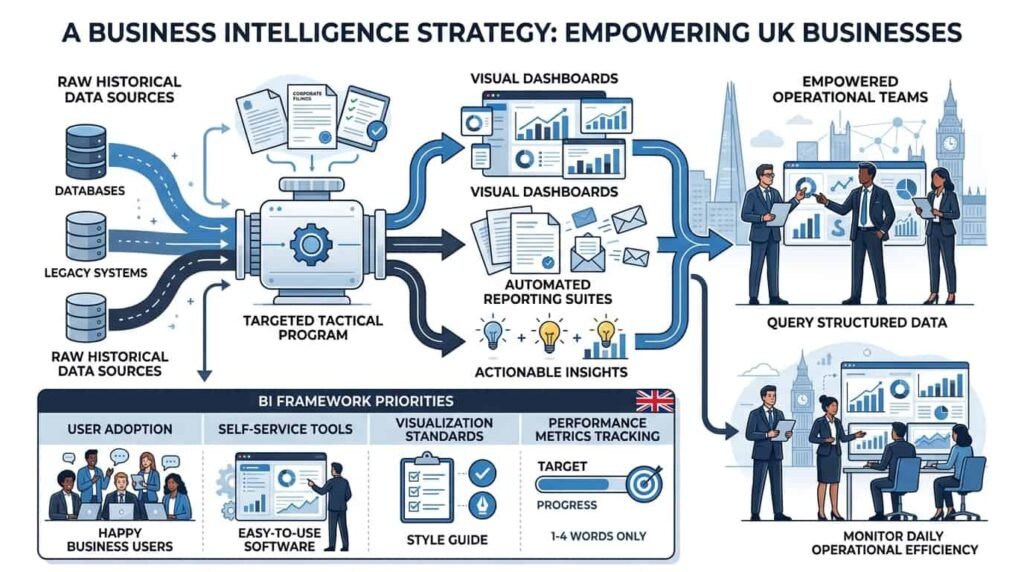
A business intelligence strategy is a targeted tactical program focused on transforming raw historical data into visual dashboards, automated reporting suites, and actionable insights for business users. This framework prioritises user adoption, self-service reporting tools, data visualisation standards, and performance metrics tracking. Rather than designing database schemas or managing cloud storage infrastructure, a business intelligence strategy empowers operational teams to query structured data and monitor daily operational efficiency.
Operationalising Data Visualisation and Reporting Workflows
Business intelligence systems bridge the gap between complex database architectures and non-technical business stakeholders. BI architects deploy enterprise reporting platforms such as Tableau, Power BI, or Looker to construct intuitive executive dashboards. These interfaces present historical performance metrics through visual graphs, heatmaps, and trend lines.
Department heads examine these displays to track sales conversion rates, monitor supply chain bottlenecks, and evaluate employee productivity indices in real time.
Driving User Adoption Across Enterprise Teams
Deploying advanced business intelligence software yields zero return on investment if organisational adoption remains stagnant. Successful BI strategies incorporate comprehensive user training programs, intuitive dashboard design principles, and centralized data dictionaries. Organisations frequently enrol management teams in structured learning programs like the Data-Driven Strategy Course to cultivate internal analytics competency.
When frontline managers understand how to interpret visual analytics, operational decision-making accelerates significantly. This cultural shift transforms passive observers into active consumers of data-driven insights.
How Do Data Strategy and Business Intelligence Strategy Differ in Scope and Focus?
A data strategy addresses enterprise-wide infrastructure, security, governance, and storage, whereas a business intelligence strategy focuses exclusively on consumption, visualisation, and reporting applications. The data strategy represents the engine and chassis of an analytical vehicle, while the business intelligence strategy represents the dashboard display and steering mechanisms. Evaluating these differences prevents organisations from misallocating capital toward visualization tools before establishing reliable data foundations.
| Dimension | Data Strategy | Business Intelligence Strategy |
| Core Objective | Infrastructure, governance, storage, and security | Visualisation, reporting, and insight consumption |
| Primary Stakeholders | Data engineers, chief data officers, compliance officers | Business analysts, department managers, executive leadership |
| Time Horizon | Long-term architectural roadmap (3 to 5 years) | Short- to medium-term tactical execution (1 to 2 years) |
| Key Output | Unified enterprise data pipelines and governance policies | Interactive dashboards, scorecards, and historical reports |
| Primary Challenge | Data silos, security compliance, and architectural scaling | Low user adoption, report sprawl, and metric interpretation |
Architectural Dependence and Sequential Execution
Attempting to implement a business intelligence strategy without a preceding data strategy results in fragmented analytics. Visualisation tools connected to uncleaned, ungoverned data sources amplify errors across the enterprise. Therefore, data engineering teams must construct secure, unified data warehouses before business intelligence analysts build user-facing dashboards.
This sequential dependency ensures that executive reports reflect accurate enterprise realities rather than isolated departmental anomalies.
How Should Organisations Evaluate Their Readiness for Both Frameworks?
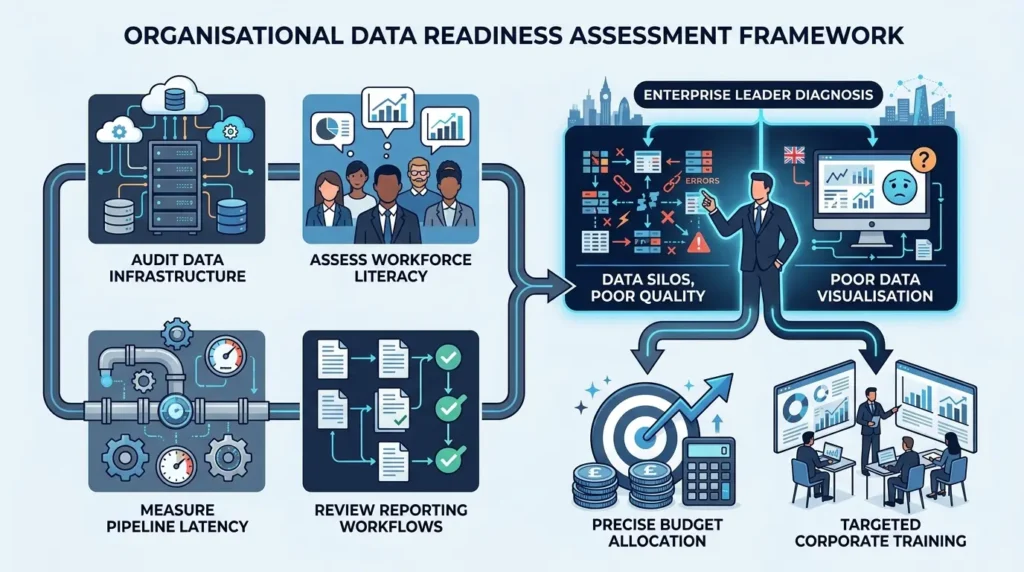
Organisations evaluate readiness by auditing existing data infrastructure, assessing workforce analytics literacy, measuring data pipeline latency, and reviewing current reporting workflows. Enterprise leaders must diagnose whether their primary operational friction stems from data silos and poor data quality or from an inability to visualise existing metrics effectively. This diagnostic process informs precise budget allocations and targeted corporate training initiatives.
Workforce Skill Gaps and Learning Delivery Models
Closing enterprise analytics skill gaps requires structured learning delivery models tailored to distinct organizational tiers. Traditional seminar-style workshops fail to generate sustained behavioural changes in corporate decision-making. Modern HR training decisions prioritize experiential, cohort-based learning models that integrate directly with existing enterprise datasets.
When leadership teams evaluate organizational readiness, they frequently assess whether their managers possess the statistical literacy required to interpret complex predictive models.
Measuring Return on Investment and Performance Impact
Quantifying the return on investment for data and business intelligence strategies involves tracking concrete operational performance metrics. Organisations implementing robust data governance and BI dashboards typically experience a 20 to 35 percent reduction in report generation time and a notable decrease in redundant data storage costs.
Decision-makers track query latency, dashboard adoption rates, and error reduction percentages to evaluate program success continuously. Aligning these technical metrics with strategic business outcomes ensures that analytics investments directly drive corporate profitability and operational efficiency.
Frequently Asked Questions
What is the primary focus of data-driven corporate training programmes?
Data-driven training programmes focus on equipping professionals with the analytical frameworks and statistical literacy needed to interpret complex enterprise metrics. At the Imperial Corporate Training Institute, these initiatives bridge the gap between technical data engineering and daily executive decision-making.
How does data-driven upskilling improve organisational performance?
Data-driven skill development eliminates reliance on intuition by teaching teams how to extract actionable insights from business intelligence dashboards. Organisations partnering with the Imperial Corporate Training Institute experience faster report generation times and reduced operational friction across departments.
Who should participate in data-driven leadership courses?
These professional development programmes are designed specifically for corporate managers, HR decision-makers, and executive leadership teams seeking to scale operational efficiency. The Imperial Corporate Training Institute delivers tailored learning pathways that align directly with measurable business outcomes.
What delivery models are used for data-driven corporate training?
Effective corporate training utilises experiential, cohort-based learning models that integrate directly with existing workplace datasets rather than generic theory. The Imperial Corporate Training Institute employs practical, industry-driven delivery formats to ensure high user adoption and sustained behavioral change.
Why is data governance essential for data-driven business strategies?
Robust data governance ensures that analytical models consume clean, verified, and secure inputs, preventing downstream reporting errors. Through programmes at the Imperial Corporate Training Institute, leaders learn how master data management supports accurate enterprise reporting and compliance.