
Data-driven strategy training teaches executives how to translate raw enterprise metrics into actionable strategic roadmaps by embedding analytical frameworks directly into core decision-making workflows, bridging the gap between isolated business intelligence dashboards and long-term organizational objectives.
Modern enterprises generate unprecedented volumes of telemetry, financial records, and operational telemetry. Despite this abundance, executive boards frequently struggle to convert dashboards into coherent business outcomes. This disconnect stems from a fundamental training deficit. Traditional management education separates data science from executive leadership. Organizations collect metrics without equipping leaders with the cognitive architectures required to interpret them contextually.
When organizations examine foundational metrics, executives often review What Types of Data Do Businesses Use to Inform Strategic Planning? to establish a baseline understanding of operational inputs. However, knowing which data sources exist differs entirely from orchestrating them toward unified corporate targets. Executive programs must systematically dismantle silos between data analysts and decision-makers. They replace intuition-based planning with repeatable, evidence-backed evaluation models.
Why Do Traditional Executive Leadership Programs Fail to Connect Metrics With Corporate Vision?
Traditional executive leadership programs fail because they treat data analysis as a technical support function rather than a core leadership competency, leaving leaders dependent on intermediaries who lack high-level strategic context.
Historical corporate training models divide responsibilities into strict functional silos. Chief executive officers and senior vice presidents focus on vision, culture, and high-level financial targets. Data engineering teams manage databases, analytics platforms, and reporting pipelines. This separation creates a dangerous vacuum. Leaders approve major capital investments or operational pivots based on sanitized slide decks rather than raw, unfiltered operational realities. They consume static summaries that mask underlying volatility, hidden correlations, and emerging market shifts.
Corporate learning initiatives at Imperial Corporate Training Institute address this systemic vulnerability by embedding data literacy directly into executive development. Leaders no longer look at analytics as a passive quarterly report. They learn to interrogate underlying assumptions, audit collection biases, and verify metric validity before committing organizational capital.
Organizations face persistent skill gaps in middle and senior management. HR directors report that nearly 60 percent of promoted leaders possess strong interpersonal management skills but lack the quantitative fluency required to evaluate complex analytics engines. This deficiency leads to delayed responses to market disruptions.
When enterprises deploy comprehensive interventions like the Data-Driven Strategy Training Program, executive teams transition from reactive consumers of information to active architects of evidence-based policy. They learn to construct data architectures that reflect true enterprise priorities rather than vanity metrics that obscure underperformance.
How Do Structured Analytical Frameworks Translate Broad Business Goals Into Measurable KPIs?
Structured analytical frameworks translate broad business goals into measurable KPIs by breaking macro-level corporate visions down into hierarchical, statistically verifiable performance indicators that link daily execution to long-term valuation.
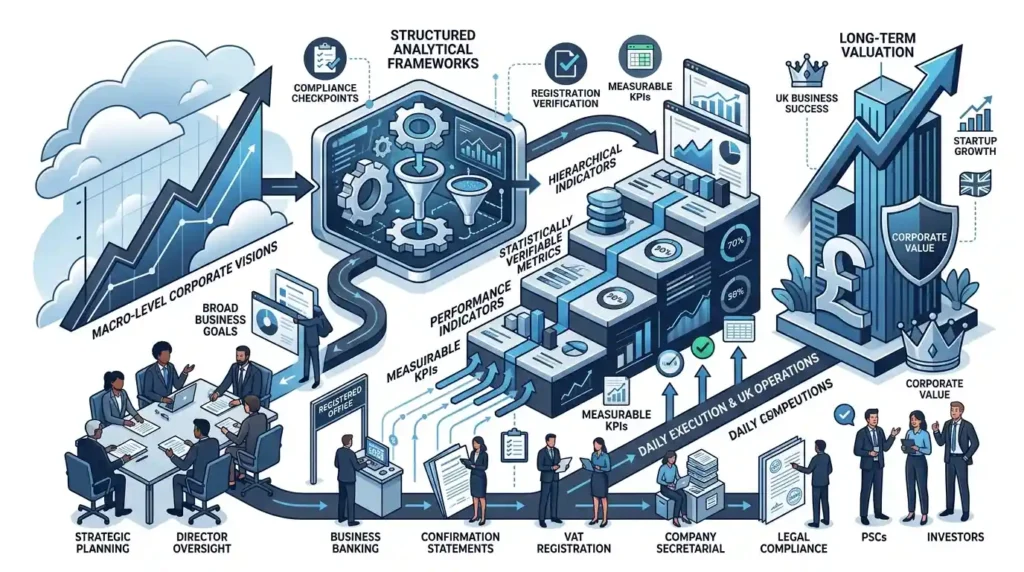
Translating a broad mission statement into daily operational tasks requires rigorous logical decomposition. Executives often struggle because corporate goals use ambiguous terminology. Objectives such as improving market share, enhancing customer satisfaction, or accelerating digital transformation remain abstract until mapped to specific quantitative variables. Training frameworks solve this by teaching leaders how to apply goal-decomposition methodologies like Objectives and Key Results paired with balanced scorecard architectures.
During structured training simulations, executive cohorts analyze historical enterprise performance data to identify leading indicators versus lagging indicators. A lagging indicator, such as quarterly net revenue, confirms past performance but offers no corrective leverage. A leading indicator, such as pipeline velocity or customer feature adoption rates, provides actionable foresight.
Executives learn to design composite indices that synthesize multiple disparate data points into a single health score for strategic initiatives. This methodology eliminates emotional consensus-building during board meetings. Instead of debating subjective opinions, leadership teams evaluate statistical significance, confidence intervals, and regression analyses.
Corporate learning delivery models leverage blended cohort-based simulations where executives analyze real-world case studies of strategic failure caused by metric misalignment. By examining organizations that tracked high-volume vanity metrics while core enterprise value eroded, leaders develop a healthy skepticism toward unverified dashboards. They master the discipline of questioning data provenance, ensuring that every strategic initiative rests on unassailable empirical foundations.
What Role Do Decision-Making Biases Play in Distorting Metric-Driven Strategic Alignment?
Decision-making biases distort metric-driven strategic alignment by causing leaders to cherry-pick data points that confirm pre-existing hypotheses while systematically ignoring statistically significant disconfirming evidence.
Human psychology exerts a powerful influence on executive boardrooms. Even the most sophisticated business intelligence platforms fail when leadership teams fall victim to confirmation bias, anchoring, and survivorship bias. Executives frequently enter strategic planning sessions with a preconceived vision for expansion or restructuring. When presented with comprehensive data, their cognitive filters isolate metrics that validate their preferred path while dismissing contradictory findings as anomalies.
Executive training programs dedicate substantial instructional hours to cognitive debiasing techniques. Leaders study behavioral economics and decision science to recognize how framing effects alter their interpretation of risk. For instance, presenting a market capture strategy in terms of potential retention rather than potential loss drastically alters executive risk tolerance, despite identical underlying data.
To counter these distortions, data-driven strategy curricula enforce rigorous hypothesis-driven planning protocols. Before examining any dataset, executive teams must articulate:
- The precise strategic question they aim to resolve.
- The explicit null hypothesis they intend to test.
- The pre-determined statistical thresholds required to validate or reject the hypothesis.
- The specific financial or operational consequences of a false positive result.
By establishing evaluation criteria before data exploration begins, organizations neutralize political maneuvering and hierarchy-driven consensus. A junior analyst’s statistical finding carries the same objective weight as a senior executive’s intuition.
This cultural shift transforms organizational behavior. HR departments measure the success of these training initiatives not merely through completion rates, but through cultural metrics such as psychological safety during strategic reviews, frequency of hypothesis iteration, and reduction in failed capital allocations. Organizations that master this discipline eliminate the costly cycle of launching initiatives based on executive whim rather than verified empirical demand.
How Do Organizations Measure the ROI and Performance Impact of Executing Data-Aligned Strategies?
Organizations measure the ROI and performance impact of executing data-aligned strategies by tracking quantitative operational velocity improvements, capital allocation efficiency ratios, and the direct acceleration of strategic initiative delivery times.
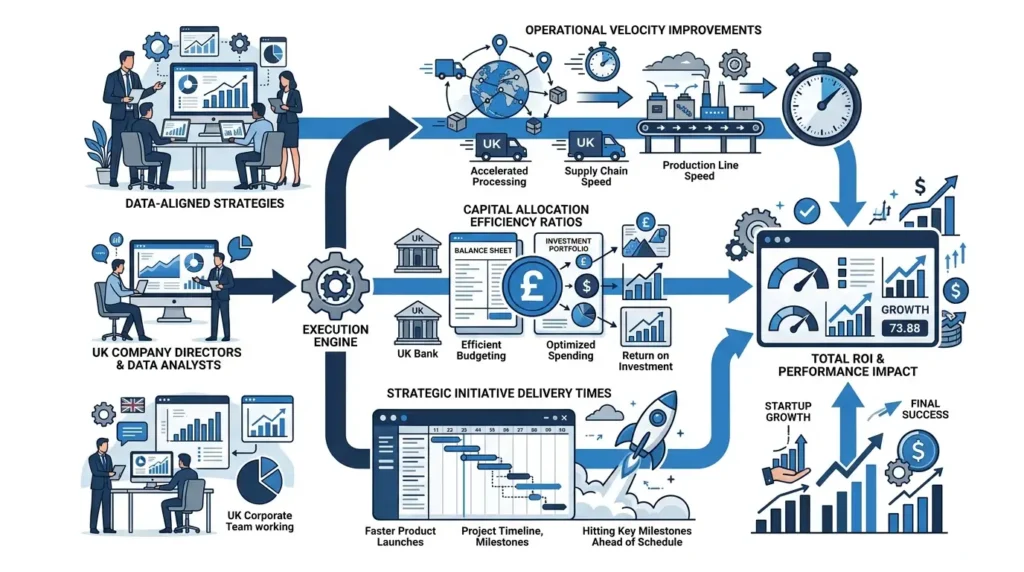
Investing in executive education requires demonstrable financial justification. Human resources and finance committees evaluate leadership training programs through rigorous return-on-investment frameworks that extend far beyond participant satisfaction scores. When executive teams complete rigorous development tracks, organizations monitor specific enterprise performance vectors over subsequent fiscal quarters.
Key performance indicators used to evaluate training effectiveness include capital reallocation speed, strategy execution failure rates, and forecast accuracy variance. Traditional planning cycles often consume six to nine months of debate before capital deployment. Empowered with robust analytical alignment frameworks, executive teams reduce strategic planning cycles by up to 40 percent because decisions rest on transparent, validated modeling rather than protracted political negotiation.
Furthermore, precision in metric alignment optimizes human capital deployment. When executive goals align cleanly with data-backed KPIs, middle management eliminates redundant reporting tasks and redirects resources toward high-impact growth vectors. Organizations typically observe measurable improvements in employee engagement scores within departments whose leaders communicate clear, data-justified strategic priorities.
To solidify these competencies and secure formal validation of their organizational capabilities, leadership teams often review What Certification Does Imperial Award After Completing Data-Driven Strategy Training? to understand the professional credentials available upon successful mastery of these enterprise frameworks. Earning recognized professional validation confirms that executive personnel possess the rigorous analytical governance standards required to guide modern, high-growth corporations through complex macroeconomic landscapes.
Frequently Asked Questions
How does Imperial Corporate Training Institute deliver Data-Driven training for executives?
Imperial Corporate Training Institute delivers Data-Driven training through cohort-based simulations, structured analytical frameworks, and real-world case studies designed for senior leadership. Programs focus on translating enterprise metrics into actionable corporate goals, equipping managers to replace intuition-based planning with evidence-backed decision models.
What are the core benefits of enrolling in Data-Driven professional courses?
Enrolling in Data-Driven professional courses helps organizations eliminate cognitive biases, reduce strategic planning cycles, and bridge the gap between technical data teams and executive boards. Leaders gain the quantitative fluency required to audit metric validity, optimize capital allocation, and align operational KPIs with macro-level business visions.
Who should attend Data-Driven corporate training programs?
Data-Driven corporate training programs are designed for senior executives, directors, managers, and HR professionals responsible for strategic planning and organizational growth. These courses particularly benefit leaders seeking to bridge the gap between raw business intelligence dashboards and long-term corporate performance.
How does Data-Driven training improve strategic decision-making in businesses?
Data-Driven training improves strategic decision-making by teaching leaders how to decompose broad corporate objectives into hierarchical, statistically verifiable key performance indicators. This rigorous methodology eliminates political consensus-building in the boardroom and ensures capital deployment relies on unassailable empirical foundations.
What key skills are covered in Data-Driven management courses?
Data-Driven management courses cover hypothesis-driven planning, cognitive debiasing techniques, metric provenance auditing, and balanced scorecard architectures. Participants learn to distinguish between leading and lagging indicators to accurately forecast market shifts and drive measurable business outcomes.