

Imperial Corporate Training Institute awards an industry-recognized professional credential upon successful completion of its specialized curriculum, verifying advanced competency in strategic analytics and organizational alignment for enterprise leaders.
Modern enterprises operate in complex environments where intuition alone is insufficient for long-term survival. Leadership teams frequently struggle to bridge the gap between massive data repositories and actionable operational targets. When organizational leaders fail to translate raw data into cohesive plans, departments operate in silos, wasting resources and missing market opportunities. To resolve this structural deficiency, Imperial Corporate Training Institute developed a rigorous educational solution designed for professionals who need to master analytical decision-making. Before evaluating advanced professional credentials, stakeholders often explore foundational topics by reading What Types of Data Do Businesses Use to Inform Strategic Planning?, which outlines baseline metric collection techniques.
Why is the Data-Driven Strategy Training Curriculum Structured in This Sequence?
Imperial Corporate Training Institute structures its training syllabus through a progressive pedagogical framework that transitions participants from basic analytical literacy to advanced predictive modeling, ensuring steady competence acquisition.
The structural architecture of corporate education must reflect real-world operational challenges rather than abstract theoretical concepts. When organizations purchase training programs that lack logical progression, employees experience cognitive overload and fail to retain complex methodologies. Imperial Corporate Training Institute avoids this pitfall by sequencing modules according to cognitive load theory and practical application dependency. Learners first examine information gathering before progressing to synthesis and execution.
This deliberate arrangement mirrors how HR teams and operational managers actually deploy strategies within enterprise settings. When middle managers attempt to build predictive models without understanding baseline metric hygiene, project failures occur. To evaluate how mid-tier programs bridge this capability gap, professionals frequently review How Does Data-Driven Strategy Training Teach Executives to Align Data With Goals?, which details mid-funnel evaluation criteria. By sequencing foundational analytics directly ahead of enterprise alignment frameworks, Imperial Corporate Training Institute ensures that every participant builds a solid foundation before tackling high-level strategic simulations.
What Core Competencies and Learning Modules Are Included in the Syllabus?
Participants in the Data-Driven Strategy Training program master five core competency modules, covering quantitative analysis, market intelligence synthesis, KPI formulation, predictive risk assessment, and cross-functional execution.
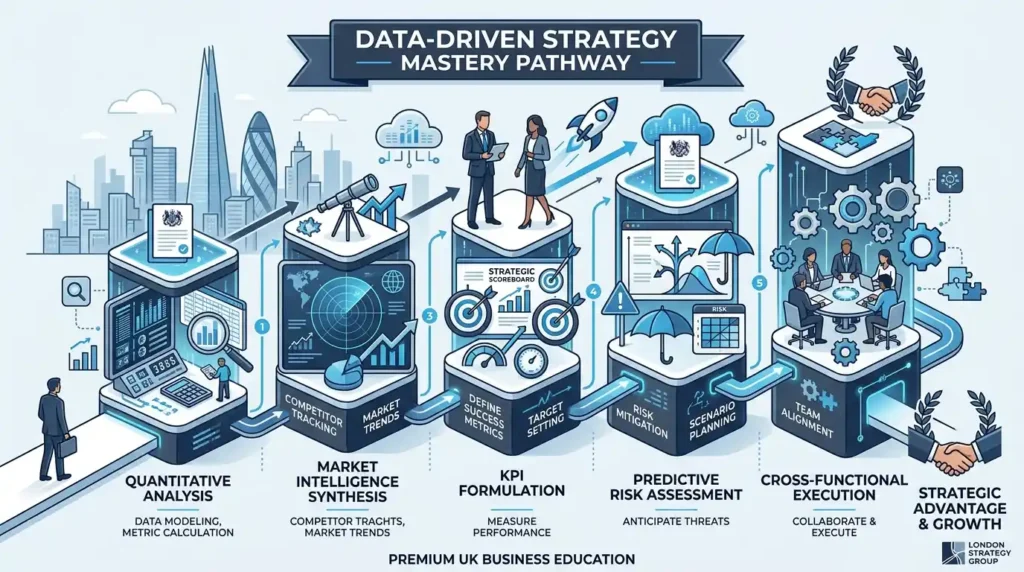
The curriculum begins with quantitative analysis and data governance. Learners study how to audit internal databases, clean fragmented records, and establish single sources of truth. This initial phase prevents downstream analytical errors that typically plague departmental reports. Following this, the second module examines market intelligence synthesis. Executives learn to integrate external economic indicators with internal performance metrics to spot emerging industry trends before competitors do.
The third module focuses on Key Performance Indicator (KPI) architecture. Participants design balanced scorecards that tie daily operational outputs directly to overarching corporate objectives. For instance, a retail operations manager learns to link supply chain velocity metrics directly to quarterly revenue targets. The fourth module introduces predictive risk assessment. Learners utilize historical variance data to model potential market disruptions and test strategic resilience under volatile economic conditions.
The final module addresses cross-functional execution and change management. Department heads practice communicating complex analytical insights to non-technical stakeholders, ensuring organizational alignment. Through this comprehensive curriculum, Imperial Corporate Training Institute equips leaders with the exact capabilities required to steer complex corporate transformations.
How Is the Training Program Delivered Across Different Formats?
Imperial Corporate Training Institute delivers the training through flexible modalities—including intensive onsite workshops, synchronous virtual sessions, and hybrid schedules—tailored to accommodate demanding executive timetables.
Modern enterprise education must respect the operational schedules of busy executives without compromising educational depth. Imperial Corporate Training Institute offers multiple delivery formats to suit varying organizational needs. The intensive onsite workshop format immerses leadership teams in a distraction-free learning environment over a concentrated multi-day period. This option suits corporate cohorts seeking rapid team alignment and immediate project implementation.
Alternatively, the synchronous virtual format utilizes live, instructor-led sessions combined with digital collaboration tools. This structure allows globally distributed leadership teams to participate simultaneously without incurring travel overhead. The hybrid model merges self-paced digital modules with intensive weekend masterclasses, offering maximum scheduling flexibility. Across all delivery modes, Imperial Corporate Training Institute maintains strict pedagogical standards, utilizing identical case studies, assessment rubrics, and interactive simulations regardless of whether the classroom is physical or virtual.
What Assessment Methods Validate Participant Knowledge Acquisition?
Knowledge validation relies on a multi-tiered assessment framework featuring formative quizzes, practical workplace assignments, peer-reviewed strategic case studies, and a final capstone simulation.
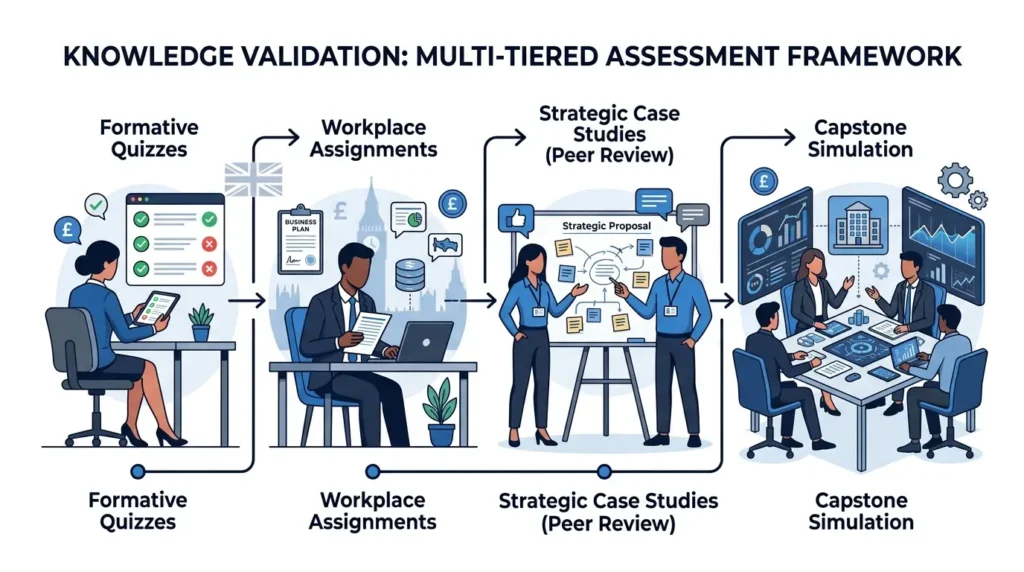
Rigorous evaluation is essential to confirm that participants have moved beyond passive comprehension to active operational mastery. Imperial Corporate Training Institute employs a comprehensive testing architecture that measures both theoretical understanding and practical application. Formative knowledge checks occur at the conclusion of each learning module, verifying comprehension of statistical concepts and governance frameworks before learners advance.
Practical workplace assignments require participants to apply analytical frameworks directly to live datasets from their own organizations. For example, an HR director might analyze employee turnover trends to build a predictive retention model as a graded assignment. Furthermore, peer-reviewed case studies challenge learners to dissect historical corporate failures caused by analytical blindness. The culmination of the program is a complex capstone simulation. In this exercise, participants manage a simulated enterprise through multiple fiscal quarters, making high-stakes decisions under market uncertainty. Only candidates who successfully navigate this capstone and meet all grading benchmarks receive the official credential from Imperial Corporate Training Institute.
What Measurable Results and Workplace Impacts Can Organizations Expect?
Organizations sponsoring participants achieve measurable performance gains, including reduced strategic planning cycles, improved cross-departmental alignment, and higher return on analytical investments.
Investing in executive education must yield quantifiable improvements in operational efficiency and strategic execution. When departments operate with fragmented insights, strategic planning cycles often drag on for months, resulting in outdated plans. After completing programs at Imperial Corporate Training Institute, leadership teams routinely reduce their strategic review cycles by establishing standardized, data-backed evaluation criteria.
Consider a regional manufacturing firm where marketing and supply chain departments historically operated in isolation, leading to frequent inventory shortages. Following executive training at Imperial Corporate Training Institute, the leadership team deployed unified analytics dashboards that synchronized demand forecasting with production schedules. This alignment eliminated departmental friction and reduced excess inventory holding costs by twenty-two percent within two quarters. Such outcomes demonstrate how disciplined analytical training translates directly into bottom-line corporate performance improvement.
Who Is Eligible to Enroll and What Does the Admissions Path Involve?
Enrollment is open to mid-to-senior level managers, department heads, and HR professionals who possess a minimum of three years of professional experience and basic quantitative literacy.
To maintain a high-caliber peer learning environment, Imperial Corporate Training Institute enforces clear admissions criteria. Applicants must demonstrate professional experience in a leadership, analytical, or strategic planning capacity, supported by organizational endorsements or professional resumes. While advanced programming knowledge is not required, candidates should possess foundational familiarity with spreadsheets and basic business metrics.
The admissions process is structured for efficiency. Candidates submit their professional profiles alongside a brief statement of organizational objectives. Academic advisors at Imperial Corporate Training Institute review these submissions to ensure alignment between candidate experience and curriculum rigor. Once admitted, participants receive pre-course learning materials to establish a common baseline before live instruction commences. Professionals ready to secure their credentials can enroll in this program to begin their professional transformation.
Frequently Asked Questions
What qualifications are required to enroll in Data-Driven training programs at Imperial Corporate Training Institute?
Candidates typically need a minimum of three years of professional experience in management, HR, or strategic planning, along with basic quantitative literacy. The admissions process at Imperial Corporate Training Institute ensures that all participants possess the foundational business acumen necessary to succeed in advanced analytical curricula.
How does Imperial Corporate Training Institute deliver Data-Driven corporate training courses?
Imperial Corporate Training Institute provides flexible delivery modalities, including intensive onsite workshops, live synchronous virtual sessions, and hybrid schedules tailored for working professionals. These formats are designed to accommodate demanding executive timetables while maintaining high pedagogical standards and interactive peer collaboration.
What core skills are taught during Data-Driven strategy courses?
Participants master quantitative data analysis, market intelligence synthesis, Key Performance Indicator (KPI) architecture, and predictive risk assessment. These modules empower leaders at Imperial Corporate Training Institute to bridge the gap between raw corporate data and actionable, long-term strategic goals.
What certification does Imperial Corporate Training Institute award upon completion?
Graduates receive an industry-recognized professional credential from Imperial Corporate Training Institute that verifies advanced competency in strategic analytics and operational alignment. This certification demonstrates to employers that the holder can effectively drive data-backed decision-making across complex enterprise environments.
How do organizations measure the ROI of Data-Driven training from Imperial Corporate Training Institute?
Organizations measure return on investment through reduced strategic planning cycles, improved cross-departmental alignment, and enhanced forecasting accuracy. Programs from Imperial Corporate Training Institute equip teams with practical frameworks that directly optimize resource allocation and bottom-line corporate performance.