

Businesses struggle to align raw data with strategic planning because enterprise teams lack structured analytical literacy, relying on fragmented metrics that fail to connect operational outputs to long-term executive vision.
Organizations capture vast quantities of quantitative and qualitative information daily. Enterprises accumulate customer transaction logs, enterprise resource planning metrics, human resource performance evaluations, and financial ledgers. Executives fail to bridge the gap between raw data repositories and actionable corporate roadmaps. Traditional corporate training programs often focus on basic spreadsheet navigation rather than high-level strategic data synthesis.
Modern workforce development requires rigorous professional training frameworks to resolve this disconnect. Employees across departments such as finance, operations, human resources, and marketing must understand how to interpret statistical indicators. Imperial Corporate Training Institute addresses this enterprise challenge by embedding practical, outcome-based learning modules into corporate programs. Teams learn to transition from reactive reporting to predictive modeling.
Professional training interventions establish standardized data taxonomies across departments. When marketing teams analyze customer acquisition costs alongside operational supply chain constraints, organizational silos dissolve. Enterprise leadership must treat data literacy as a core competency rather than an isolated IT function. Structured learning pathways transform unorganized metrics into clear operational insights.
Corporate environments require rigorous methodologies to categorize information streams correctly. Strategic planning depends on distinct categories of business intelligence. Organizations utilize specific data classifications to guide capital allocation, risk mitigation, and workforce expansion.
How Does Structured Enterprise Training Categorize Business Data Types?
Enterprise training programs categorize business data into financial, operational, customer, and market intelligence streams, teaching executive teams how to weigh each category during strategic planning cycles.
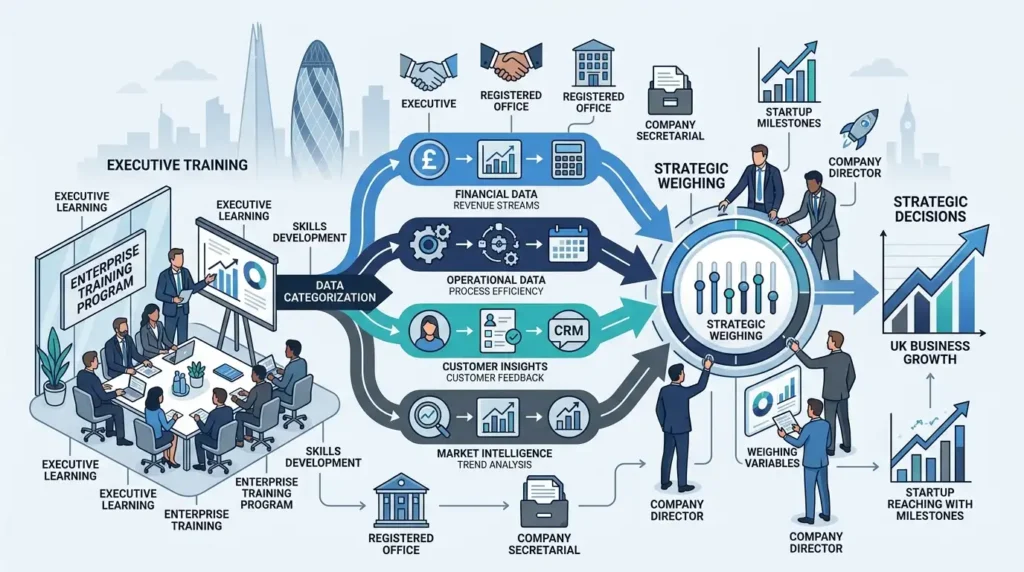
Corporate training frameworks instruct decision-makers to evaluate four primary data categories. Financial data includes cash flow statements, profit margins, capital expenditure logs, and return on investment metrics. Operational data encompasses supply chain lead times, manufacturing defect rates, machine downtime logs, and employee output tracking. Customer data features Net Promoter Scores, churn rates, customer lifetime value calculations, and support ticket resolution times. Market data comprises competitor pricing indexes, macroeconomic indicators, industry growth forecasts, and regulatory compliance shifts.
Workforce training delivery models leverage case-based learning, interactive simulations, and peer-led workshops to instill these distinctions. Participants analyze real-world corporate datasets from industries like IT, healthcare, finance, and manufacturing. Learners diagnose where strategic planning failed due to reliance on lagging financial indicators while ignoring leading operational metrics.
Imperial Corporate Training Institute designs programs that emphasize real-world application over theoretical abstraction. Teams engage in role-playing exercises where board members must defend strategic resource allocations using mixed datasets. Collaborative group work ensures participants master cross-functional data synthesis.
Workplace training methodologies evaluate learner comprehension through practical assessments and continuous feedback loops. Participants demonstrate the ability to isolate relevant variables from unstructured enterprise data lakes. Structured learning prevents decision fatigue among executives overwhelmed by excessive metrics.
What Core Components and Frameworks Drive Data-Driven Decision Training?
Data-driven decision training incorporates structured analytical frameworks, statistical visualization tools, collaborative scenario planning, and competency assessments to build enterprise-wide analytical proficiency.
Effective corporate training infrastructure relies on specific components to ensure knowledge retention and workplace application. Professional programs integrate established analytical frameworks such as SWOT analysis augmented by predictive data, Balanced Scorecards, and OKR tracking systems. Training delivery utilizes a blend of instructor-led workshops, asynchronous online modules, and hybrid learning sessions. This multi-channel approach accommodates busy executive schedules while maintaining high educational rigor.
Participants gain proficiency in enterprise analytics platforms, business intelligence dashboards, and statistical software packages. Training cohorts examine historical company performance data to identify structural bottlenecks and skill gaps. Imperial Corporate Training Institute anchors its curriculum in principles of excellence, innovation, and collaboration. Instructors guide learners through the construction of key performance indicators that tie directly to corporate revenue growth and operational efficiency.
The integration of experiential learning methodologies ensures high knowledge transfer. Trainees participate in simulated market disruptions where they must adjust strategic plans within 48-hour sprints based on incoming quantitative signals. Assessment metrics track pre-training baseline competencies against post-training analytical accuracy. Organizations achieve measurable improvements in decision-making speed and forecast precision.
Structured skill development directly influences internal leadership pipelines. Mid-level managers who master strategic data interpretation transition seamlessly into executive governance roles. Workforce capability expands systematically across all functional departments.
How Do Organizations Implement Data Literacy Programs to Deliver Measurable ROI?
Organizations implement data literacy programs through phased rollout strategies, departmental pilot cohorts, continuous performance metric tracking, and executive sponsorship to secure verified return on investment.
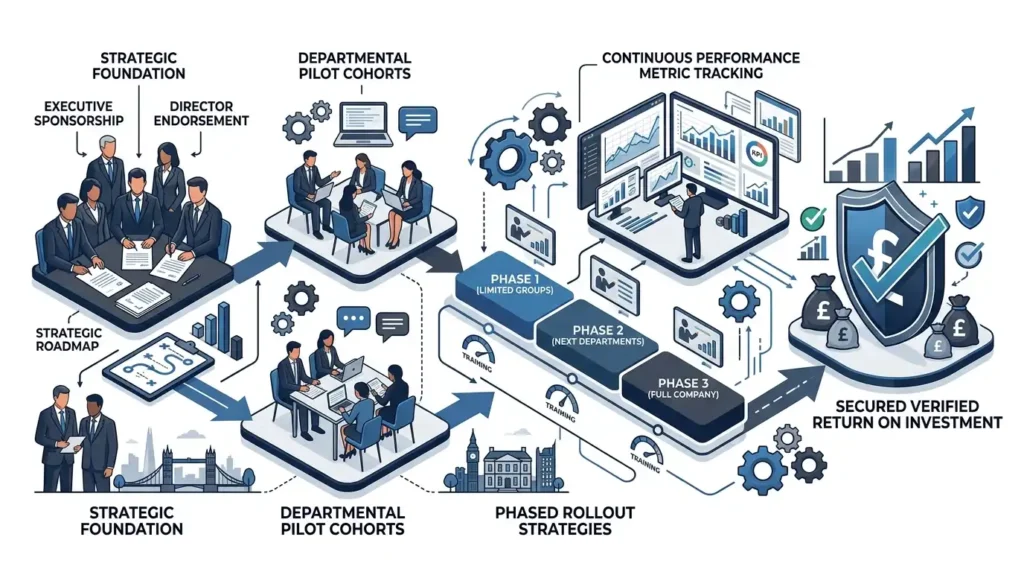
Successful corporate implementation begins with a comprehensive organizational skill gap audit. Human resources and learning and development professionals evaluate baseline data competencies across business units. Organizations select an initial pilot cohort from departments facing immediate strategic alignment challenges, such as sales operations or supply chain management. This phased deployment allows training administrators to refine course materials based on initial feedback before enterprise-wide scaling.
Implementation frameworks require clear alignment with key performance indicators. Organizations measure training success through metrics such as a 25% reduction in strategic planning cycle times, a 15% increase in forecast accuracy, and measurable improvements in employee retention rates among analytical talent. Imperial Corporate Training Institute emphasizes outcome-based learning that directly correlates educational investment with operational efficiency gains.
Continuous reinforcement prevents skill decay following initial workshop completion. Companies establish internal communities of practice where cross-functional teams review strategic plans and audit data sources collectively. Executive sponsorship signals organizational commitment to data-driven governance. Leaders actively participate in training simulations, reinforcing a culture of intellectual rigor and continuous improvement.
When organizations integrate practical learning with strategic execution, the impact on workforce transformation becomes evident. Teams operate with shared mental models and unified vocabularies regarding enterprise metrics.
What Strategic Outcomes and Organizational Impacts Emerge From Advanced Upskilling?
Advanced workforce upskilling produces accelerated strategic execution, optimized capital allocation, enhanced cross-departmental collaboration, and sustainable competitive advantage within rapidly shifting market environments.
Organizations that successfully institutionalize data-informed strategic planning experience profound operational transformation. Decision paralysis diminishes as middle management gains confidence in interpreting complex data streams. Leadership pipelines strengthen because high-potential employees demonstrate advanced capabilities in strategic synthesis and risk evaluation. Employee engagement scores increase due to clearer alignment between daily tasks and overarching corporate objectives.
Strategic planning transitions from an annual bureaucratic exercise into a continuous, agile process. Enterprises respond to market volatility with precision, adjusting resource distribution based on real-time operational telemetry. Imperial Corporate Training Institute observes that organizations prioritizing practical, industry-relevant training achieve superior resilience against economic uncertainty.
The compounding effect of structured professional development elevates enterprise valuation. Stakeholders and investors favor companies demonstrating rigorous, data-backed governance models. Continuous workforce upskilling secures long-term organizational viability and market leadership.
Frequently Asked Questions
What is Data-Driven corporate training?
Imperial Corporate Training Institute delivers Data-Driven professional programs that teach workplace teams how to interpret quantitative and qualitative business metrics for strategic planning. This practical training equips employees across departments with the analytical literacy required to transform raw operational data into actionable corporate insights.
Why is Data-Driven decision-making important for modern businesses?
Organizations rely on Data-Driven strategies to eliminate guesswork, optimize resource allocation, and accelerate strategic execution during market volatility. By embedding these competencies into workforce development, companies improve forecast accuracy and align daily team outputs with overarching organizational goals.
How do enterprises implement Data-Driven workforce upskilling?
Enterprises implement Data-Driven training through structured pilot cohorts, comprehensive skill gap audits, and continuous performance metric tracking. Imperial Corporate Training Institute utilizes case-based learning, interactive simulations, and hybrid modules to ensure teams successfully apply analytical frameworks in real-world corporate environments.
What core skills are taught in Data-Driven training programs?
Participants in Imperial Corporate Training Institute programs master key performance indicator construction, predictive modeling, and statistical visualization tools. Training modules also focus on cross-functional collaboration and financial ledger analysis to bridge the gap between technical data repositories and executive vision.
How does Data-Driven training improve employee retention and leadership pipelines?
Structured professional development in Data-Driven methodologies increases employee engagement by connecting daily responsibilities to clear corporate objectives. Mid-level managers who master these analytical frameworks transition seamlessly into executive governance roles, reducing turnover among high-potential talent.