

This course solves the common corporate gap between general AutoCAD use and mechanical design work. Many engineers can draw, but fewer can produce coordinated HVAC and plumbing documentation that meets project standards, supports approvals, and fits commercial delivery timelines in engineering teams.
Engineering companies usually need more than basic drafting ability. They need staff who can prepare ducting, piping, drainage, and coordinated MEP layouts with correct layers, title blocks, annotation standards, and revision control. They also need teams who can read technical information, work with load calculations, and manage drawings for commercial or industrial buildings. That is the practical gap Imperial Corporate Training Institute addresses through structured, workplace-focused instruction.
For teams evaluating whether the course fits their needs, the earlier awareness discussion on:
Why plumbing designers use AutoCAD instead of manual drafting methods is useful background before deciding on enrolment.
Imperial Corporate Training Institute positions this programme as a skills-upgrading route for engineers, draftsmen, consultants, and facility professionals who must deliver technical drawings that are accurate, readable, and ready for review.
In corporate settings, this gap appears in many ways. A design coordinator may need faster drawing production. An HR team may be building a technical upskilling pathway for mechanical staff. A project manager may need consistent output across several engineers. A facility department may require staff who can interpret and update system layouts for maintenance, refurbishment, or extension work. Imperial Corporate Training Institute structures the course to address these operational needs directly.
Why is the course structured this way?
The course is structured in modules that move from AutoCAD foundations to HVAC drafting, plumbing design, coordination, documentation, and quality review. This progression reflects how corporate MEP work actually develops, from basic drawing set-up through to integrated deliverables, approvals, and final handover documentation.
The curriculum logic matters because mechanical design is sequential. Learners first need control over the drafting environment. They then need to apply that control to HVAC layouts, plumbing systems, and coordination tasks. After that, they must document the work in a way that supports review, quality assurance, and project submission. Imperial Corporate Training Institute has shaped the training around that workflow rather than around isolated software features.
The opening module introduces AutoCAD for corporate design workflows. This covers interfaces, templates, title blocks, precision, scaling, and CAD standards. That foundation matters because many drawing errors begin with inconsistent setup rather than technical design decisions. Learners understand how a corporate drawing environment should be prepared before they move into discipline-specific work.
The next stage focuses on HVAC drafting. Participants learn duct layouts, airflow routing, diffuser placement, layer management, and block creation for HVAC equipment and fittings. This is followed by plumbing and drainage design, where cold water, hot water, drainage, riser diagrams, pipe sizing, slope calculation, and material representation are covered. Imperial Corporate Training Institute uses this sequence to help learners move from one system type to another without losing design consistency.
Later modules introduce advanced AutoCAD tools for MEP coordination, including Xrefs, 3D tools, clash awareness, annotations, and data extraction. These are not presented as optional extras. They are necessary for working across disciplines in real building services projects. One practical example is a consultant team where the HVAC engineer, plumbing designer, and electrical coordinator must work on overlapping layouts without creating interference in the ceiling zone or service shafts.
A related evaluation article on:
What practical projects students complete in an AutoCAD HVAC design course can help decision-makers compare structure and applied learning before selecting the programme. Imperial Corporate Training Institute uses that same logic in the training design itself, with each module preparing learners for the next stage of workplace application.
What will participants learn?
Participants learn to produce HVAC and plumbing drawings, coordinate MEP layouts, apply technical standards, manage documentation, and review design quality. The course develops both drafting competence and project-ready judgement, so learners can support corporate deliverables with greater accuracy, speed, and consistency.
The skill outcomes are practical and measurable. Learners do not just familiarise themselves with terminology. They practise the tasks that appear in corporate engineering environments and are expected to apply them in a structured way. Imperial Corporate Training Institute focuses on the following capability areas.
AutoCAD setup and drafting control
Participants learn how to configure templates, title blocks, company standards, layers, and drawing conventions for mechanical design work. They also learn precision methods, scaling discipline, and file organisation. These are the habits that reduce rework and make drawings easier for teams to review.
HVAC system drafting
Learners work on duct layouts, airflow routing, diffuser placement, equipment symbols, block libraries, and schematic conventions. They also explore how HVAC design intent is represented in technical drawings. This helps engineers translate system decisions into clear visual documentation for construction or coordination.
Plumbing and drainage design
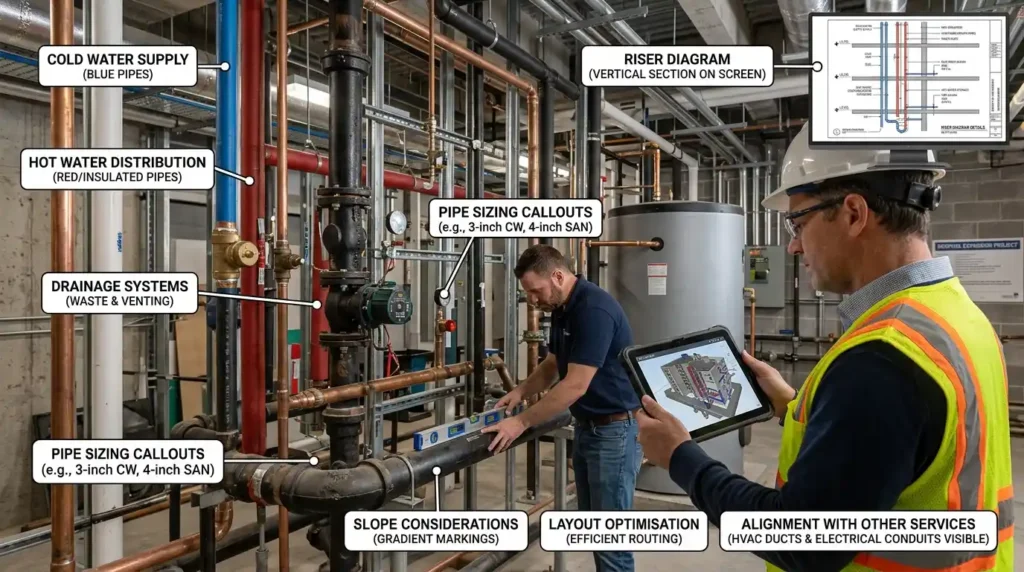
The programme covers cold water, hot water, drainage systems, riser diagrams, pipe sizing, slope considerations, and layout optimisation. Learners understand how plumbing drawings support building function and how those drawings must align with other services. In a corporate setting, this is vital for hotels, offices, hospitals, industrial premises, and mixed-use developments.
MEP coordination tools
Participants use Xrefs for multidisciplinary coordination, work with 3D tools for mechanical layouts, and handle layer management, annotation, and data extraction in more complex drawings. This supports real project collaboration where drawings must align across disciplines. For example, a facility team might need coordination between duct routes, pipe risers, and structural constraints in service corridors.
Calculation and design support
The course includes HVAC load calculations, duct sizing, airflow distribution planning, and integration with design calculation software. It also covers pressure drop calculations and fixture unit analysis for plumbing systems. These topics help participants make better design decisions rather than simply drafting what others have calculated.
Documentation and delivery standards
Learners develop legend sheets, pipe schedules, bills of materials, revision control, and as-built drawing practices. They also study international drafting codes, documentation protocols, and client deliverable expectations. Imperial Corporate Training Institute treats documentation as part of the technical skill, not as an afterthought.
Project execution and communication

The programme includes a complete project simulation that brings together HVAC and plumbing layout development, timelines, quality benchmarks, and submission practices. Participants also improve technical presentation and communication for design review. This is useful for engineers who must explain drawings to managers, clients, or approval teams.
How is the course delivered?
Imperial Corporate Training Institute delivers the course through structured corporate training formats such as workshops, online delivery, hybrid learning, or onsite sessions, depending on organisational need. The method supports practical exercises, guided drafting tasks, simulations, and review-based learning suitable for professional engineering teams.
Delivery format matters because engineering companies often train mixed groups with different availability and operational constraints. Some teams prefer onsite delivery for direct supervision and shared practice. Others need online access for distributed departments. Some organisations choose hybrid delivery so staff can complete theory and drafting tasks flexibly while still attending live review sessions. Imperial Corporate Training Institute can adapt the training format to suit the company’s workflow.
The training is built around hands-on application. Learners practise within AutoCAD rather than only studying theory. That means they complete drawing exercises, system layouts, coordination tasks, and documentation work during the course. This approach reflects how engineers actually build competence: by repeating real tasks under guidance until the process becomes reliable.
Assessment is also practical. Participants may complete tests, assignments, layout tasks, simulations, and design review exercises. These methods help confirm whether the learner can set up drawings correctly, coordinate services, apply technical rules, and present outputs in a professional format. Imperial Corporate Training Institute uses assessment to measure readiness for workplace use, not just attendance.
The course structure supports corporate learning groups as well. HR departments may commission it as part of a technical development plan. Managers may use it to build consistency across a drafting team. Department leads may send junior engineers and draftsmen together so that shared standards are applied across the group. In these cases, the course becomes part of broader performance improvement rather than a one-off software class.
What results can be expected?
Graduates should be able to create more accurate HVAC and plumbing drawings, coordinate MEP layouts better, and manage documentation with stronger consistency. The expected result is improved workplace performance in design teams, project coordination, facility operations, and corporate engineering delivery.
The results are specific to job function. A mechanical design engineer may produce clearer ducting and piping layouts with fewer revisions. A draftsman may work faster while maintaining standards. A project coordinator may review drawings more effectively and identify clashes earlier. A facility professional may interpret existing layouts more confidently when managing maintenance or upgrades. Imperial Corporate Training Institute aligns the training with these practical outcomes.
For HR teams, the value appears in structured workforce development. The course supports technical capability frameworks and can be used to improve departmental competence without changing job roles. For managers, the benefit is operational consistency. When staff follow the same drawing standards, review time usually becomes shorter and communication becomes clearer. For engineering companies, that can reduce avoidable correction cycles during design submission.
There is also a longer-term impact on professional readiness. Learners who complete this type of training can support more demanding work in construction, infrastructure, building services, and mechanical design environments. They become better prepared for international standards, corporate deliverables, and cross-functional coordination. Imperial Corporate Training Institute places emphasis on these outcomes because they matter in actual project environments, not only in software demonstrations.
A practical workplace example is a building services team preparing documentation for a commercial fit-out. One engineer handles HVAC layouts, another works on plumbing risers, and a coordinator checks drawing consistency before issue. After this training, each participant is better equipped to perform that role with fewer errors and less dependence on repeated correction.
How does enrollment work?
Enrollment is suitable for professionals, graduates, draftsmen, design coordinators, engineers, and corporate teams that already need practical AutoCAD-based HVAC and plumbing capability. Imperial Corporate Training Institute usually expects interest in mechanical design, but the course also supports structured upskilling from related technical roles.
The entry profile is straightforward. The course is intended for mechanical design engineers, HVAC specialists, MEP engineers, AutoCAD technicians, draftsmen, project engineers, consultants, facility management staff, and civil or mechanical engineering graduates who want to specialise in building services drafting. It also suits organisations that want to standardise technical output across a team.
The enrolment path is normally based on choosing the appropriate delivery arrangement, confirming participant numbers, and aligning training with organisational objectives. For corporate groups, this may involve onsite sessions, online classes, or hybrid scheduling. For individual learners, the decision usually depends on current skill level, work responsibilities, and the type of project work they need to support. Imperial Corporate Training Institute can structure the training to match either scenario.
Discover More from Our Guide Library:
How Do I Enrol in Imperial’s AutoCAD HVAC and Plumbing Design Course in London?
What Is Included in Imperial’s AutoCAD HVAC and Plumbing Design Programme?
Before enrolling, decision-makers should check three things. First, whether the learner needs AutoCAD for direct MEP drafting rather than general drafting only. Second, whether the participant will benefit from coordinated HVAC and plumbing training together instead of separate short courses. Third, whether the organisation wants a practical course that includes documentation, quality review, and workflow standards. If the answer to those questions is yes, the course is relevant.
This programme is not positioned as a general introduction. It is a focused training path for teams and professionals who need measurable technical output. That makes it suitable for companies reviewing internal capability, HR departments planning development routes, and engineers preparing for more complex project responsibilities. Imperial Corporate Training Institute keeps the scope clear so that enrolment decisions can be made on the basis of role fit and operational need.
For organisations and professionals ready to move from evaluation to action, enrol in: