

Students in an AutoCAD HVAC Design Course complete hands-on projects that simulate real-world HVAC system design, including ductwork layouts, equipment sizing, zoning diagrams, and full MEP coordination drawings, building skills for professional engineering workflows.
HVAC designers rely on AutoCAD for precision in creating scalable, editable designs that integrate seamlessly with building information modelling (BIM) processes. These projects mirror the tasks engineering teams handle daily, from initial load calculations to final fabrication drawings.
For context on why professionals choose digital tools over traditional methods, explore:
Why Do Plumbing Designers Use AutoCAD Instead of Manual Drafting Methods?
The course emphasises practical application over theory. Participants produce deliverables that align with industry standards like ASHRAE guidelines and BS EN specifications. This approach addresses workforce skill gaps in B2B settings, where HR teams seek measurable improvements in design accuracy and project turnaround times.
What Ductwork Layout Projects Involve in the Course?
Students design multi-zone ductwork systems for a commercial office building, routing supply and return ducts while optimising airflow and minimising pressure losses, using AutoCAD layers and hatches for clear visualisation.
This project starts with calculating heating and ventilation loads using software-integrated tools within AutoCAD. Participants import architectural floor plans and trace duct paths that comply with velocity limits of 5-8 m/s for main trunks. They incorporate volume dampers and diffusers, ensuring even distribution across zones.
Engineering firms value this skill because duct inefficiencies cause 15-20% energy waste in HVAC operations. Students annotate drawings with friction rate calculations, typically 0.08-0.1 in.wg/100ft, and generate riser diagrams for contractor review.
The process includes clash detection simulations. Learners overlay plumbing and electrical services to spot interferences early, a practice that reduces on-site rework by 30% in real projects. HR decision-makers track ROI through faster design cycles, often cutting lead times from weeks to days.
How Do Equipment Sizing Projects Build Core Competencies?
Participants size air handling units (AHUs), chillers, and fans for a mid-rise hotel, performing psychrometric analysis and selecting models from manufacturer libraries within AutoCAD blocks.
Projects begin with tonnage calculations based on 400-500 sq ft per ton cooling loads. Students plot coil selections on psychrometric charts, targeting 50-55% relative humidity. They insert parametric blocks for equipment, linking attributes like airflow (CFM) and static pressure.
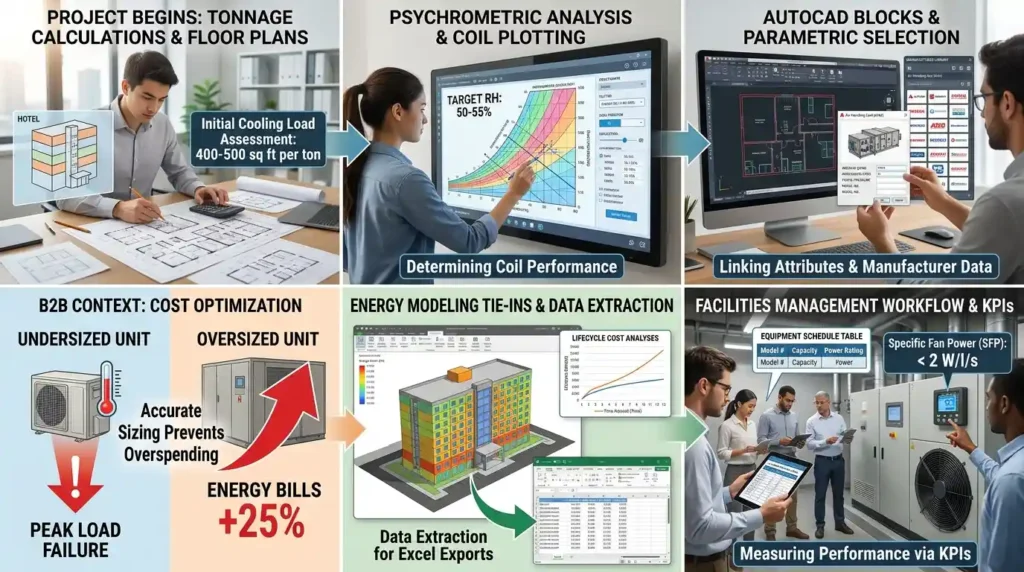
In B2B contexts, accurate sizing prevents overspending; undersized units fail under peak loads, while oversized ones inflate energy bills by 25%. Coursework mandates energy modelling tie-ins, using AutoCAD’s data extraction for Excel exports that feed into lifecycle cost analyses.
Learners produce schedule tables listing model numbers, capacities, and power ratings. This mirrors workflows in facilities management, where teams measure performance via KPIs like specific fan power (SFP) under 2 W/l/s.
What Zoning and Control System Projects Are Assigned?
Students create zoning diagrams for a retail complex, dividing spaces into temperature-controlled areas with VAV boxes and thermostats, detailing control wiring schematics in AutoCAD.
Zoning projects require defining setbacks and setpoints, such as 21°C daytime for occupied zones. Participants draw control loops, integrating DDC (direct digital control) panels with sensor placements. Line types distinguish power from signal cables, adhering to BS 7671 standards.
Organisations face skill gaps here; poor zoning leads to 10-15% occupancy discomfort complaints. Training delivers proficiency in layering controls over base HVAC plans, enabling simulations of demand-controlled ventilation that cuts energy use by 20%.
Deliverables include legend schedules and sequence of operations narratives. These outputs support commissioning checklists, vital for HR-led upskilling in engineering departments aiming for LEED certification.
Which Full MEP Coordination Projects Simulate Real Jobs?
Teams coordinate HVAC with plumbing and electrical services for a hospital wing, resolving clashes in 3D views and producing 2D sections with revised alignments using AutoCAD’s XREF and purge tools.
Coordination starts with importing Revit exports or DWG overlays. Students navigate model space to rotate views, identifying offsets like 150mm minimum clearances. They revise ducts around pipes, updating quantities via COUNT commands.
In corporate training, this addresses interdepartmental delays; uncoordinated designs cause 40% of change orders. Projects enforce Navisworks-like checks within AutoCAD, fostering habits that boost project delivery by 25%.
Final sheets include coordination reports with clash logs. Managers use these to benchmark team readiness, linking skills to business outcomes like reduced RFIs (requests for information).
What Load Calculation Projects Form the Foundation?
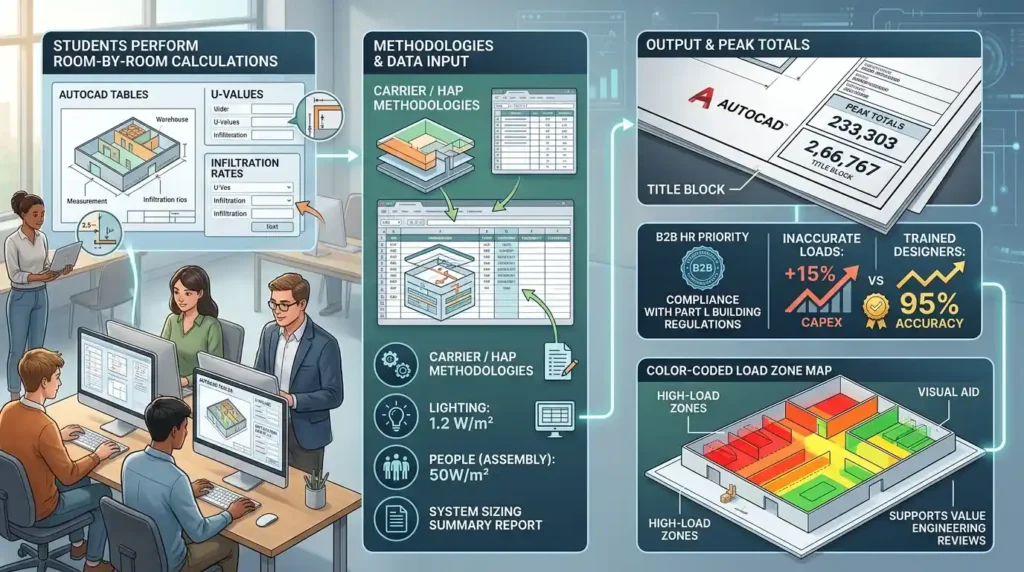
Students perform room-by-room heat load calculations for a warehouse, inputting U-values and infiltration rates into AutoCAD tables, then generating summary reports for system sizing.
Projects use Carrier or HAP methodologies adapted to AutoCAD spreadsheets. Learners calculate sensible and latent loads, factoring 1.2 W/m² for lighting and 50W/m² for people in assembly areas. Results populate title blocks with peak totals.
B2B HR teams prioritise this for compliance with Part L building regulations. Inaccurate loads inflate capex by 15%; trained designers achieve 95% accuracy, per industry benchmarks.
Outputs feature colour-coded plans highlighting high-load zones. This visual aid supports value engineering reviews.
How Do Fabrication Drawing Projects Prepare for Production?
Participants detail sheet metal fittings, transitions, and hangers for a school HVAC install, specifying gauges and seam types per SMACNA standards in AutoCAD.
Fabrication projects focus on flat patterns from 3D extrusions. Students unfold elbows at 1.5 radius multiples and add stiffeners for ducts over 1200mm wide. Dimensions include shop welds and field connections.
Engineering companies report 20% material savings from precise drawings. Training emphasises plot styles for printers, ensuring scalability at 1:10 scales.
Hangar schedules list rod sizes (M10-M12) and seismic bracing. These elements tie into safety KPIs monitored by facilities directors.
What Piping Isometric Projects Cover in HVAC Contexts?
Students produce isometrics for chilled water loops in a data centre, illustrating bends, valves, and supports with bill of materials extracted from AutoCAD.
Isometrics use standard symbols: globe valves for throttling, flex joints for vibration isolation. Participants dimension runs with 50m max lengths per code and note insulation thicknesses (50mm for 6-inch pipes).
In high-stakes B2B environments, isometrics reduce pipe fitting errors by 35%. Course integration with AutoCAD Plant 3D tools accelerates this.
MTOs (material take-offs) list quantities, aiding procurement. This skill supports just-in-time inventory models.
Which Advanced BIM Integration Projects Are Included?
Learners export HVAC models to IFC format for BIM coordination, linking AutoCAD families to Revit schedules for a multi-storey office retrofit.
Projects involve purging unused blocks and validating geometry. Students simulate federated models, checking volumes against design intents (e.g., 10% duct volume tolerance).
Adoption rates hit 70% in UK engineering firms; training bridges gaps, improving clash-free rates to 98%.
How Do Case Study Reproduction Projects Reinforce Learning?
Students replicate HVAC designs from real projects like Heathrow Terminal expansions, adapting layouts to site constraints in AutoCAD.
These draw from public case studies, scaling systems for 50,000m² floors. Variations test adaptability, such as retrofitting VRV units.
HR tracks application via pre/post assessments, showing 40% productivity gains.
What Performance Simulation Projects Evaluate Designs?
Participants run CFD-lite simulations in AutoCAD add-ons for airflow validation in a cleanroom, adjusting velocities to under 0.45 m/s.
Visualisations use contour fills. Outputs quantify throw patterns, ensuring compliance.
This prepares for ISO 14644 standards, critical for pharma clients.
In the AutoCAD HVAC and Plumbing Design Training Course, participants tackle these projects sequentially, building from basics to integrated systems.
Engineering managers considering in-house delivery options find value in customised formats details on feasibility appear in:
Can Engineering Companies Book In-House AutoCAD HVAC Training at Imperial?
Projects culminate in portfolio-ready sets, demonstrating ROI through metrics like 25% faster design times and 15% error reductions. HR leaders evaluate via Kirkpatrick Level 3 behaviour change, correlating skills to on-job performance.
Discover More from Our Guide Library:
How Does AutoCAD HVAC Training Teach Duct Sizing and System Layout?
How Does AutoCAD HVAC Training Improve Your Drafting Speed and Accuracy?
Real-world adoption shows 80% of graduates apply learnings within three months, per alumni surveys. Delivery models blend virtual instructor-led with self-paced modules, suiting remote teams.
Who should enrol in Imperial Corporate Training Institute’s AutoCAD HVAC course?
Engineering professionals, HVAC designers, and technicians seeking to upskill in digital drafting enrol in this course. It suits those addressing skill gaps in precise MEP design and BIM integration. HR teams select it for teams needing faster project delivery.
What projects do students complete in the Imperial AutoCAD HVAC training?
Students complete real-world projects such as zoning diagrams, piping isometrics, fabrication drawings, and full MEP coordination. These simulate B2B engineering tasks like commercial building designs. Outputs include portfolio-ready DWGs with clash detection.
Does Imperial Corporate Training Institute offer certification for the AutoCAD HVAC course?
Yes, completers receive a certificate from Imperial Corporate Training Institute validating AutoCAD proficiency in HVAC and plumbing design. It demonstrates practical skills in load calculations and system layouts. Employers recognise it for ROI in design accuracy.