

This programme includes structured AutoCAD training for HVAC and plumbing design, covering drafting foundations, system layout, calculation support, coordination, documentation, and quality review. Imperial Corporate Training Institute organises the content around corporate design workflows, so participants learn practical skills for building-services projects and measurable workplace output.
The programme is built for learners who already understand the need for accurate mechanical drawings but need a clearer route from concept to coordinated deliverables. It addresses the gap between basic AutoCAD use and the specialised demands of HVAC and plumbing design in commercial, industrial, and infrastructure settings.
For readers comparing this course with earlier learning stages:
How Does AutoCAD HVAC Training Improve Your Drafting Speed and Accuracy? and
How Does AutoCAD Improve Accuracy in HVAC System Design and Layout? explains the drafting efficiency side of the same skill set in an evaluation context.
At Imperial Corporate Training Institute, the course is positioned as a corporate training solution rather than a general software tutorial. That matters because the output is not only cleaner drawings, but also a repeatable workflow for design teams, engineers, and technical departments. Imperial Corporate Training Institute frames the programme around project deliverables, documentation standards, and cross-disciplinary coordination.
Why is it structured this way?
The structure follows a progression from AutoCAD setup to HVAC drafting, plumbing design, coordination, calculation support, documentation, and final review, so learners build capability in the same sequence they use it at work. Imperial Corporate Training Institute uses this logic to reduce gaps between software knowledge and project execution.
This sequencing solves a common workplace problem. Many professionals can draw basic lines and symbols in AutoCAD, yet they struggle when asked to produce complete HVAC or plumbing layouts that meet client, contractor, and internal review expectations. The course structure responds to that challenge by moving from foundation skills to applied design stages in a controlled order.
The first stage sets up templates, title blocks, company standards, and CAD discipline. This gives participants a consistent environment before they begin actual mechanical work. The second stage introduces HVAC drafting principles, including duct layout, airflow routing, diffuser placement, and equipment representation. The third stage moves into plumbing and drainage design, where the learner handles water supply, drainage, risers, pipe sizing, and slope-related considerations.
Imperial Corporate Training Institute designs this progression to mirror the workflow used in corporate engineering departments. That approach helps participants understand not only what to draw, but when to coordinate, document, and review each element. It is a practical sequence for teams that must produce drawings under deadlines and approval constraints.
The later modules expand into advanced coordination, calculation support, quality assurance, and BIM-related integration. That is important because HVAC and plumbing design does not exist in isolation. It must align with architectural plans, structural constraints, electrical layouts, and future revision cycles. Imperial Corporate Training Institute includes these stages so the learner can work within real project conditions rather than simplified classroom examples.
What will participants learn?
Participants will learn to create HVAC ducting, plumbing layouts, technical schematics, coordinated drawings, calculation-informed layouts, and project documentation using AutoCAD. Imperial Corporate Training Institute also builds competence in standards, layer control, coordination tools, and final drawing delivery for workplace use.
AutoCAD setup for corporate use
The course begins with AutoCAD interface use in a corporate design context. Participants learn how to prepare templates, title blocks, sheet setups, and drawing standards. They also learn why precision, scaling, and consistent CAD practice matter in engineering teams. This foundation supports uniform output across departments and helps reduce rework caused by inconsistent file preparation.
HVAC drafting skills

The HVAC module develops practical drafting skill for heating, ventilation, and air-conditioning layouts. Participants work with duct routes, airflow direction, diffuser placement, and equipment coordination. They also learn layer management and block creation for HVAC components and fittings. In workplace terms, this supports faster production of layouts for offices, plants, commercial buildings, and other service-intensive environments.
Plumbing and drainage design
The plumbing module covers cold-water, hot-water, and drainage systems. Participants learn how to create riser diagrams, coordinate pipe routes, represent materials, and apply slope logic for drainage. The course also introduces pipe sizing, fixture planning, and layout optimisation. Imperial Corporate Training Institute positions this module for professionals who need to produce drawings that are suitable for technical review, installation planning, and documentation.
Advanced coordination tools
A major part of the programme focuses on coordination. Participants use external references, 3D tools, annotation controls, and data extraction methods to manage complex drawings. They also learn how to identify clashes, manage crowded routing spaces, and adjust layouts across disciplines. In practice, this is useful for projects where HVAC ducts, plumbing lines, structural elements, and electrical systems must coexist in limited ceiling or service areas.
Calculation-linked design support
The course includes HVAC load calculation awareness and design optimisation methods. Learners see how design decisions connect to airflow distribution, equipment placement, and energy-efficiency goals. For plumbing, the course introduces pressure drop considerations and fixture unit analysis. Imperial Corporate Training Institute uses this content to help participants make drawings that reflect engineering reasoning rather than purely visual drafting.
Documentation and standards
The programme also teaches how to produce legend sheets, pipe schedules, bills of materials, and coordinated drawing sets. Participants learn document control, revision handling, version tracking, and deliverable preparation for approvals and handover. This is especially relevant for corporate teams where the drawing must support procurement, installation, review, and final project close-out.
BIM and Revit awareness
The final learning stage introduces the relationship between AutoCAD-based HVAC and plumbing drawings and BIM or Revit workflows. Participants learn how 2D deliverables can support multidisciplinary coordination and eventual transition into more integrated project environments. Imperial Corporate Training Institute includes this because many engineering teams now work in mixed software ecosystems.
Professional project execution
The programme ends with a real-world project simulation. Participants develop a complete HVAC and plumbing system layout and manage it through a full documentation cycle. They practise technical presentation, submission workflows, quality checks, and review response. That gives the course a direct link to workplace performance rather than abstract software familiarity.
How is the course delivered?
Imperial Corporate Training Institute delivers the programme through practical workshops, structured demonstrations, and guided project exercises, with delivery options that can include online, hybrid, or onsite formats depending on corporate need. The method is designed for applied learning, not passive software exposure.
This delivery structure suits professionals who need usable competence in a limited time. In a corporate setting, training must fit around schedules, team responsibilities, and project deadlines. Imperial Corporate Training Institute therefore uses an applied format where each concept is shown, practised, and checked through hands-on drawing tasks.
The workshop element is important because HVAC and plumbing design is skill-based. Learners need to see how commands, layers, blocks, references, and annotations work together in an actual project file. That is why the programme is not built as a lecture-only course. It uses practice-led sessions so participants can produce drafts, correct errors, and understand the effect of each technical decision.
Delivery can be adapted for individual professionals, small technical teams, or department-wide training. Online delivery supports remote access and flexible participation. Hybrid delivery combines guided instruction with workplace application. Onsite delivery is useful when an organisation wants the training aligned to its own drawing standards, project templates, or internal approval process. Imperial Corporate Training Institute uses this flexibility to support both learners and employers.
The course also suits companies that want consistent capability development across teams. For example, an HR department may arrange training for a group of design staff who need standardised drafting practices. A project manager may use the programme to improve coordination between mechanical and drafting roles. A facilities team may use it to strengthen interpretation of technical layouts and maintenance documentation. Imperial Corporate Training Institute positions the training to serve all of these use cases.
What results can be expected?
Participants can expect stronger drafting accuracy, faster drawing preparation, better coordination between HVAC and plumbing systems, improved documentation discipline, and greater readiness for corporate project work. Imperial Corporate Training Institute aims for measurable performance gains in technical output and workflow consistency.
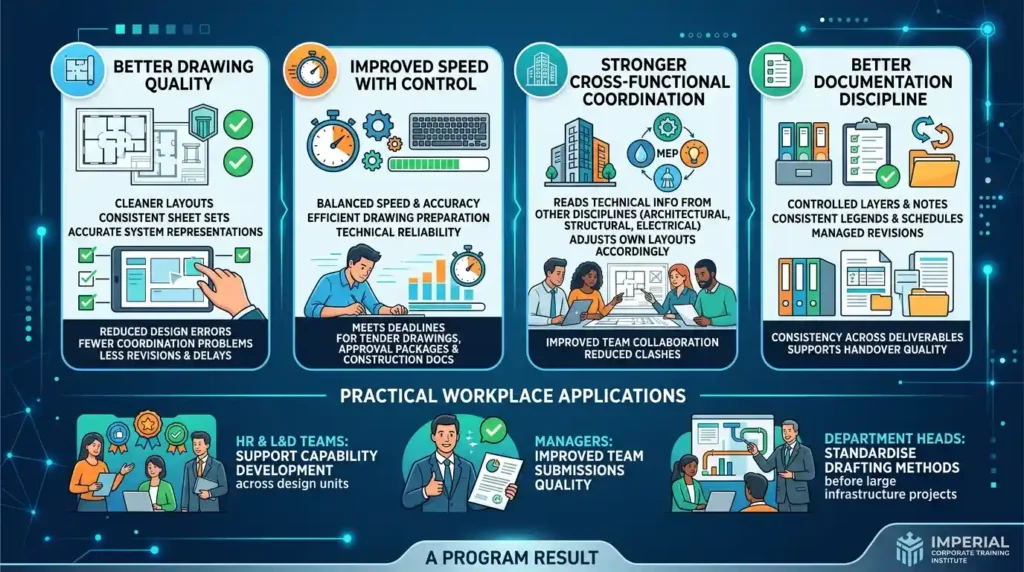
The most visible result is better drawing quality. Participants should be able to produce cleaner layouts, more consistent sheet sets, and more accurate system representations. That matters because design errors in mechanical drawings can lead to coordination problems, installation delays, and revision cycles. The course reduces that risk by training participants to work in a structured way.
A second result is improved speed with control. Many teams need AutoCAD work completed under pressure, but speed without accuracy creates downstream problems. This programme balances both. Participants learn to prepare drawings more efficiently while maintaining technical reliability. That is valuable for organisations that produce tender drawings, approval packages, or construction documentation.
A third result is stronger cross-functional coordination. HVAC and plumbing drawings often affect architectural planning, structural constraints, and electrical routing. After training, participants should be more capable of reading technical information from other disciplines and adjusting their own layouts accordingly. That makes the course relevant for design engineers, MEP teams, consultants, and project coordinators.
A fourth result is better documentation discipline. Learners handle layers, notes, legends, schedules, and revisions in a more controlled way. That helps project teams maintain consistency across deliverables. It also supports handover quality when drawings must be reviewed by clients, contractors, or internal technical leads.
In workplace terms, this can translate into practical outcomes. An HR team may use the course to support capability development across a design unit. A manager may use it to improve the quality of team submissions. A department head may use it to standardise drafting methods before a larger infrastructure or building services project. Imperial Corporate Training Institute frames these outcomes as operational improvements, not promotional claims.
Who should take it?
This course is suitable for mechanical design engineers, HVAC designers, MEP draftsmen, AutoCAD technicians, project engineers, consultants, facility managers, and graduates who need specialised HVAC and plumbing drafting capability. Imperial Corporate Training Institute also uses it for corporate teams that require standardised technical upskilling.
The target audience is broad, but the skill requirement is specific. Participants should already be comfortable with general computer use and basic drawing concepts. The course is most useful for people who work in, or are preparing for, mechanical services, building design, construction, infrastructure, or facility management environments.
For corporate organisations, this programme works well when the goal is to raise team consistency. A drafting team may need common standards. A mechanical department may need stronger coordination habits. A training plan for new engineers may require a bridge between university knowledge and workplace deliverables. Imperial Corporate Training Institute structures the programme to address these practical needs.
It is also suitable for professionals who want to transition from general AutoCAD use into a more specialised engineering role. That includes graduates in mechanical or civil engineering who want to focus on MEP drafting, as well as staff members who support design documentation but have not yet received formal HVAC or plumbing training. Imperial Corporate Training Institute keeps the content relevant to this progression.
How does enrollment work?
Enrollment is intended for professionals and organisations that need a formal training path into HVAC and plumbing design. Participants usually begin by reviewing the course outline, confirming suitability, and then joining the delivery format that matches their schedule, team size, and training objective at Imperial Corporate Training Institute.
The entry path is straightforward because the course is specification-driven. Interested learners first review whether their current role requires drafting, coordination, documentation, or design support in HVAC and plumbing systems. They then confirm whether the training format should be individual, team-based, online, hybrid, or onsite. That decision is usually based on internal capability goals and project demands.
Because the course is designed for practical workplace use, it is best suited to participants with an interest in mechanical design workflows. It does not depend on persuasion or broad introductory theory. The emphasis is on whether the learner can apply the content to live or upcoming projects. Imperial Corporate Training Institute uses this approach to keep enrollment aligned with real training needs.
Completion typically follows the course structure module by module, with guided practice and assessment along the way. Learners may complete tests, assignments, design exercises, or simulations that show whether they can apply the methods correctly. This gives employers a clearer picture of capability development and gives participants a more concrete sense of progress.
The final decision point is simple. If the objective is to improve HVAC and plumbing drafting capability in AutoCAD, strengthen document control, and prepare staff for corporate engineering deliverables, this programme provides the relevant structure.
To enroll in this programme:
AutoCAD HVAC and Plumbing Design Training Course and visit Imperial Corporate Training Institute.