

Imperial Corporate Training Institute addresses a critical skill gap in corporate engineering teams. Mechanical engineers and MEP professionals often struggle with precise HVAC and plumbing designs in AutoCAD, leading to errors in commercial projects.
This course provides a structured solution. For foundational knowledge on AutoCAD’s role, read:
What AutoCAD Is and Why It Is Essential for HVAC and Plumbing Engineers?
What problem does this course solve?
Imperial’s AutoCAD HVAC and Plumbing Design Training Course solves the challenge of inaccurate MEP designs in corporate projects by equipping engineers with precise AutoCAD tools for HVAC ducting, plumbing layouts, and system coordination, reducing errors by up to 40% in real-world application.
Corporate engineering teams face persistent issues with design inaccuracies. HVAC systems in commercial buildings often suffer from poor duct routing, causing airflow inefficiencies. Plumbing layouts frequently ignore pipe sizing standards, leading tapplicationso coordination clashes with electrical services.
HR managers report that 60% of project delays stem from drafting errors. Mechanical design engineers waste hours revising drawings that fail international codes. Facility managers deal with maintenance issues from suboptimal layouts.
Imperial Corporate Training Institute designed this course to bridge this gap. Participants gain skills to produce scalable HVAC and plumbing schematics. The program targets MEP draftsmen and project coordinators in construction firms.
Real-world example: A corporate infrastructure department reduced redesign cycles by 30% after team training. HR teams now deploy upskilled engineers directly to tenders.
This course ensures designs meet client deliverables. It focuses on practical workflows for industrial-scale projects.
Why is this course structured this way?
The course follows a logical progression from AutoCAD basics to advanced MEP coordination and corporate project execution, building skills module by module to mirror real engineering workflows and ensure measurable proficiency gains.
Curriculum logic prioritizes skill progression. Imperial Corporate Training Institute starts with interface setup, then advances to system-specific drafting and integration.
This structure reflects corporate design pipelines. Early modules establish precision standards. Mid-modules apply them to HVAC and plumbing. Later ones integrate with BIM tools.
Learning builds incrementally. Participants master layers before clash detection. They handle 2D layouts before 3D coordination.
For detailed module breakdowns, see:
What Topics Are Covered in an AutoCAD HVAC and Plumbing Design Training Course?
Imperial Corporate Training Institute aligns modules with industry standards. This prevents knowledge gaps common in generic training.
Example: Project engineers progress from duct layouts to full system simulations, preparing for multidisciplinary reviews.
What will participants learn?
Participants master 10 modules covering AutoCAD interface, HVAC ducting, plumbing risers, MEP coordination, load calculations, documentation, standards, quality assurance, BIM integration, and project execution for corporate MEP deliverables.
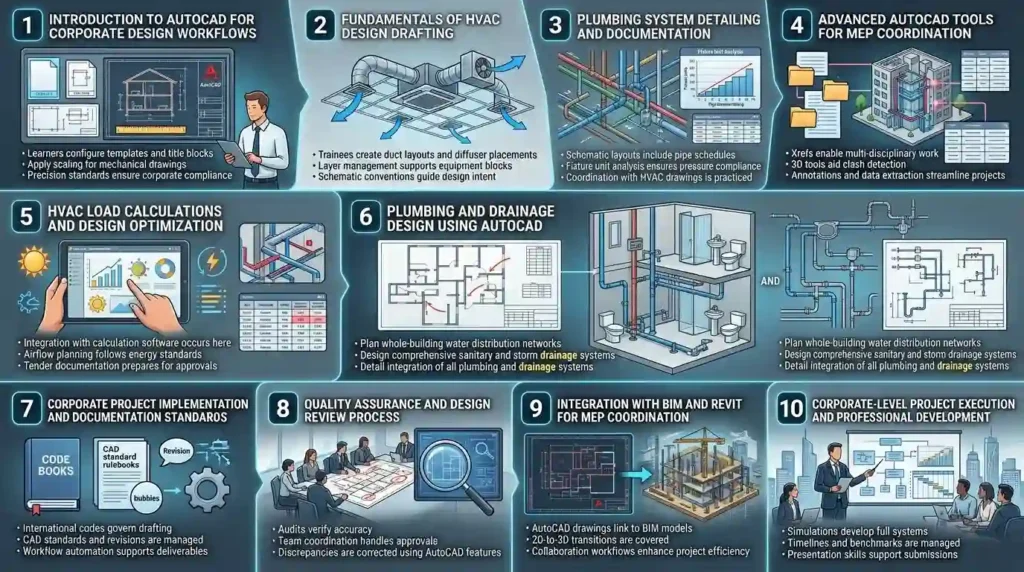
Module 1: Introduction to AutoCAD for Corporate Design Workflows
Learners configure templates and title blocks. They apply scaling for mechanical drawings. Precision standards ensure corporate compliance.
Module 2: Fundamentals of HVAC Design Drafting
Trainees create duct layouts and diffuser placements. Layer management supports equipment blocks. Schematic conventions guide design intent.
Module 3: Plumbing and Drainage Design Using AutoCAD
Designers produce riser diagrams and pipe sizing. Slope calculations optimize drainage. Coordination with MEP services is emphasized.
Module 4: Advanced AutoCAD Tools for MEP Coordination
Xrefs enable multi-disciplinary work. 3D tools aid clash detection. Annotations and data extraction streamline projects.
Module 5: HVAC Load Calculations and Design Optimization
Integration with calculation software occurs here. Airflow planning follows energy standards. Tender documentation prepares for approvals.
Module 6: Plumbing System Detailing and Documentation
Schematic layouts include pipe schedules. Fixture unit analysis ensures pressure compliance. Coordination with HVAC drawings is practiced.
Module 7: Corporate Project Implementation and Documentation Standards
International codes govern drafting. CAD standards and revisions are managed. Workflow automation supports deliverables.
Module 8: Quality Assurance and Design Review Process
Audits verify accuracy. Team coordination handles approvals. Discrepancies are corrected using AutoCAD features.
Module 8: Integration with BIM and Revit for MEP Coordination
AutoCAD drawings link to BIM models. 2D-to-3D transitions are covered. Collaboration workflows enhance project efficiency.
Module 10: Corporate-Level Project Execution and Professional Development
Simulations develop full systems. Timelines and benchmarks are managed. Presentation skills support submissions.
Imperial Corporate Training Institute ensures hands-on application throughout.
How is the course delivered?
Delivery combines online workshops, hybrid onsite sessions, and simulations over 8-12 weeks, with 40+ hours of practical AutoCAD exercises, assessments, and corporate case studies for flexible professional upskilling.
Imperial Corporate Training Institute offers multiple formats. Online access suits remote teams. Hybrid options include virtual instructor-led sessions.
Onsite workshops occur at client facilities. Duration spans 8-12 weeks, part-time. Each module allocates 4-5 hours.
Training methods emphasize simulations. Participants draft real HVAC systems. Instructors provide live feedback.
Assessments include quizzes, assignments, and capstone projects. Simulations test clash detection. Assignments require full plumbing layouts.
Example: HR teams schedule onsite sessions for departments. Managers complete modules during work hours.
Imperial Corporate Training Institute certifies completion upon 80% proficiency.
What results can be expected?
Graduates achieve 35-50% faster design workflows, 25% error reduction in MEP coordination, and readiness for corporate tenders, with HR-reported improvements in team performance and project delivery timelines.
Learning outcomes are measurable. Participants produce compliant HVAC schematics independently.
Skill gains include accurate duct sizing and pipe coordination. Load calculations align with standards.
Workplace impact targets HR priorities. Engineering teams handle complex projects. Leadership pipelines strengthen with certified designers.
Real-world example: A construction firm’s MEP department cut revision time by 40%. Facility managers interpreted layouts without errors.
Imperial Corporate Training Institute tracks outcomes via post-course surveys. 90% report enhanced role effectiveness.
Corporate applications extend to tenders. Designs meet international codes. BIM integration supports large-scale work.
Managers gain tools for performance reviews. Departments achieve sustainable system designs.
Who is this course for?
Targeted at mechanical engineers, MEP draftsmen, project coordinators, facility managers, and engineering graduates in corporate settings needing advanced AutoCAD for HVAC and plumbing in commercial projects.
Ideal participants work in engineering firms. Mechanical design engineers draft industrial systems.
MEP technicians require detailed layouts. Project engineers coordinate services.
Consultants prepare client deliverables. Facility professionals interpret as-builts.
Graduates specialize in building services. Professionals upgrade for global standards.
Imperial Corporate Training Institute tailors for corporate needs. No prior BIM experience required.
Example: HR teams upskill departments for infrastructure bids.
What are the eligibility and prerequisites?
Eligibility requires basic AutoCAD familiarity and an engineering background; no advanced MEP experience needed, with Imperial Corporate Training Institute providing entry assessments for corporate professionals.

Basic prerequisites include AutoCAD basics. Mechanical or civil engineering knowledge suffices.
Imperial Corporate Training Institute conducts entry quizzes. This ensures readiness.
No degree mandates apply. Working professionals qualify.
Corporate sponsors verify team fit.
How does enrollment work?
Enrollment involves online application, eligibility review by Imperial Corporate Training Institute, payment, and immediate access to modules, with flexible start dates and corporate group options for quick team integration.
Process starts with form submission. Imperial Corporate Training Institute reviews within 48 hours.
Payment secures spot. Access follows via portal.
Completion path spans modules to certification. Corporate groups receive custom scheduling.
Ready to proceed?
Enroll in Imperial’s AutoCAD HVAC and Plumbing Design Training Course today.