

Organisations implementing continuous improvement programmes often discover that identifying symptoms is easier than identifying root causes. Defects, delays and quality failures appear visible, but the underlying mechanisms creating them remain hidden. Cause-and-effect analysis provides a structured method for tracing operational problems back to their origins, making it one of the most important competencies for Lean Six Sigma leaders.
Professionals pursuing advanced process improvement skills frequently explore how root cause methodologies are taught at expert level. Before examining advanced training practices, it helps to understand the foundations of fishbone analysis and its practical role in process improvement through this guide on:
What Is a Fishbone Diagram and How Is It Used in Lean Six Sigma? Master Black Belt education builds on these principles by transforming analytical tools into enterprise-wide problem-solving frameworks.
Why is cause-and-effect analysis central to Lean Six Sigma Master Black Belt training?
Cause-and-effect analysis forms the foundation of advanced Lean Six Sigma practice because organisations achieve sustainable improvements only when they eliminate root causes rather than symptoms. Master Black Belts learn to apply analytical frameworks across complex systems, departments and business functions.
Lean Six Sigma defines quality as the ability of a process to consistently meet customer requirements while minimising variation and waste. Cause-and-effect analysis supports this objective by identifying factors that influence process outcomes.
In Master Black Belt training, professionals move beyond basic troubleshooting. They learn how multiple variables interact within operational systems. A manufacturing defect, for example, rarely stems from a single source. Human behaviour, equipment reliability, supplier quality and process design frequently contribute simultaneously.
The analysis typically examines the classic categories of:
- People
- Process
- Materials
- Machines
- Environment
- Measurement systems
This structured investigation prevents organisations from implementing ineffective solutions.
Research from quality management studies consistently shows that organisations solving root causes experience significantly greater long-term performance improvements compared with businesses relying on corrective actions alone. Sustainable improvement requires systematic analysis rather than reactive fixes.
For HR teams and learning managers, this creates a workforce capability advantage. Employees trained in root cause methodologies solve problems independently and contribute to continuous improvement cultures.
How does Master Black Belt training teach advanced fishbone analysis?
Master Black Belt programmes teach fishbone analysis as a strategic diagnostic framework rather than a simple diagramming tool. Learners develop expertise in facilitating workshops, validating causes with data and integrating findings into improvement projects.
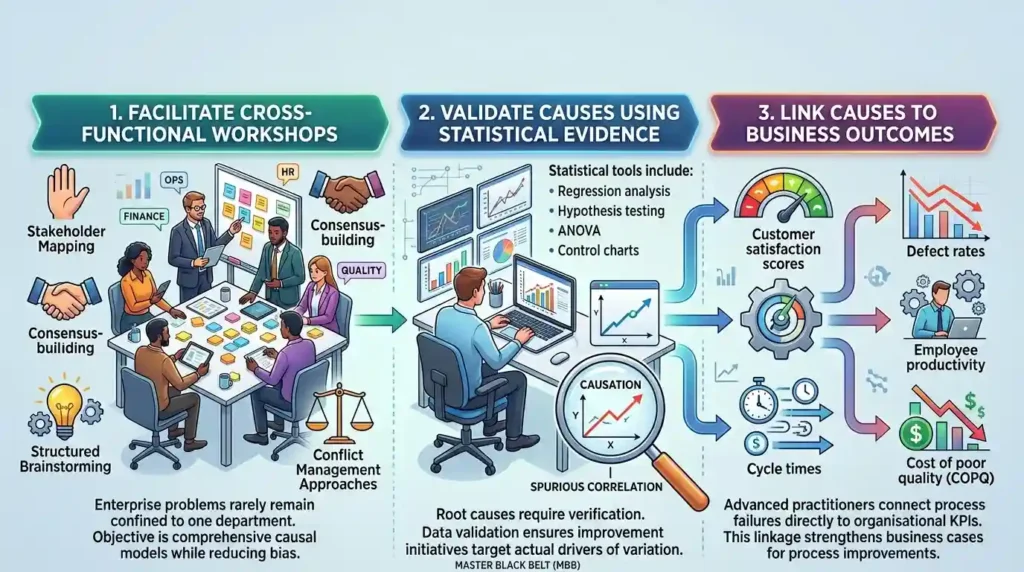
At Green Belt or Black Belt levels, fishbone diagrams often focus on identifying possible causes. Master Black Belt education adds greater analytical depth.
Participants learn to:
Facilitate cross-functional workshops
Enterprise problems rarely remain confined to one department. Master Black Belts lead sessions involving operations, HR, procurement, finance and quality teams.
Facilitation techniques include:
- Stakeholder mapping
- Consensus-building methods
- Structured brainstorming
- Conflict management approaches
The objective is generating comprehensive causal models while reducing bias.
Validate causes using statistical evidence
Root causes require verification.
Teams frequently confuse correlation with causation. Master Black Belt training therefore integrates statistical tools such as:
- Regression analysis
- Hypothesis testing
- Analysis of Variance (ANOVA)
- Control charts
Data validation ensures improvement initiatives target actual drivers of variation.
Link causes to business outcomes
Advanced practitioners connect process failures directly to organisational KPIs.
Examples include:
- Customer satisfaction scores
- Defect rates
- Employee productivity
- Cycle times
- Cost of poor quality (COPQ)
This linkage strengthens business cases for process improvements.
How is cause-and-effect analysis integrated into DMAIC methodology?
Master Black Belt training embeds cause-and-effect analysis throughout DMAIC projects, particularly within the Analyse phase. Learners understand how diagnostic tools interact with data collection, validation techniques and improvement strategies.
DMAIC stands for:
- Define
- Measure
- Analyse
- Improve
- Control
Cause-and-effect analysis becomes most prominent during the Analyse phase.
Define phase
Teams clarify project scope and customer requirements.
Critical-to-Quality (CTQ) characteristics are identified.
Measure phase
Process data is collected.
Measurement system analysis ensures data reliability.
Analyse phase
Root causes are identified and validated.
Fishbone diagrams often serve as an initial framework before statistical testing.
Improve phase
Validated causes lead to targeted interventions.
Control phase
Monitoring systems sustain improvements over time.
Master Black Belt learners understand that tools do not operate independently. Instead, analytical methods work together as part of an integrated improvement system.
What teaching approaches are used for root cause analysis in Master Black Belt programmes?
Effective Master Black Belt programmes use experiential learning, case studies and project-based applications because advanced analytical skills develop through practice rather than theory alone. Real business scenarios improve knowledge transfer and workplace implementation.
Corporate learning research consistently demonstrates that experiential learning improves retention and application rates.
Training providers commonly use several instructional methods.
Simulation-based learning
Participants solve realistic operational problems.
Scenarios may involve:
- Manufacturing defects
- Service delivery failures
- Supply chain disruptions
- Customer complaints
Simulation develops decision-making skills under realistic constraints.
Case-study analysis
Complex organisational cases expose learners to multi-variable environments.
Professionals evaluating practical applications often examine examples of:
How Imperial’s MBB programme applies fishbone diagrams in case studies when assessing implementation depth and learning effectiveness.
Case-based learning helps participants understand how analytical frameworks perform in real environments rather than textbook settings.
Project mentoring
Advanced training frequently includes supervised improvement projects.
Learners receive coaching on:
- Data interpretation
- Cause validation
- Change implementation
- Performance measurement
This approach supports workplace transfer and measurable outcomes.
How do Master Black Belts distinguish symptoms from root causes?
Master Black Belts use structured questioning, data validation and systems thinking to separate observable symptoms from underlying drivers. This distinction prevents organisations from investing resources in ineffective corrective actions.

Many operational issues create misleading indicators.
For example:
- High turnover is often a symptom.
- Poor engagement may be a symptom.
- Reduced productivity may be a symptom.
The underlying causes frequently include:
- Ineffective leadership
- Process bottlenecks
- Skills gaps
- Inadequate communication systems
The Five Whys technique
The Five Whys method repeatedly asks why a problem occurs until reaching the underlying source.
Example:
Problem: Customer complaints increased.
Why? Delivery delays increased.
Why? Production scheduling failed.
Why? Forecasting errors occurred.
Why? Data inputs were inaccurate.
Why? Standard procedures were absent.
This method supports deeper investigation.
Systems thinking
Master Black Belts examine interactions across organisational systems rather than isolated events.
Systems thinking recognises that changes in one process frequently affect multiple functions simultaneously.
This perspective becomes increasingly important in large organisations with interconnected workflows.
How does cause-and-effect analysis support organisational performance?
Cause-and-effect analysis improves operational performance by reducing defects, increasing efficiency and strengthening decision-making. Organisations applying root cause methodologies often achieve measurable improvements across quality, cost and customer outcomes.
Businesses increasingly use process improvement frameworks to enhance competitiveness.
Key benefits include:
- Lower operational costs
- Improved customer experiences
- Reduced rework
- Higher productivity
- Faster process cycles
Industry research frequently reports quality improvement initiatives delivering substantial returns when implemented systematically.
For HR leaders, analytical capability represents a workforce development priority.
Organisations investing in advanced improvement skills often experience:
- Greater employee engagement
- Improved cross-functional collaboration
- Stronger problem-solving cultures
- Increased innovation capacity
The value extends beyond operational metrics into organisational learning and capability building.
How should organisations evaluate Master Black Belt training programmes?
Training evaluation should focus on practical application, analytical depth and measurable business outcomes. Organisations selecting programmes benefit from assessing curriculum design, project requirements and workplace transfer mechanisms.
Not all Master Black Belt programmes deliver equivalent outcomes.
Evaluation criteria often include the following factors:
| Evaluation Area | Key Questions |
|---|---|
| Curriculum Depth | Does training cover advanced statistics and root cause analysis? |
| Project Work | Are real business projects required? |
| Coaching Support | Is mentoring included? |
| Assessment Method | Are competencies practically evaluated? |
| Business Application | Does learning connect to organisational KPIs? |
Learning and Development teams increasingly evaluate programmes based on return on investment rather than attendance metrics alone.
A robust programme demonstrates measurable impact through:
- Reduced defects
- Cost savings
- Productivity gains
- Leadership capability development
Professionals seeking structured expertise often review the Lean Six Sigma Master Black Belt Certification Training Course when comparing advanced learning pathways aligned with enterprise improvement objectives.
How does Master Black Belt expertise influence long-term business transformation?
Master Black Belt expertise enables organisations to institutionalise continuous improvement through leadership, coaching and strategic alignment. Advanced practitioners build systems that sustain performance gains beyond individual projects.
Master Black Belts serve multiple organisational roles:
- Improvement leaders
- Coaches
- Mentors
- Strategic advisors
Their influence extends beyond project execution.
They establish governance frameworks that standardise improvement activities across departments.
This capability becomes increasingly valuable as organisations expand digital transformation initiatives and data-driven decision-making.
Discover More from Our Guide Library:
How Does Master Black Belt Training Prepare Finance Professionals for Six Sigma Projects?
How Is Measurement System Analysis Taught in Master Black Belt Training?
Continuous improvement maturity develops over time.
Businesses with advanced analytical capabilities often demonstrate:
- Faster problem resolution
- Greater adaptability
- Improved operational resilience
- Stronger customer satisfaction outcomes
Cause-and-effect analysis therefore functions not only as a quality tool but as an organisational capability supporting long-term competitiveness.
Frequently Asked Questions
Who should attend a Lean Six Sigma Master Black Belt Certification Training Course?
This course is designed for senior quality professionals, process improvement leaders and experienced Black Belts. The Lean Six Sigma Master Black Belt Certification Training Course helps professionals manage complex projects and mentor improvement teams.
How does Master Black Belt training improve business performance?
Master Black Belt training improves operational efficiency by reducing defects, waste and process variation. Imperial Corporate Training Institute focuses on data-driven decision-making to support measurable business outcomes and continuous improvement.
What tools are taught in a Lean Six Sigma Master Black Belt Certification Training Course?
Participants learn advanced Lean Six Sigma tools such as fishbone diagrams, hypothesis testing, regression analysis and control charts. These tools support root cause analysis and process optimisation across industries.
Why is cause-and-effect analysis important in Lean Six Sigma?
Cause-and-effect analysis helps organisations identify the root causes of defects and inefficiencies rather than treating symptoms. In the Lean Six Sigma Master Black Belt Certification Training Course, learners apply these methods to improve quality and process performance.