

Banking and insurance organisations operate in highly regulated environments where process efficiency, risk control, service quality, and cost management directly influence performance outcomes. Financial institutions are expected to manage increasing customer expectations while maintaining compliance standards, operational accuracy, and profitability. These demands create a need for professionals who can lead large-scale process improvement initiatives using structured methodologies.
Professionals working in financial services often encounter challenges related to process variation, long transaction cycles, service bottlenecks, claims processing delays, compliance inefficiencies, and data-driven decision-making. Understanding how Lean Six Sigma addresses these challenges is essential when evaluating advanced improvement programmes.
Readers seeking foundational knowledge can explore how Six Sigma applies to financial services and banking operations at:
How Does Six Sigma Apply to Financial Services and Banking Operations?
What Is the Lean Six Sigma Master Black Belt Certification Training Course and What Problem Does It Solve?
Yes. Banking and insurance professionals can attend the Lean Six Sigma Master Black Belt Certification Training Course because the programme focuses on enterprise-wide process improvement, strategic leadership, operational excellence, and measurable performance enhancement across both service-based and transactional business environments.
Many banking and insurance professionals already participate in process improvement projects. However, organisations often face a shortage of leaders capable of managing multiple improvement programmes across departments while aligning operational initiatives with strategic business goals.
The Lean Six Sigma Master Black Belt Certification Training Course delivered by Imperial Corporate Training Institute addresses this gap. The programme is designed for senior professionals responsible for managing organisational performance, operational efficiency, quality improvement, and business transformation initiatives.
Unlike project-level Six Sigma training, this advanced programme focuses on enterprise deployment. Participants learn how to create governance systems, mentor project teams, evaluate business performance metrics, and manage portfolios of improvement projects across complex organisational structures.
For banking organisations, this may include improving loan processing cycles, reducing compliance-related delays, streamlining customer onboarding procedures, and optimising back-office operations.
For insurance organisations, applications may include claims management optimisation, underwriting process improvements, fraud detection workflows, policy administration efficiency, and customer service performance enhancement.
Imperial Corporate Training Institute structures the programme to ensure that participants can move beyond individual project execution and develop the capability to lead organisation-wide transformation initiatives.
Why Is the Course Structured for Senior Banking and Insurance Professionals?
The curriculum follows a strategic progression that develops analytical expertise, leadership capability, project governance knowledge, and organisational transformation skills required for managing large-scale Lean Six Sigma programmes within financial institutions and insurance operations.
Financial organisations operate through interconnected systems. Improvements in one department frequently affect multiple functions including operations, compliance, customer service, risk management, finance, technology, and human resources.
A Master Black Belt must understand these relationships.
Imperial Corporate Training Institute therefore organises the curriculum around enterprise-level thinking rather than isolated process improvement techniques.
Strategic Leadership and Enterprise Alignment
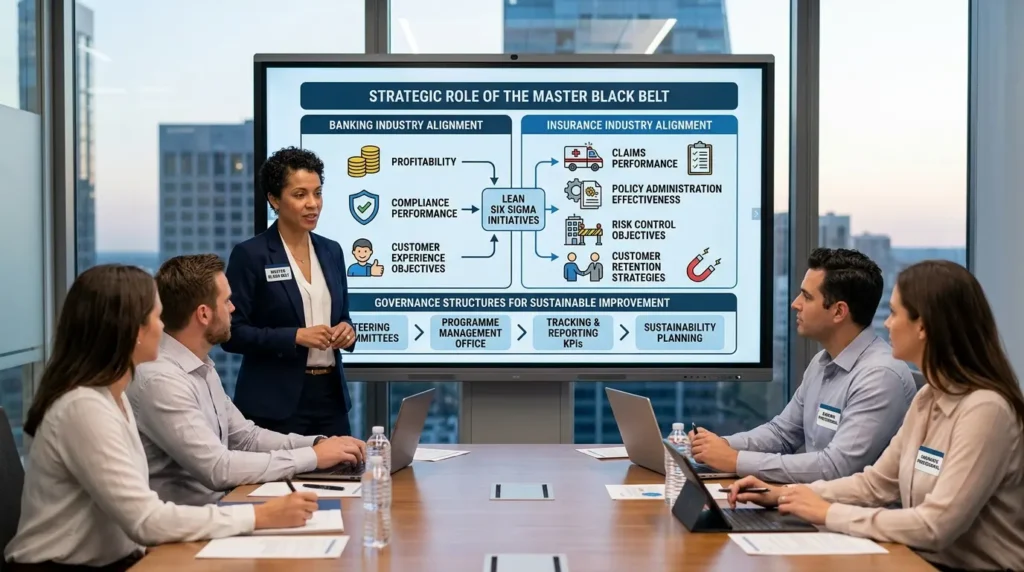
The first module focuses on the strategic role of the Master Black Belt. Participants learn how Lean Six Sigma deployment aligns with organisational objectives and performance goals.
For banking professionals, this includes understanding how operational efficiency initiatives support profitability, compliance performance, and customer experience objectives.
For insurance professionals, it involves aligning improvement programmes with claims performance, policy administration effectiveness, risk control objectives, and customer retention strategies.
Participants examine governance structures that support sustainable improvement programmes across large organisations.
Advanced Analytical Capability
Financial institutions generate significant volumes of operational and customer data.
Imperial Corporate Training Institute includes advanced statistical analysis modules to help participants interpret this information effectively.
Topics include:
- Multivariate analysis
- Advanced regression models
- Design of Experiments (DOE)
- Capability studies
- Statistical process control
- Advanced analytical software applications
These tools enable participants to identify root causes of performance variation and evaluate improvement opportunities using objective evidence rather than assumptions.
Enterprise Transformation Focus
Banking and insurance organisations frequently manage multiple transformation initiatives simultaneously.
The programme develops the capability to evaluate organisational value streams, identify waste, calculate return on investment, and implement enterprise-level improvement frameworks.
This approach ensures that improvement projects contribute directly to business performance objectives.
What Will Banking and Insurance Participants Learn?
Participants develop expertise in process optimisation, statistical analysis, transformation leadership, project portfolio management, organisational capability development, and sustainable performance improvement systems that can be applied across financial services environments.
The curriculum is designed to build progressively from strategic understanding to implementation capability.
Module 1: Strategic Role of the Master Black Belt
Participants learn:
- Enterprise-wide Lean Six Sigma deployment
- Corporate strategy alignment
- Improvement programme governance
- Leadership responsibilities in operational excellence
Banking leaders can apply these principles when managing customer service transformation initiatives, branch optimisation projects, or operational efficiency programmes.
Module 2: Advanced Analytical and Statistical Tools
Participants learn:
- Multivariate analysis
- Advanced regression techniques
- Design of Experiments
- Capability studies
- Advanced statistical software applications
These skills support data-driven decision-making within credit operations, underwriting departments, compliance functions, and risk management teams.
Module 3: Enterprise-Level Lean Transformation
Participants explore:
- End-to-end value stream mapping
- Lean implementation frameworks
- Waste elimination methodologies
- Cost optimisation strategies
- ROI measurement techniques
This module is particularly relevant for financial institutions seeking to improve transaction processing efficiency and reduce operational costs.
Module 4: Change Leadership and Organisational Culture
Participants learn:
- Performance culture development
- Resistance management
- Transformation communication strategies
- Cross-functional leadership techniques
Banking and insurance projects often involve multiple departments. Effective change leadership therefore becomes critical for successful implementation.
Module 5: Business Process Reengineering and Innovation
Participants examine:
- Agile process design
- Digital transformation initiatives
- Automation integration
- AI-supported process improvement
- Innovation management frameworks
These skills support modernisation initiatives commonly found within financial services organisations.
Module 6: Project Portfolio Management
Participants learn:
- Project selection methodologies
- Strategic prioritisation techniques
- Executive reporting systems
- Business case development
- Performance tracking frameworks
These capabilities are particularly valuable for senior managers overseeing multiple improvement projects simultaneously.
Module 7: Coaching, Mentoring, and Capability Building
Participants develop skills in:
- Black Belt coaching
- Green Belt mentoring
- Competency assessment
- Internal capability development
- Organisational knowledge transfer
Imperial Corporate Training Institute includes this module because sustainable improvement requires internal expertise development.
Module 8: Advanced Control and Sustainability Systems
Participants learn:
- KPI dashboard development
- Process auditing methodologies
- Continuous improvement tracking
- Maturity assessment frameworks
Financial organisations rely heavily on measurement systems to maintain performance improvements after project completion.
Module 9: Financial Impact and Corporate Value Creation
Participants examine:
- Financial benefit calculation
- Cost-benefit analysis
- Sensitivity analysis
- Value creation methodologies
- Strategic KPI alignment
This module helps banking and insurance professionals demonstrate measurable business outcomes from improvement initiatives.
Module 10: Capstone Project and Certification Evaluation
Participants complete:
- Real-world project presentations
- Executive evaluation sessions
- Strategic reporting exercises
- Certification assessments
Imperial Corporate Training Institute uses this capstone structure to validate practical application capability rather than theoretical knowledge alone.
How Is the Course Delivered and Assessed?
The programme combines structured instruction, practical workshops, analytical exercises, project-based learning, leadership development activities, and formal assessments to ensure participants can apply Lean Six Sigma methodologies in complex organisational environments.
Learning effectiveness depends not only on curriculum content but also on delivery structure.
Imperial Corporate Training Institute uses multiple learning methods to support different professional backgrounds and workplace requirements.
Delivery Formats
The programme may be delivered through:
- Classroom-based training
- Live virtual learning
- Hybrid learning environments
- Corporate onsite delivery
This flexibility allows banking and insurance organisations to select formats that align with workforce development strategies.
Practical Workshops
Participants engage in structured workshops focused on:
- Statistical analysis
- Process mapping
- Project evaluation
- Performance measurement
- Improvement planning
These sessions help translate theory into practical workplace application.
Case-Based Learning
Real-world business cases are incorporated throughout the programme.
Participants analyse organisational challenges, evaluate improvement opportunities, and develop solutions using Lean Six Sigma methodologies.
Financial sector professionals benefit from understanding how similar approaches can be applied to banking operations, insurance services, compliance processes, and customer experience management.
Assessment Methods
Imperial Corporate Training Institute incorporates several assessment mechanisms:
- Knowledge evaluations
- Analytical exercises
- Applied assignments
- Project documentation reviews
- Executive presentations
- Capstone project assessments
This assessment framework ensures participants demonstrate both technical competence and leadership capability.
What Results Can Banking and Insurance Professionals Expect?
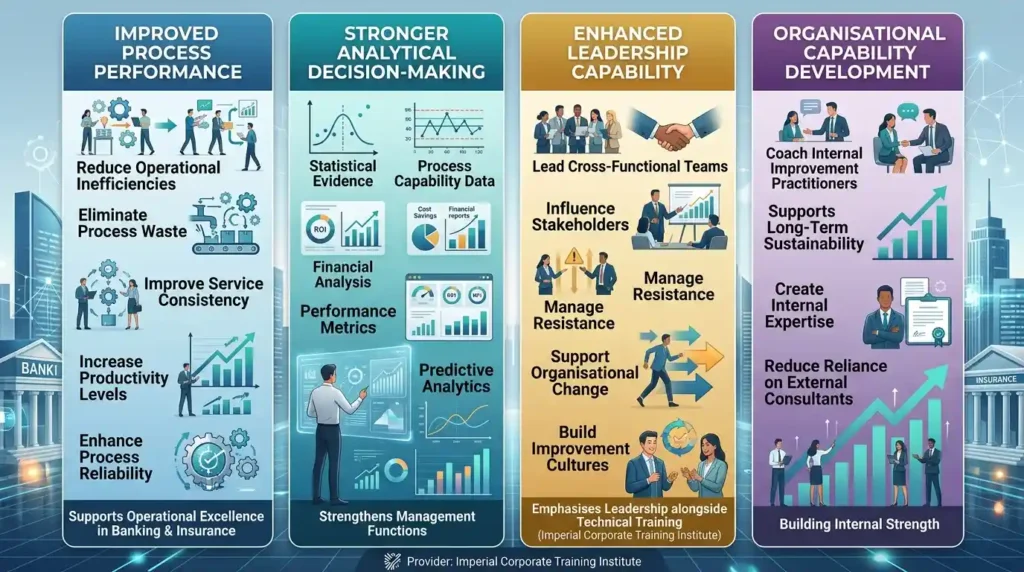
Participants can expect measurable improvements in strategic decision-making, project leadership, process optimisation capability, analytical expertise, organisational influence, and enterprise-level improvement programme management effectiveness.
The course focuses on workplace application rather than academic theory.
Learning outcomes are linked directly to organisational performance requirements.
Improved Process Performance
Participants gain the ability to:
- Reduce operational inefficiencies
- Eliminate process waste
- Improve service consistency
- Increase productivity levels
- Enhance process reliability
These outcomes support operational excellence objectives within banking and insurance environments.
Stronger Analytical Decision-Making
Participants learn to evaluate performance using:
- Statistical evidence
- Process capability data
- Financial analysis
- Performance metrics
- Predictive analytics
This capability strengthens decision-making quality across management functions.
Enhanced Leadership Capability
Master Black Belts frequently serve as organisational improvement leaders.
Imperial Corporate Training Institute therefore emphasises leadership development alongside technical training.
Participants learn how to:
- Lead cross-functional teams
- Influence stakeholders
- Manage resistance
- Support organisational change
- Build improvement cultures
Organisational Capability Development
Participants develop the skills required to coach internal improvement practitioners.
This capability supports long-term organisational sustainability by creating internal expertise rather than relying exclusively on external consultants.
Professionals evaluating advanced training pathways may also benefit from reviewing how Master Black Belt training prepares finance professionals for Six Sigma projects:
How Does Master Black Belt Training Prepare Finance Professionals for Six Sigma Projects?
How Does Enrolment Work and Who Is Eligible?
The programme is intended for experienced professionals responsible for operational excellence, transformation leadership, process improvement, strategic performance management, and organisational capability development within complex corporate environments.
The Lean Six Sigma Master Black Belt Certification Training Course is not designed as an introductory Six Sigma programme.
Participants should possess professional experience in process improvement, operations management, quality management, business transformation, project management, or organisational performance initiatives.
Suitable Professional Backgrounds
The programme is particularly relevant for:
- Senior Operations Managers
- Banking Operations Directors
- Insurance Process Improvement Leaders
- Continuous Improvement Managers
- Quality Management Professionals
- Transformation Consultants
- Strategy Leaders
- Corporate Capability Development Managers
- Existing Black Belts seeking advanced certification
Completion Path
Participants progress through:
- Structured learning modules
- Practical application exercises
- Analytical assessments
- Leadership development activities
- Capstone project completion
- Certification evaluation
Imperial Corporate Training Institute uses this structured pathway to ensure participants demonstrate advanced competence across technical, strategic, and leadership dimensions.
Discover More from Our Guide Library:
Does Imperial’s MBB Programme Include Practical MSA and Gage R&R Exercises?
Does Imperial’s MBB Course Cover Lean-Agile Hybrid Approaches?