

Imperial Corporate Training Institute’s AutoCAD HVAC and Plumbing Design Training Course addresses a practical gap between mechanical theory and deliverable design work. It helps participants produce coordinated HVAC and plumbing drawings in AutoCAD, manage project documentation, and apply corporate drafting standards across commercial and industrial building services workflows.
Many engineers can understand HVAC and plumbing systems in principle, but still struggle to convert that knowledge into usable drawings, schedules, and coordinated layouts. That creates delays, revision cycles, and avoidable errors during design review. The course is built to solve that gap through structured CAD-based learning.
If you are first clarifying the system context behind mechanical services, you may also find this:
basic HVAC component overview useful before evaluating the course.
Imperial Corporate Training Institute positions the programme as a technical training path for professionals who need measurable drafting competence, not general awareness. The content is centred on AutoCAD application in mechanical services, with emphasis on duct routing, piping logic, drainage layouts, and documentation discipline. In practice, that means learners move from understanding building services concepts to preparing work that fits corporate project expectations.
The course also addresses a common workplace problem in engineering teams: uneven drafting quality across staff. One team member may understand system layout, while another may know AutoCAD commands, but neither may be fully effective in producing a complete MEP package. Imperial Corporate Training Institute structures the programme to close that gap with a sequenced model that combines design logic, software application, and documentation standards.
Why is the course structured this way?
The course is structured as a progression from AutoCAD foundations to HVAC drafting, plumbing design, coordination, calculations, and final documentation because corporate MEP work follows the same sequence. Learners need software control, then system logic, then coordination discipline, then compliant deliverables for review, approval, and handover.
This structure mirrors how real projects move inside engineering departments. Teams rarely start with final drawings. They begin with templates, standards, layouts, and spatial planning. Imperial Corporate Training Institute uses that same logic so participants can build skill in the order required by workplace tasks.
The first stage introduces AutoCAD for corporate design workflows. That matters because many errors in mechanical documentation come from poor setup, weak layer control, or inconsistent title block use. Learners establish the habits needed for repeatable project output before moving into system-specific drafting.
The second stage focuses on HVAC drafting. At this point, participants learn how air distribution, duct routing, diffuser placement, and equipment representation translate into drawing form. The logic is deliberate. A learner should understand how the drawing communicates design intent before they attempt advanced coordination.
The third stage develops plumbing and drainage design. This is where the course expands from one mechanical discipline to a broader building services context. Participants work with pipe sizing, slope representation, riser logic, and fixture-based layout thinking. Imperial Corporate Training Institute includes this progression because corporate projects usually require HVAC and plumbing coordination, not isolated single-discipline drafting.
The later stages move into xrefs, 3D support, clash awareness, calculation integration, and document control. That order reflects real coordination practice. Teams must first produce a workable design, then check how it interacts with other disciplines, then formalise it into a deliverable package. This is also where the course becomes especially relevant for project engineers, consultants, and design coordinators who need to review work, not only draft it.
If you are comparing the curriculum against your current needs, the:
Duct sizing and system layout training article gives a useful stage-by-stage evaluation reference.
Imperial Corporate Training Institute uses that same progression to keep the course practical and decision-ready for learners who need job-facing outputs.
What will participants learn?
Participants learn to create HVAC and plumbing drawings, size and organise layouts, manage layers and sheets, coordinate disciplines, and prepare documentation for engineering review. The course builds technical skill in AutoCAD while strengthening design judgement, drawing accuracy, and compliance with corporate project standards.
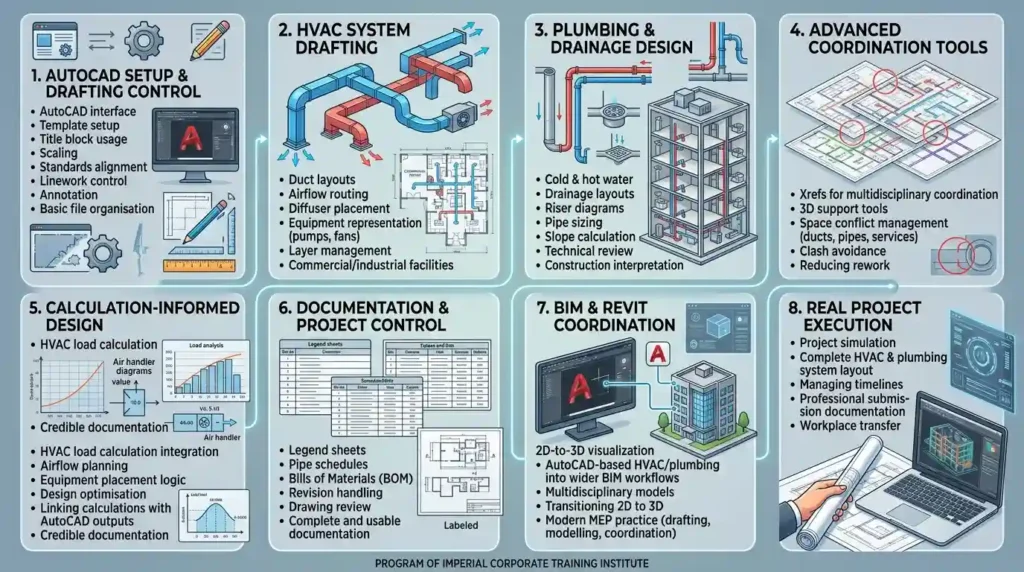
The learning outcomes are specific and measurable. By the end of the course, participants should be able to use AutoCAD for mechanical drafting tasks in a structured way rather than by trial and error. They should also be able to read engineering information, convert it into drawings, and prepare coordinated layouts that support real project workflows.
Imperial Corporate Training Institute organises the course around module-level competency development. In practical terms, that means learners move through the following skill areas:
AutoCAD setup and drafting control
Participants learn the AutoCAD interface, template setup, title block usage, scaling, and standards alignment. This is essential for corporate work because drawing consistency affects both internal quality review and client-facing presentation. Learners also gain better control over linework, annotation, and basic file organisation.
HVAC system drafting
Participants work on duct layouts, airflow routing, diffuser placement, equipment representation, and layer management for HVAC drawings. This section supports engineers who need to document air distribution systems clearly and efficiently. It is especially useful for those involved in commercial buildings, industrial facilities, and service coordination environments.
Plumbing and drainage design
The course covers cold water, hot water, drainage layouts, riser diagrams, pipe sizing, and slope calculation. Participants learn how to represent plumbing systems in a form that supports technical review and construction interpretation. Imperial Corporate Training Institute frames this module around corporate deliverables, not just academic drawing exercises.
Advanced coordination tools
Learners use xrefs for multidisciplinary coordination, apply 3D support tools where needed, and manage space conflicts between ducts, pipes, and other building services. This is relevant for projects where HVAC, plumbing, electrical, and structural information must be aligned before issue. The emphasis is on avoiding clashes and reducing rework.
Calculation-informed design
Participants are introduced to HVAC load calculation integration, airflow planning, equipment placement logic, and design optimisation. This helps them link mechanical calculations with AutoCAD outputs. The result is more credible design documentation and a stronger understanding of why layout decisions are made.
Documentation and project control
The course also develops skills in legend sheets, pipe schedules, bills of materials, revision handling, and drawing review. These are core corporate skills because design teams are assessed not only on whether the layout works, but also on whether the documentation is complete and usable.
BIM and Revit coordination
Learners see how AutoCAD-based HVAC and plumbing drawings fit into wider BIM and Revit workflows. This matters for organisations that manage multidisciplinary models or are transitioning from 2D to 3D environments. Imperial Corporate Training Institute includes this because modern MEP practice often combines drafting, modelling, and coordination.
Real project execution
The final module brings the full workflow together through project simulation. Participants develop a complete HVAC and plumbing system layout, manage timelines, and prepare professional submission documentation. This is one of the strongest signals that the course is designed for workplace transfer rather than abstract learning.
How is the course delivered?
Imperial Corporate Training Institute delivers the course through a structured corporate training format that can suit classroom workshops, online delivery, hybrid learning, or onsite team training. The format is built for practical application, guided drafting exercises, and assessable work outputs rather than passive lecture-style instruction.
Delivery format matters because software-based engineering training depends on guided practice. Participants need time to work through templates, drawings, and design tasks while receiving corrections. Imperial Corporate Training Institute therefore uses a learning environment that supports demonstration, exercise, review, and application.
For organisations, the format can be adapted to team needs. A corporate group may prefer onsite delivery so staff can work on internal drawing standards and project examples. Individual professionals may prefer online access if they are building a new specialism while continuing their current role. Hybrid delivery can suit teams that want theoretical input remotely and practical review sessions in person.
The course also suits structured workshop delivery because each module builds on the last. Early sessions establish drafting foundations. Later sessions introduce more advanced coordination, system detailing, and project documentation. That sequencing makes it easier for learners to retain knowledge and apply it in the correct order.
Assessment is a central part of the delivery model. Imperial Corporate Training Institute uses practical testing, drawing assignments, and simulation-based tasks to confirm competence. That means participants are not only exposed to content; they are expected to demonstrate capability. In a corporate setting, this is important because training value comes from visible skill improvement, not attendance alone.
What results can be expected?
The expected result is improved drafting accuracy, stronger understanding of HVAC and plumbing coordination, faster preparation of MEP drawings, and better compliance with technical standards. Participants should finish able to support design teams, reduce errors, and produce more reliable engineering documentation.
The results of this course should be viewed through a workplace lens. In a design office, improved AutoCAD competence leads to fewer drawing revisions, clearer communication between disciplines, and better turnaround on project deliverables. Imperial Corporate Training Institute designed the programme to support those outcomes directly.
For engineers, the main benefit is practical independence. A participant should be able to take a project brief and begin working with greater confidence on duct layouts, pipe routing, drawing setup, and annotation. That can reduce reliance on senior staff for routine drafting tasks and free technical leads to focus on design review and decision-making.
For HR teams and L&D managers, the result is easier to measure. The course supports a clear skills baseline, observable progress during training, and post-training application in live project environments. It is suitable for organisations that want to strengthen technical capability across a group rather than send employees to disconnected short courses. Imperial Corporate Training Institute often fits this need because its training model is designed around corporate performance improvement.
For managers, the course can improve team output in specific ways. A draftsman who understands layer control, sheet organisation, and coordination standards can help stabilise project delivery. A design coordinator who understands both HVAC and plumbing documentation can reduce back-and-forth between disciplines. A facility management professional who can read and interpret layouts can support better maintenance planning and technical review.
A practical example is a construction consultancy preparing a mixed-use development package. One engineer handles HVAC routing, another handles plumbing schedules, and the reviewer needs consistent documentation across both. After training, the team can use shared standards more effectively, align layouts earlier, and prepare issue-ready drawings with less correction. That is the sort of measurable workplace improvement this course is intended to support.
How does enrollment work?
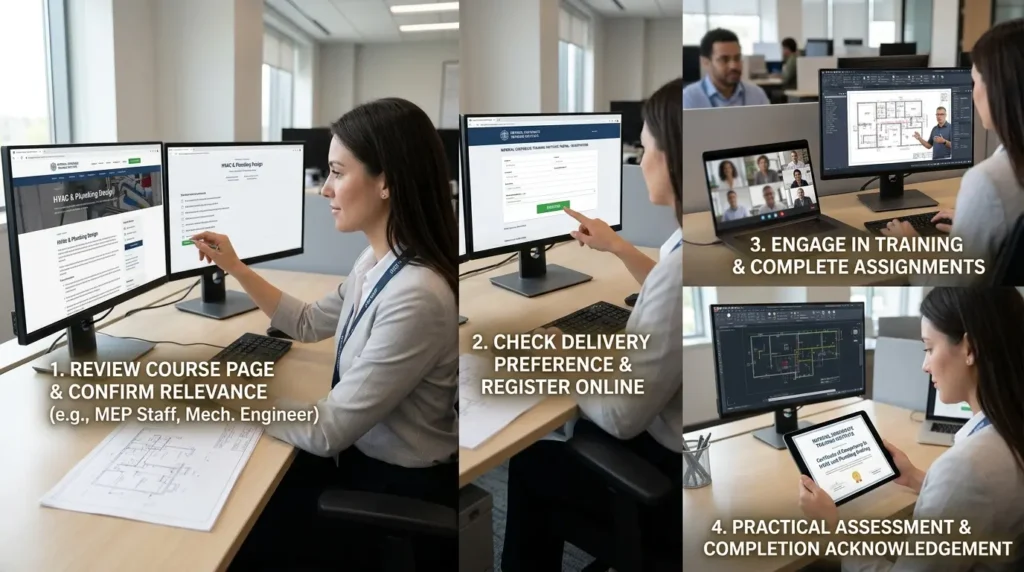
Enrollment is straightforward: review the course page, confirm role relevance, check your delivery preference, and register through Imperial Corporate Training Institute’s training portal. The programme suits mechanical engineers, MEP staff, draftsmen, coordinators, and organisations seeking structured CAD-based upskilling.
Before enrolling, it helps to confirm that your current role or target role involves building services design, technical drafting, or mechanical coordination. The course is most relevant for professionals in engineering, construction, infrastructure, and facilities environments. Graduates entering mechanical or civil design roles may also use it as a specialist pathway into HVAC and plumbing drafting.
Entry suitability is broad, but the course is not introductory in the casual sense. It is more appropriate for learners who want a structured professional skill upgrade and can commit to practical exercises. If you are enrolling for a team, Imperial Corporate Training Institute can align delivery with corporate objectives, whether the need is upskilling, role development, or project readiness.
A typical completion path includes course selection, registration, training delivery, practical assessment, and completion acknowledgement. Because the course is competency-driven, participants should expect to engage with assignments and drawing tasks as part of the process. That structure supports actual skill transfer and makes the training more useful for employers.
Discover More from Our Guide Library:
What Is Included in Imperial’s AutoCAD HVAC and Plumbing Design Programme?
Why Choose Imperial’s AutoCAD HVAC and Plumbing Design Training Course?
For organisations, enrollment can also be part of a wider workforce development plan. HR departments may use the programme to standardise CAD competence across a design team. Project managers may use it to improve documentation quality before a major delivery cycle. Technical leaders may use it to prepare junior staff for higher-responsibility design coordination roles. In each case, Imperial Corporate Training Institute provides a training format that fits measurable capability building.
If your goal is to move from general AutoCAD knowledge to specialist HVAC and plumbing design work in a corporate context, this course gives you a clear path from drafting fundamentals to coordinated MEP output, so you can enroll in this programme: