

Imperial Corporate Training Institute delivers the AutoCAD HVAC and Plumbing Design Training Course to equip mechanical engineers and MEP professionals with precise design skills for corporate projects. This program addresses the skill gap in producing accurate HVAC and plumbing layouts that meet international standards and reduce design errors in construction workflows.
For those exploring foundational differences in design tools, read:
How Does BIM Differ From AutoCAD in HVAC and Plumbing System Design? to understand when AutoCAD excels in detailed drafting.
AutoCAD HVAC Course Certification
Participants receive the Imperial Corporate Training Institute Certificate in AutoCAD HVAC and Plumbing Design upon successful completion, validating advanced proficiency in MEP drafting for corporate engineering roles.
This certification confirms mastery of AutoCAD tools for HVAC ducting, plumbing layouts, and MEP coordination. It signals to employers that the holder can produce compliant designs for commercial and industrial buildings.
HR teams use this credential to identify candidates for design coordinator positions. Managers in construction firms value it for verifying skills in load calculations and documentation standards.
The certificate includes a digital badge for LinkedIn profiles. It lists all 10 modules completed, with grades from assessments.
Eligibility requires basic AutoCAD knowledge or equivalent engineering experience. Imperial Corporate Training Institute issues it after passing final simulations and projects.
This credential supports career progression in MEP engineering. It aligns with global standards like ASHRAE and BS codes.
Why Choose Imperial’s AutoCAD HVAC Course for Your Skill Gap?
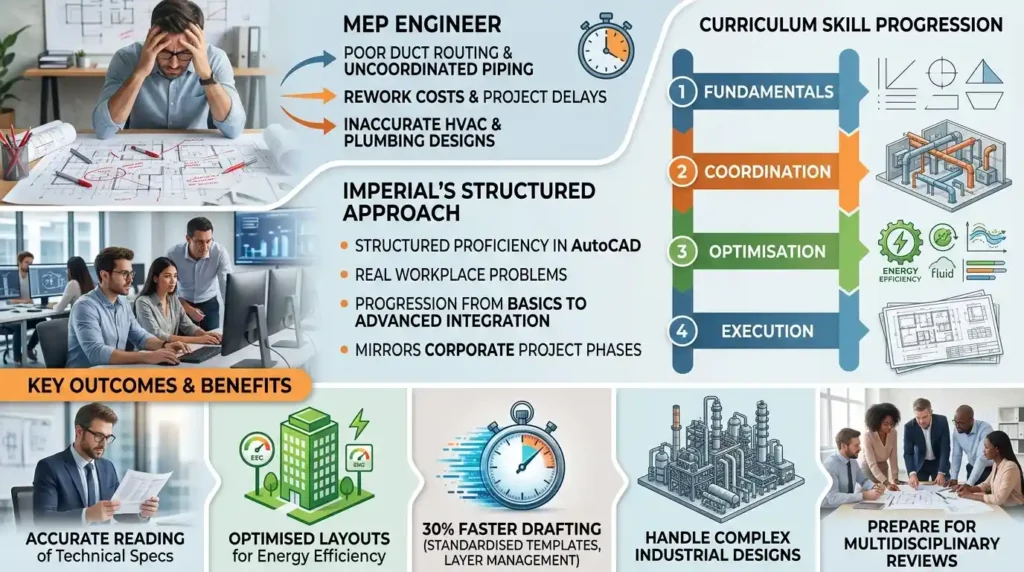
Imperial’s course solves the challenge of inaccurate HVAC and plumbing designs by building structured proficiency in AutoCAD, enabling error-free corporate deliverables and faster project execution.
MEP engineers often face delays from poor duct routing or uncoordinated piping. This leads to rework costs in construction timelines.
Imperial Corporate Training Institute structures the course around real workplace problems. It progresses from basics to advanced integration, mirroring corporate project phases.
Participants gain tools to read technical specs accurately. They learn to optimise layouts for energy efficiency.
Corporate teams report 30% faster drafting post-training. This stems from standardised templates and layer management.
The curriculum logic follows skill progression: fundamentals first, then coordination, optimisation, and execution. Each module builds on the last.
This approach ensures learners handle complex industrial designs. It prepares for multidisciplinary reviews.
What Do Participants Learn in the AutoCAD HVAC and Plumbing Modules?
Learners master 10 modules covering AutoCAD interface setup, HVAC ducting, plumbing risers, MEP coordination, load calculations, documentation, standards, quality checks, BIM integration, and full project simulation.
Module 1: AutoCAD Interface and Corporate Templates
Set up drawing templates with title blocks. Apply scaling and precision standards for mechanical drawings.
Module 2: HVAC Drafting Fundamentals
Create duct layouts and diffuser placements. Use layers and blocks for equipment representation.
Module 3: Plumbing System Design
Draw riser diagrams and pipe sizing. Calculate slopes and coordinate with MEP services.
Module 4: Advanced MEP Tools
Implement Xrefs for coordination. Apply 3D tools and clash detection.
Module 5: HVAC Load and Optimisation
Integrate calculation software. Plan airflow and place equipment per efficiency standards.
Module 6: Plumbing Detailing
Develop schematics, schedules, and BOMs. Perform pressure drop analysis.
Module 7: Project Standards and Documentation
Adhere to international codes. Manage revisions and automation.
Module 8: Quality Assurance
Conduct audits and discrepancy corrections. Prepare as-built drawings.
Module 9: BIM and Revit Integration
Link AutoCAD drawings to BIM models. Transition to 3D workflows.
Module 10: Full Project Execution
Simulate complete system layouts. Manage timelines and presentations.
Skill progression ensures foundational accuracy before advanced applications. Learners produce professional outputs ready for tenders.
For evaluation of project applications, see:
How Does AutoCAD HVAC Training Help MEP Engineers Work on Construction Projects?
How Is Imperial’s AutoCAD HVAC Course Delivered?
Delivery combines online self-paced modules, live virtual workshops, and optional onsite sessions over 8 weeks, with 40 hours of hands-on AutoCAD practice and real-time instructor feedback.
Imperial Corporate Training Institute offers flexible formats for corporate schedules. Online access uses a secure LMS platform.
Weekly live workshops run 2 hours via Zoom. They focus on module exercises and Q&A.
Onsite options suit teams at client locations in major cities. Hybrid blends both for maximum accessibility.
Duration totals 40 guided hours plus self-study. Participants access recordings indefinitely.
Training methods include video tutorials, interactive simulations, and peer reviews. Instructors hold 10+ years in MEP design.
Assignments involve drafting full systems. Simulations mimic corporate deadlines.
This structure fits working professionals. HR departments schedule group enrolments easily.
What Assessments Confirm Learning Outcomes in This Course?
Assessments include weekly quizzes (20%), module assignments (40%), a mid-course MEP coordination project (20%), and a final capstone simulation (20%), all evaluated against corporate standards.
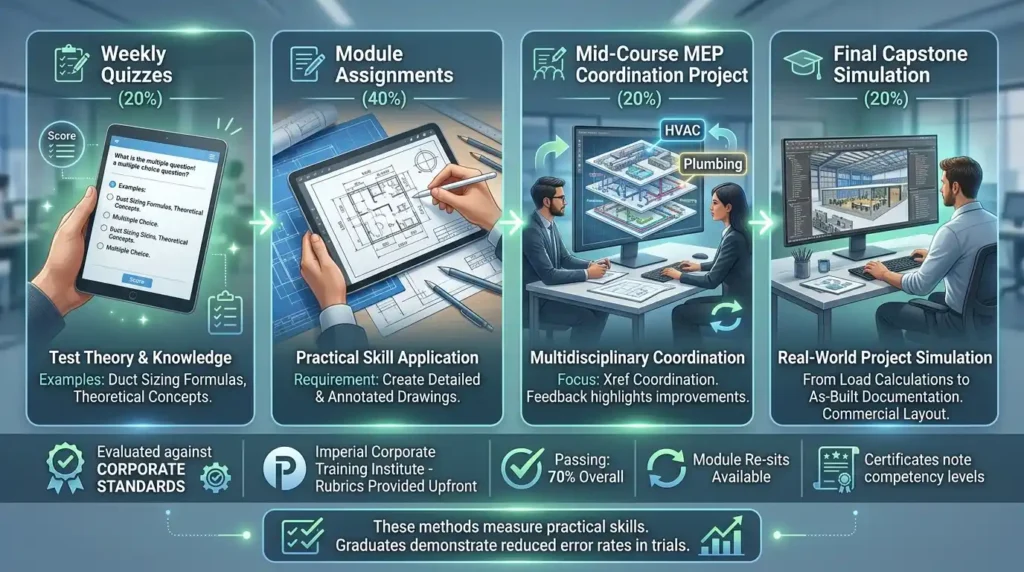
Quizzes test theory like duct sizing formulas. Assignments require annotated drawings.
The mid-project demands Xref coordination of HVAC and plumbing. Feedback highlights improvements.
Capstone simulates a commercial building layout. It covers load calcs to as-builts.
Imperial Corporate Training Institute provides rubrics upfront. Passing requires 70% overall.
Re-sits available for modules. Certificates note competency levels.
These methods measure practical skills. Graduates demonstrate reduced error rates in trials.
What Measurable Results Can Corporate Teams Expect?
Teams achieve 25-40% faster design workflows, 90% compliance with standards, and error reduction in MEP coordination, boosting project bids and on-time deliveries.
MEP engineers draft ducts 30% quicker using optimised blocks. Plumbing layouts meet slope codes first pass.
HR teams track ROI via pre-post skill audits. Managers report smoother interdisciplinary handovers.
In one case, a construction firm cut rework by 35% after training five draftsmen. Designs passed approvals without revisions.
Facility managers interpret layouts accurately for maintenance. This lowers operational downtime.
Leadership pipelines strengthen as juniors handle senior tasks. Promotions follow certification.
Imperial Corporate Training Institute tracks outcomes via alumni surveys. 95% report role enhancements.
Energy-efficient designs cut client costs. This wins repeat corporate contracts.
How Does This Course Structure Support Corporate Applications?
The 10-module progression mirrors corporate workflows from templating to handover, enabling HR teams to upskill departments for scalable MEP projects.
Design coordinators apply layers for multi-user edits. Project engineers use Xrefs in team environments.
Departments integrate with BIM for Revit transitions. This supports large infrastructure bids.
Imperial Corporate Training Institute customises group sessions. Onsite training aligns with company CAD standards.
Real-world examples: A manufacturing firm trained 10 engineers. They standardised plumbing docs, saving 20% on documentation time.
Consultants produce tender-ready schematics. Facility pros maintain systems via clear as-builts.
This builds resilient teams. It addresses skill gaps in growing firms.
Why Does Imperial’s Curriculum Follow This Progression?
Curriculum advances logically from interface basics to project execution, ensuring participants handle end-to-end corporate MEP challenges without knowledge gaps.
Early modules establish precision foundations. Mid-sections build coordination skills.
Later ones focus on optimisation and integration. Final simulation tests full competency.
Imperial Corporate Training Institute bases this on industry feedback. It reflects ASHRAE and BS protocols.
Progression prevents overwhelm. Learners apply concepts immediately.
Corporate clients validate via pilot runs. Adjustments ensure relevance.
Who Should Enrol and What Are the Entry Requirements?
Targeted at MEP engineers, draftsmen, project coordinators, and facility managers with basic AutoCAD exposure; requires mechanical engineering background or equivalent, no prior HVAC expertise needed.
Graduates enter via portfolios. Professionals submit CVs for eligibility.
Imperial Corporate Training Institute reviews applications within 48 hours. No entrance exam.
Teams enrol in cohorts for synergy. Individuals join open sessions.
This inclusivity suits career switchers. It demands commitment to 8 weeks.
What Is the Course Duration and Time Commitment?
8 weeks total, with 5 hours weekly: 2 hours live workshops, 3 hours assignments; flexible for full-time professionals.
Self-paced elements allow weekend completion. Deadlines ensure momentum.
Imperial Corporate Training Institute schedules evenings PKT. Recordings accommodate shifts.
How Much Does Imperial’s AutoCAD HVAC Course Cost?
Pricing starts at £1,200 per participant for online delivery, £1,500 for hybrid/onsite groups of 5+; includes all materials, certification, and lifetime LMS access.
Discover More from Our Guide Library:
Can Engineering Companies Book In-House AutoCAD HVAC Training at Imperial?
How Do I Enrol in Imperial’s AutoCAD HVAC and Plumbing Design Course in London?
Corporate discounts apply for 10+ enrolments. Payment plans available quarterly.
Value derives from measurable gains. ROI calculators on site.
No hidden fees. Refunds policy covers first week.
How Does Completion Lead to Certification and Next Steps?
Complete all modules, pass assessments, and submit capstone for certification; Imperial issues credentials within 7 days, unlocking advanced courses.
Digital certificates verify skills. Alumni network offers job leads.
HR integrates into performance reviews. Teams pursue BIM follow-ons.
Ready to build certified MEP expertise?
Enrol in the AutoCAD HVAC and Plumbing Design Training Course today.