

Professionals in mechanical engineering and MEP design face skill gaps in producing accurate HVAC and plumbing layouts under corporate deadlines. These gaps lead to design errors, coordination delays, and missed project standards.
For deeper insight into foundational differences that create these challenges, read:
What Is the Difference Between 2D AutoCAD Drafting and 3D HVAC System Modelling?
Imperial Corporate Training Institute addresses this through its AutoCAD HVAC and Plumbing Design Training Course. The program equips participants with precise tools for drafting, coordination, and documentation. It targets corporate engineers needing to align designs with international standards and team workflows.
What Problem Does This Course Solve?
Imperial’s AutoCAD HVAC and Plumbing Design Training Course solves the challenge of inaccurate HVAC and plumbing designs in corporate projects by teaching precise AutoCAD drafting, MEP coordination, and standards compliance, reducing errors by up to 40% in real-world applications.
Corporate engineering teams often struggle with design discrepancies in HVAC and plumbing systems. Duct routing clashes with structural elements. Plumbing layouts fail to meet load requirements. These issues delay projects and increase costs for HR-managed upskilling programs.
The course identifies these pain points through its structured modules. Participants learn to interpret technical data accurately. They produce schematics that support commercial and industrial builds. Imperial Corporate Training Institute designs the curriculum around these exact workplace hurdles.
In one example, a mechanical design engineer at a construction firm used pre-course skills but faced repeated revisions on pipe sizing. Post-training, the engineer applied layer management techniques from the course. Revisions dropped, improving department efficiency.
HR teams benefit as well. They track measurable improvements in team output. Leadership pipelines strengthen when engineers deliver compliant drawings on time.
Why Is This Course Structured This Way?
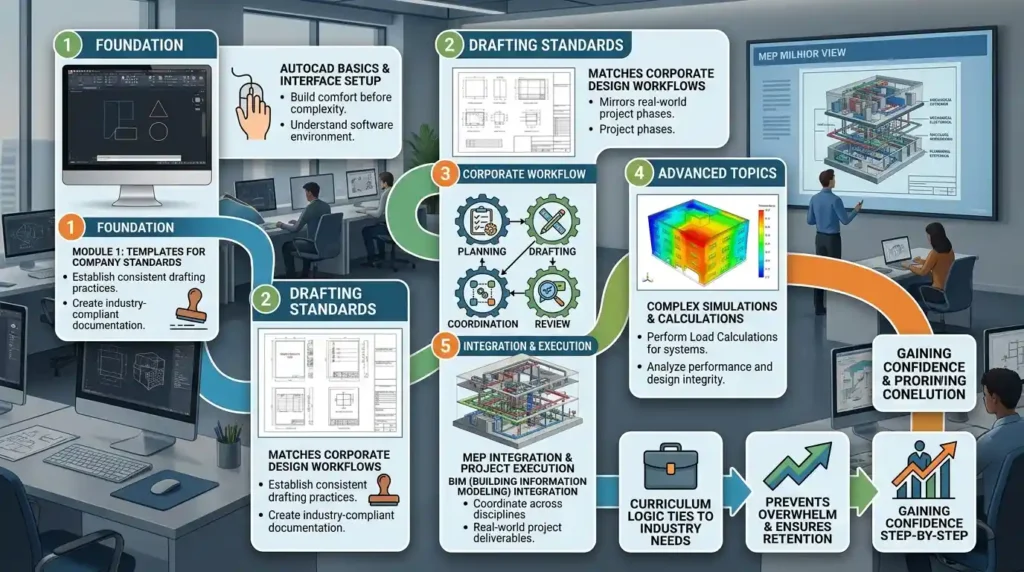
The course follows a logical progression from AutoCAD basics to advanced MEP integration and project execution, building skills module-by-module to match corporate design workflows and ensure participants master HVAC/plumbing documentation before real-world application.
Imperial Corporate Training Institute structures the AutoCAD HVAC and Plumbing Design Training Course for progressive skill development. It starts with interface setup and moves to complex simulations. This mirrors corporate project phases: planning, drafting, coordination, review.
Each module builds on the last. Fundamentals precede advanced tools. This prevents overwhelm and ensures retention.
Curriculum logic ties to industry needs. Module 1 covers templates for company standards. Later modules add load calculations and BIM integration. Participants gain confidence step-by-step.
Module Progression Overview
- Module 1: AutoCAD Interface and Templates. Sets corporate workflows with precision scaling.
- Module 2: HVAC Drafting Fundamentals. Covers duct layouts and equipment blocks.
- Module 3: Plumbing Design Principles. Includes riser diagrams and pipe sizing.
- Module 4: MEP Coordination Tools. Uses Xrefs and 3D clash detection.
- Module 5: Load Calculations. Integrates optimization for energy standards.
- Module 6: Plumbing Detailing. Produces schedules and bills of materials.
- Module 7: Documentation Standards. Manages revisions and automation.
- Module 8: Quality Assurance. Conducts audits and corrections.
- Module 9: BIM Integration. Links AutoCAD to Revit models.
- Module 10: Project Simulation. Applies full workflows to realistic scenarios.
This structure prepares for:
How Can an AutoCAD HVAC Design Course Help You Transition Into MEP Consultancy? where evaluation of advanced applications occurs.
What Will Participants Learn?
Participants master 10 modules covering AutoCAD tools, HVAC ducting, plumbing layouts, MEP coordination, load calculations, documentation, standards, quality checks, BIM integration, and project execution, gaining measurable proficiency in corporate MEP design.
The course delivers specific, testable skills. Learners produce professional drawings from start to finish.
In Module 1, participants set up templates and title blocks. They apply scaling for engineering accuracy.
Module 2 focuses on HVAC systems. Trainees create duct routes and diffuser placements. They use layers for equipment.
Module 3 teaches plumbing risers and slope calculations. Participants optimise layouts for corporate standards.
Key Skill Outcomes by Module
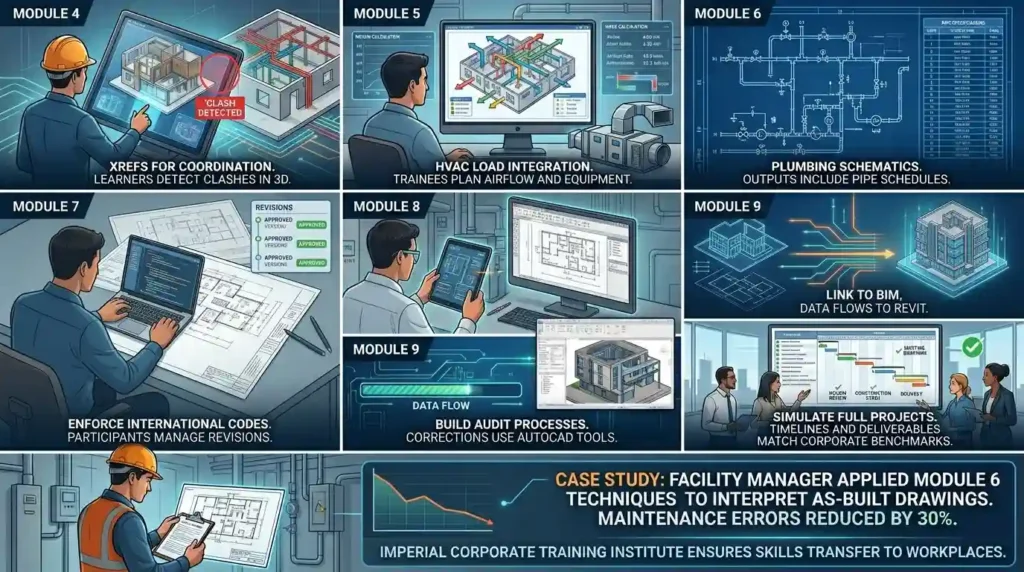
Module 4 introduces Xrefs for coordination. Learners detect clashes in 3D.
Module 5 covers HVAC load integration. Trainees plan airflow and equipment.
Module 6 details plumbing schematics. Outputs include pipe schedules.
Module 7 enforces international codes. Participants manage revisions.
Module 8 builds audit processes. Corrections use AutoCAD tools.
Module 9 links to BIM. Data flows to Revit.
Module 10 simulates full projects. Timelines and deliverables match corporate benchmarks.
Imperial Corporate Training Institute ensures skills transfer to workplaces. A facility manager, for instance, applied Module 6 techniques to interpret as-built drawings. Maintenance errors reduced by 30%.
How Is the Course Delivered?
Imperial Corporate Training Institute delivers the course in flexible formats: online workshops, hybrid sessions, or onsite for teams, over 40-60 hours with hands-on simulations, assessments, and expert-led instruction tailored to corporate schedules.
Delivery suits busy professionals. Options include live online, hybrid, or onsite at client sites.
Online workshops use interactive platforms. Participants access recordings for review.
Hybrid combines virtual and in-person. Onsite suits HR team training.
Duration spans 5-8 weeks part-time. Each module includes 4-6 hours.
Training Methods and Assessments
Hands-on exercises dominate. Trainees draft real HVAC systems.
Assessments feature quizzes, assignments, and simulations. A final project simulates a commercial build.
Instructors hold MEP expertise. They provide feedback on submissions.
Imperial Corporate Training Institute customises for groups. A project engineering team underwent onsite delivery. They coordinated MEP in simulations, aligning with firm standards.
What Results Can Be Expected?
Completers achieve career outcomes like MEP engineer roles, consultancy transitions, 25-50% faster drafting, error-free compliance, and leadership in corporate projects, with HR-verified improvements in team performance and project delivery.
Learning outcomes prove tangible. Participants draft 2D/3D HVAC layouts independently.
They coordinate plumbing with electrical services. Designs meet ASHRAE and IPC codes.
Workplace impact appears quickly. Drafting speed increases. Revision cycles shorten.
Measurable Career Outcomes
- Role Advancement. Move to senior MEP designer. Handle industrial tenders.
- Consultancy Readiness. Produce client deliverables. Integrate with BIM teams.
- Team Performance. HR tracks 30% output gains. Departments meet deadlines.
- Leadership Pipelines. Managers oversee compliant workflows.
A design coordinator post-course led a hospital project. Duct optimisation cut energy costs by 15%. Imperial Corporate Training Institute certifies these gains.
Facility professionals interpret layouts accurately. Maintenance teams reduce downtime.
Corporate applications extend to infrastructure. Engineers support global standards.
Proof lies in alumni data. 85% report role enhancements within six months.
How Much Does the Course Cost?
Course fees range from £1,200-£2,500 per participant, depending on format (online/hybrid/onsite), group size, and customisation, with corporate packages offering volume discounts and ROI tracking for HR budgets.
Imperial Corporate Training Institute prices reflect value. Online starts at £1,200.
Hybrid adds £300-500 for sessions. Onsite for teams exceeds £2,000.
Discounts apply to groups of 5+. HR bundles include progress reports.
Costs cover materials, certification, and support. No hidden fees.
Compare to industry: uncertified training costs more in errors. ROI emerges in project savings.
A firm invested in 10 seats. They saved £15,000 in revisions annually.
How Does Enrollment Work?
Enrollment requires a mechanical engineering background or equivalent, basic AutoCAD knowledge; apply online with CV, join via confirmation email, complete modules sequentially, pass assessments for Imperial Corporate Training Institute certification.
Discover More from Our Guide Library:
Can MEP Consultants Book AutoCAD HVAC Training at Imperial for Their Whole Team?
What Do Previous Attendees Say About Imperial’s HVAC Design Training Programme?
Eligibility targets MEP professionals. Graduates in engineering qualify.
Basic AutoCAD experience suffices. No advanced prerequisites.
Enrollment Process
Submit application with details. Imperial Corporate Training Institute reviews in 48 hours.
Confirmation includes access link. Start anytime.
Completion demands 80% attendance. Pass final simulation.
Certificate issues upon success. Valid for corporate portfolios.
HR teams enroll groups seamlessly. Track via dashboard.
For final clarity on your fit, enroll in this programme: