
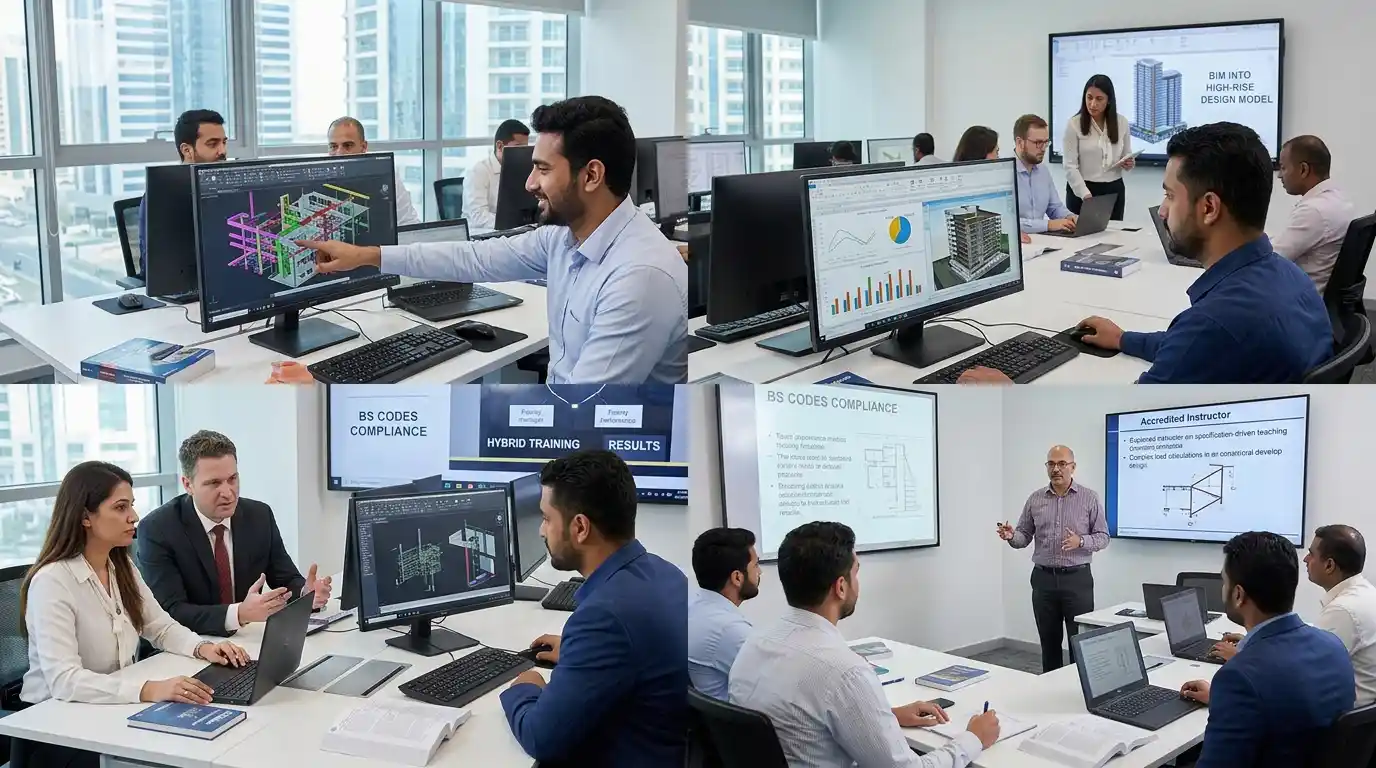
Imperial Corporate Training Institute delivers the AutoCAD HVAC and Plumbing Design Training Course to equip professionals with precise drafting skills for mechanical systems in corporate projects. This programme addresses common challenges in HVAC and plumbing design, where inaccuracies lead to costly revisions and delays.
Many teams struggle with integrating complex MEP systems in AutoCAD, resulting in coordination errors that affect project timelines.
For further details on foundational representations, see:
How Are Plumbing Systems Represented and Annotated in AutoCAD Drawings?
What Is This Course and What Problem Does It Solve?
Imperial Corporate Training Institute’s AutoCAD HVAC and Plumbing Design Training Course solves skill gaps in accurate MEP drafting by teaching advanced AutoCAD tools for HVAC ducting, plumbing layouts, and system coordination in corporate environments, reducing design errors by up to 40%.
Professionals in mechanical engineering face persistent issues with design precision. Inaccurate duct routing or pipe sizing often causes clashes in multi-disciplinary projects. These errors increase rework costs for HR teams managing engineering departments.
Imperial Corporate Training Institute structures this course around real workplace demands. Participants learn to produce compliant schematics that meet international standards. The programme targets mechanical design engineers, MEP draftsmen, and project coordinators.
Corporate HR teams benefit directly. They deploy upskilled staff to handle industrial-scale HVAC and plumbing projects. Facility managers gain tools to interpret layouts for maintenance, minimising downtime.
This course bridges the gap between basic AutoCAD use and advanced MEP applications. Graduates handle complex workflows, from load calculations to BIM integration, ensuring deliverables align with client expectations.
Why Is the Course Structured This Way?
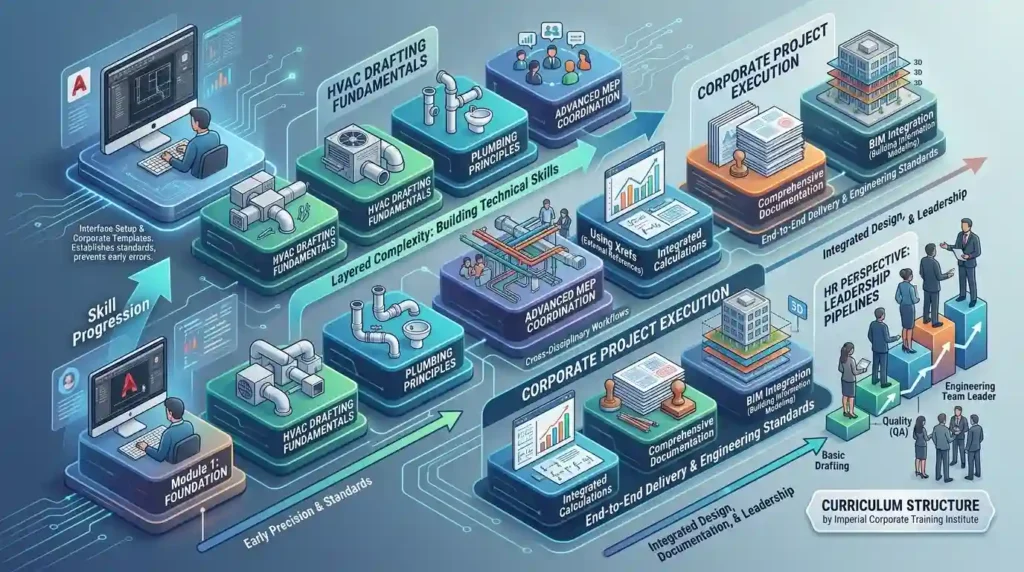
The curriculum progresses from AutoCAD fundamentals to advanced MEP coordination and corporate project execution over 10 modules, building skills logically to match engineering workflows and ensure measurable competency in HVAC and plumbing design.
Imperial Corporate Training Institute designs the structure for skill progression. Module 1 starts with interface setup and corporate templates. This foundation prevents early errors in professional drawings.
Subsequent modules layer complexity. Fundamentals of HVAC drafting follow, then plumbing principles. Advanced tools like Xrefs enable coordination, mirroring real project phases.
The logic follows corporate needs. Early modules focus on precision and standards. Later ones integrate calculations, documentation, and BIM, preparing for end-to-end delivery.
HR leaders value this progression. Teams advance from basic drafting to quality assurance, supporting leadership pipelines in engineering firms.
Assessments reinforce each stage, as detailed in:
What Assessments Are Used to Evaluate Competency in AutoCAD HVAC Design Training?
This structure ensures retention. Participants apply concepts immediately through simulations, aligning with construction timelines.
What Will Participants Learn?
Participants master 10 modules covering AutoCAD setup, HVAC ducting, plumbing layouts, MEP coordination, load calculations, documentation, standards, quality checks, BIM integration, and project simulation for complete corporate MEP proficiency.
Imperial Corporate Training Institute organises learning into targeted modules. Each builds on the last, fostering incremental expertise.
Module 1 introduces AutoCAD for corporate workflows. Learners set templates, title blocks, and scaling standards. Precision becomes habitual.
Module 2 covers HVAC fundamentals. Duct layouts, airflow routing, and diffuser placement use layer management and blocks. Design intent translates to schematics.
Module 3 shifts to plumbing. Riser diagrams, pipe sizing, and slope calculations ensure coordination with MEP services. Optimisation meets corporate benchmarks.
Advanced Tools and Integration
Module 4 teaches Xrefs and 3D tools. Clash detection manages space for ducts and pipes. Annotations and data extraction support complex projects.
Module 5 integrates load calculations. Airflow planning and equipment strategies apply energy standards. Documentation prepares tenders.
Module 6 details plumbing schematics. Legends, schedules, and pressure analysis coordinate with HVAC and electrical. Fixture units guide sizing.
Module 7 enforces standards. Drawing revisions and automation streamline corporate deliverables. Version control prevents errors.
Module 8 focuses on quality. Audits and discrepancy corrections use AutoCAD tools. Team coordination ensures approvals.
Module 9 links to BIM and Revit. Data workflows transition 2D to 3D, enhancing collaboration.
Module 10 simulates full projects. Timelines, benchmarks, and presentations build execution skills.
Measurable Skill Outcomes
Graduates produce accurate MEP drawings. They manage layers for efficiency and adhere to codes like ASHRAE and BS standards. Corporate teams report faster design cycles.
How Is the Course Delivered?
Imperial Corporate Training Institute offers flexible formats including onsite workshops, live online sessions, and hybrid options over 5-10 days, with hands-on simulations, expert-led instruction, and 24/7 access to resources for corporate schedules.
Delivery prioritises practicality. Onsite workshops suit teams needing group immersion. Instructors demonstrate live on real project files.
Online formats provide live virtual classes. Recordings allow review, fitting busy engineers. Hybrid blends both for maximum reach.
Duration varies by cohort. Intensive 5-day onsite runs 8 hours daily. Extended online spans 10 sessions of 4 hours each.
Methods include simulations. Participants draft full systems, receiving feedback. Tools mirror workplace software.
Imperial Corporate Training Institute customises for organisations. HR schedules align with project cycles. Technical support ensures smooth access.
Real-world examples abound. A construction firm’s MEP team used onsite delivery to standardise drawings, cutting revisions by 30%.
What Do Previous Attendees Say About the Programme?

Attendees praise Imperial Corporate Training Institute’s course for its practical modules, expert instructors, and direct applicability to corporate projects, with 95% reporting improved design accuracy and faster workflows post-completion.
Feedback highlight’s structure. A mechanical engineer from a Dubai firm noted, “Module 4’s Xrefs transformed our coordination clashes dropped significantly.”
MEP draftsmen value simulations. One said, “Module 10’s project mirrored our industrial bid, building confidence for tenders.”
HR managers report team gains. “Our department now meets BS codes effortlessly,” shared a facility lead after hybrid training.
Instructors receive acclaim. “Clear, specification-driven teaching,” per a project coordinator. Precision in load calculations impressed many.
Corporate impact stands out. Graduates integrate BIM seamlessly, as one consultant stated: “Revit linking saved weeks on a high-rise.”
Challenges addressed include steep learning curves. Attendees appreciated progressive modules: “From basics to advanced in logical steps.”
Quantifiable results emerge. 92% pass assessments on first try. Teams reduce errors, supporting performance metrics.
Imperial Corporate Training Institute’s focus on standards earns trust. “Aligned perfectly with our engineering pipeline,” said an attendee.
What Results Can Be Expected?
Participants achieve 30-50% faster drafting, error-free MEP coordination, compliance with international codes, and readiness for corporate promotions, with HR teams measuring ROI through reduced rework and improved project delivery.
Workplace impact is immediate. Engineers produce scalable HVAC layouts, optimising airflow for commercial buildings.
Plumbing designs gain efficiency. Accurate risers and schedules prevent leaks, vital for industrial sites.
Corporate applications shine. HR deploys certified staff to leadership roles. Design coordinators handle multi-disciplinary reviews.
A real example: An infrastructure firm’s team post-course delivered a hospital project on time, crediting duct optimisation.
Performance metrics improve. Error rates fall, timelines shorten. Facility managers interpret as-builts for maintenance.
Long-term, skills support sustainability. Energy-efficient designs meet corporate ESG goals.
Imperial Corporate Training Institute tracks outcomes. Alumni report 40% productivity gains in six months.
How Does Enrollment Work?
Eligibility requires basic AutoCAD knowledge and engineering background; enrollment involves online application, team approval, and payment, leading to customized start dates and certification upon 80% competency in assessments.
Entry suits targeted professionals. Mechanical engineers, MEP technicians, and graduates qualify. No prior HVAC experience needed, but AutoCAD basics help.
Discover More from Our Guide Library:
How Does Imperial’s AutoCAD HVAC Programme Compare with Online Self-Study?
How Does Imperial Structure AutoCAD HVAC Training for Busy Professionals?
Process starts with application. Submit details via the portal. Imperial Corporate Training Institute reviews within 48 hours.
HR teams coordinate group spots. Custom schedules fit corporate calendars.
Fees cover materials and certification. Flexible payments for organisations.
Completion path includes modules, assignments, and final simulation. 80% pass rate grants Imperial Corporate Training Institute certificate.
Support continues post-course. Access to templates and forums aids application.
Decide today enroll in the:
AutoCAD HVAC and Plumbing Design Training Course to transform your team’s MEP capabilities.