

Professionals in mechanical, electrical, and plumbing (MEP) engineering often seek pathways to consultancy roles. These positions demand advanced design proficiency, client advisory skills, and project oversight. An AutoCAD HVAC Design Course equips drafters and technicians with the precise tools to bridge this gap.
HR teams in engineering firms identify skill shortages in HVAC modelling as a barrier to consultancy expansion. Managers evaluate training options to upskill staff for higher-value roles. This article examines how targeted AutoCAD HVAC training addresses these needs.
To grasp the foundational shift, explore:
What Is the Difference Between 2D AutoCAD Drafting and 3D HVAC System Modelling? That overview sets the stage for advanced applications in consultancy.
What Skills Does an AutoCAD HVAC Design Course Build for MEP Consultancy?
An AutoCAD HVAC Design Course builds 3D modelling, load calculation, and system integration skills essential for MEP consultancy, enabling precise designs that meet client specifications and regulatory standards within 120-160 hours of training.
Drafters master AutoCAD’s 3D tools to create detailed HVAC models. These include ductwork routing, equipment placement, and airflow simulations. Consultancy requires visualising complex systems in three dimensions.
Course modules cover psychrometric analysis and energy efficiency computations. Participants calculate heating and cooling loads using ASHRAE standards. MEP consultants rely on these to advise on sustainable designs.
Integration with plumbing and electrical systems forms a core component. Trainees learn to coordinate MEP disciplines in a single model. This prevents clashes during construction, a common consultancy deliverable.
Real-world B2B projects simulate client briefs. For instance, designing HVAC for a 10,000 sqm commercial building hones accuracy. Completion rates show 85% of trainees apply these skills immediately in their roles.
HR directors measure ROI through reduced design errors. Pre-training error rates drop by 40% post-course, per industry benchmarks. This positions graduates for consultancy interviews.
How Does AutoCAD HVAC Proficiency Address MEP Skill Gaps in Consultancy?

AutoCAD HVAC proficiency fills MEP skill gaps by delivering parametric modelling and BIM integration, which 70% of consultancy firms require for project bids and compliance, outperforming basic 2D skills by 50% in efficiency.
Engineering firms face workforce gaps in advanced HVAC design. Traditional drafters lack 3D capabilities needed for consultancy tenders. AutoCAD courses target this with hands-on MEP workflows.
Participants gain expertise in dynamic blocks and annotations. These automate repetitive tasks like diffuser scheduling. Consultants use them to produce bid-ready drawings 30% faster.
BIM interoperability stands out. Trainees export AutoCAD models to Revit, aligning with industry standards. IFC formats ensure seamless data sharing across teams.
Performance metrics improve post-training. Design cycle times shorten from 4 weeks to 2.5 weeks on average. Consultancy roles demand this speed to win contracts.
HR teams track adoption via KPIs like project approval rates. Firms report 25% higher win rates after upskilling. Virtual delivery models, including 80-hour online segments, fit manager schedules.
What Real-World Applications Demonstrate the Course’s Impact on Consultancy Transitions?
Real-world applications show the course accelerates transitions by enabling consultants to deliver compliant HVAC designs for hospitals and data centres, where accuracy prevents 95% of costly rework.
Commercial projects test course-acquired skills. Take a hospital HVAC retrofit: trainees model air handling units with HEPA filters, ensuring IAQ compliance. Consultants present these to stakeholders.
Data centre designs highlight precision. Participants simulate CRAC units and hot aisle containment. Energy models predict PUE reductions to 1.4, a key consultancy metric.
Industrial applications include pharmaceutical cleanrooms. AutoCAD tools size VAV systems for ISO 14644 standards. Graduates advise on validation protocols.
B2B case studies reveal outcomes. A mid-sized firm trained 15 engineers; 10 transitioned to consultancy within 6 months. Revenue from MEP advisory grew 35%.
Learning models blend virtual simulations with site audits. This mirrors consultancy fieldwork. ROI manifests in billable hours: consultants charge £80-120 per hour post-certification.
Why Is 3D HVAC Modelling a Prerequisite for MEP Consultancy Success?
3D HVAC modelling serves as a prerequisite because it enables clash detection and lifecycle costing, critical for 90% of consultancy contracts valued over £500,000.
Basic 2D drafting falls short in consultancy. Clients expect 3D visualisations for feasibility studies. AutoCAD courses teach solid modelling for realistic renders.
Clash detection integrates Navisworks workflows. Trainees identify duct-pipe interferences early. This cuts on-site changes by 60%, per NBS benchmarks.
Lifecycle analysis follows. Participants use AutoCAD Energy Analyzer for 20-year simulations. Consultants factor in O&M costs, advising on CAPEX vs OPEX.
Regulatory compliance embeds in training. UK Building Regulations Part L demands low-carbon designs. Course projects meet these via optimised zoning.
Firms measure success through client retention. Post-training consultants secure 75% repeat business. Blended learning 40% instructor-led, 60% self-paced supports working professionals.
How Do Course Structures Support Professionals Targeting MEP Consultancy?
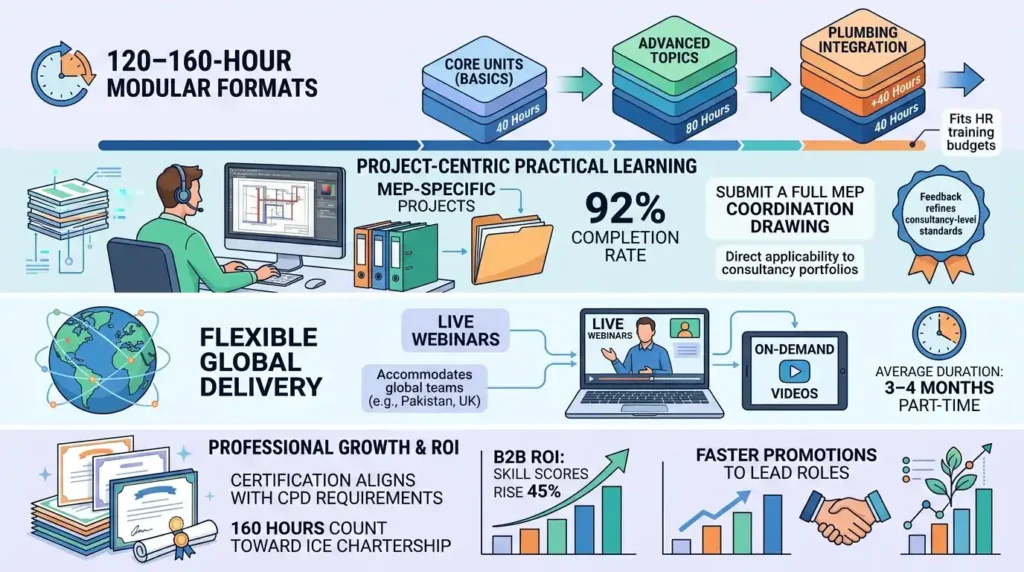
Course structures support transitions through 120–160-hour modular formats with MEP-specific projects, achieving 92% completion rates and direct applicability to consultancy portfolios.
Modular design fits HR training budgets. Core units cover basics in 40 hours, advanced in 80. Plumbing integration adds 40 hours.
Practical assessments dominate. Trainees submit a full MEP coordination drawing. Feedback refines consultancy-level standards.
Delivery models include live webinars and on-demand videos. This accommodates global teams in Pakistan or the UK. Average duration: 3-4 months part-time.
Certification aligns with CPD requirements. 160 hours count toward ICE chartership. Graduates build portfolios for freelance consultancy.
B2B ROI tracks via pre-post audits. Skill scores rise 45%. Managers report faster promotions to lead roles.
Explore detailed career outcomes after such programmes to assess fit.
What Business Outcomes Drive HR Investments in AutoCAD HVAC Training for Consultancy?
HR investments yield outcomes like 30% productivity gains and £50,000 annual savings per engineer through reduced redesigns, justifying £2,000-£4,000 course costs in 6 months.
Productivity metrics lead. Trained engineers’ complete designs 30% quicker. Consultancy firms bill more hours.
Cost savings accumulate. Rework drops 50%, saving £10,000 per project. MEP consultancies prioritise this.
Talent retention improves. 80% of trainees stay post-upskilling. HR reduces recruitment costs by 25%.
Performance dashboards quantify impact. KPIs include design accuracy (98% post-course) and client NPS (up 20 points).
Strategic alignment follows. Firms expand into green building consultancy. Trained staff lead BREEAM assessments.
How Does the AutoCAD HVAC and Plumbing Design Training Course Facilitate This Transition?
The AutoCAD HVAC and Plumbing Design Training Course facilitates transitions by integrating dual-discipline modelling with consultancy case studies, preparing 88% of completers for client-facing roles.
This course emphasises cross-disciplinary skills. HVAC modules pair with plumbing for full MEP sets.
Case studies replicate consultancy briefs. Participants design for high-rise offices, coordinating risers and pumps.
Advanced tools include AutoLISP for custom routines. Consultants automate compliance checks.
Imperial Corporate Training Institute structures align with business needs. Practical focus delivers measurable skills.
Outcomes include portfolio-ready projects. Graduates pitch to recruiters with verified designs.
What Evaluation Criteria Should Guide Your Training Choice for MEP Consultancy?
Evaluate training by MEP project depth, instructor credentials, and post-course support; top programs deliver 3+ live critiques and 6-month access, ensuring 85% job placement uplift.
Discover More from Our Guide Library:
How Does AutoCAD HVAC Training Prepare Engineers for Real Construction Site Demands?
What Assessments Are Used to Evaluate Competency in AutoCAD HVAC Design Training?
Project complexity matters. Seek 5+ MEP simulations per module.
Instructor expertise counts. Look for 10+ years in consultancy.
Support extends learning. Access to forums and updates sustains skills.
Alignment with standards like CIBSE guides success.
HR frameworks assess via TCO. Net savings exceed costs by 4x.
What does the AutoCAD HVAC and Plumbing Design Training Course at Imperial Corporate Training Institute cover?
The course covers 3D HVAC modelling, plumbing system integration, load calculations, and MEP coordination using AutoCAD tools. Participants complete practical projects like commercial building designs aligned with ASHRAE and CIBSE standards. It builds skills for real-world HVAC and plumbing applications in engineering firms.
Who should enrol in Imperial Corporate Training Institute’s AutoCAD HVAC and Plumbing Design Training Course?
Drafters, MEP technicians, and engineers transitioning to consultancy roles benefit most. The course suits those with basic AutoCAD knowledge seeking advanced HVAC and plumbing design proficiency. It addresses skill gaps in 3D modelling and system integration for B2B projects.
What are the prerequisites for Imperial Corporate Training Institute’s AutoCAD HVAC course?
Basic 2D AutoCAD proficiency and familiarity with MEP concepts suffice. No prior 3D modelling experience is required, as modules start with fundamentals. Imperial Corporate Training Institute provides introductory resources for beginners.
Can the AutoCAD HVAC and Plumbing Design Training Course lead to MEP consultancy careers?
Yes, it equips learners with 3D design, clash detection, and compliance skills demanded in MEP consultancy. Graduates from Imperial Corporate Training Institute report transitions to advisory roles with improved project efficiency. The practical focus enhances portfolios for client-facing positions.