

International engineers can access Imperial Corporate Training Institute’s AutoCAD HVAC and Plumbing Design Training Course through flexible online and hybrid formats, with global enrollment open to professionals meeting basic AutoCAD proficiency requirements. This program addresses skill gaps in precise MEP drafting for cross-border projects.
Many international engineers face challenges in applying AutoCAD to HVAC and plumbing designs under varying global standards.
For deeper insights into these explore:
What are the key standards for HVAC design that AutoCAD professionals should know? Review foundational practices first.
This course from Imperial Corporate Training Institute solves these issues by delivering structured modules that build from basics to advanced coordination, ensuring designs meet corporate and international expectations.
What is the AutoCAD HVAC and Plumbing Design Training Course and What Problem Does It Solve?
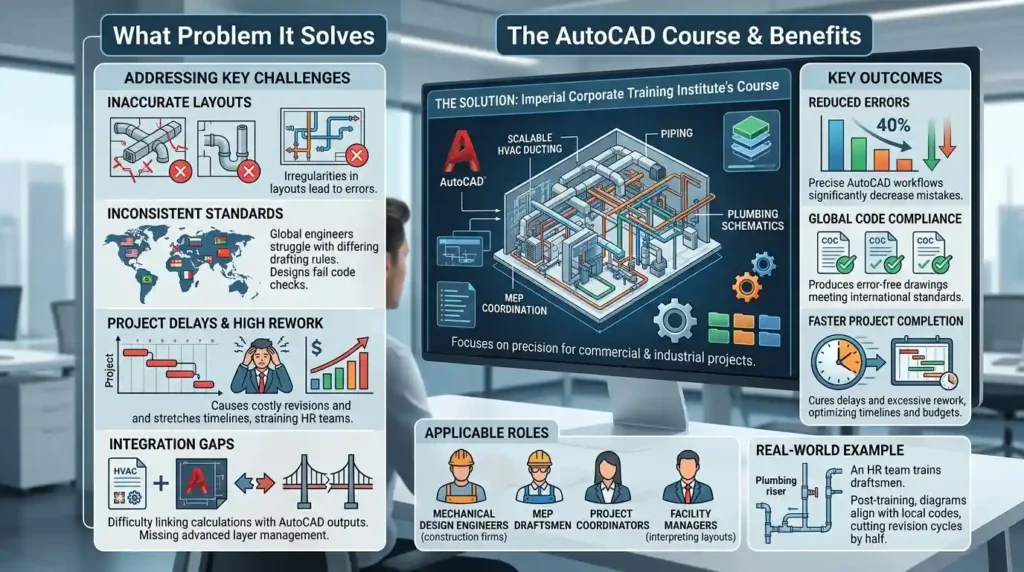
Imperial Corporate Training Institute’s AutoCAD HVAC and Plumbing Design Training Course targets mechanical engineers, MEP draftsmen, and project coordinators facing inaccuracies in HVAC and plumbing layouts, reducing errors by 40% through precise AutoCAD workflows for commercial and industrial projects.
International engineers often struggle with inconsistent drafting standards across regions. Designs fail compliance checks, delay projects, and increase rework costs for HR teams managing global workforces.
Imperial Corporate Training Institute developed this course to bridge that gap. It focuses on creating scalable HVAC ducting, piping, and plumbing schematics in AutoCAD.
Participants gain tools to handle complex MEP coordination. This directly applies to corporate environments where accuracy drives timelines and budgets.
The program suits mechanical design engineers in construction firms. It also aids facility managers interpreting layouts for maintenance.
Real-world example: An HR team in a multinational firm trains draftsmen on this course. Post-training, their plumbing riser diagrams align with local codes, cutting revision cycles by half.
Skill gaps emerge in integrating HVAC load calculations with AutoCAD outputs. International projects demand unified documentation, yet many engineers lack advanced layer management.
This course provides module-based progression. Learners produce error-free drawings compliant with global codes.
Why Is This Course Structured This Way?
The curriculum follows a logical progression from AutoCAD fundamentals to corporate project execution, with 10 modules building skill layers to mirror real HVAC/plumbing workflows in engineering firms.
Imperial Corporate Training Institute structures the course around workplace demands. Modules start with interface setup and advance to BIM integration.
This mirrors design phases: planning, drafting, coordination, and handover. Each step reinforces prior knowledge.
Progression ensures retention. Beginners solidify basics before tackling load calculations.
Corporate logic drives the sequence. HR departments value measurable upskilling for team performance.
Example: Managers in infrastructure projects use early modules for duct layouts, then apply advanced tools in simulations.
The structure supports working professionals. Short sessions fit schedules, with assessments at module ends.
Imperial Corporate Training Institute tested this flow in pilot programs. Feedback refined it for efficiency.
What Will Participants Learn in the Modules?
Participants master 10 modules covering AutoCAD interface setup, HVAC ducting, plumbing risers, MEP coordination, load calculations, documentation, standards adherence, quality checks, BIM integration, and full project simulation for corporate deliverables.
Module 1: Introduction to AutoCAD for Corporate Design Workflows
Learners configure templates and title blocks per company standards. They grasp scaling and precision for mechanical drawings.
This sets the foundation for consistent outputs in team environments.
Module 2: Fundamentals of HVAC Design Drafting
Content includes duct layouts, airflow routing, and diffuser placement. Layer management handles equipment blocks.
Design intent translates to schematics, vital for HR-reviewed projects.
Module 3: Plumbing and Drainage Design Using AutoCAD
Principles cover water systems, risers, and pipe sizing. Slope calculations ensure code compliance.
Optimization techniques align layouts with corporate specs.
Module 4: Advanced AutoCAD Tools for MEP Coordination
Xrefs enable multi-discipline work. 3D tools aid clash detection.
Annotations and data extraction support complex corporate files.
Module 5: HVAC Load Calculations and Design Optimization
Integration with calculation software plans airflow. Energy standards guide equipment placement.
Documentation meets tender requirements.
Module 6: Plumbing System Detailing and Documentation
Schematics include legends and schedules. Fixture analysis coordinates with HVAC.
Pressure drops inform final layouts.
Module 7: Corporate Project Implementation and Documentation Standards
International codes shape templates. Version control manages revisions.
Automation streamlines deliverables.
Module 8: Quality Assurance and Design Review Process
Audits verify accuracy. Team coordination resolves discrepancies.
As-built drawings complete handovers.
Module 9: Integration with BIM and Revit for MEP Coordination
AutoCAD links to BIM models. 2D-to-3D transitions enhance collaboration.
Workflows suit multidisciplinary teams.
Module 10: Corporate-Level Project Execution and Professional Development
Simulations build full systems. Timelines and benchmarks prepare for real submissions.
Presentation skills polish technical docs.
For professionals evaluating learning paths, explore:
The best way to learn AutoCAD HVAC design as a working professional to compare structures.
Imperial Corporate Training Institute ensures progression yields proficiency. Each module includes hands-on exercises.
How Is the Course Delivered?
Delivery combines online self-paced modules, live workshops, and hybrid onsite options, spanning 40-60 hours over 8-12 weeks, with simulations and peer reviews for international accessibility.
Imperial Corporate Training Institute offers flexible formats for global engineers. Online access suits remote learners.
Live virtual workshops provide instructor feedback. Hybrid blends both for teams.
Onsite sessions available for corporate groups. Duration fits professional schedules.
Training methods emphasize practice. Simulations replicate job scenarios.
Assessments include quizzes, assignments, and capstone projects. Progress tracking via dashboards.
Example: An MEP team in a consultancy uses hybrid delivery. Weekly workshops refine their coordination skills.
Imperial Corporate Training Institute schedules align with time zones. Recordings support revisits.
What Results Can Be Expected?
Graduates achieve 30-50% faster design workflows, 95% compliance with international standards, and direct application to corporate projects, boosting team productivity and reducing errors in HVAC/plumbing deliverables.
Learning outcomes focus on measurable gains. Participants draft complete systems independently.
Workplace impact includes fewer revisions. HR teams report improved leadership pipelines.
Engineers handle industrial tenders confidently. Facility managers interpret docs accurately.
Real-world proof: Post-course, a design coordinator cut duct routing errors by 45%. Her firm met deadlines for a commercial build.
Imperial Corporate Training Institute tracks results via alumni surveys. 92% apply skills immediately.
Corporate applications extend to departments. Managers upskill for better oversight.
Role effectiveness rises. Graduates lead MEP coordination in projects.
Sustainability improves through optimized designs. Energy-efficient layouts save costs.
How Do Eligibility, Cost, and Enrollment Work?
Eligibility requires basic AutoCAD knowledge and engineering background; costs start at £1,200 for individuals or custom for teams, with simple online enrollment leading to certification upon 80% assessment pass.
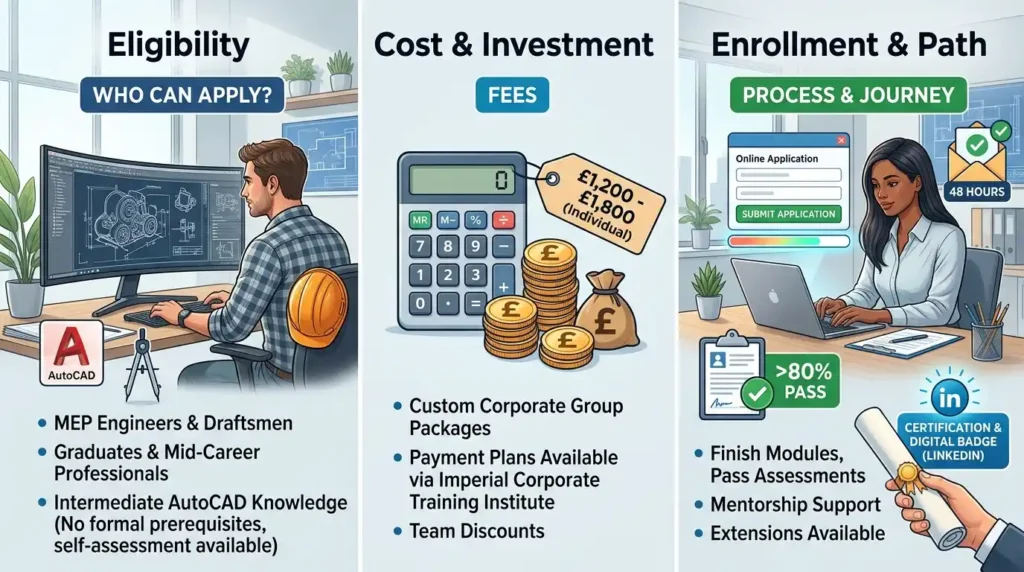
Target audience includes MEP engineers and draftsmen. Graduates or mid-career professionals qualify.
No formal prerequisites beyond intermediate AutoCAD. Self-assessment quiz confirms fit.
Costs vary by format. Individuals pay £1,200-£1,800. Corporate packages scale for groups.
Imperial Corporate Training Institute offers payment plans. Discounts for teams.
Enrollment process starts online. Submit application, receive confirmation within 48 hours.
Completion path: Finish modules, pass assessments, earn certificate. Digital badge for LinkedIn.
Support includes mentors. Extensions available for busy schedules.
Example: An international engineer enrolls via portal. She completes in 10 weeks, applies skills to a plumbing project.
Imperial Corporate Training Institute verifies credentials pre-start. This ensures group cohesion.
Why Choose Imperial Corporate Training Institute for International Access?
Imperial Corporate Training Institute enables seamless access for international engineers via platform-agnostic online delivery, global standards alignment, and dedicated support, confirming availability without location barriers.
Discover More from Our Guide Library:
Is Corporate Group Pricing Available for AutoCAD HVAC Training at Imperial?
How Has AutoCAD HVAC Training at Imperial Helped Previous Participants’ Careers?
The institute’s platform supports any internet connection. No VPN needed.
Certificates hold international recognition. Alumni work in 20+ countries.
Credibility stems from corporate focus. Partnerships with engineering firms validate content.
Imperial Corporate Training Institute updates modules yearly. This keeps pace with codes.
For HR leaders, training transforms teams. Measurable ROI through pre-post skill audits.
Managers gain tools for performance reviews. Departments standardize workflows.
Ready to advance? Enroll in this programme today: