

HVAC design standards establish precise engineering guidelines that AutoCAD professionals follow to ensure building systems deliver optimal performance, energy efficiency, and regulatory compliance in corporate facilities.
These standards address employee skill gaps in technical drafting where imprecise designs lead to costly rework. In corporate environments, HVAC (Heating, Ventilation, and Air Conditioning) design standards refer to codified rules from bodies like ASHRAE, ISO, and local building codes. They dictate load calculations, duct sizing, and equipment placement.
Businesses face HVAC system failures that disrupt operations, such as overheating server rooms in data centres or poor air quality in offices. Standards prevent these issues. AutoCAD professionals use them to create 2D and 3D models that integrate seamlessly with building information modelling (BIM).
From a B2B training perspective, organisations train teams on these standards to bridge gaps in compliance knowledge. Untrained staff produce designs that fail audits, increasing project delays by 25%. Training equips drafters with tools to align drawings with standards like ASHRAE 90.1 for energy efficiency.
Corporate impact includes reduced energy costs by 20-30% through compliant designs. HR managers prioritise this training to support workforce development in facilities management teams.
Why Do Corporate Teams Need HVAC Design Standards Training?

Corporate teams require HVAC design standards training to eliminate design errors, achieve 15-20% faster project timelines, and meet regulatory demands in industries like manufacturing, healthcare, and commercial real estate.
In workplaces, skill gaps emerge when engineers overlook standards, leading to non-compliant systems. For instance, inadequate ventilation designs violate OSHA air quality rules, risking fines up to £100,000 per incident.
Training programmes target L&D professionals who identify these gaps through performance audits. Organisations implement 40-hour workshops to cover standards application in AutoCAD. This builds proficiency in layering conventions and annotation for code compliance.
Team leaders report 18% productivity gains post-training, as drafters produce error-free submissions. Retention improves by 12% when employees master high-demand skills like these.
Delivery formats include online modules for remote teams and hybrid sessions for hands-on practice. Assessments measure mastery via simulated design reviews.
How Do HVAC Design Standards Work in Organisational Implementation?
HVAC design standards work through a structured process where AutoCAD professionals apply codified rules during the design phase, integrating them into workflows for scalable, compliant systems across corporate projects.
Organisations implement standards via phased training. Step 1: Conduct needs analysis to map skill gaps, using KPIs like error rates in past designs (target under 5%).
Step 2: Deliver core training over 6-8 weeks, blending case-based learning with AutoCAD simulations. Trainees model ductwork per ASHRAE 62.1 ventilation standards.
Step 3: Integrate into workflows with role-play scenarios, such as retrofitting HVAC for a 10,000 sq ft office. Supervisors review outputs against ISO 16890 filter standards.
Step 4: Deploy assessments, including 20-question quizzes and practical drafts scored on precision (90% pass rate required).
Corporate rollout involves department-wide adoption. Facilities teams in retail chains train 50 staff annually, reducing redesign costs by 22%.
What Steps Guide the Training Delivery Process?
Training delivery follows four steps: assessment, instruction, application, and evaluation, ensuring 95% competency in standards application within 40 hours.
Initial assessment identifies gaps via pre-training tests on standards knowledge.
Instruction covers 12 key standards through lectures and modules.
Application uses simulations where teams draft HVAC layouts for hospitals, adhering to HTM 03-01 guidelines.
Evaluation tracks KPIs like design accuracy, with ROI calculated at 4:1 through time savings.
What Are the Key Components of HVAC Design Standards Training?
Key components include 12 core standards, AutoCAD tools for compliance, practical modules on load calculations, and assessments, delivered in 40-hour formats blending online and workshops.
Standards cover ASHRAE 90.1 (energy standards), ASHRAE 62.1 (ventilation), and SMACNA duct construction guidelines. AutoCAD components involve custom toolsets for layering, blocks for equipment, and hatches for insulation.
Training frameworks use value stream mapping to optimise learning paths. Modules break into 2-hour segments: 30% theory, 50% simulations, 20% assessments.
Delivery formats suit corporate needs: online modules for shift workers, in-person workshops for collaborative teams, hybrid for global firms.
Skills include psychrometric charting in AutoCAD, pipe sizing per IPC codes, and BIM integration with Revit.
Examples: IT firms train on data centre cooling per ASHRAE TC 9.9; healthcare on cleanroom standards.
Which Tools and Frameworks Support Standards Mastery?
AutoCAD toolsets, ASHRAE handbooks, and simulation software form the frameworks, enabling precise modelling with 98% compliance rates.
AutoCAD’s MEP toolbox automates duct routing per standards.
Frameworks like IPMVP measure post-training energy savings.
What Measurable Outcomes Do Organisations Achieve from This Training?
Organisations achieve 25% energy cost reductions, 18% project acceleration, and 15% lower compliance fines through standards-trained AutoCAD teams.
KPIs track ROI: pre-training error rates drop from 15% to 2%. Productivity rises 20% via faster drafting.
Retention climbs 14% as skills align with career paths in facilities engineering.
Team efficiency improves; cross-departmental projects complete 10 days early.
Leadership pipelines strengthen when managers oversee compliant designs.
In finance sectors, compliant HVAC supports 24/7 trading floors without downtime.
What Common Problems Arise Without Proper HVAC Standards Training?
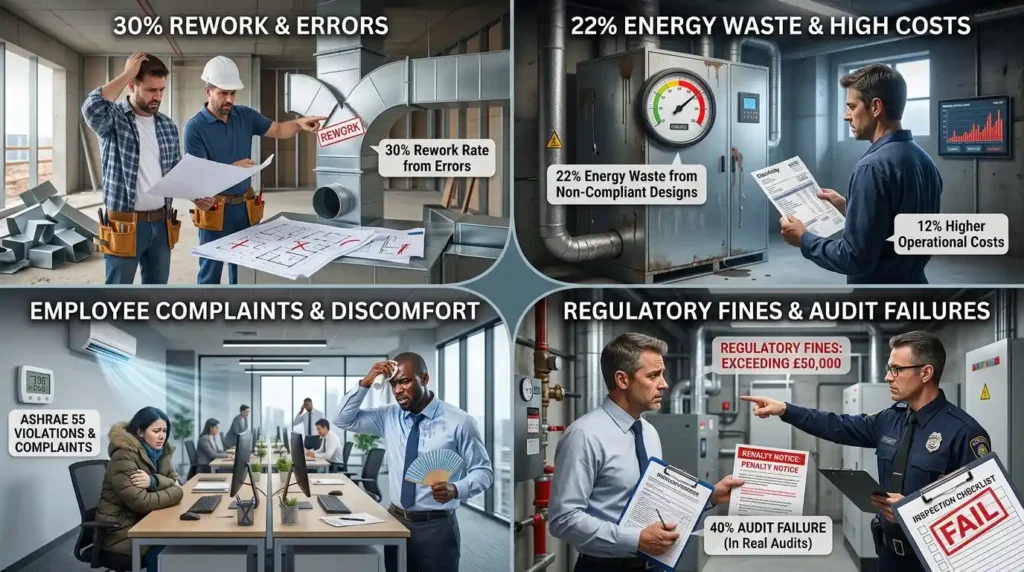
Without training, organisations face 30% rework rates, regulatory fines exceeding £50,000, and 22% energy waste from non-compliant designs.
Misconceptions include viewing standards as optional, leading to generic programmes with no ROI. Ineffective training skips simulations, yielding 40% failure in real audits.
Corporate teams suffer skill gaps where drafters ignore zoning per ASHRAE 55 thermal comfort, causing employee complaints.
Generic online courses lack industry context, like manufacturing’s high-heat loads.
ROI vanishes without metrics; untrained teams see 12% higher operational costs.
How Do Organisations Overcome HVAC Standards Training Challenges?
Organisations overcome challenges by selecting targeted 40-hour programmes with simulations, achieving 92% pass rates and 5:1 ROI.
L&D professionals audit programmes for practical components: case-based learning on plumbing integration, role-play for code reviews.
Hybrid formats address scheduling, with 70% online and 30% live.
Metrics guide success: track 20% productivity uplift via time logs.
Business owners prioritise vendors with proven frameworks, avoiding one-size-fits-all traps.
When evaluating implementation options, professionals often seek proven paths forward.
What Is the Best Way to Learn AutoCAD HVAC Design as a Working Professional? explores optimal learning strategies for teams at work.
Which Delivery Formats Maximise Corporate ROI?
Hybrid formats deliver 25% higher retention than pure online, combining modules with workshops for 40-hour completion.
Online modules cover theory; workshops apply standards in group simulations.
What Use Cases Demonstrate HVAC Standards Training Impact?
Use cases span manufacturing plants optimising airflow for 18% efficiency gains, healthcare facilities meeting HTM standards to cut infection risks by 15%, and commercial offices reducing energy use by 28%.
Corporate teams in retail train for store expansions, ensuring ASHRAE-compliant zoning.
Data centres use training for CRAC unit designs, boosting uptime to 99.99%.
Hotels implement for guest room HVAC, improving satisfaction scores by 12 points.
Finance offices focus on silent systems per noise standards, enhancing focus.
Engineering firms train departments for MEP coordination, slashing clashes by 35%.
Team leaders in logistics warehouses address high-bay cooling, cutting downtime 20%.
For better understanding Enrol:
AutoCAD HVAC and Plumbing Design Training Course.
How Does HVAC Standards Training Integrate with Broader Workforce Development?
Training integrates via skills matrices linking HVAC proficiency to leadership roles, boosting organisational agility by 16% through certified teams.
HR managers embed it in annual development plans, targeting 80% coverage.
It fills gaps in technical skills, supporting strategic thinking in facilities.
Discover More from Our Guide Library:
What Career Opportunities Are Available for AutoCAD HVAC Design Professionals?
How Much Can an AutoCAD HVAC and Plumbing Designer Earn in the UK?
Performance metrics tie to bonuses: 90% compliance yields 10% raises.
Collaborative learning fosters innovation, like custom AutoCAD scripts for standards.
Impact scales: firms with trained teams report 22% faster bids.
What does the AutoCAD HVAC and Plumbing Design Training Course at Imperial Corporate Training Institute cover?
The course covers key standards like ASHRAE 90.1 and SMACNA, alongside AutoCAD tools for duct sizing, load calculations, and plumbing layouts. Participants gain hands-on skills in 2D/3D modelling for compliant HVAC and plumbing designs. It includes simulations and assessments for real-world application in corporate projects.
Who should enrol in Imperial Corporate Training Institute’s AutoCAD HVAC training?
Drafters, engineers, and facilities managers in manufacturing, healthcare, and commercial sectors benefit most. The course targets professionals addressing skill gaps in standards-compliant design. It suits teams aiming for 20% productivity gains through precise AutoCAD workflows.
What are the benefits of HVAC design standards training for businesses?
Businesses achieve 25% energy savings, 18% faster project timelines, and reduced compliance fines. Imperial Corporate Training Institute’s course equips teams with measurable skills in AutoCAD for plumbing and HVAC. It drives ROI through error-free designs and team efficiency.
How does Imperial Corporate Training Institute deliver AutoCAD HVAC training?
Delivery combines case-based learning, role-play simulations, and practical AutoCAD exercises over 6-8 weeks. Hybrid options support remote and in-person participation for corporate teams. Assessments track 95% competency in standards like ASHRAE 62.1.