

AutoCAD HVAC Design Professionals support the planning, drafting, coordination, and documentation of heating, ventilation, and air conditioning systems inside buildings. In corporate environments, this role connects engineering intent with construction-ready drawings, supports facility performance, and reduces design errors. Organisations use these skills to improve project speed, compliance, and cross-team coordination.
What does AutoCAD HVAC design mean in a corporate workplace?
AutoCAD HVAC design means creating precise technical drawings for heating, ventilation, and air conditioning systems that guide installation, coordination, and maintenance. In businesses, it improves project clarity, reduces rework, supports compliance, and helps engineering, construction, and facilities teams deliver building systems with measurable efficiency and fewer errors.

AutoCAD HVAC design sits at the point where mechanical intent becomes a usable document. The work includes drafting duct routes, pipe layouts, equipment placement, sections, details, and coordinated plans for commercial and industrial buildings. In corporate settings, this reduces ambiguity between design, procurement, site teams, and maintenance teams.
The business value is direct. Clear HVAC drawings reduce clashes with structural and electrical systems, shorten review cycles, and cut costly site changes. Facilities teams also use these drawings as a reference for future servicing, upgrades, and space planning. In industries like commercial real estate, manufacturing, healthcare, and hospitality, this support affects uptime, comfort, energy use, and compliance.
From a workforce development perspective, this skill bridges a common gap between engineering knowledge and production-ready documentation. Many organisations have technical staff who understand mechanical principles but lack drafting precision. AutoCAD HVAC training closes that gap with structured practice, drawing standards, and project-based learning.
For deeper insight enrol:
AutoCAD HVAC and Plumbing Design Training Course.
How does AutoCAD HVAC training work inside organisations?
AutoCAD HVAC training works through structured learning that builds drafting accuracy, design literacy, and workplace application. Organisations deliver it through workshops, online modules, simulations, and project tasks. The process moves from software basics to system drafting, coordination, assessment, and measured performance improvement across live or simulated projects.
Corporate training usually begins with a skills gap analysis. HR managers and L&D teams identify where performance breaks down, such as slow drawing production, inconsistent layering, weak annotation, or poor understanding of HVAC symbols. That analysis shapes the training scope and determines whether the goal is onboarding, upskilling, or role transition.
The delivery model follows a sequence. First, learners study AutoCAD interface functions, command use, file management, and drawing setup. Next, they learn HVAC-specific drafting conventions, layer control, line types, blocks, dimensions, title blocks, and plotting. Then they apply those skills to system layouts, equipment schedules, duct routing, and coordination exercises. Assessment completes the cycle through task-based evaluation, drawing reviews, and accuracy checks.
Organisations implement the training through 3 delivery formats. Workshops suit teams that need hands-on guidance and immediate correction. Online modules suit distributed teams that need flexibility and standardisation. Hybrid learning combines both, with digital theory and live practical sessions. This structure supports different work patterns while keeping standards consistent.
A practical example is a facilities management department training 12 technicians and junior designers. Week 1 covers software control. Week 2 covers HVAC symbols and layout rules. Week 3 uses a building floor plan to draft ductwork and equipment placement. Week 4 includes a assessed drawing submission. The organisation then measures reduction in drafting revisions, turnaround time, and supervisor correction hours.
What skills and components does the training include?
The training includes software operation, HVAC drafting standards, technical interpretation, coordination skills, and quality control. It also covers systems thinking, drawing presentation, and workplace documentation. These components build consistent performance, improve collaboration between departments, and prepare staff for project-based mechanical design tasks in corporate environments.
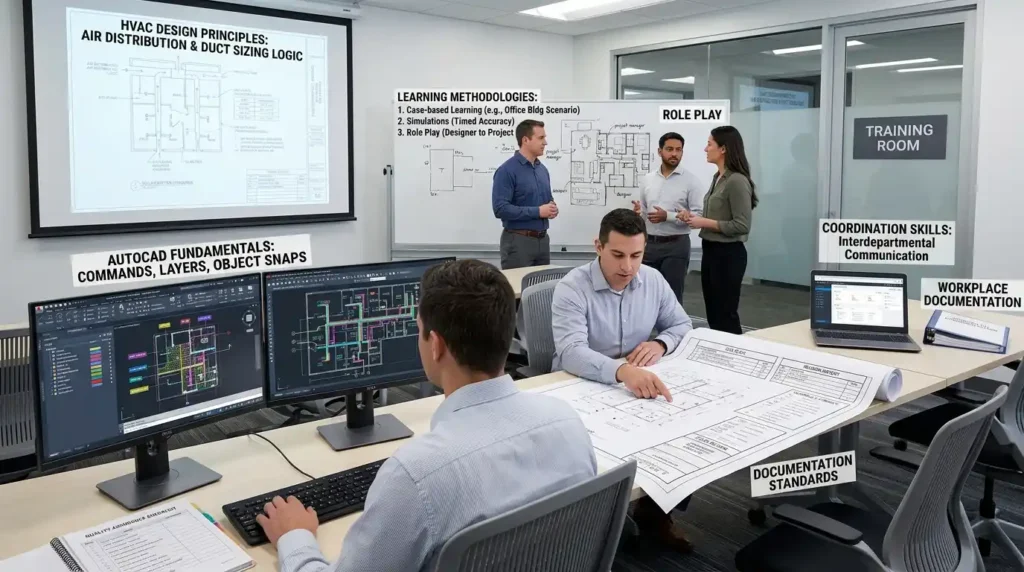
The core components are technical and process-based.
AutoCAD fundamentals include interface navigation, commands, layers, object snaps, blocks, text, hatching, and plotting. These are the base skills needed for any professional drafting task.
HVAC design principles include air distribution, duct sizing logic, equipment positioning, ventilation pathways, and coordination with building structure and services. Learners need this knowledge to produce drawings that match real systems.
Documentation standards include title blocks, revision control, sheet organisation, notes, legends, and symbol consistency. These standards matter because corporate teams rely on shared documents for decisions, approvals, and site execution.
Quality assurance includes checking dimensions, layering, naming conventions, and completeness. In business terms, QA prevents design defects that create delays, change requests, and unnecessary cost.
Learning methodologies also matter. Case-based learning gives learners a building scenario with real constraints. Simulations let them practise drawing under time and accuracy requirements. Role play supports communication between designer, project manager, and site engineer. Assessments measure whether learners can produce reliable outputs without constant supervision.
What business benefits does this capability create?
AutoCAD HVAC capability improves productivity, reduces design errors, strengthens coordination, and supports faster project delivery. For organisations, the measurable outcomes include fewer drawing revisions, shorter approval cycles, stronger compliance, improved team efficiency, and better use of engineering resources across projects and departments.
The benefits appear at three levels: project, team, and organisation.
At project level, teams deliver cleaner drawings and fewer site conflicts. That lowers rework rates and change orders. In construction and building services, rework consumes budget and creates schedule pressure. A team that drafts accurately at the start protects both cost and timeline.
At team level, communication improves. Designers, engineers, procurement staff, and site supervisors work from a common reference. This reduces dependency on verbal clarification and improves handover quality. Teams spend less time resolving avoidable mistakes and more time on actual design or execution work.
At organisation level, the training supports standardisation. When staff use the same drafting conventions and document structure, management gains predictable output. That consistency improves audit readiness, compliance, and cross-project quality. It also strengthens the internal talent pipeline because junior staff develop into independent contributors faster.
Common KPIs include drawing turnaround time, revision rate, first-pass approval rate, defect density, training completion rate, and post-training productivity improvement. Some organisations also track savings from reduced rework, fewer RFIs, and better use of senior engineer time. A 15% to 30% reduction in drafting corrections is a realistic corporate target when training is structured and reinforced with assessment.
Which teams and industries use these skills?
These skills support design, engineering, construction, facilities, and maintenance teams across industries like commercial real estate, healthcare, manufacturing, education, retail, hospitality, and data centres. They improve building-system planning, operational continuity, and cross-functional execution in environments that depend on reliable temperature and airflow control.
Corporate use cases are broad.
Design consultancies use AutoCAD HVAC drafting to prepare client drawings, tender documents, and coordinated layouts. Engineering firms use it to standardise production across multiple projects and junior staff levels. Construction companies use it to support site installation and clash reduction. Facilities teams use it to maintain building services, plan upgrades, and document equipment changes.
In healthcare, accurate HVAC documentation supports infection control, pressure zoning, and regulated ventilation standards. In manufacturing, it helps maintain stable temperature and air movement for equipment and production areas. In hospitality and retail, it supports occupant comfort and energy control. In data centres, it contributes to cooling reliability and infrastructure planning.
Managers use these skills when departments need higher drafting capacity without adding headcount. That makes training a workforce transformation tool, not just a technical course. It increases internal capability, improves utilisation of existing staff, and reduces reliance on external corrections.
How do organisations implement the training effectively?
Effective implementation starts with role analysis, competency mapping, practical delivery, and performance measurement. Organisations align training content to project needs, define target outputs, use assessments to verify skill transfer, and track KPIs such as accuracy, speed, retention, and supervisor review time.
Implementation begins with identifying the role profile. Some learners need basic drafting competence. Others need project-ready HVAC documentation. A clear competency map sets the scope and prevents generic training. It also helps L&D teams match the programme to business priorities.
Next comes curriculum design. Strong programmes organise content from simple to complex. They start with AutoCAD operation, move to HVAC symbols and layouts, then progress to full plan production and coordination. Each stage includes practice, feedback, and review. That sequence builds confidence through repeated application rather than passive instruction.
Delivery works best when it reflects the workplace. For example, a 20-person team can complete online theory before attending a 2-day practical workshop. A hybrid format supports standard knowledge transfer and live correction. Trainers then use drawing tasks, timed exercises, and peer review to check whether learners can perform under project conditions.
Assessment is essential. Organisations need evidence that the training changed behaviour, not just attendance records. Useful measures include pre- and post-tests, sample drawing audits, supervisor evaluation, and 60-day performance tracking. If learners improve speed but not accuracy, the training remains incomplete. If accuracy improves but output volume stays low, the curriculum needs more efficiency practice.
What problems do organisations face with poor training?
Poor training produces generic skills, weak transfer to the job, inconsistent drawings, low confidence, and limited ROI. Organisations waste time when programmes focus on theory alone, ignore company standards, omit practice, or fail to measure whether learners apply the skill in real projects.
A common misconception is that software training alone creates job readiness. It does not. Knowing commands does not equal producing coordinated HVAC drawings. Learners also need drafting standards, system logic, and workplace documentation habits.
Another problem is one-size-fits-all content. A facility team, a design office, and a contractor do not share identical requirements. If training ignores role-specific tasks, the output stays superficial. The result is low adoption, repeated errors, and a weak return on learning spend.
A third issue is lack of reinforcement. One session without follow-up rarely changes performance. Skills decay when learners return to work without practice assignments, manager review, or drawing standards. Strong programmes include post-training application tasks and performance monitoring.
The final issue is weak ROI measurement. Many organisations track attendance but not business outcomes. That creates the false impression that training activity equals value. Real evaluation links learning to fewer revisions, faster delivery, lower rework, and better team throughput.
What should decision-makers look for in a training pathway?
Decision-makers should look for role relevance, practical exercises, assessment, measurable outcomes, and alignment with workplace standards. A strong training pathway builds drafting competence, supports project delivery, and produces evidence through improved quality, faster output, and reduced supervision requirements across teams.
When evaluating a training pathway, organisations should ask three questions. Does the content match the actual work? Does the learner practise enough to build speed and accuracy? Does the programme measure performance before and after training?
For better understanding explore:
What Prerequisites Are Required to Enrol in an AutoCAD HVAC Design Course?
The best pathway uses real drawings, not abstract exercises. It also uses structured checkpoints so managers can see progress in quality, consistency, and independence. This matters because workforce development succeeds when training is tied to current operational demands and future capability needs.
Discover More from Our Guide Library:
How Much Can an AutoCAD HVAC and Plumbing Designer Earn in the UK?
How Does AutoCAD Help Engineers Produce Compliant Plumbing Design Drawings?
For teams planning capability building, the most useful approach is a phased model. Start with core drafting skills. Add HVAC-specific application. Then include reviewed project tasks. That structure supports business continuity, team efficiency, and long-term competence.
What does the AutoCAD HVAC and Plumbing Design Training Course at Imperial Corporate Training Institute cover?
The course covers AutoCAD fundamentals, HVAC system drafting, plumbing layouts, coordination techniques, and standards for professional drawings. Learners gain skills in duct routing, pipe sizing, equipment scheduling, and clash detection through practical exercises. This builds workplace-ready capability for building services design.
Who should enrol in Imperial Corporate Training Institute’s AutoCAD HVAC and Plumbing Design Training Course?
Drafters, technicians, engineers, and facilities staff seeking HVAC and plumbing design skills should enrol. The course suits those with basic CAD knowledge aiming to specialise in mechanical systems for construction and maintenance roles. It addresses common skill gaps in precise technical documentation.
What are the prerequisites for the Imperial Corporate Training Institute AutoCAD HVAC and Plumbing Design Training Course?
Basic AutoCAD familiarity and mechanical systems knowledge are required. No advanced engineering degree is needed, but comfort with 2D drafting helps. The institute provides a readiness assessment to confirm suitability.
What career benefits come from completing the AutoCAD HVAC and Plumbing Design Training Course?
Graduates qualify for roles like HVAC drafter, MEP coordinator, or design technician in construction and facilities. The skills improve drawing accuracy, project speed, and team collaboration, leading to better job performance and advancement. Employers value the practical, industry-aligned training.