
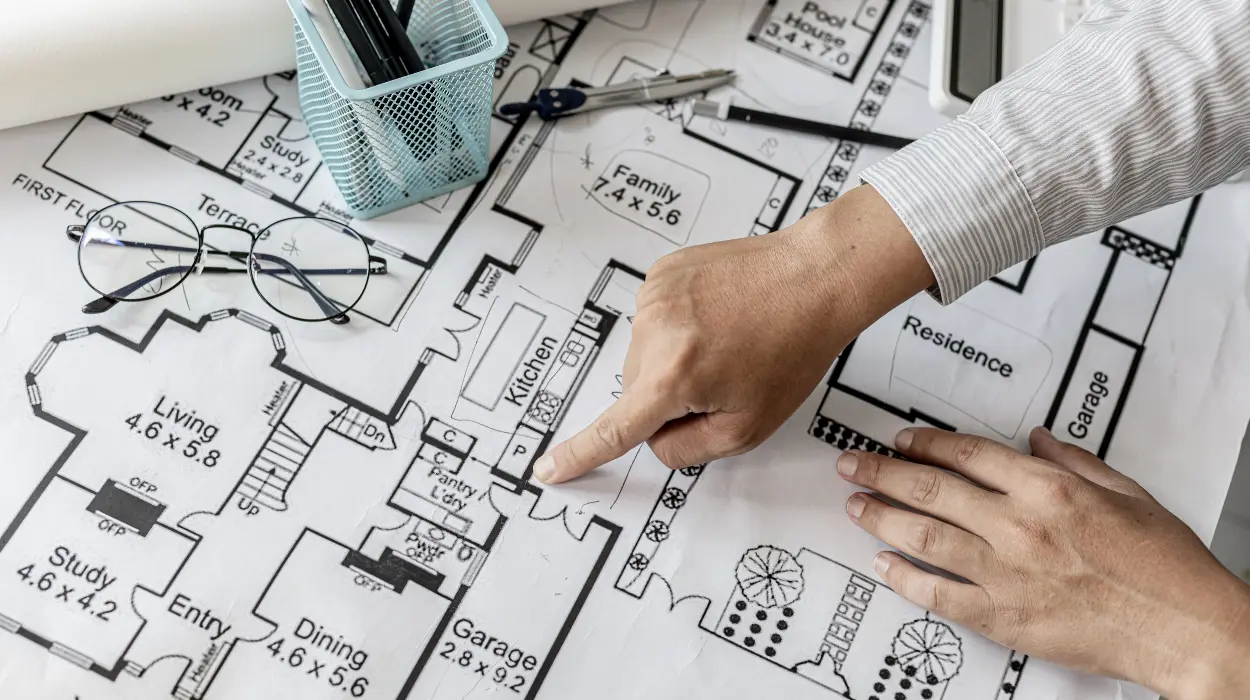
Organisations involved in building services engineering often require professionals who can work across different project types without compromising drawing accuracy, compliance requirements, or coordination standards. Residential projects and commercial developments have different HVAC and plumbing design requirements, yet many employers expect engineers, draftsmen, and MEP professionals to understand both environments. This creates a skills gap when training focuses on only one project category.
Professionals evaluating specialised AutoCAD HVAC training frequently ask whether a course covers both residential and commercial design methodologies or concentrates on a single application area. Understanding this distinction is important because the ability to produce accurate layouts, coordinate services, and comply with project specifications directly influences engineering performance and project delivery outcomes.
Those seeking foundational context may benefit from reviewing how residential and commercial workflows differ through this educational resource:
How Does AutoCAD HVAC Training Differ Between Residential and Commercial Projects?
The AutoCAD HVAC and Plumbing Design Training Course delivered by Imperial Corporate Training Institute is structured to develop competencies that apply across residential, commercial, industrial, and large-scale building services projects. The curriculum progresses from drafting fundamentals to advanced MEP coordination, enabling participants to understand how design principles adapt according to building type, occupancy requirements, engineering standards, and corporate project expectations.
What Does the AutoCAD HVAC and Plumbing Design Training Course Cover?
The course covers HVAC and plumbing drafting, coordination, documentation, calculation integration, and project workflows applicable to residential, commercial, industrial, and corporate environments. Participants develop the technical capability to create professional AutoCAD drawings while understanding how design requirements differ between building categories and project scales.
Many organisations encounter project delays because design teams understand software operation but lack practical knowledge of real-world HVAC and plumbing applications. Drawings may satisfy drafting requirements while failing to support installation, coordination, maintenance access, or compliance objectives.
Imperial Corporate Training Institute addresses this challenge through a curriculum that combines AutoCAD functionality with engineering design application. Participants learn how HVAC and plumbing systems are represented, documented, coordinated, and managed throughout project lifecycles.
The course extends beyond simple software instruction. Learners develop an understanding of how mechanical systems function within buildings and how technical drawings communicate design intent to project stakeholders.
Residential Design Coverage
Residential design concepts are incorporated through system layout development, plumbing distribution principles, duct routing practices, equipment placement considerations, and drawing documentation requirements.
Participants learn how smaller-scale systems require efficient space utilisation, accurate equipment representation, and clear documentation for construction teams and maintenance personnel.
Residential projects often involve simplified mechanical arrangements compared with large commercial facilities. The course demonstrates how these systems can be effectively drafted while maintaining professional engineering standards.
Commercial Design Coverage
Commercial design requirements are integrated throughout the programme using examples involving larger HVAC systems, multi-zone layouts, coordinated MEP services, complex duct networks, and extensive plumbing infrastructure.
Imperial Corporate Training Institute includes project scenarios that expose participants to the coordination challenges commonly found in office buildings, retail facilities, healthcare environments, educational institutions, and infrastructure developments.
Commercial projects require higher levels of documentation, coordination, and compliance. These considerations are embedded throughout the training structure.
Why Is the Course Structured Around Both Residential and Commercial Applications?
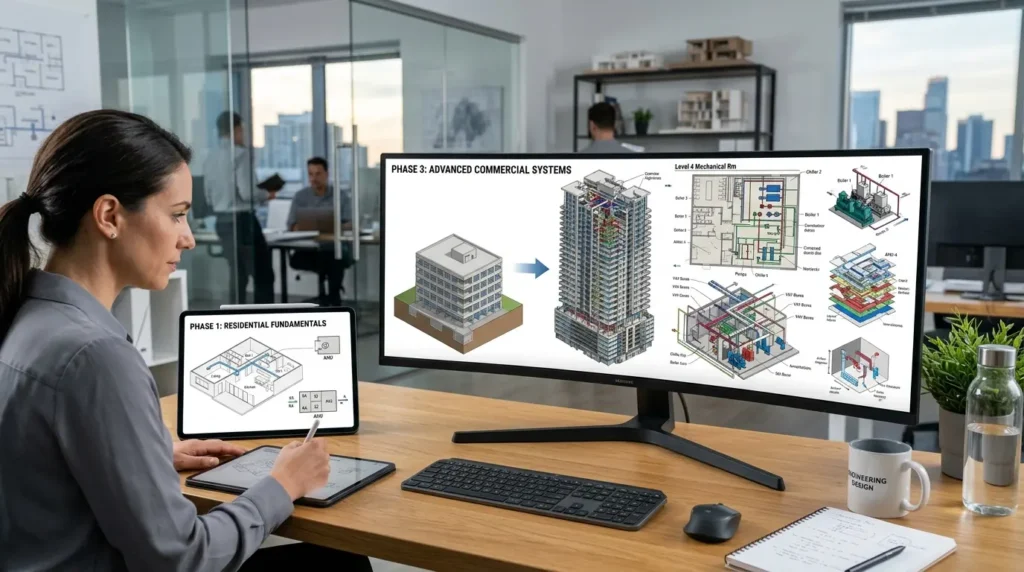
The curriculum follows a progressive learning structure that develops core drafting skills before introducing increasingly complex design environments. This approach ensures participants understand universal HVAC and plumbing principles before applying them to residential, commercial, and multidisciplinary engineering projects with different operational and documentation requirements.
Many training programmes separate residential and commercial learning paths. While this approach may simplify instruction, it can limit professional versatility.
Imperial Corporate Training Institute uses a progression model that begins with fundamental AutoCAD workflows and gradually introduces project complexity. This reflects how professionals encounter building services projects throughout their careers.
Building Foundational Design Competence
Module 1 establishes AutoCAD standards, templates, scaling practices, and corporate drawing conventions.
This foundation is critical because both residential and commercial projects depend on consistent drafting accuracy. Without these fundamentals, advanced coordination activities become difficult to manage.
Progressing Towards Complex Engineering Environments
Modules focused on HVAC drafting, plumbing design, and MEP coordination introduce increasingly sophisticated project requirements.
Participants learn how workflows evolve as project size increases. They understand how coordination requirements become more demanding when multiple disciplines work simultaneously on a shared development.
This progression supports practical skill transfer rather than isolated software knowledge.
What Will Participants Learn About Residential and Commercial HVAC Design?
Participants learn drafting methodologies, duct and piping layouts, HVAC documentation standards, system coordination techniques, airflow planning principles, equipment placement strategies, and engineering documentation processes used across residential and commercial projects while maintaining compliance with recognised engineering and construction standards.
The learning outcomes are designed to support workplace application rather than theoretical understanding alone.
HVAC Drafting and Layout Development
Module 2 focuses on HVAC design drafting principles.
Participants learn to create duct layouts, airflow routes, diffuser placements, equipment blocks, and schematic representations.
These capabilities support both residential and commercial HVAC documentation requirements.
Plumbing Design and Drainage Systems
Module 3 develops competence in plumbing and drainage system drafting.
Learners create cold-water systems, hot-water networks, drainage layouts, and riser diagrams while understanding coordination requirements with other building services.
This knowledge applies to residential buildings as well as large commercial developments.
HVAC Load Calculations and Optimisation
Module 5 introduces design optimisation concepts.
Participants understand how design calculations support equipment selection, airflow planning, and system performance objectives.
Imperial Corporate Training Institute integrates these concepts with AutoCAD workflows to strengthen practical engineering understanding.
Design Documentation Standards
Professional engineering projects require consistent documentation.
Participants learn how to organise sheets, manage revisions, prepare schedules, develop legends, and maintain drawing standards that align with corporate expectations.
How Does the Course Address Commercial-Level MEP Coordination?
The programme includes advanced coordination modules covering multidisciplinary workflows, clash identification, drawing integration, BIM interaction, project documentation, and design review procedures. These capabilities are essential for commercial projects where HVAC, plumbing, electrical, and structural systems must operate within shared construction environments.
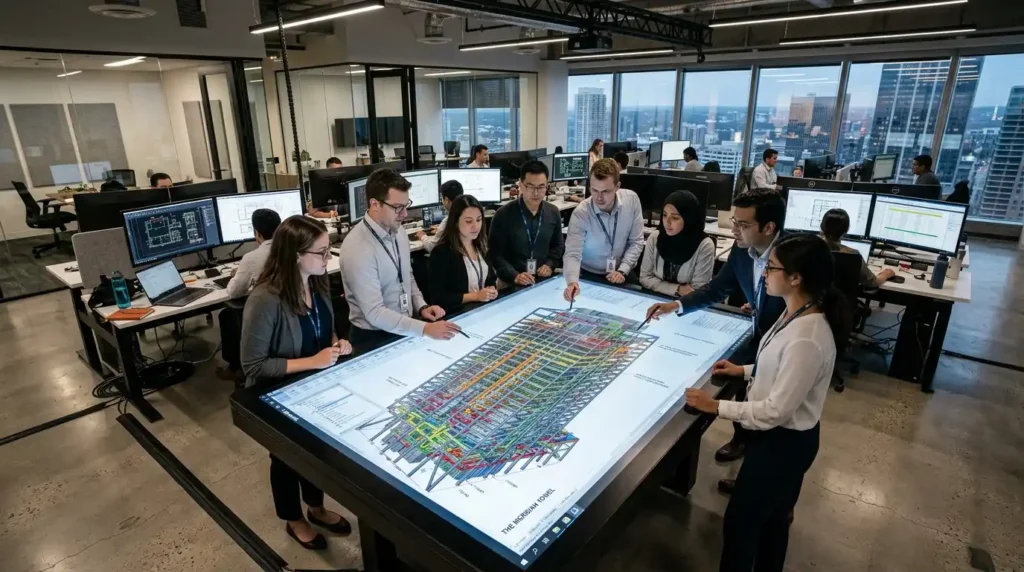
One of the major differences between residential and commercial projects is coordination complexity.
Commercial developments involve numerous stakeholders, technical disciplines, and project constraints.
Advanced AutoCAD Tools
Module 4 introduces advanced AutoCAD capabilities.
Participants learn how external references, layer management systems, annotation strategies, and data extraction processes improve project coordination.
These workflows are commonly used within corporate engineering environments.
BIM and Revit Integration
Modern engineering organisations increasingly operate within BIM-based environments.
Imperial Corporate Training Institute includes BIM and Revit integration concepts through Module 9.
Participants understand how AutoCAD-generated HVAC and plumbing drawings interact with larger digital project models.
Design Review and Quality Assurance
Module 8 focuses on design verification processes.
Learners perform drawing reviews, identify discrepancies, support approval workflows, and improve overall documentation quality.
These competencies are highly relevant to commercial engineering operations.
For professionals comparing training depth and curriculum coverage, additional evaluation criteria can be explored through:
How Are Residential and Commercial HVAC Drawing Requirements Covered in Training?
How Is Training Delivered and Assessed?
The course combines structured instruction, practical exercises, project simulations, technical assignments, and applied design activities. Training delivery supports skill development through hands-on learning while assessment methods verify the participant’s ability to apply HVAC and plumbing drafting concepts in realistic project scenarios.
Technical skills cannot be developed solely through lectures.
Professionals must demonstrate the ability to create and manage engineering drawings within practical project environments.
Training Delivery Formats
Imperial Corporate Training Institute supports corporate learning requirements through multiple delivery options.
Training may be delivered through classroom workshops, online sessions, hybrid programmes, or onsite corporate training arrangements.
This flexibility enables organisations to align learning schedules with operational requirements.
Practical Learning Activities
Participants complete drafting exercises, design development tasks, coordination activities, and documentation assignments.
These exercises mirror workplace responsibilities encountered within engineering and construction organisations.
Assessment Approach
Assessment focuses on practical capability.
Learners demonstrate understanding through project-based activities, design simulations, technical exercises, and documentation reviews.
The objective is measurable skill development rather than simple software familiarity.
What Results Can Organisations and Professionals Expect?
Participants gain practical drafting competence, improved project coordination capability, stronger documentation skills, greater understanding of engineering standards, and enhanced ability to contribute to residential and commercial HVAC and plumbing projects within corporate environments and multidisciplinary teams.
Training outcomes should be evaluated according to workplace performance improvement.
Imperial Corporate Training Institute structures this programme around competencies that support operational engineering requirements.
Improved Design Accuracy
Participants become more proficient in producing organised and technically accurate drawings.
This contributes to reduced documentation errors and more efficient project communication.
Better Coordination Across Departments
Engineering projects frequently require collaboration between mechanical, electrical, architectural, and construction teams.
The course strengthens participants’ ability to coordinate technical information across departments.
Enhanced Professional Capability
Graduates develop stronger technical documentation skills, improved drawing management practices, and greater confidence when contributing to complex projects.
These outcomes support both individual professional development and organisational capability building.
Corporate Workforce Development
HR teams and departmental managers often require structured technical upskilling initiatives.
Imperial Corporate Training Institute provides a curriculum that supports workforce development objectives through measurable technical skill acquisition and practical project readiness.
How Does Enrolment Work and Who Should Attend?
The programme is designed for engineers, draftsmen, technicians, consultants, facility professionals, project coordinators, and graduates seeking advanced HVAC and plumbing design capabilities. Participants follow a structured progression from foundational concepts through advanced coordination, documentation, and project execution competencies.
The course is intended for professionals operating within engineering, construction, infrastructure, and facility management environments.
Suitable Participants
The programme is particularly relevant for:
- Mechanical design engineers
- HVAC professionals
- MEP engineers
- AutoCAD technicians
- Design coordinators
- Construction consultants
- Facility management professionals
- Engineering graduates
Imperial Corporate Training Institute structures the curriculum to accommodate professionals seeking advanced technical specialisation while maintaining practical workplace relevance.
Completion Path
Participants progress through ten structured modules covering drafting fundamentals, HVAC systems, plumbing design, MEP coordination, BIM integration, quality assurance, and project execution.
Each module builds upon previous learning outcomes to ensure consistent skill development.
Decision Criteria for Prospective Participants
Professionals evaluating whether the course covers both residential and commercial design can assess the curriculum based on its learning outcomes.
Discover More from Our Guide Library:
How Does Imperial’s HVAC Programme Teach Design Basis Reporting Skills?
Does Imperial’s HVAC Programme Include Underfloor Heating Drawing Exercises?
The programme addresses residential system layouts, commercial coordination requirements, documentation standards, project simulations, and multidisciplinary engineering workflows within a single structured training pathway.
This integrated approach enables participants to develop capabilities that are transferable across different building types and project environments while aligning with corporate engineering expectations. To begin the next step, review the official course details and apply for: