

HVAC drafting standards vary significantly between residential and commercial buildings. Engineers, designers, technicians, and facility professionals need different levels of drawing knowledge depending on the type of project they support. Training programmes therefore focus on helping learners understand the design principles, drafting conventions, compliance requirements, and documentation standards used across both environments.
Understanding these differences is important when evaluating HVAC design education pathways. Professionals comparing training options often begin by exploring how residential and commercial workflows differ before assessing programme content.
This is why many learners first review educational resources such as:
How Does AutoCAD HVAC Training Differ Between Residential and Commercial Projects? before examining specialised training frameworks.
How Do Residential and Commercial HVAC Drawings Differ in Training?
Residential HVAC drawings focus on smaller-scale layouts, simplified duct routing, equipment placement, and basic load considerations. Commercial HVAC drawings introduce complex systems, multi-zone designs, detailed coordination requirements, compliance standards, and extensive documentation practices that require broader technical understanding and drafting accuracy.
Training programmes typically begin with residential HVAC design concepts because they provide a clear foundation for understanding airflow distribution, equipment selection, and building services coordination.
Residential drawings generally include:
- Floor plans
- Equipment schedules
- Duct layouts
- Vent placement
- Thermostat locations
- Basic plumbing integration
Learners study how heating and cooling systems serve individual homes, apartments, and small residential developments. Training often emphasises readability, drafting standards, and practical design principles.
Commercial HVAC drawings involve a much wider scope.
Commercial projects commonly include:
- Variable Air Volume (VAV) systems
- Air Handling Units (AHUs)
- Chilled water systems
- Mechanical plant rooms
- Smoke control systems
- Building Management Systems (BMS)
- Multi-floor distribution networks
Because of this complexity, commercial drafting exercises require greater attention to coordination, layer management, annotation standards, and interdisciplinary collaboration.
Training programmes cover both environments to ensure learners understand how project scale influences drawing requirements.
What Drawing Components Are Commonly Taught Across Both Project Types?
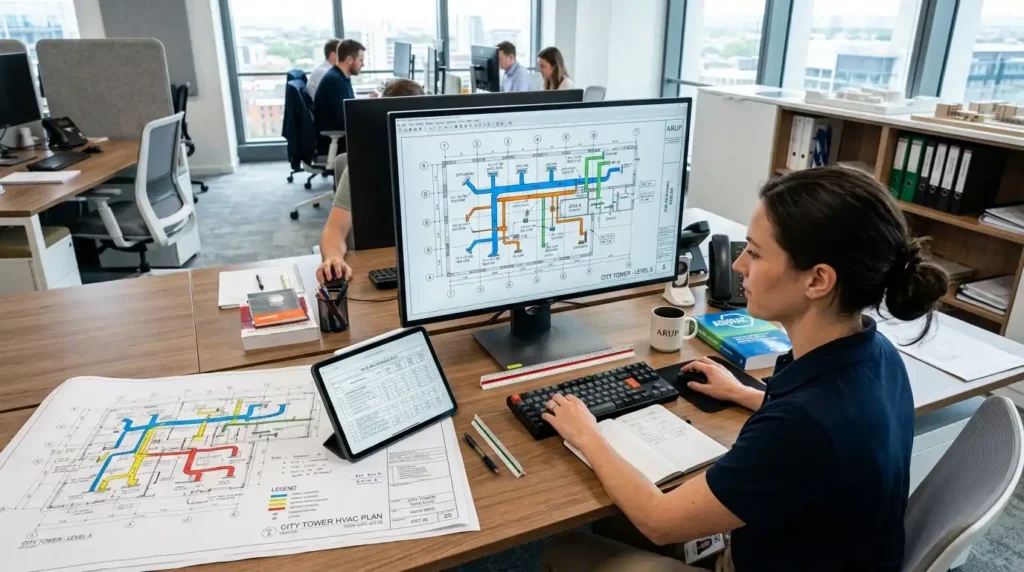
Most HVAC training programmes teach core drawing elements that apply to all building types, including ductwork layouts, equipment symbols, airflow paths, schedules, annotations, system coordination, and drafting standards used throughout mechanical engineering documentation.
Regardless of project size, HVAC drawings communicate technical information between multiple stakeholders.
Common drawing components include:
Ductwork Design
Learners study duct routing principles, sizing conventions, and airflow distribution methods.
Training covers:
- Supply air ducts
- Return air ducts
- Exhaust systems
- Flexible connections
- Diffuser placement
HVAC Equipment Representation
Standardised symbols help ensure consistency across projects.
Typical equipment includes:
- Condensing units
- Air handling units
- Fan coil units
- Exhaust fans
- Heat pumps
- Chillers
Annotation and Labelling
Technical communication depends on accurate annotation.
Training focuses on:
- Equipment tags
- Duct dimensions
- Airflow rates
- Elevation references
- Drawing notes
Drawing Coordination
Mechanical systems must integrate with architectural, structural, and electrical designs.
Learners practise identifying clashes and coordinating multiple building systems within shared spaces.
These foundational skills create the basis for more advanced commercial design work.
Why Does Commercial HVAC Training Require More Detailed Documentation?
Commercial projects involve larger buildings, multiple occupants, stricter regulations, and complex mechanical systems. Training therefore includes extensive documentation practices that support construction coordination, regulatory compliance, maintenance planning, and long-term facility management requirements.
Documentation complexity increases as building size grows.
Commercial HVAC drawings often include:
- Detailed mechanical schedules
- Equipment specifications
- Control diagrams
- Riser diagrams
- Sequence-of-operation references
- Coordination drawings
Facility managers rely on these documents throughout a building’s lifecycle.
Training therefore introduces learners to documentation workflows used by consulting engineers, contractors, commissioning teams, and building operators.
Commercial environments also require stronger version control practices.
Learners are taught how revisions, updates, and drawing issuance procedures affect project delivery and stakeholder communication.
How Are Industry Standards and Compliance Requirements Covered?
HVAC drawing training incorporates industry standards, engineering conventions, and compliance requirements to ensure designs align with recognised construction practices, safety regulations, and building performance expectations across residential and commercial environments.
Compliance plays a major role in HVAC design quality.
Training often introduces standards related to:
- Indoor air quality
- Ventilation requirements
- Energy efficiency
- Fire safety
- Equipment accessibility
- Mechanical system performance
Residential projects generally focus on local housing requirements and simplified compliance procedures.
Commercial projects require deeper understanding because larger facilities must satisfy broader operational and regulatory expectations.
Learners study how standards influence:
- Equipment placement
- Duct sizing
- Ventilation calculations
- Mechanical room design
- Emergency systems
This helps designers produce drawings that support successful project approval and implementation.
How Does AutoCAD Support Residential and Commercial HVAC Drafting?
AutoCAD provides a structured environment for creating, modifying, coordinating, and documenting HVAC systems. Training uses AutoCAD tools to develop drafting accuracy, layer management skills, annotation consistency, and workflow efficiency across different project scales.
Digital drafting has become a standard requirement across the HVAC industry.
AutoCAD training teaches learners how to:
Create Mechanical Layouts
Users develop HVAC plans using precise drafting tools.
Key activities include:
- Drawing duct systems
- Positioning equipment
- Creating mechanical zones
- Producing installation layouts
Manage Drawing Layers
Layer organisation improves drawing readability.
Training covers:
- Layer naming conventions
- Visibility controls
- Colour management
- Printing standards
Produce Professional Documentation
Commercial projects often contain hundreds of drawing elements.
Learners practise creating:
- Plot-ready layouts
- Scaled drawings
- Schedules
- Construction documentation packages
Professionals evaluating programme content often examine whether a training pathway includes practical residential and commercial applications. This consideration becomes particularly relevant when assessing resources such as:
Does Imperial’s HVAC AutoCAD Course Cover Both Residential and Commercial Design? The training scope directly influences workplace readiness.
The AutoCAD HVAC and Plumbing Design Training Course is frequently reviewed in this context because integrated HVAC and plumbing coordination reflects real-world project environments where multiple building services must work together.
What Skills Are Developed Through Residential HVAC Drawing Exercises?
Residential drawing exercises develop drafting fundamentals, spatial awareness, system layout skills, equipment coordination capabilities, and technical communication practices that create the foundation for more advanced HVAC design responsibilities.
Training exercises usually progress through structured learning stages.
Early projects often focus on:
- Single-family homes
- Villas
- Small residential buildings
Learners gain experience in:
Reading Building Plans
Mechanical designers must understand architectural layouts before creating HVAC systems.
Training develops interpretation skills related to:
- Room dimensions
- Occupancy patterns
- Building orientation
- Service spaces
Designing Efficient Layouts
Residential projects emphasise practical system routing.
Learners evaluate:
- Equipment locations
- Duct paths
- Maintenance access
- Space utilisation
Applying Drafting Standards
Consistency improves communication across project teams.
Exercises reinforce standard practices used throughout the mechanical design profession.
These competencies establish confidence before learners transition to more demanding commercial scenarios.
How Are Commercial Coordination Challenges Addressed in Training?
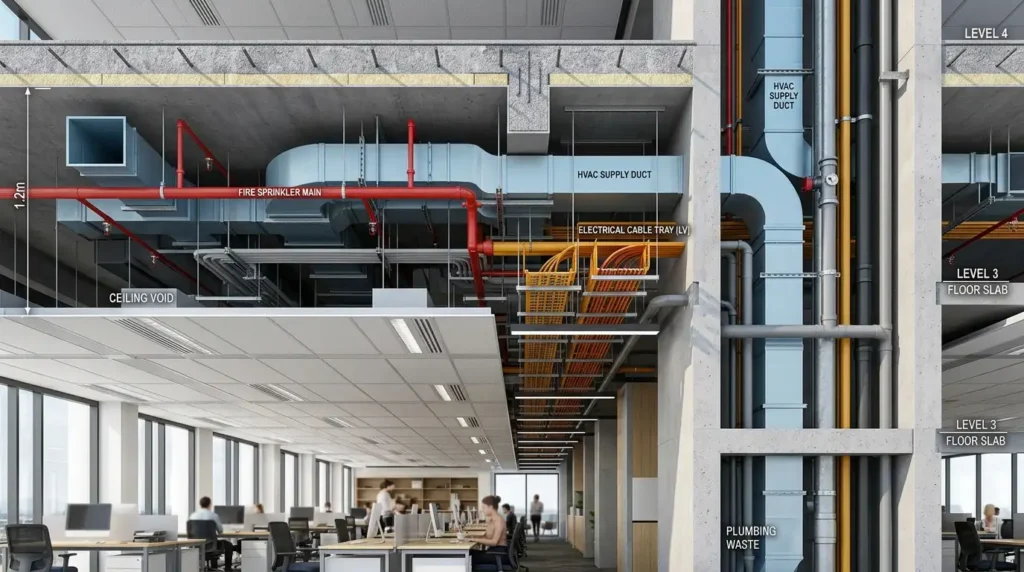
Commercial HVAC training introduces coordination methods that help learners manage interactions between mechanical, electrical, plumbing, structural, and architectural systems within complex building environments.
Modern commercial buildings contain numerous interconnected services.
Training therefore includes coordination exercises involving:
- Ceiling spaces
- Service shafts
- Mechanical rooms
- Plant areas
- Equipment access zones
Multi-Disciplinary Coordination
Commercial projects require collaboration between multiple departments.
Learners examine how HVAC systems interact with:
- Lighting systems
- Fire protection systems
- Structural components
- Plumbing networks
Clash Detection Awareness
Drawing conflicts create project delays and construction issues.
Training demonstrates how careful drafting and coordination reduce installation problems.
Space Planning Considerations
Commercial facilities often have limited service space.
Exercises teach learners how to optimise layouts while maintaining accessibility and operational performance.
These capabilities support effective project delivery and improve design quality.
What Training Formats Help Learners Master HVAC Drawing Requirements?
Effective HVAC drawing education combines theory, software practice, project-based learning, and real-world design exercises. Different training formats provide varying levels of technical depth, practical application, and workplace relevance.
Organisations evaluating workforce development initiatives often compare several learning approaches.
Classroom-Based Training
Instructor-led programmes provide structured guidance and direct feedback.
Benefits include:
- Real-time problem solving
- Peer interaction
- Practical demonstrations
- Guided exercises
Project-Based Learning
Project work replicates workplace environments.
Learners apply knowledge through realistic design scenarios involving residential and commercial systems.
Software-Focused Workshops
Technical workshops concentrate on drafting efficiency and software proficiency.
Participants develop practical AutoCAD skills through hands-on exercises.
Blended Learning Models
Many organisations combine instructor-led sessions with self-paced activities.
This approach supports workforce flexibility while maintaining practical skill development.
HR teams frequently prefer blended formats because they balance productivity requirements with professional development objectives.
How Can Organisations Evaluate HVAC Drawing Training Quality?
Training quality can be evaluated through curriculum coverage, practical exercises, software application, assessment methods, workplace relevance, and measurable skill development outcomes that align with organisational performance objectives.
Organisations investing in technical development programmes require objective evaluation criteria.
Curriculum Breadth
Strong programmes cover both residential and commercial applications.
Learners should understand:
- Design principles
- Drafting standards
- Documentation practices
- Coordination processes
Practical Application
Hands-on exercises indicate whether training develops workplace-ready skills.
Programmes that incorporate realistic project scenarios generally provide stronger learning transfer.
Software Integration
Modern HVAC drafting depends heavily on digital tools.
Training should demonstrate practical software workflows rather than focusing exclusively on theory.
Business Impact
Training effectiveness can be measured using performance indicators such as:
| Evaluation Area | Measurement Focus |
|---|---|
| Drafting Accuracy | Reduction in drawing errors |
| Productivity | Faster drawing completion times |
| Coordination Quality | Fewer design clashes |
| Documentation Standards | Improved project consistency |
| Technical Competence | Assessment performance |
These metrics help organisations connect training investment with operational outcomes.
How Should Learners Compare Residential and Commercial HVAC Training Coverage?
Learners should compare training programmes based on project diversity, software application, documentation depth, coordination requirements, and practical exercises that reflect actual workplace responsibilities across different building types.
A useful evaluation framework focuses on capability development rather than course duration alone.
| Evaluation Factor | Residential Focus | Commercial Focus |
| System Complexity | Low to moderate | High |
| Documentation Requirements | Basic | Extensive |
| Coordination Demands | Limited | Significant |
| Equipment Diversity | Moderate | Extensive |
| Compliance Considerations | Standard | Advanced |
| Drawing Volume | Smaller sets | Large packages |
This comparison helps learners identify programmes that match their career objectives.
Discover More from Our Guide Library:
How Does AutoCAD HVAC Training Help Engineers Prepare Design Basis Documentation?
How Does AutoCAD HVAC Training Cover Underfloor Heating Layout and Manifold Design?
Professionals seeking design, drafting, and coordination responsibilities often benefit from training that covers both environments because employers increasingly value adaptable technical capability across multiple project categories.
Understanding how residential and commercial HVAC drawing requirements are taught allows learners and organisations to assess training quality more effectively. The strongest programmes connect drafting fundamentals, software proficiency, documentation standards, and interdisciplinary coordination into a structured learning pathway that reflects actual project delivery requirements across the built environment.
Frequently Asked Questions
What skills are taught in an AutoCAD HVAC and Plumbing Design Training Course?
The AutoCAD HVAC and Plumbing Design Training Course covers HVAC drafting, plumbing system layouts, equipment scheduling, ductwork design, and technical drawing standards. At Imperial Corporate Training Institute, learners develop practical skills for creating coordinated mechanical and plumbing drawings using AutoCAD.
Does HVAC and plumbing design training cover both residential and commercial projects?
Yes, the AutoCAD HVAC and Plumbing Design Training Course typically includes residential and commercial design applications. Imperial Corporate Training Institute teaches drawing requirements, system layouts, and coordination practices used across different building types.
Why is AutoCAD important for HVAC and plumbing design professionals?
AutoCAD is widely used for creating accurate HVAC and plumbing drawings, construction documentation, and system layouts. The AutoCAD HVAC and Plumbing Design Training Course helps learners apply industry-standard drafting methods for engineering and building services projects.
How does HVAC and plumbing design training improve project coordination?
HVAC and plumbing systems must work alongside architectural, structural, and electrical services. The AutoCAD HVAC and Plumbing Design Training Course teaches drawing coordination techniques that help reduce design conflicts and improve project documentation quality.