

AutoCAD HVAC training equips engineers with structured drafting and modelling capabilities that directly translate into accurate design basis documentation by linking spatial system design, technical parameters, and engineering assumptions into a unified workflow that supports consistent, auditable, and project-compliant reporting outputs across mechanical systems.
Design basis documentation in HVAC engineering defines the technical foundation of a project. It includes load assumptions, system selection logic, air distribution strategy, and compliance references. Without structured training, engineers often treat these elements as separate tasks, which leads to inconsistency between drawings and documentation.
AutoCAD-based HVAC training changes this workflow by integrating design intent with documentation logic. Engineers learn how model geometry, system sizing, and component selection feed directly into documentation structure. This reduces fragmentation between design development and reporting stages.
A key advantage is traceability. Every duct route, diffuser placement, and equipment selection in AutoCAD can be linked to a documented engineering rationale. This creates alignment between visual design outputs and written technical justification.
For a foundational understanding of how these systems interact in early-stage design thinking, see this overview on:
What Is a Design Basis Report and How Does HVAC AutoCAD Work Support It?
This connection is critical because design basis documentation is not created after the design is completed. It evolves in parallel with modelling decisions. AutoCAD HVAC training, therefore, builds a dual competency: design execution and documentation discipline.
How does AutoCAD-based workflow improve accuracy and compliance in design basis reporting?
AutoCAD-based HVAC workflows improve accuracy and compliance by standardising engineering inputs, reducing manual calculation errors, and ensuring that system parameters are consistently reflected across drawings, schedules, and design basis documentation, which strengthens regulatory alignment and technical validation throughout project delivery stages.
In traditional workflows, engineers often update drawings without synchronising documentation. This creates discrepancies between the design model and the design basis report. AutoCAD HVAC training eliminates this gap by enforcing structured modelling rules.
Engineers learn to define system parameters such as airflow rates, thermal loads, and equipment capacities directly within the drafting environment. These parameters are not isolated values; they become embedded design attributes.
Compliance improves because HVAC standards depend on consistent interpretation of technical inputs. When AutoCAD is used correctly, documentation reflects actual model conditions instead of manually interpreted summaries.
This reduces audit risk in engineering projects. Clients and regulators increasingly require traceable justification for HVAC system decisions, particularly in commercial buildings, hospitals, and industrial facilities.
The workflow also improves revision control. When design changes occur, updates in AutoCAD propagate into associated documentation fields. This reduces the likelihood of outdated design basis data being submitted during approval stages.
From a performance standpoint, organisations report up to 30–40% reduction in documentation rework when structured AutoCAD HVAC training is implemented across engineering teams.
Why do engineers struggle with design basis documentation without structured HVAC training?
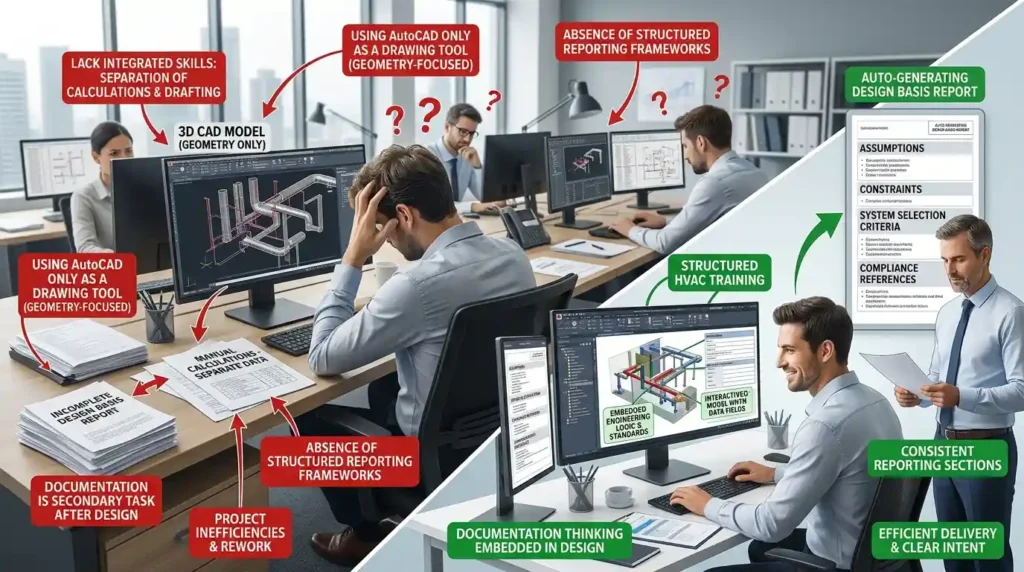
Engineers struggle with design basis documentation without structured HVAC training because they lack integrated exposure to modelling standards, documentation frameworks, and system-level HVAC decision logic, resulting in fragmented reporting that does not accurately reflect engineering intent or project-specific performance requirements.
Most engineers are trained in either design calculation or drafting, but not both as an integrated system. This separation creates gaps when producing design basis reports.
Without training, AutoCAD is often used purely as a drawing tool. Engineers focus on geometry rather than engineering logic. As a result, documentation becomes a secondary task completed after design finalisation.
Another challenge is the absence of structured reporting frameworks. Design basis documentation requires consistent sections such as assumptions, constraints, system selection criteria, and compliance references. Without training, these sections are often incomplete or misaligned with actual design decisions.
This leads to project inefficiencies. Rework cycles increase when consultants or clients request clarification between drawings and written justification.
Training resolves this by embedding documentation thinking into the design process. Engineers learn to document decisions as they design, rather than reconstructing logic after completion.
In corporate environments, this skill gap is a major driver of project delays. HR and technical managers increasingly prioritise structured HVAC AutoCAD capability when assessing engineering teams for complex project delivery.
How does HVAC AutoCAD training align engineering design decisions with project requirements?
HVAC AutoCAD training aligns engineering design decisions with project requirements by integrating system modelling, performance criteria, and client specifications into a unified digital workflow that ensures every design choice is traceable, justified, and consistent with the approved design basis framework.
In real project environments, HVAC systems must satisfy multiple constraints simultaneously, including energy efficiency, spatial limitations, regulatory codes, and client performance expectations.
Without structured training, engineers often treat these constraints separately. This leads to design conflicts where documentation does not match operational requirements.
AutoCAD HVAC training introduces a requirement-driven design approach. Engineers are trained to translate project briefs into system parameters before modelling begins. This ensures that design decisions are anchored in documented requirements.
This alignment is particularly important in large-scale commercial projects where multiple stakeholders review the design basis report before approval. Consistency between drawings and documentation becomes a critical success factor.
At this stage, organisations often evaluate structured training pathways such as the:
How Does Imperial’s HVAC Programme Teach Design Basis Reporting Skills? To ensure engineers are capable of linking technical modelling with documentation standards.
The integration of requirements also improves communication between disciplines. Mechanical engineers, architects, and project managers work from the same validated data set, reducing interpretation errors.
Ultimately, alignment reduces design iteration cycles. Projects move from concept to approval faster because the engineering logic is clearly documented and technically defensible.
What skills from AutoCAD HVAC training directly influence design basis report quality?
AutoCAD HVAC training builds critical skills such as system parameter definition, load calculation integration, drafting accuracy, documentation structuring, and compliance mapping, all of which directly improve the clarity, consistency, and technical reliability of design basis reports in engineering projects.
The quality of a design basis report depends on how well engineering decisions are translated into structured documentation. AutoCAD HVAC training strengthens this translation process.
One of the most important skills is system parameter control. Engineers learn how airflow, pressure, and thermal load values are embedded into design models and reflected in documentation outputs.
Another key skill is structured drafting. Engineers develop the ability to produce drawings that are not only visually accurate but also documentation-ready, meaning they align with reporting templates used in professional engineering submissions.
Documentation structuring is also a core outcome. Engineers are trained to organise design basis reports into logical sections that reflect real design workflows rather than generic templates.
Compliance mapping is another critical skill. Engineers learn to connect design decisions with standards such as ASHRAE or ISO requirements, ensuring that documentation is audit-ready.
These capabilities are reinforced through applied learning modules in the:
AutoCAD HVAC and Plumbing Design Training Course, where engineers apply modelling and documentation principles in project-based simulations.
When these skills are combined, the design basis report becomes a live extension of the design model rather than a separate administrative document.
How does AutoCAD HVAC training improve business outcomes for engineering teams?

AutoCAD HVAC training improves business outcomes by reducing design rework, increasing documentation efficiency, accelerating project approval, and enhancing cross-disciplinary coordination, collectively leading to lower project costs and greater delivery reliability in engineering consultancy and construction environments.
From a business perspective, design basis documentation is directly linked to project approval cycles. Poor documentation increases review time and delays procurement decisions.
When engineers are trained in AutoCAD HVAC workflows, documentation becomes more consistent and structured. This reduces clarification requests from clients and consultants.
Rework reduction is one of the most measurable outcomes. Organisations typically observe fewer revision cycles because design intent is accurately captured from the beginning.
Another outcome is improved resource efficiency. Engineers spend less time correcting documentation inconsistencies and more time on technical optimisation.
Project delivery speed also improves. When design basis reports are aligned with AutoCAD models, approvals move faster through regulatory and client review stages.
Cross-functional coordination improves as well. MEP teams, architects, and project managers work from a unified design language, reducing miscommunication.
These improvements directly impact profitability in consultancy-driven engineering firms, where project timelines and revision cycles influence revenue performance.
How should organisations evaluate HVAC AutoCAD training for documentation capability?
Organisations should evaluate HVAC AutoCAD training based on its ability to integrate design modelling with documentation workflows, improve compliance accuracy, reduce rework rates, and demonstrate measurable improvements in design basis report quality through applied engineering assessments and project-based learning outcomes.
Evaluation of training programmes should focus on real engineering outcomes rather than theoretical content coverage.
The first criterion is integration capability. Training must show how AutoCAD models translate directly into structured design basis documentation.
The second criterion is compliance readiness. Engineers should be able to produce reports that align with industry standards and project approval requirements.
The third criterion is performance impact. Organisations should measure reduction in documentation errors, revision cycles, and approval delays.
Another important factor is applied learning structure. Training must include scenario-based HVAC projects where engineers build both models and design basis reports simultaneously.
Discover More from Our Guide Library:
How Does AutoCAD HVAC Training Cover Underfloor Heating Layout and Manifold Design?
How Does AutoCAD HVAC Training Cover Quantity Take-Off from Design Drawings?
Assessment should also include documentation consistency scoring. This evaluates whether engineers maintain alignment between drawings and written engineering justification.
Finally, organisations should consider scalability. Training should be applicable across teams, not limited to individual skill development.
When these criteria are met, HVAC AutoCAD training becomes a strategic capability rather than a technical upskilling exercise.
Frequently Asked Questions
What is the AutoCAD HVAC and Plumbing Design Training Course used for in engineering practice?
The AutoCAD HVAC and Plumbing Design Training Course is used to develop skills in mechanical system drafting, modelling, and documentation for building services projects. At Imperial Corporate Training Institute, it focuses on integrating HVAC and plumbing design outputs with technical documentation such as design basis reports and construction drawings.
How does AutoCAD HVAC training improve design basis documentation quality?
AutoCAD HVAC training improves design basis documentation by aligning engineering calculations, system layouts, and technical assumptions within a single CAD workflow. This ensures consistency between drawings and documentation, reducing errors in HVAC system reporting and improving compliance accuracy.
What skills are developed in AutoCAD HVAC and Plumbing Design Training?
The training builds skills in HVAC system modelling, duct and pipe routing, load interpretation, and design documentation structuring. It also strengthens the ability to produce design basis documentation aligned with industry standards and engineering project requirements.
Why is AutoCAD important in HVAC and plumbing system design workflows?
AutoCAD is important because it enables precise drafting, system visualisation, and integration of engineering data into construction-ready drawings. In HVAC and plumbing workflows, it supports structured design development and ensures documentation accuracy throughout the project lifecycle.