

Underfloor heating systems have become a standard component of modern residential, commercial, and mixed-use developments. As building services projects increasingly prioritise energy efficiency, thermal comfort, and space optimisation, HVAC professionals require specialised design skills that extend beyond traditional ductwork and piping layouts. AutoCAD HVAC training addresses this requirement by teaching how heating circuits, manifold assemblies, zoning arrangements, and pipe routing strategies are represented within professional construction drawings.
Understanding how underfloor heating systems are documented begins with recognising the drawing conventions, symbols, and coordination requirements used in design projects. Professionals seeking foundational knowledge often start by exploring how underfloor heating layouts appear within technical drawings, such as;
How Is Underfloor Heating System Design Represented in AutoCAD Drawings? before progressing to the detailed drafting workflows used in professional HVAC design environments.
How does AutoCAD HVAC training teach underfloor heating layout development?
AutoCAD HVAC training teaches underfloor heating layout development through structured drafting exercises that cover room zoning, pipe circuit routing, heat distribution planning, spacing calculations, drawing standards, and coordination with architectural and mechanical building services documentation requirements.
Underfloor heating design begins with understanding the physical components of the system. Training programmes introduce learners to heating pipes, insulation layers, manifolds, control systems, actuators, pumps, and zoning arrangements. Each component must be represented accurately within AutoCAD drawings.
The layout process typically starts with analysing floor plans. Trainees learn how to import architectural backgrounds and identify heated spaces. Rooms are assessed according to their dimensions, occupancy requirements, thermal loads, and functional use. This evaluation forms the basis for pipe routing decisions.
AutoCAD exercises focus on creating pipe loops that provide consistent heat distribution across occupied spaces. Learners develop practical drafting skills by positioning circuits while maintaining required pipe spacing and avoiding clashes with structural elements.
Professional HVAC training also introduces drawing layer management. Underfloor heating systems frequently require separate layers for pipe circuits, manifolds, annotations, dimensions, control devices, and reference information. Organised layering improves collaboration between design disciplines and simplifies future revisions.
Within the context of the AutoCAD HVAC and Plumbing Design Training Course, participants learn how drafting standards support project consistency throughout the design lifecycle. This enables designers to produce drawings that align with industry expectations and construction documentation requirements.
Why is manifold design an important part of HVAC drafting training?
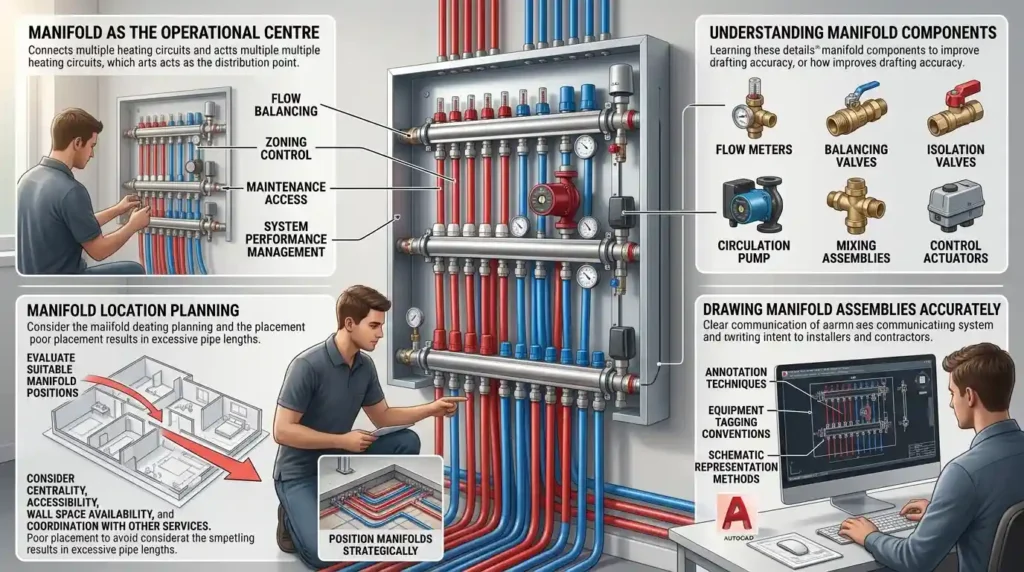
Manifold design receives significant attention because it serves as the operational centre of underfloor heating systems, connecting multiple heating circuits while supporting flow balancing, zoning control, maintenance access, and overall system performance management.
The manifold acts as the distribution point where heating circuits originate and return. Accurate manifold representation is essential because installation teams rely on HVAC drawings to position equipment correctly.
Training programmes explain manifold components in detail. Learners become familiar with flow meters, balancing valves, isolation valves, circulation pumps, mixing assemblies, and control actuators. Understanding these elements improves drafting accuracy.
Understanding manifold location planning
Manifold placement influences pipe lengths, pressure losses, installation costs, and maintenance accessibility. AutoCAD HVAC training teaches how to evaluate suitable manifold positions within a building.
Designers assess centrality, accessibility, wall space availability, and coordination with other services. Poor placement often results in excessive pipe lengths and operational inefficiencies.
Practical drawing exercises require trainees to position manifolds strategically while maintaining compliance with design constraints. This approach develops decision-making skills alongside drafting proficiency.
Drawing manifold assemblies accurately
Professional HVAC drawings require more than simple symbols. Manifold assemblies often include multiple labelled components and connection points.
Training exercises teach annotation techniques, equipment tagging conventions, and schematic representation methods. These skills enable designers to communicate system intent clearly to installers, contractors, and project stakeholders.
What drafting methods are used to represent heating circuits in AutoCAD?
AutoCAD HVAC training introduces several drafting methods for representing heating circuits, including serpentine patterns, spiral layouts, zoning configurations, loop identification systems, and coordinated routing approaches that support installation accuracy and thermal performance objectives.
Heating circuit representation requires both technical accuracy and drawing clarity. Designers must balance readability with construction detail.
The serpentine layout remains common in many projects. This pattern routes heating pipes back and forth across a room. AutoCAD exercises teach how to maintain consistent spacing while accommodating room geometry.
Spiral layouts receive significant attention because they improve temperature distribution across larger spaces. Training demonstrates how supply and return pipes can be arranged to minimise temperature variation throughout the heated area.
Loop identification and documentation
Large buildings often contain dozens or even hundreds of heating circuits. Effective documentation becomes essential.
AutoCAD HVAC training teaches numbering systems, circuit tagging methods, and annotation standards that improve project coordination.
Each loop requires clear identification to support installation, commissioning, balancing, and future maintenance activities. Designers learn how documentation standards contribute directly to operational efficiency.
How does training connect underfloor heating design with HVAC system performance?
Effective training links drafting activities to HVAC system performance by demonstrating how layout decisions influence heat output, energy consumption, pressure losses, hydraulic balance, occupant comfort, and long-term operational efficiency.
Many new designers focus primarily on drawing production. Advanced HVAC training emphasises the relationship between graphical representation and system performance.
Pipe spacing provides a useful example. Closer spacing increases heat output but also increases material requirements and installation complexity. Wider spacing reduces installation costs but affects temperature uniformity.
Training programmes explain these trade-offs through practical design scenarios. Learners understand why specific layouts are selected for different building types.
Thermal zoning considerations
Modern buildings frequently require multiple heating zones. Office spaces, residential areas, meeting rooms, and communal spaces often have different heating demands.
AutoCAD exercises demonstrate how zoning strategies are incorporated into underfloor heating layouts. Designers learn how manifolds, control devices, and heating circuits interact within larger building management strategies.
This knowledge helps professionals create drawings that support both installation requirements and operational objectives.
What role does coordination play in underfloor heating drawing exercises?
Coordination forms a critical training component because underfloor heating systems interact directly with architectural layouts, structural elements, plumbing services, electrical installations, and broader mechanical engineering requirements throughout a project lifecycle.
Building services design depends on interdisciplinary collaboration. Underfloor heating systems occupy physical space that must be coordinated carefully with other construction elements.
Training programmes introduce coordination workflows used within real projects. Learners review architectural plans, structural drawings, and mechanical layouts to identify potential conflicts.
Coordination challenges addressed during training
Common coordination issues include:
- Pipe routing near structural joints
- Manifold placement conflicts
- Equipment accessibility concerns
- Penetration locations
- Floor finish compatibility
- Service corridor congestion
Practical exercises help learners understand how design decisions affect other project disciplines.
As training becomes more project-focused, many professionals evaluate whether programmes include realistic design activities. This consideration often leads to discussions around:
Does Imperial’s HVAC Programme Include Underfloor Heating Drawing Exercises? particularly when comparing training approaches that prioritise practical drafting experience over purely theoretical instruction.
How do HVAC training programmes evaluate underfloor heating design competency?
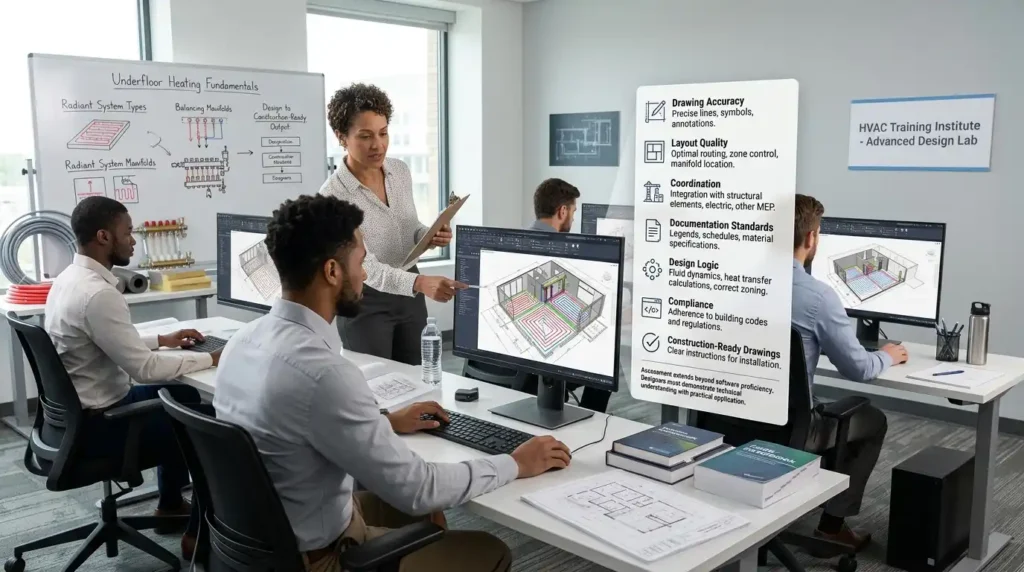
Training programmes assess competency through drawing accuracy, layout quality, coordination effectiveness, documentation standards, design logic, compliance with project requirements, and the ability to produce construction-ready HVAC drawings within realistic project scenarios.
Competency assessment extends beyond software proficiency. Professional HVAC designers must demonstrate technical understanding alongside drafting skills.
Assessment activities often require learners to create complete underfloor heating systems from architectural floor plans. These projects simulate workplace conditions and encourage practical application of design principles.
Common assessment criteria
Design reviews typically examine:
| Assessment Area | Evaluation Focus |
|---|---|
| Layout Accuracy | Pipe routing and spacing consistency |
| Manifold Design | Correct component representation |
| Documentation Quality | Annotation and labelling standards |
| Coordination | Clash avoidance and integration |
| Drawing Standards | Layer management and presentation |
| System Logic | Practicality of design decisions |
These criteria reflect the expectations commonly encountered within engineering consultancies and contractor organisations.
How do different learning approaches affect underfloor heating drafting skills?
Learning outcomes depend heavily on training methodology, with project-based drafting exercises producing stronger design capability than theory-only instruction because learners repeatedly apply technical concepts within realistic HVAC documentation scenarios.
Training providers use different instructional models. Some focus primarily on software commands. Others integrate technical design knowledge with drafting practice.
The distinction becomes important when evaluating workforce development strategies.
Comparison of common HVAC learning approaches
| Learning Approach | Primary Focus | Skill Development Outcome |
| Software-Centred Training | AutoCAD commands | Drafting proficiency |
| Theory-Centred Training | HVAC concepts | Technical understanding |
| Project-Based Training | Real design tasks | Applied design capability |
| Case Study Learning | Project analysis | Evaluation skills |
| Hybrid Learning Model | Design plus drafting | Comprehensive competency |
Project-based learning often produces stronger workplace readiness because trainees encounter realistic design challenges throughout the training process.
For HR managers evaluating technical training investments, this distinction directly influences learning transfer, productivity improvement, and workforce capability development.
How does underfloor heating training support workplace performance?
Underfloor heating drafting skills support workplace performance by improving design accuracy, reducing drawing revisions, strengthening multidisciplinary coordination, accelerating project delivery, and increasing confidence when working on modern energy-efficient building projects.
Engineering organisations increasingly seek professionals who can contribute immediately to project delivery. Underfloor heating expertise addresses a growing area of building services design.
The adoption of low-temperature heating systems continues to expand across residential and commercial developments. As a result, demand for designers who understand these systems has increased significantly.
Business benefits of structured HVAC training
Organisations often evaluate training through measurable outcomes. Relevant performance indicators include:
| Business Objective | Training Impact |
| Reduced Design Errors | Improved drawing accuracy |
| Faster Project Delivery | Increased drafting efficiency |
| Better Coordination | Fewer construction clashes |
| Enhanced Technical Capability | Broader project coverage |
| Workforce Development | Stronger internal expertise |
These outcomes support both individual career development and organisational capability improvement.
For workforce planning teams, technical HVAC training contributes to closing skills gaps associated with modern building services technologies. The combination of software proficiency, design understanding, and documentation expertise creates measurable value within engineering, construction, and facilities sectors.
How should organisations evaluate HVAC training that includes underfloor heating design?
Organisations should evaluate HVAC training based on practical design exercises, technical depth, project realism, assessment quality, workplace applicability, and the extent to which learners produce complete underfloor heating and manifold design documentation.
Training evaluation should focus on capability development rather than software exposure alone. Effective programmes teach learners how to think like HVAC designers rather than simply operate drafting tools.
Decision-makers should review curriculum structure carefully. The strongest programmes integrate technical principles with practical drawing production. This combination supports knowledge retention and workplace application.
The inclusion of manifold design exercises, heating circuit layouts, zoning strategies, coordination activities, and documentation standards provides a strong indicator of training relevance.
Discover More from Our Guide Library:
How Does AutoCAD HVAC Training Cover Quantity Take-Off From Design Drawings?
How Does AutoCAD HVAC Training Teach Drawing Set Organisation and Issue Management?
The AutoCAD HVAC and Plumbing Design Training Course represents the type of structured learning framework where drafting skills are connected directly to engineering applications. This approach aligns technical training with operational requirements commonly encountered in modern building services projects.
By understanding how AutoCAD HVAC training addresses underfloor heating layouts and manifold design, learners and organisations can better evaluate training options based on practical outcomes, technical depth, and workplace applicability rather than software familiarity alone.
Frequently Asked Questions
Is AutoCAD HVAC and Plumbing Design training suitable for beginners?
Yes, the AutoCAD HVAC and Plumbing Design Training Course is suitable for beginners as well as professionals seeking to improve their technical drafting skills. The course introduces HVAC and plumbing design principles alongside practical AutoCAD applications.
Does the course include HVAC and plumbing drawing exercises?
The AutoCAD HVAC and Plumbing Design Training Course includes practical drawing exercises that help learners develop HVAC layouts, plumbing schematics, duct routing plans, and piping system drawings. These exercises reflect common building services design requirements.
Why is AutoCAD important for HVAC and plumbing design projects?
AutoCAD helps designers create accurate HVAC and plumbing drawings that support construction, installation, and maintenance activities. Imperial Corporate Training Institute includes AutoCAD-based workflows to help learners understand industry-standard drafting practices.
What skills can professionals gain from an AutoCAD HVAC and Plumbing Design Training Course?
Professionals can gain skills in HVAC drafting, plumbing system design, equipment coordination, drawing annotation, layer management, and technical documentation. The AutoCAD HVAC and Plumbing Design Training Course develops competencies needed for building services engineering projects.