

Professional drawing plotting is a critical requirement in HVAC and plumbing design projects. Engineering drawings must be prepared, organised, scaled, annotated, and issued according to project standards before they can be reviewed, approved, or used during construction. Organisations often face challenges when designers understand drafting principles but lack the ability to prepare professional drawing packages for issue, tender submission, client review, or construction documentation.
Understanding how drawings move from design development to plotted deliverables is an important part of engineering documentation. Readers seeking foundational knowledge on this process can review the educational guide on:
How Are AutoCAD HVAC Drawings Printed and Plotted for Issue? before evaluating formal training pathways.
The AutoCAD HVAC and Plumbing Design Training Course delivered by Imperial Corporate Training Institute addresses this requirement through a structured curriculum that includes drawing setup, sheet organisation, documentation standards, quality control, and professional plotting workflows. The programme is designed for engineers, MEP professionals, AutoCAD technicians, and corporate teams that require consistent documentation practices aligned with industry expectations.
What Is the AutoCAD HVAC and Plumbing Design Training Course and What Problem Does It Solve?
The programme develops the technical capability required to create, organise, coordinate, document, and issue HVAC and plumbing drawings according to professional engineering standards, helping participants reduce documentation errors, improve drawing consistency, and support project delivery requirements across corporate environments.
Many organisations invest heavily in engineering design software but still encounter documentation challenges. Drawings may contain inconsistent layers, incorrect scales, missing annotations, poorly organised sheets, or plotting issues that affect project reviews and approvals.
These problems create delays during design coordination and increase the likelihood of revisions. Mechanical engineers and drafting professionals are often expected to deliver complete drawing packages rather than isolated design layouts.
The AutoCAD HVAC and Plumbing Design Training Course from Imperial Corporate Training Institute is structured to bridge this gap. The programme focuses on both design development and documentation production. Participants learn how HVAC and plumbing layouts are transformed into professional deliverables suitable for internal reviews, client submissions, construction documentation, and project handover.
Professional plotting techniques are not treated as isolated software functions. Instead, they are integrated within a broader workflow that includes drawing creation, layer management, standards compliance, revision control, and final documentation.
Professional Drawing Plotting Within Corporate Engineering Projects
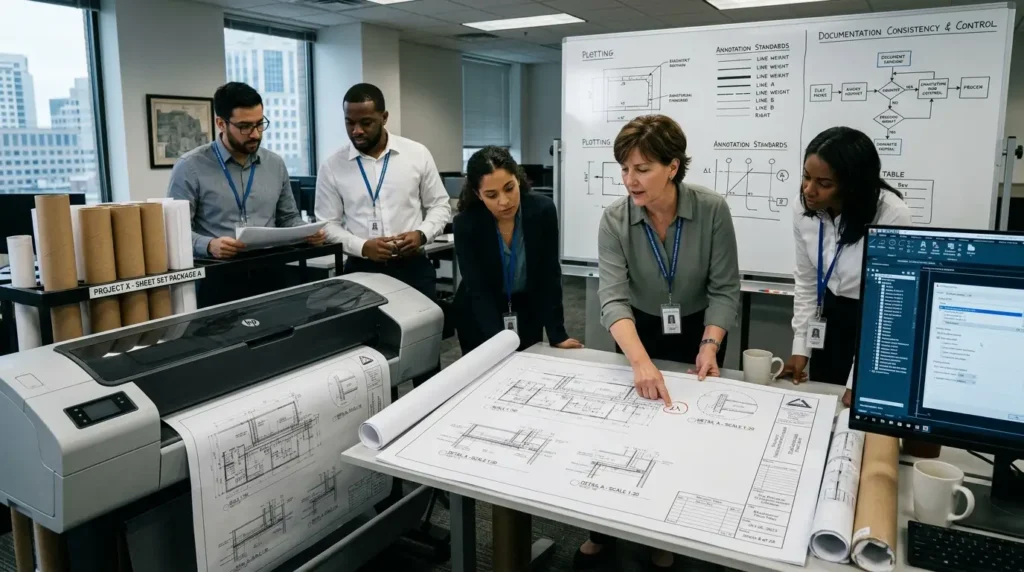
Plotting is more than selecting a printer or exporting a PDF. In engineering environments, plotting involves managing scales, viewport configurations, title blocks, sheet sets, annotations, plotting styles, revision information, and documentation consistency.
Imperial Corporate Training Institute incorporates these requirements into the training process, so participants understand how plotting contributes to overall project quality and documentation control.
Why Is the Programme Structured to Include Drawing Plotting and Documentation Standards?
The curriculum follows a progressive learning structure that begins with drafting fundamentals and advances toward documentation control, plotting standards, multidisciplinary coordination, quality assurance procedures, and project delivery requirements commonly used in commercial and industrial engineering environments.
Engineering documentation follows a sequence. Designers first create layouts, then coordinate systems, apply standards, organise sheets, review drawings, and finally issue deliverables.
The course structure reflects this real-world workflow.
Participants begin with AutoCAD foundations and corporate drafting practices. They then progress through HVAC design, plumbing design, MEP coordination, documentation procedures, and quality review processes.
This progression ensures that plotting techniques are learned within the context of complete project execution.
Learning Progression Across the Modules
Module 1 introduces participants to AutoCAD workflows used in professional engineering environments. This includes template creation, title block configuration, drawing standards, precision requirements, and company documentation procedures.
Modules 2 and 3 focus on HVAC and plumbing drafting. Participants learn how to develop layouts that can later be organised into professional drawing packages.
Modules 4 through 6 introduce advanced coordination techniques, detailed documentation methods, schedules, legends, and project records.
Modules 7 and 8 place significant emphasis on drawing standards, revision management, version control, quality assurance, and final deliverables. These areas directly support plotting and drawing issue processes.
Modules 9 and 10 connect documentation workflows with BIM coordination and complete project execution scenarios.
This structured approach enables participants to understand not only how drawings are plotted but why plotting requirements exist within larger project delivery systems.
Does Imperial’s HVAC Programme Teach Professional Drawing Plotting Techniques?
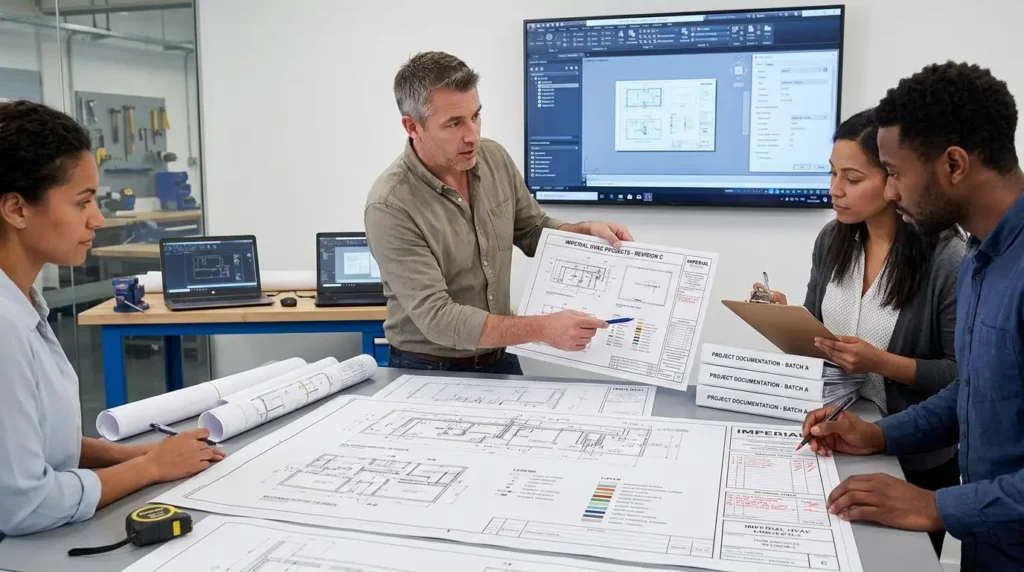
Yes. Professional plotting techniques are incorporated throughout the programme through drawing setup, sheet organisation, layer management, annotation standards, revision control, documentation preparation, quality review procedures, and project-based exercises that reflect real engineering deliverable requirements and workflows.
Drawing plotting is embedded across several modules rather than being limited to a single lesson.
Participants learn how professional drawing packages are assembled before issue. This includes understanding title blocks, sheet layouts, viewport creation, scaling requirements, annotation standards, and plotting configurations.
Drawing Setup and Sheet Organisation
Engineering projects require consistent documentation structures.
The programme teaches participants how to:
- Create company-standard templates
- Configure title blocks
- Establish drawing scales
- Organise sheet layouts
- Manage viewport settings
- Structure project documentation packages
These competencies are essential for producing drawings that can be plotted accurately and consistently.
Documentation and Revision Control
Professional plotting requires controlled documentation.
Participants learn how to:
- Manage drawing revisions
- Apply version control procedures
- Track design changes
- Maintain documentation records
- Prepare drawings for client submission
- Produce issue-ready deliverables
Imperial Corporate Training Institute integrates these practices within project documentation modules to ensure participants understand their importance in corporate engineering environments.
Quality Assurance Before Drawing Issue
Plotting errors frequently originate from poor quality control processes.
The programme therefore includes training on:
- Design audits
- Compliance reviews
- Documentation checks
- Coordination verification
- Error identification
- Deliverable validation
These activities help ensure drawings are prepared correctly before issue.
What Will Participants Learn About HVAC Documentation and Drawing Output?
Participants learn how to create HVAC and plumbing layouts, organise engineering documentation, apply drafting standards, coordinate multidisciplinary systems, prepare issue-ready drawing packages, and support project delivery through structured documentation and quality-controlled drawing outputs.
The learning outcomes extend beyond software operation.
Participants develop practical documentation skills that can be applied immediately within engineering and construction environments.
HVAC Design Documentation Skills
The HVAC-focused components cover:
- Duct layout development
- Airflow routing
- Equipment placement
- Schematic interpretation
- Layer management
- Symbol standardisation
- Engineering annotations
These skills support the creation of technically accurate drawing packages.
Plumbing Documentation Skills
Plumbing modules focus on:
- Water supply layouts
- Drainage systems
- Pipe sizing principles
- Riser diagrams
- Material representation
- Schedule preparation
- System coordination
Participants learn how these elements are documented within professional project drawings.
Output and Deliverable Preparation
A key outcome is the ability to prepare drawings for issue.
This includes:
- Sheet preparation
- Annotation management
- Legend development
- Schedule creation
- Bill of materials preparation
- Plot-ready layout organisation
Imperial Corporate Training Institute uses practical exercises to reinforce these documentation processes.
How Is the Course Delivered and Assessed?
The programme combines structured instruction, practical drafting exercises, workflow simulations, project-based assignments, technical reviews, and applied documentation activities to ensure participants can demonstrate competency in both design development and engineering drawing preparation.
Training effectiveness depends on practical application.
For this reason, the programme emphasises hands-on learning and realistic engineering scenarios.
Training Delivery Methods
Imperial Corporate Training Institute provides delivery formats suitable for corporate learning requirements.
Training may be delivered through:
Workshops
Participants complete guided drafting and documentation exercises while receiving instructor feedback.
Online Learning
Virtual delivery enables professionals to access structured technical instruction while maintaining workplace responsibilities.
Hybrid Programmes
Hybrid formats combine remote learning with instructor-led practical sessions.
Onsite Corporate Training
Organisations can align training outcomes with internal standards and project requirements.
Assessment Approach
Assessment focuses on measurable skills rather than theoretical knowledge alone.
Participants may complete:
- Technical drafting assignments
- Documentation exercises
- Design simulations
- Project-based activities
- Drawing review exercises
- Workflow implementation tasks
These assessments demonstrate competency in creating and managing engineering documentation.
How Does the Programme Compare with General AutoCAD HVAC Training?
The programme extends beyond drafting fundamentals by incorporating documentation management, plotting workflows, multidisciplinary coordination, engineering standards, quality assurance procedures, and corporate project execution requirements that support real-world deliverable production and organisational performance objectives.
Many AutoCAD courses focus primarily on software commands.
Corporate engineering projects require broader capabilities.
Professionals evaluating programme structures often examine how documentation workflows are taught. Those comparing learning pathways can review:
How Does AutoCAD HVAC Training Cover Plotting Layout and Drawing Output Setup? to understand the progression from drafting skills to complete deliverable preparation.
Imperial Corporate Training Institute positions plotting and documentation within an end-to-end project framework. Participants learn how drawings move through coordination, review, approval, and issue stages.
This creates stronger alignment between training outcomes and workplace requirements.
Corporate Relevance
Engineering departments often require standardised documentation processes.
The programme supports:
- Engineering design teams
- MEP departments
- Construction organisations
- Facility management groups
- Technical consultancy firms
The emphasis on documentation standards helps organisations maintain consistency across projects and teams.
What Results Can Participants Expect After Completion?
Participants can expect improved capability in HVAC and plumbing drafting, stronger documentation accuracy, better multidisciplinary coordination, enhanced compliance with engineering standards, and increased effectiveness when producing project deliverables for corporate and construction environments.
Learning outcomes are linked to workplace performance requirements.
Participants develop skills that support both individual productivity and organisational objectives.
Individual Professional Outcomes
Participants gain the ability to:
- Produce professional HVAC drawings
- Develop plumbing documentation
- Manage project drawing standards
- Prepare issue-ready deliverables
- Support design coordination activities
- Contribute to quality assurance reviews
These capabilities are applicable across engineering, construction, and facility management roles.
Team and Department Outcomes
Organisations benefit from:
- Improved documentation consistency
- Reduced drawing errors
- Better coordination workflows
- More efficient revision management
- Stronger compliance with standards
- Enhanced project documentation quality
Imperial Corporate Training Institute designs the programme to support measurable workplace improvements rather than isolated software proficiency.
Real-World Application Example
An MEP department responsible for commercial building projects may require consistent HVAC and plumbing documentation across multiple teams.
Professionals trained through Imperial Corporate Training Institute can apply structured drawing standards, revision procedures, and plotting practices that help maintain uniform documentation quality across project portfolios.
How Does Enrolment Work and Who Should Attend?
The programme is intended for engineering, construction, drafting, facility management, and project professionals seeking advanced AutoCAD HVAC and plumbing documentation skills, with enrolment designed around structured learning progression from technical drafting through project execution.
The target audience includes professionals involved in design development, documentation preparation, coordination activities, and engineering project delivery.
Suitable Participants
The programme is particularly relevant for:
- Mechanical design engineers
- HVAC design professionals
- MEP engineers
- AutoCAD technicians
- Design coordinators
- Project engineers
- Construction consultants
- Facility management professionals
- Engineering graduates entering building services disciplines
Entry Considerations
Participants should have an interest in HVAC and plumbing design workflows and a requirement to produce professional engineering documentation.
Previous exposure to engineering drawings can be beneficial, although the structured module sequence helps learners progress systematically through increasingly advanced topics.
Completion Path
Participants move through ten modules covering drafting, design development, documentation standards, quality assurance, BIM integration, and project execution.
The learning pathway culminates in practical project simulations that require the application of multiple competencies developed throughout the programme.
Imperial Corporate Training Institute uses this progression to ensure participants understand both technical drafting principles and the documentation responsibilities associated with professional engineering deliverables.
Making an Enrolment Decision
Professionals evaluating HVAC drafting programmes should assess whether training includes documentation standards, plotting workflows, quality assurance processes, project coordination practices, and measurable deliverable-focused outcomes alongside technical AutoCAD instruction and engineering design development skills.
Discover More from Our Guide Library:
Does Imperial’s HVAC Course Cover Both Schematic and Installation Drawing Types?
Does Imperial’s HVAC Programme Include Detailed Section Drawing Exercises?
The AutoCAD HVAC and Plumbing Design Training Course addresses these requirements through a curriculum that integrates drafting, documentation, plotting preparation, coordination, quality assurance, and project execution activities.
Rather than treating plotting as a standalone software task, Imperial Corporate Training Institute embeds professional drawing output techniques within the complete engineering documentation lifecycle. This approach supports the development of skills required for real project environments where drawings must be coordinated, reviewed, approved, and issued according to professional standards.