

Organisations involved in building services design often require engineers, MEP professionals, and technical drafting teams to produce more than basic layouts. Project documentation frequently includes sectional views, construction details, equipment connections, duct risers, pipe penetrations, coordination drawings, and installation documentation. A common evaluation question for prospective learners is whether detailed section drawing exercises are included within a structured HVAC design programme.
The answer is yes. The AutoCAD HVAC and Plumbing Design Training Course delivered by Imperial Corporate Training Institute incorporates practical drafting activities that support the development of detailed HVAC and plumbing documentation, including the production of sections, coordinated layouts, construction details, and project-ready engineering drawings. These capabilities are embedded throughout the curriculum rather than being treated as isolated software functions.
Professionals who want foundational knowledge may first benefit from understanding how AutoCAD manages HVAC sections and detailed drawing workflows through the educational resource:
How Does AutoCAD Handle Sections and Details for HVAC System Drawings?
This course is designed for decision-stage learners who need clarity on curriculum depth, learning outcomes, delivery methods, assessment standards, and workplace applicability before selecting a professional development programme.
What Is the AutoCAD HVAC and Plumbing Design Training Course and What Problem Does It Solve?
The programme addresses the gap between basic AutoCAD drafting skills and the practical engineering documentation requirements needed for HVAC and plumbing projects, including coordinated layouts, detailed sections, construction documentation, multidisciplinary integration, and compliance with professional engineering standards.
Many engineering professionals can create plans and schematic layouts but encounter challenges when producing detailed documentation required for construction, installation, review, and project approvals. Employers frequently require technical staff to understand not only drawing creation but also the relationships between systems, equipment, building structures, and construction details.
The AutoCAD HVAC and Plumbing Design Training Course from Imperial Corporate Training Institute addresses this challenge through a structured progression from drafting fundamentals to advanced project execution. Participants learn how HVAC and plumbing systems are represented, coordinated, documented, reviewed, and delivered within professional engineering environments.
Detailed section drawing exercises form part of this broader learning process. Rather than focusing solely on software commands, the course demonstrates how sections support engineering communication, design verification, clash prevention, and installation planning.
Participants develop skills relevant to commercial buildings, industrial facilities, infrastructure projects, and multidisciplinary construction environments where detailed documentation directly affects project delivery quality.
Why Is the Programme Structured to Include Detailed Section Drawing Exercises?
Section drawings are essential for communicating spatial relationships, equipment positioning, duct routing, piping arrangements, and construction requirements, making them a critical component of professional HVAC and plumbing documentation and therefore an integral part of the training structure.
Modern HVAC and plumbing projects involve significant coordination between mechanical, electrical, structural, architectural, and facility management teams. Plan views alone rarely provide sufficient information for installation and construction activities.
Imperial Corporate Training Institute structures the programme around the progression engineers follow in real projects. Participants first establish drafting fundamentals, then develop system layouts, and ultimately create coordinated documentation that includes sections and detailed construction information.
This progression mirrors workplace requirements. Engineers commonly begin with design concepts before developing coordinated plans, riser diagrams, sectional views, equipment details, schedules, annotations, and project documentation packages.
Building Documentation Skills Through Progressive Learning
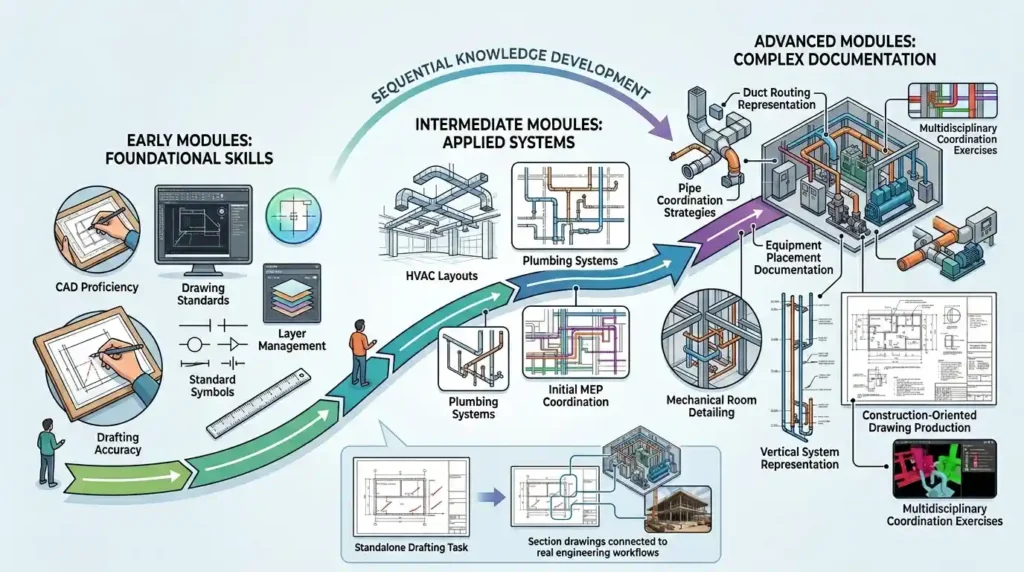
The curriculum develops knowledge sequentially. Early modules establish AutoCAD proficiency, drawing standards, layer management, and drafting accuracy. Intermediate modules focus on HVAC layouts, plumbing systems, and MEP coordination.
As participants progress, they encounter increasingly complex documentation requirements. These include:
- Duct routing representation
- Pipe coordination strategies
- Equipment placement documentation
- Mechanical room detailing
- Vertical system representation
- Construction-oriented drawing production
- Multidisciplinary coordination exercises
This structure ensures section drawing exercises are connected to real engineering workflows rather than treated as standalone drafting tasks.
What Will Participants Learn About Sections, Details, and HVAC Documentation?
Participants learn how to create coordinated HVAC and plumbing drawings, develop technical sections, manage documentation standards, organise project information, integrate engineering calculations, and produce deliverables aligned with professional corporate project requirements.
The course curriculum covers a broad range of competencies that contribute directly to producing detailed engineering documentation.
Module 1: Corporate Design Workflow Foundations
The opening module introduces participants to professional AutoCAD environments used within engineering organisations. Learners establish templates, title blocks, drawing standards, scaling procedures, and documentation conventions.
These foundations support later section drawing activities by ensuring consistency across project documentation.
Module 2: HVAC Drafting and Layout Development
Participants learn HVAC system representation, airflow routing, duct layout development, diffuser placement, and mechanical drafting conventions.
During this stage, learners begin understanding how plan information translates into sectional documentation. HVAC layouts frequently require sectional views to demonstrate elevation changes, ceiling coordination, and equipment placement.
Module 3: Plumbing and Drainage Documentation
The plumbing component focuses on system layouts, riser development, drainage coordination, pipe sizing, and material representation.
Section drawing exercises become particularly valuable when documenting vertical plumbing systems, floor penetrations, risers, and service coordination requirements.
Module 4: Advanced MEP Coordination
This module introduces external references, 3D AutoCAD capabilities, clash detection principles, and space management techniques.
Detailed sections are often created to resolve coordination challenges between mechanical and structural systems. Participants learn how documentation supports multidisciplinary communication.
Module 5: HVAC Design Optimisation
Design calculations and documentation become increasingly interconnected during this phase. Learners examine airflow distribution, equipment selection considerations, and design optimisation principles.
Engineering sections help communicate these design decisions clearly within project deliverables.
Module 6: Plumbing Detailing and Documentation
This module directly supports detailed drawing production through schematic development, schedules, legends, and material documentation.
Participants learn how detailed documentation contributes to construction accuracy and project coordination.
How Are Detailed Section Drawing Exercises Produced During Training?

Learners apply AutoCAD drafting techniques within realistic engineering scenarios where section creation, detailing, annotation, coordination, and documentation activities replicate workplace design and project delivery requirements commonly encountered in commercial and industrial developments.
The programme focuses on practical application rather than software theory. Detailed section exercises emerge naturally from project-based activities.
Participants work through design scenarios requiring documentation beyond simple plans. They must interpret engineering requirements, organise drawing information, coordinate services, and communicate design intent effectively.
Practical Drawing Development
Exercises may involve:
- Mechanical room layouts
- Duct routing coordination
- Pipe installation documentation
- Equipment connection detailing
- Service penetration representation
- Vertical riser coordination
- Construction-oriented drawing production
These activities reinforce the importance of sections as communication tools within engineering documentation.
Real Project Context
Imperial Corporate Training Institute emphasises corporate project workflows throughout the training experience. Rather than creating isolated drawings, participants develop documentation packages that resemble professional deliverables.
This approach helps learners understand when sections are required, what information they should contain, and how they contribute to project execution.
Professionals evaluating training depth may also find value in reviewing:
How Are Sections and Construction Details Produced in AutoCAD HVAC Training?
How Is the Course Delivered?
The programme uses structured learning methods that combine technical instruction, practical workshops, project-based exercises, simulations, documentation activities, and professional review processes to support measurable development of HVAC and plumbing design competencies.
Training effectiveness depends on both content quality and delivery methodology. Imperial Corporate Training Institute applies a structured approach designed for corporate learners and technical professionals.
Workshop-Based Learning
Workshops allow participants to apply concepts immediately after instruction. Drafting exercises reinforce theoretical knowledge through practical implementation.
This format supports retention and enables participants to build confidence with increasingly complex design tasks.
Project Simulations
The curriculum includes realistic project scenarios that replicate engineering documentation workflows. Participants encounter challenges similar to those found within professional design environments.
These simulations help develop decision-making capabilities alongside software proficiency.
Documentation-Focused Assignments
Assignments focus on creating deliverables rather than merely demonstrating software functions. Participants produce drawings, layouts, schedules, coordinated documentation, and project records.
This aligns learning outcomes with workplace expectations.
Flexible Corporate Delivery
Imperial Corporate Training Institute supports delivery formats suitable for organisational requirements, including classroom instruction, corporate workshops, onsite programmes, and other structured professional development environments.
This flexibility enables organisations to align training delivery with workforce development objectives.
How Are Participants Assessed Throughout the Programme?
Assessment focuses on practical competence, documentation accuracy, design coordination, workflow execution, project simulations, drawing quality, and the ability to produce professional engineering deliverables that meet established standards and project requirements.
Assessment methods are designed to verify workplace readiness rather than test theoretical knowledge alone.
Participants demonstrate their capabilities through practical exercises, technical assignments, project activities, and documentation reviews.
Technical Drafting Assignments
Assignments evaluate the ability to create organised and technically accurate drawings.
Participants apply drafting standards, coordinate systems, manage layers, and produce structured documentation.
Design Documentation Reviews
Review activities assess the completeness and quality of engineering deliverables.
This process reflects real-world quality assurance procedures used in professional engineering organisations.
Project-Based Evaluation
Project simulations provide opportunities to demonstrate integrated skills.
Participants apply drafting, coordination, detailing, documentation, and communication capabilities within realistic engineering contexts.
Quality Assurance Activities
The programme includes design review processes that help participants identify discrepancies, improve documentation quality, and strengthen technical accuracy.
What Results Can Organisations and Professionals Expect?
Successful participants develop stronger drafting capabilities, improved documentation accuracy, enhanced coordination skills, better project communication practices, and increased ability to contribute effectively to engineering, construction, and facility management environments.
Training outcomes are directly linked to workplace performance.
Imperial Corporate Training Institute structures learning objectives around measurable professional capabilities rather than general software familiarity.
Improved Engineering Documentation
Participants gain the ability to create more comprehensive and organised project documentation.
This includes layouts, schedules, annotations, details, coordinated drawings, and section-based representations.
Stronger Coordination Skills
Engineering projects increasingly require multidisciplinary collaboration.
Participants learn techniques that improve communication between mechanical, electrical, structural, and architectural teams.
Greater Project Accuracy
Accurate documentation helps reduce design errors, coordination issues, and revision requirements.
The programme emphasises quality control processes that support improved project outcomes.
Enhanced Professional Capability
Engineers, MEP specialists, design coordinators, consultants, and technical drafting professionals can apply these competencies across commercial, industrial, and infrastructure projects.
Imperial Corporate Training Institute aligns training outcomes with contemporary corporate engineering expectations and international documentation standards.
How Does Enrolment Work and Who Should Consider the Programme?
The programme is intended for professionals involved in HVAC, plumbing, MEP coordination, engineering design, drafting, project delivery, and construction documentation who require structured development of practical AutoCAD-based mechanical system design competencies.
The course is suitable for a wide range of technical professionals.
Ideal Participants
Target learners include:
- Mechanical design engineers
- HVAC professionals
- MEP engineers
- AutoCAD technicians
- Design coordinators
- Construction consultants
- Project engineers
- Facility management professionals
- Engineering graduates entering building services sectors
Entry Considerations
Participants benefit most when they possess an interest in engineering documentation, building services systems, or technical design workflows.
The structured curriculum supports progressive development from foundational knowledge to advanced project execution.
Discover More from Our Guide Library:
How Does Imperial’s HVAC Course Develop Multi-Discipline Coordination Skills?
Does Imperial’s HVAC Course Cover Drawing Issue Management Procedures?