

HVAC drawings communicate far more than equipment locations and duct routes. Construction teams rely on sections and detailed drawings to understand elevations, clearances, installation requirements, and coordination between building services. For organisations developing technical design capability, understanding how these drawings are produced within training programmes helps evaluate whether a learning pathway develops practical workplace competence.
In HVAC design environments, sections and details transform two-dimensional layouts into construction-ready documentation. Professionals comparing technical learning approaches often review how training addresses drawing interpretation, model coordination, and detailing accuracy. Those seeking foundational knowledge of HVAC detailing concepts often begin by exploring:
How Does AutoCAD Handle Sections and Details for HVAC System Drawings? before evaluating how these techniques are taught in structured training environments.
How do sections contribute to HVAC design documentation?
Sections provide a vertical representation of HVAC systems, allowing designers to visualise heights, clearances, equipment relationships, and installation requirements. They bridge the gap between plan drawings and physical construction conditions, ensuring accurate communication between engineers, contractors, and facility stakeholders.
Plan views show horizontal layouts.
Sections reveal what happens above and below those layouts.
An HVAC section cuts through a building and exposes internal relationships between ducts, pipes, structural elements, ceilings, equipment, and occupied spaces. This perspective helps designers verify that systems fit within available building zones.
Training programmes typically introduce section drawing after learners understand basic HVAC layouts. This progression reflects workplace practice because professionals first establish system routing before analysing vertical coordination.
In commercial buildings, sections support several objectives:
- Ceiling void coordination
- Duct elevation verification
- Equipment installation planning
- Structural conflict identification
- Maintenance access assessment
- Construction sequencing
Without sections, design teams rely on assumptions regarding available space. Construction projects frequently encounter delays when these assumptions prove incorrect.
For HR teams evaluating technical training investments, section drawing competence represents a measurable skill because it directly affects drawing quality, coordination efficiency, and project accuracy.
What information appears in HVAC sections?
A section drawing typically includes:
- Supply and return ductwork
- Chilled water piping
- Drainage connections
- Equipment elevations
- Ceiling heights
- Structural beams
- Fire protection systems
- Access requirements
- Dimension references
The ability to represent these elements accurately distinguishes basic drafting from professional HVAC documentation.
How are construction details taught within AutoCAD HVAC training?
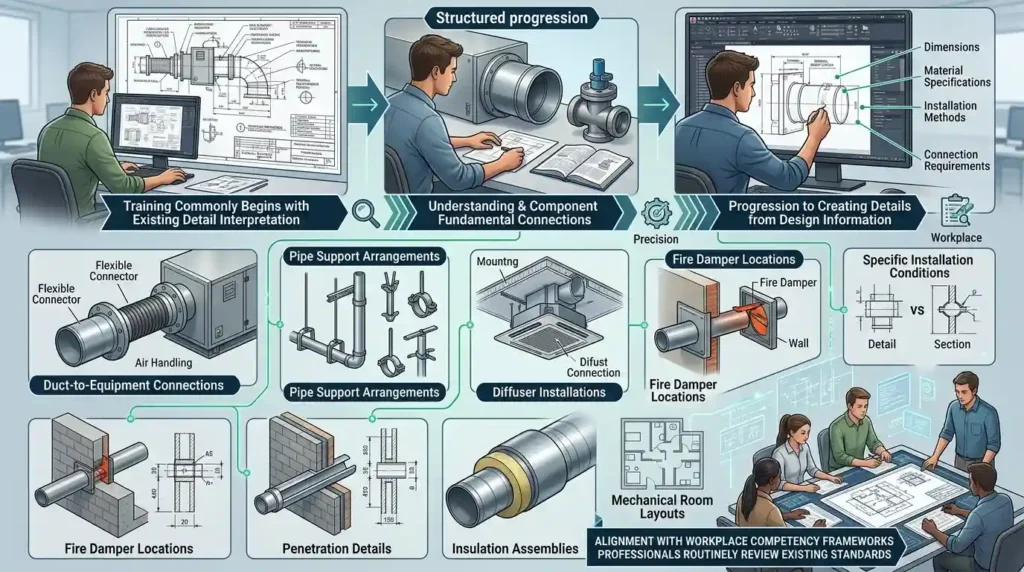
Construction details are taught through a structured progression that moves from component understanding to drawing production. Learners develop the ability to create enlarged technical views showing installation methods, connection requirements, dimensions, materials, and construction standards used during project execution.
Construction details focus on precision.
While sections provide broader context, details concentrate on specific installation conditions.
Examples include:
- Duct-to-equipment connections
- Pipe support arrangements
- Diffuser installations
- Fire damper locations
- Penetration details
- Insulation assemblies
- Mechanical room layouts
Training commonly begins with existing detail interpretation.
Learners examine professional drawings to understand symbols, line weights, annotations, dimensions, and technical references. Once these concepts are understood, participants progress to creating details from design information.
This learning sequence aligns with workplace competency frameworks because professionals routinely review existing standards before producing new documentation.
Within the AutoCAD HVAC and Plumbing Design Training Course, detail production is generally integrated with drafting workflows rather than taught as an isolated subject. This reflects real project environments where details emerge from design decisions and coordination activities.
Why are construction details important?
Construction details reduce ambiguity.
They provide contractors with explicit installation instructions.
Benefits include:
- Reduced rework
- Faster construction
- Improved quality control
- Better compliance outcomes
- Lower coordination costs
- More predictable project delivery
For organisations managing engineering talent pipelines, these capabilities support operational performance and project consistency.
What AutoCAD tools are commonly used to create HVAC sections and details?
AutoCAD section and detail production relies on drafting tools, annotation systems, layer management techniques, scaling controls, and reference workflows. Effective training focuses on integrating these functions into repeatable documentation processes rather than teaching software commands in isolation.
Technical proficiency depends on workflow efficiency.
Professional HVAC drawings require consistency across multiple sheets and project stages.
Common AutoCAD functions include:
Layer Management
Layers organise drawing elements.
Separate layers often control:
- Ductwork
- Pipework
- Equipment
- Dimensions
- Annotations
- Structural references
Proper layer management improves visibility and drawing control.
Annotation Tools
Annotations communicate design intent.
Training typically covers:
- Text styles
- Leaders
- Multileaders
- Callouts
- Notes
- Reference tags
Accurate annotation supports construction interpretation.
Dimensioning Functions
Dimensions establish measurable requirements.
Designers use dimensions to communicate:
- Elevations
- Offsets
- Clearances
- Equipment spacing
- Service access zones
External References (Xrefs)
Xrefs enable multidisciplinary coordination.
Mechanical drawings frequently reference:
- Architectural plans
- Structural drawings
- Electrical layouts
This workflow reflects real project delivery practices where multiple disciplines contribute to a shared design environment.
How does section drawing training improve coordination skills?
Section drawing training develops spatial awareness and coordination capabilities by requiring learners to analyse interactions between HVAC systems, structural components, architectural features, and other building services before construction begins.
Coordination remains one of the most significant challenges in building projects.
Mechanical systems compete for limited space.
Designers must identify conflicts before installation.
Section development encourages learners to evaluate:
- Ceiling congestion
- Beam interference
- Equipment accessibility
- Pipe routing constraints
- Vertical shaft utilisation
These activities strengthen problem-solving skills beyond software operation.
Many organisations identify a gap between drafting capability and coordination capability.
An individual may create accurate plans while struggling to identify construction conflicts.
Section-based exercises help close this gap because they require visualisation of three-dimensional building conditions.
What business value does coordination training provide?
Organisations often measure project success through:
- Reduced rework costs
- Faster approvals
- Improved design quality
- Lower change-order frequency
- Increased productivity
Coordination-focused learning contributes directly to these outcomes.
This explains why employers increasingly evaluate practical drawing exercises rather than software familiarity alone.
How do different HVAC training approaches teach detailing skills?
HVAC detailing skills are developed through various learning approaches, including software-focused instruction, project-based training, simulation exercises, and workplace-integrated learning. Each approach produces different competency outcomes and levels of practical readiness.
Training methodologies vary significantly.
The choice affects skill transfer and workplace performance.
| Training Approach | Primary Focus | Strengths | Limitations |
|---|---|---|---|
| Software Demonstration | AutoCAD functionality | Fast knowledge acquisition | Limited practical application |
| Project-Based Learning | Real drawing production | Strong workplace relevance | Requires more training time |
| Simulation Exercises | Controlled scenarios | Consistent assessment | Less project complexity |
| Workplace Projects | Live project exposure | High realism | Variable learning outcomes |
Project-based approaches generally provide stronger competency development because learners create complete documentation packages rather than isolated exercises.
This becomes particularly relevant when evaluating programmes such as:
Does Imperial’s HVAC Programme Include Detailed Section Drawing Exercises, where decision-makers assess how practical exercises contribute to job readiness?
What competencies are developed through section and detail drawing exercises?
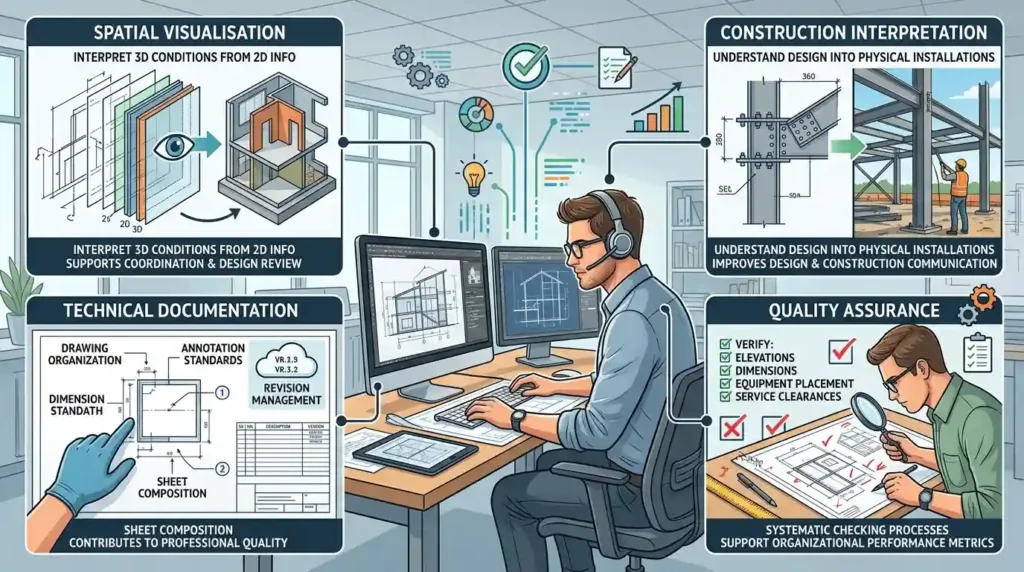
Section and detail drawing exercises develop technical drafting, design interpretation, spatial reasoning, coordination analysis, documentation control, and communication skills. These competencies support broader engineering and construction project objectives across multiple industries.
Employers increasingly seek measurable competencies.
Technical training delivers greater value when outcomes align with workplace requirements.
Key competencies include:
Spatial Visualisation
Designers learn to interpret three-dimensional conditions from two-dimensional information.
This capability supports coordination and design review activities.
Technical Documentation
Participants develop skills in:
- Drawing organisation
- Annotation standards
- Revision management
- Sheet composition
These skills contribute to professional documentation quality.
Construction Interpretation
Learners understand how design information translates into physical installations.
This perspective improves communication between design and construction teams.
Quality Assurance
Section reviews encourage systematic checking processes.
Professionals learn to verify:
- Elevations
- Dimensions
- Equipment placement
- Service clearances
Quality-focused behaviours support organisational performance metrics.
How are section drawings evaluated in professional training environments?
Professional training evaluates section drawings through accuracy, compliance, clarity, coordination quality, and documentation standards. Assessment frameworks focus on practical performance indicators that reflect real project requirements rather than software knowledge alone.
Modern technical training increasingly adopts competency-based assessment.
Evaluation criteria commonly include:
| Assessment Area | Measurement Focus |
| Accuracy | Correct dimensions and elevations |
| Coordination | Clash identification and resolution |
| Documentation | Drawing organisation and standards |
| Communication | Annotation clarity |
| Compliance | Adherence to design conventions |
This approach aligns learning outcomes with workplace expectations.
For HR departments and learning managers, competency-based assessment provides clearer evidence of capability development than attendance-based training metrics.
How is performance measured?
Training providers often assess:
- Drawing completion rates
- Error reduction
- Coordination accuracy
- Documentation quality
- Design review performance
These indicators support ROI measurement for workforce development initiatives.
Why do organisations value employees who can produce HVAC sections and details?
Employees capable of producing HVAC sections and construction details contribute to project accuracy, interdisciplinary coordination, construction efficiency, and documentation quality. Their skills help organisations reduce risk while improving project delivery performance and technical communication standards.
Construction projects involve multiple stakeholders.
Errors in documentation create downstream impacts across design, procurement, installation, and commissioning phases.
Professionals who understand sections and detailing support:
- Better design decisions
- Improved contractor communication
- Faster issue resolution
- More reliable project execution
Industry demand for these capabilities continues to increase because modern buildings contain increasingly complex mechanical systems.
Healthcare facilities, data centres, manufacturing plants, airports, and commercial developments require extensive service coordination.
Discover More from Our Guide Library:
How Does Imperial’s HVAC Course Develop Multi-Discipline Coordination Skills?
Does Imperial’s HVAC Course Cover Drawing Issue Management Procedures?
Detailed HVAC documentation plays a central role in meeting those requirements.
As organisations address engineering skill shortages, training programmes that combine AutoCAD proficiency with section development and construction detailing provide stronger alignment with workplace needs than software-only instruction.
The effectiveness of a learning pathway depends on how well it develops practical drawing production capabilities, coordination awareness, and documentation standards. These factors determine whether learners can translate design concepts into construction-ready information that supports project success across the building lifecycle.
Frequently Asked Questions
Who should attend an AutoCAD HVAC and Plumbing Design Training Course?
The AutoCAD HVAC and Plumbing Design Training Course is suitable for mechanical engineers, HVAC technicians, plumbing designers, CAD drafters, and construction professionals. It helps participants develop technical drawing and design documentation skills for building services projects.
How does AutoCAD support HVAC and plumbing system design?
AutoCAD supports HVAC and plumbing design through precise drafting tools, layer management, annotation features, and detailed construction drawing capabilities. The AutoCAD HVAC and Plumbing Design Training Course at Imperial Corporate Training Institute teaches how these tools are applied in professional design workflows.
Why are HVAC sections and detailed drawings important in construction projects?
HVAC sections and detailed drawings help teams understand system elevations, equipment locations, service clearances, and installation requirements. The AutoCAD HVAC and Plumbing Design Training Course explains how detailed documentation improves coordination between engineering and construction disciplines.
What skills can participants gain from an AutoCAD HVAC and Plumbing Design Training Course?
Participants gain skills in HVAC drafting, plumbing layout design, construction detailing, technical documentation, and drawing coordination. Imperial Corporate Training Institute integrates practical exercises that reflect real-world building services design requirements.