

This course closes the gap between AutoCAD drafting skills and tender‑ready HVAC/plumbing deliverables for corporate engineering teams. It targets errors in documentation, coordination delays, and non‑compliant tender submissions.
The problem in many organisations is a mismatch between CAD output and tender requirements. Individual drafters can produce drawings, but those drawings often lack consistent templates, revision control, schedules, and coordination standards required by procurement and clients. Human errors in layer use, unclear annotations, missing schedules, and poor cross‑discipline coordination create rework and tender rejection.
Imperial Corporate Training Institute designed this course to remove those barriers. The course specifies firm drafting conventions, deliverable checklists, and QA steps that convert design intent into contract‑grade documents.
Early awareness material on:
How HVAC engineers use AutoCAD for design submissions explains the context and typical failures.
Why this course is structured this way
The curriculum follows a technical progression from core AutoCAD proficiency to tender documentation, integrating QA, coordination, and BIM interoperability to meet corporate delivery standards.
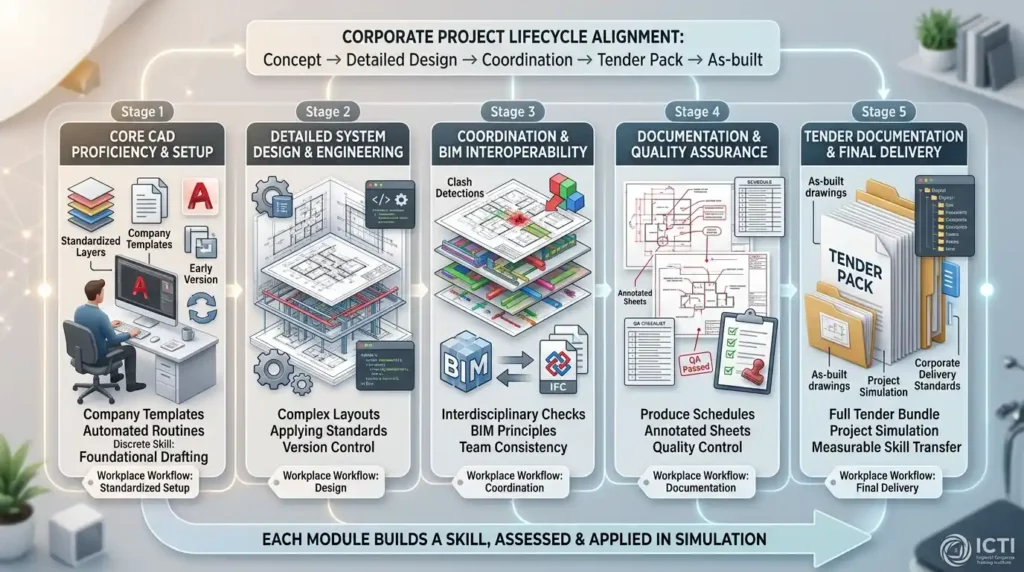
The structure reflects common workplace workflows. Learners begin with standardised CAD setup and proceed through system design, coordination, and documentation. Each module builds a discrete skill that is assessed and then applied in a project simulation. This sequencing aligns with corporate project lifecycles: concept → detailed design → coordination → tender pack → as‑built.
Imperial Corporate Training Institute uses this progression to ensure measurable skill transfer. Company templates, automated routines, and version control are introduced early. Later modules require learners to apply those standards to complex layouts, produce schedules, and prepare a full tender bundle. The course therefore trains for both individual proficiency and team consistency.
What will participants learn?
Participants will gain measurable skills in AutoCAD-based HVAC and plumbing design, documentation standards, coordination techniques, and tender-ready deliverable production.
Learning outcomes (measurable)
- Produce company‑standard CAD templates, title blocks, and layer structures to reduce revision cycles by defined metrics.
- Create detailed ducting and piping layouts with correct sizing, slopes, and annotations.
- Generate plumbing riser diagrams, fixture schedules, and bills of materials to tender specification.
- Use Xrefs, external layers and naming conventions to enable reliable multi‑discipline coordination.
- Perform basic clash checks and document conflict resolutions for tender submissions.
- Integrate AutoCAD deliverables with BIM/Revit workflows for data continuity.
- Apply QA checklists and sign‑off procedures to create tender bundles acceptable to clients and procurement.
Module breakdown and skill progression
- Module 1: Introduction to AutoCAD for Corporate Design Workflows
- Set up company templates, standard title blocks, and drawing scales.
- Establish layer naming conventions and precision settings.
- Deliverable: Template pack and checklist for corporate drawings.
- Module 2: Fundamentals of HVAC Design Drafting
- Produce duct layouts, diffuser schedules, and airflow routing.
- Create blocks for equipment and fittings with parameter control.
- Deliverable: Detailed HVAC plan for a single floor.
- Module 3: Plumbing and Drainage Design Using AutoCAD
- Draft cold/hot water systems, drainage runs, and risers.
- Calculate slopes and pipe sizes; annotate pipe types and materials.
- Deliverable: Plumbing layout with riser and schedule.
- Module 4: Advanced AutoCAD Tools for MEP Coordination
- Implement Xrefs, external file management and layer filters.
- Use 3D tools for space checks and basic clash identification.
- Deliverable: Coordinated multi‑discipline drawing set.
- Module 5: HVAC Load Calculations and Design Optimisation
- Link AutoCAD layouts to load calculation outputs.
- Size ducts and select equipment to match calculations.
- Deliverable: HVAC sizing sheet and layout aligned to calculations.
- Module 6: Plumbing System Detailing and Documentation
- Create legends, pipe schedules, and bills of materials.
- Carry out simple pressure drop and fixture unit checks.
- Deliverable: Tender‑grade plumbing package.
- Module 7: Corporate Project Implementation and Documentation Standards
- Define drawing revision workflows and version control.
- Implement deliverable checklists for tenders and approvals.
- Deliverable: Company CAD standards manual draft.
- Module 8: Quality Assurance and Design Review Process
- Run internal audits, produce review markups, and track corrective actions.
- Deliverable: QA report and corrected final drawings.
- Module 9: Integration with BIM and Revit for MEP Coordination
- Establish data transfers, coordinate element IDs and parameters.
- Deliverable: Linked AutoCAD and Revit exchange workflow.
- Module 10: Corporate-Level Project Execution and Professional Development
- Complete a simulated project from concept to tender pack.
- Present technical documentation to a review panel.
- Deliverable: Full tender submission ready for client review.
How is the course delivered?
Delivery combines instructor-led workshops, practical lab sessions, and a final project simulation; formats include on-site, live online, and hybrid modalities to suit corporate deployment.
Delivery modes
- On-site intensive. Instructor-led sessions at client premises or Imperial Corporate Training Institute facilities. Best when team alignment and immediate collaboration are required.
- Live online. Scheduled virtual workshops and supervised CAD labs. Suitable for dispersed teams and individual enrolments.
- Hybrid. Combination of on‑site kick‑off plus online labs for follow‑through. Ideal for ongoing corporate upskilling without extended site presence.
Duration and scheduling
- Typical programme length is 40–60 contact hours. This is configurable to 5‑day intensive or modular delivery across 6–8 weeks for reduced operational impact.
- Sessions are half‑day or full‑day blocks, with supervised lab time that matches corporate shift patterns where required.
Instructional methods
- Short lectures establish standards and techniques.
- Guided lab exercises apply techniques to corporate templates and sample projects.
- Real‑world datasets replicate corporate CAD libraries, site constraints, and client deliverable standards.
- Peer review sessions mimic internal QA and multidisciplinary coordination meetings.
- Final simulation requires submission of a tender pack that meets specified acceptance criteria.
Assessment methods
Assessment comprises practical assignments, timed CAD tests, documented peer reviews, and a capstone project evaluated against tender acceptance criteria.
- Formative assessments: module assignments graded against rubric for draft quality, layer usage, annotation completeness, and schedule accuracy.
- Timed competence tests: short practical exams to verify core AutoCAD functions and template setup speed.
- Simulation: capstone design for a medium‑scale commercial block. Participants submit a tender bundle including drawings, schedules, and a QA report.
- Criteria: each deliverable is measured against defined pass marks for compliance, coordination, and documentation completeness.
- Certification: participants receive a completion certificate from Imperial Corporate Training Institute on meeting assessment thresholds.
What results can be expected?
Participants will deliver tender‑ready CAD outputs, reduce coordination rework, and accelerate approval cycles, measured by reduced revision counts and faster tender submissions.
Workplace impact (measurable)
- Reduced drawing revisions: adopting company templates and QA checklists decreases revision iterations per drawing. Typical target reduction specified in course KPIs is 30–50% within the first project post‑training.
- Faster tender turnaround: standardised deliverables and checklists shorten internal review time. Target measurable improvement is 20–40% in submission readiness time.
- Fewer coordination conflicts: using Xref discipline and clash documentation reduces on‑site corrections. Metrics include reduced RFIs and coordination change orders.
- Improved procurement compliance: tender bundles meet client documentation standards, lowering rejected bids.
- Team consistency: HR and engineering managers obtain predictable output quality, aiding resource planning and leadership pipelines.
Corporate application examples
- HR teams: use course outcomes to define competency matrices, set promotion criteria, and structure continuing professional development plans for engineering staff.
- Design managers: enforce company CAD standards across multiple projects and verify tender readiness using the QA templates taught in the course.
- Project engineers: integrate AutoCAD deliverables with calculation reports and procurement schedules to meet contract award deadlines.
- Facilities teams: apply as‑built documentation produced during the course for operations and maintenance handover.
How does enrollment work?
Enrollment requires basic AutoCAD familiarity, corporate nomination or individual application, and completion of pre‑course preparation; Imperial Corporate Training Institute manages scheduling, invoicing, and certification.
Entry requirements
- Minimum: practical experience with AutoCAD basic drafting commands (line, polyline, layers, blocks).
- Recommended: 6–12 months of workplace exposure to MEP drafting or a mechanical/ civil engineering background.
- Candidates without prior CAD experience should consider foundational AutoCAD training before enrolling.
Corporate enrolment options
- Team bookings: HR or training managers can arrange cohort delivery for multiple participants. Imperial Corporate Training Institute provides a scoping call to align modules, datasets, and corporate CAD standards.
- Individual enrolment: professionals may apply directly and choose open online cohorts.
- Customisation: Imperial Corporate Training Institute will adapt content to client projects, CAD libraries, and project standards where corporate purchase orders specify bespoke scope.
Application process
- Submit nomination or apply via the course page.
- Complete a short pre‑course skills check.
- Confirm delivery mode, schedule, and corporate agreements.
- Receive pre‑course materials and company template setup instructions.
Completion path and certification
- Pass module assignments and capstone project as per assessment rubrics.
- Receive a certificate from Imperial Corporate Training Institute indicating competence in AutoCAD HVAC and plumbing tender documentation.
- Imperial Corporate Training Institute issues a CPD‑style record for HR systems and professional development logs.
Course comparison and decision criteria
When evaluating AutoCAD HVAC programmes, prioritise curriculum depth, QA and tender-focused outputs, and delivery options that match corporate schedules.
Use this course when:
- You require tender‑grade deliverables rather than basic drafting skills.
- Your goal is team standardisation and reduced rework.
- You need integrated workflows between AutoCAD and BIM platforms.
Compare this course with other offerings on:
- Depth of tender documentation (schedules, BOMs, revision control).
- Assessment rigour (practical tests and a capped simulation).
- Corporate customisation and on‑site delivery capabilities.
For a focused evaluation of:
How AutoCAD HVAC training prepares engineers for design‑and‑build tender submissions, review subject matter covered in the evaluation‑stage briefing.
Credibility and institutional context

Imperial Corporate Training Institute applies corporate delivery standards, trained instructors, and workplace datasets to ensure skills transfer and measurable team outcomes.
Imperial Corporate Training Institute’s instructors combine practical engineering experience and CAD management expertise. Training uses company‑grade templates and introduces governance processes for CAD libraries and revision control. Imperial Corporate Training Institute documents learning outcomes in measurable terms for HR and line managers. The institute supports post‑course implementation with optional follow‑up audits and customised coaching for corporate teams.
Real‑world example scenarios
Real workplace scenarios demonstrate how tender‑ready outputs reduce rework and improve procurement outcomes.
- Scenario: An engineering office working on a multi‑storey office block was experiencing repeated tender rejections due to incomplete plant schedules. After a cohort course from Imperial Corporate Training Institute, the team implemented standard schedules and a QA checklist. Result: first tender submission accepted, revision count dropped from four to one.
- Scenario: A facilities team needed consistent as‑built records for handover. Participants completed the capstone and produced coordinated as‑built drawings exported for FM systems. Result: reduced incoming maintenance queries and clear asset lists for contract managers.
- Scenario: A multinational consultancy required data continuity between AutoCAD drawings and Revit models. Imperial Corporate Training Institute mapped deliverables and trained coordinators on parameter mapping. Result: fewer data mismatches and smoother BIM handovers.
Post-course support and governance
Imperial Corporate Training Institute provides optional implementation support including CAD standards documentation, post-training audits, and targeted coaching for project rollouts.
Support options
- One‑day on‑site implementation review to align course outputs with live projects.
- Remote coaching sessions for troubleshooting template or Xref issues.
- Governance handover pack: CAD standards manual, QA checklists, and example tender bundles.
Final decision clarity
This course suits corporate teams and professionals who must produce compliant, tender‑ready HVAC and plumbing deliverables using AutoCAD and who require measurable reductions in rework and improved coordination.
Discover More from Our Guide Library:
Does Imperial’s AutoCAD HVAC Programme Cover Riser Diagram Production?
Does Imperial’s HVAC Course Include Mechanical Room Layout Design Exercises?
If your organisation needs to standardise drawing output, ensure tender compliance, and integrate CAD deliverables with BIM workflows, this course provides a structured specification‑driven pathway. Imperial Corporate Training Institute frames the curriculum around corporate KPIs, assessment rubrics, and a practical simulation that evidences competency.
To proceed, review the detailed syllabus, confirm delivery mode and dates with your HR or training coordinator, complete the pre‑course skills check, and enroll in this program via the course: