

Mechanical room layout design requires coordinated HVAC, plumbing, and spatial drafting skills that many engineering professionals do not develop through general AutoCAD training. The AutoCAD HVAC and Plumbing Design Training Course by Imperial Corporate Training Institute includes structured mechanical room layout exercises that simulate real corporate engineering workflows, project coordination standards, and multidisciplinary design requirements.
Mechanical rooms are among the most technically demanding areas in commercial and industrial building projects. These spaces contain HVAC equipment, plumbing systems, duct routing, pumps, valves, drainage lines, and service access zones that must operate within strict engineering constraints. Errors in layout planning often lead to equipment clashes, maintenance restrictions, poor airflow distribution, and delayed project approvals.
Many professionals understand drafting fundamentals but struggle with practical layout coordination. Mechanical design teams frequently face challenges related to equipment clearance management, spatial optimisation, documentation accuracy, and coordination between building services disciplines. These problems become more visible during project execution when construction teams identify routing conflicts or maintenance access limitations.
The AutoCAD HVAC and Plumbing Design Training Course delivered by Imperial Corporate Training Institute addresses these operational gaps through applied design exercises focused on HVAC and plumbing system integration. The course structure combines drafting standards, coordination workflows, mechanical room space planning, and real-world project simulation.
Professionals seeking foundational understanding before entering technical HVAC coordination training can review this educational guide on:
How AutoCAD helps with space planning for mechanical room layout to understand how spatial drafting principles support engineering design workflows.
What Mechanical Room Layout Problems Does This Course Solve?
The course resolves practical coordination issues related to HVAC equipment placement, duct routing, plumbing integration, maintenance clearances, and mechanical room documentation. It helps professionals transition from basic drafting capability to project-ready engineering layout development aligned with corporate construction and MEP coordination standards.
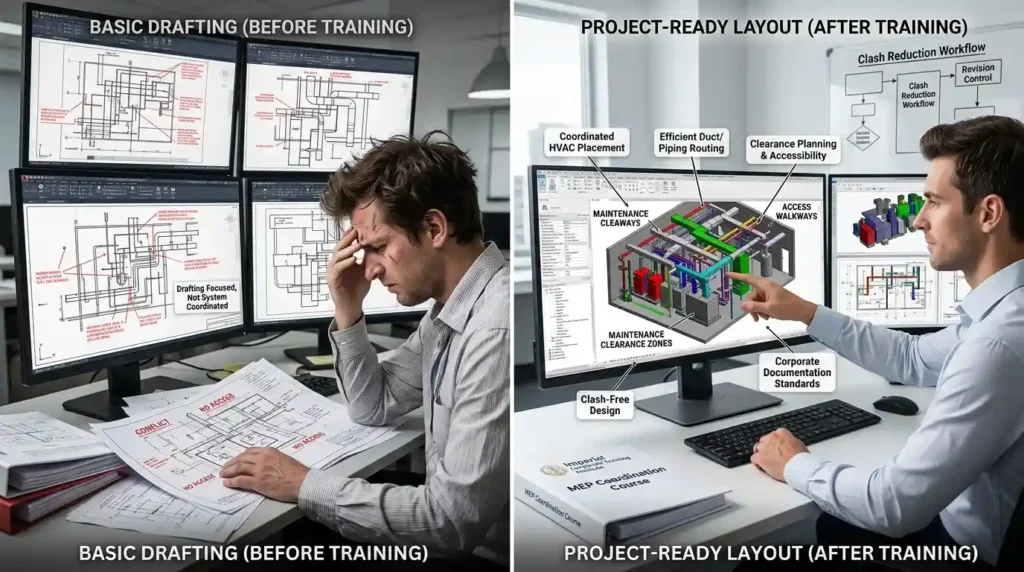
Mechanical rooms contain concentrated engineering systems that require accurate planning before construction begins. HVAC units, piping systems, drainage lines, pumps, and electrical coordination zones must fit within restricted spaces while maintaining operational accessibility.
In many organisations, design errors occur because drafting teams focus only on drawing production rather than system coordination. A technically correct duct layout may still fail during implementation if service clearances, maintenance access, or pipe routing conflicts are not considered during the design stage.
Imperial Corporate Training Institute structures this course to address these practical engineering challenges directly. Participants learn how AutoCAD drafting decisions influence installation feasibility, project sequencing, and multidisciplinary coordination.
The course includes exercises involving:
- HVAC equipment positioning
- Duct and piping coordination
- Mechanical room zoning
- Service clearance planning
- Layer management for engineering documentation
- Clash reduction workflows
- Drawing revision control
- Corporate documentation standards
Mechanical room exercises are integrated progressively throughout the training modules instead of being isolated theoretical examples. This structure reflects how engineering departments develop project deliverables in real workplace environments.
Why Is the Course Structured Around Progressive Layout Coordination?
The course follows a staged learning structure because mechanical room layout design depends on a sequence of engineering competencies. Participants first develop drafting accuracy, then system coordination capability, before progressing into multidisciplinary project simulation and corporate-level mechanical room documentation exercises.
Mechanical room design is not a single drafting task. It combines several technical disciplines that must function together within a coordinated engineering workflow.
Imperial Corporate Training Institute organises the curriculum to reflect real project progression. Early modules focus on AutoCAD interface management, drawing precision, templates, and drafting standards. Participants then advance into HVAC system layouts, plumbing coordination, and equipment placement strategies.
This progression prevents a common training problem where learners attempt advanced coordination tasks without understanding drafting organisation or engineering drawing standards.
The curriculum structure includes:
Introduction to Corporate AutoCAD Workflows
Participants establish drawing templates, title blocks, scaling standards, and engineering documentation practices used in commercial projects. This module builds consistency in project setup and layer organisation.
HVAC Drafting and Equipment Placement
Learners create duct layouts, airflow routing paths, diffuser positioning plans, and equipment representations. Mechanical room exercises begin at this stage through practical drafting tasks involving system arrangement and airflow management.
Plumbing Coordination and Drainage Planning
Participants learn how plumbing systems interact with HVAC layouts inside restricted mechanical spaces. Pipe sizing, slope calculations, riser coordination, and service integration become part of the drafting workflow.
Advanced MEP Coordination
This stage introduces Xrefs, 3D coordination tools, clash management techniques, and multi-disciplinary project collaboration methods. Mechanical room layouts become increasingly realistic through coordinated engineering simulations.
Corporate Project Documentation
Participants produce schedules, legends, revision records, and engineering deliverables aligned with organisational documentation standards.
The learning sequence used by Imperial Corporate Training Institute reflects how professional engineering department’s structure project execution across commercial developments.
What Mechanical Room Layout Skills Will Participants Learn?
Participants develop measurable competencies in HVAC equipment arrangement, duct routing, plumbing coordination, clearance management, design documentation, and AutoCAD-based MEP integration. The course focuses on workplace-ready drafting and coordination skills required for engineering, construction, and facilities management environments.
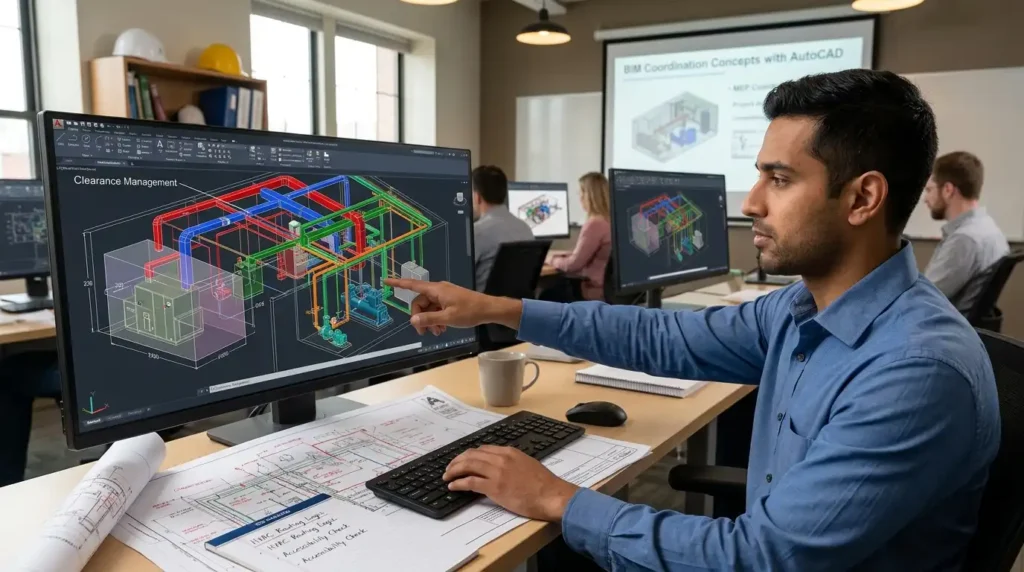
Mechanical room exercises in this course extend beyond drawing production. Participants learn how engineering systems interact within spatial and operational constraints.
Key skill outcomes include:
HVAC Equipment Layout Planning
Participants learn how to position air handling units, chillers, pumps, duct systems, and ventilation equipment according to airflow logic and maintenance accessibility requirements.
The course teaches how room dimensions, service access zones, and equipment orientation affect long-term operational efficiency.
Clearance and Accessibility Management
Mechanical room layouts must support maintenance access, inspection routes, and equipment replacement procedures. Participants learn how to allocate functional clearance spaces within constrained layouts.
This area of training is particularly important for professionals involved in facilities coordination and project approvals.
Duct and Pipe Routing Coordination
Participants develop practical routing strategies that reduce clashes between HVAC and plumbing systems. Exercises involve coordinated layer management and spatial planning using AutoCAD tools.
MEP Documentation Standards
Imperial Corporate Training Institute includes training on legends, schedules, revision workflows, drawing annotations, and corporate deliverable standards used in engineering environments.
AutoCAD Integration with BIM and Revit
The course introduces participants to BIM coordination concepts and demonstrates how AutoCAD drawings integrate with multidisciplinary project models.
Professionals evaluating how HVAC coordination training compares with equipment room planning requirements can review this technical resource on:
How AutoCAD HVAC training covers equipment room layout and clearances for additional guidance at the evaluation stage.
How Are Mechanical Room Design Exercises Delivered During Training?
Mechanical room layout exercises are delivered through practical drafting assignments, coordinated design workshops, simulation projects, and project documentation tasks. The delivery structure combines instructor guidance, applied AutoCAD activities, and engineering coordination exercises that replicate workplace project environments.
The training delivery format is designed for corporate professionals who require operational drafting capability rather than theoretical engineering awareness.
Imperial Corporate Training Institute uses a workshop-based methodology where participants apply AutoCAD tools directly within engineering design scenarios.
Training delivery methods include:
Guided Technical Workshops
Instructors demonstrate drafting workflows for HVAC layouts, plumbing coordination, and equipment positioning. Participants replicate these workflows through supervised design activities.
Mechanical Room Simulation Exercises
Learners complete project-based layout tasks involving HVAC equipment placement, duct routing, plumbing integration, and clearance management within simulated mechanical rooms.
These exercises help participants understand how design decisions affect installation practicality and project coordination.
Documentation and Review Activities
Participants prepare schedules, legends, bill of materials sheets, and coordinated engineering drawings. Design review exercises focus on identifying layout conflicts and correcting documentation inconsistencies.
Collaborative Coordination Tasks
Some activities simulate multidisciplinary coordination environments where HVAC and plumbing layouts must integrate with broader engineering requirements.
Corporate Workflow Applications
Imperial Corporate Training Institute aligns training exercises with corporate engineering documentation standards, allowing participants to develop transferable workplace capabilities.
The course may be delivered through onsite corporate training, instructor-led classroom sessions, hybrid delivery structures, or professional development workshops depending on organisational requirements and participant profiles.
How Does the Course Measure Learning and Technical Progress?
The course evaluates technical progress through drafting assignments, layout simulations, coordination exercises, documentation reviews, and project-based assessments. Participants demonstrate measurable competency in AutoCAD HVAC and plumbing coordination by producing structured engineering deliverables aligned with professional project standards.
Engineering training requires practical assessment rather than theoretical testing alone. Mechanical room design competency becomes visible through the quality, coordination, and accuracy of engineering layouts.
Imperial Corporate Training Institute incorporates assessment methods that reflect professional engineering review processes.
Assessment activities include:
Drafting Accuracy Reviews
Participants are evaluated on scaling consistency, layer organisation, annotation clarity, and engineering drawing standards.
Mechanical Room Coordination Tasks
Exercises assess participants’ ability to organise HVAC and plumbing systems within constrained spaces while maintaining accessibility and service coordination.
Documentation Compliance Checks
Learners produce engineering schedules, legends, revision records, and documentation packages aligned with project delivery requirements.
Design Problem Resolution
Participants identify routing conflicts, coordination errors, and layout inefficiencies using AutoCAD tools and engineering review procedures.
Final Project Simulation
The course concludes with a corporate-level project simulation where participants create coordinated HVAC and plumbing layouts within realistic project parameters.
This assessment structure allows organisations to measure whether participants can apply drafting knowledge within operational engineering workflows.
What Workplace Results Can Organisations Expect After Completion?
Organisations can expect improved drafting consistency, reduced coordination errors, enhanced documentation accuracy, and stronger MEP collaboration capability. Participants gain operational skills that support project delivery efficiency, engineering communication, and mechanical room coordination across construction and facilities management environments.
Mechanical room coordination problems frequently create delays during construction and commissioning phases. Poor drafting practices lead to RFIs, redesign requirements, and installation conflicts that affect project timelines.
Imperial Corporate Training Institute designs this training to improve engineering workflow reliability across corporate teams.
Expected workplace outcomes include:
Improved Design Coordination
Participants develop structured drafting approaches that support clearer coordination between HVAC, plumbing, electrical, and architectural teams.
Reduced Project Revisions
Mechanical room exercises help professionals identify layout conflicts before construction phases begin.
Stronger Documentation Standards
Engineering teams improve consistency in schedules, layer management, annotations, and drawing revision procedures.
Better Facilities Planning
Facility management professionals gain stronger understanding of system accessibility, maintenance planning, and operational layout considerations.
Enhanced Technical Communication
Participants learn how to prepare project deliverables that support client reviews, contractor coordination, and multidisciplinary engineering collaboration.
The course also supports engineering graduates and technical professionals transitioning into specialised HVAC and plumbing drafting roles within corporate construction sectors.
Who Should Enrol and How Does the Enrollment Process Work?
The course is intended for engineering professionals, MEP coordinators, HVAC designers, AutoCAD technicians, facility specialists, and project engineers seeking advanced drafting capability. Enrollment typically involves programme selection, scheduling confirmation, and participation in structured training sessions aligned with professional development objectives.
Imperial Corporate Training Institute structures this course for professionals working within engineering, construction, infrastructure, and facilities management environments.
Suitable participants include:
- Mechanical design engineers
- HVAC drafting professionals
- MEP coordinators
- AutoCAD technicians
- Plumbing system designers
- Project engineers
- Facilities management personnel
- Engineering graduates specialising in building services
The course is particularly relevant for organisations seeking measurable improvement in drafting quality, project coordination, and engineering documentation consistency.
Participants benefit most when they already possess foundational AutoCAD familiarity or general engineering knowledge. The course then builds advanced coordination capability through structured HVAC and plumbing project exercises.
Discover More from Our Guide Library:
How Does Imperial’s Programme Prepare Engineers to Coordinate HVAC With Architects?
Does Imperial’s HVAC Programme Include Commercial Ventilation Drawing Projects?
Completion pathways typically include:
Programme Registration
Participants select delivery format, schedule, and corporate training requirements.
Technical Training Participation
Learners complete structured modules, drafting workshops, and mechanical room coordination exercises.
Assessment and Project Submission
Participants demonstrate competency through project simulations and engineering documentation activities.
Completion Recognition
Training completion reflects practical capability in HVAC and plumbing drafting coordination aligned with corporate engineering workflows.
Professionals seeking structured mechanical room layout training with applied AutoCAD HVAC coordination exercises can apply for: