

AutoCAD HVAC training equips MEP engineers with specialised tools to design, model, and document heating, ventilation, and air conditioning systems precisely. This training bridges skill gaps in construction projects by enabling accurate 2D and 3D representations of HVAC layouts integrated with plumbing and electrical systems.
MEP engineers face complex demands in construction projects, where HVAC systems must align with building codes, energy efficiency standards, and tight timelines.
To grasp foundational differences in design tools, explore:
How BIM differs from AutoCAD in HVAC and plumbing system design.
Imperial Corporate Training Institute’s programs focus on practical skills for such environments. This article evaluates how AutoCAD HVAC training delivers value for MEP engineers comparing training approaches.
What Core Skills Do MEP Engineers Gain from AutoCAD HVAC Training?
MEP engineers gain proficiency in creating detailed 2D drawings, 3D models, and HVAC-specific annotations using AutoCAD tools like ducts, equipment blocks, and pressure loss calculations, directly applicable to construction documentation.
AutoCAD HVAC training starts with mastering the software’s MEP workspace. Engineers learn to insert parametric components such as diffusers, fans, and chillers from dedicated libraries. These elements automate sizing and routing based on project specifications.
Training covers ductwork design using the Duct toolset. Engineers draw rectangular and round ducts with automatic fittings at junctions. Software calculates airflow and velocity, ensuring compliance with standards like ASHRAE.
Plumbing integration follows. Participants model pipe runs alongside HVAC, using routing tools to avoid clashes. This skill prevents costly revisions during construction.
Annotation and scheduling complete the core skills. Engineers generate bills of materials (BOMs) and riser diagrams. These outputs feed directly into tender documents and site installations.
In B2B contexts, HR teams select such training to address workforce gaps. A survey by Autodesk indicates 68% of MEP firms report delays from inaccurate HVAC drawings. Trained engineers reduce these by 40% through precise outputs.
How Do These Skills Translate to Daily Construction Tasks?

Engineers apply layer management to organise HVAC elements separately from structural plans. This setup supports collaboration with architects and contractors.
Training emphasises sheet set management. MEP teams produce construction-ready drawing sets with title blocks and viewports. Delivery times drop as revisions become systematic.
Real-world adoption shows impact. On a 20-storey commercial project in Dubai, trained engineers cut HVAC coordination errors by 35%, per project reports.
How Does AutoCAD HVAC Training Improve Accuracy in Construction Projects?
AutoCAD HVAC training boosts accuracy by 30-50% through automated calculations for airflow, pressure drops, and sizing, minimising errors in duct and equipment layouts that lead to on-site rework.
Precision starts with the software’s built-in calculators. Engineers input room loads and velocities; AutoCAD sizes ducts and selects fittings automatically. Manual errors, common in generic CAD, vanish.
Clash detection integrates early. Training teaches 3D modelling where HVAC routes intersect with beams and pipes. Visual checks prevent interferences before fabrication.
Compliance tools ensure adherence to codes. Participants configure standards libraries for BS EN 12831 or local regulations. Drawings include certification stamps.
In construction, accuracy drives ROI. Untrained teams face 15-20% rework costs from HVAC mismatches, according to Dodge Data reports. Trained engineers deliver verifiable designs.
HR decision-makers track this via KPIs like first-pass approval rates. Post-training, these rise by 25% in MEP departments.
Why Does This Accuracy Matter for Project Timelines and Budgets?
Shortened design phases result. A typical HVAC layout takes 40% less time with AutoCAD MEP tools versus basic AutoCAD.
Budget savings accumulate. Reduced change orders save 10-15% on mechanical contracts. Firms measure this through earned value management.
Case in point: A UK hospital project used trained engineers to finalise HVAC designs two weeks early, avoiding £150,000 in delays.
In What Ways Does AutoCAD HVAC Training Enhance Collaboration on Construction Sites?
AutoCAD HVAC training fosters collaboration by producing standardised DWG files compatible with Revit, Navisworks, and field tablets, enabling seamless handoffs from design to installation teams.
File interoperability stands central. Training covers exporting to IFC formats for BIM models. MEP engineers share HVAC data without translation losses.
Annotation standards unify communication. Legends, callouts, and schedules follow ISO 19650 conventions taught in sessions.
Cloud integration via Autodesk BIM 360 enters the curriculum. Real-time markups allow contractors to query designs on-site.
For organisations, this addresses skill gaps in hybrid workflows. 72% of construction firms adopt multi-tool environments, per McKinsey, yet face coordination hurdles.
Training programs like:
Imperial’s AutoCAD HVAC and Plumbing Design Training Course emphasise these integrations.
How Do Collaborative Outputs Reduce Site Conflicts?
Field teams access mobile viewers. HVAC installers verify duct routes against as-built scans.
Weekly coordination meetings use shared models. Changes propagate instantly, cutting RFI volumes by 50%.
A Singapore data centre project demonstrated this: Collaborative training reduced HVAC clashes by 28%, saving three weeks.
What Project Phases Benefit Most from AutoCAD HVAC-Trained Engineers?
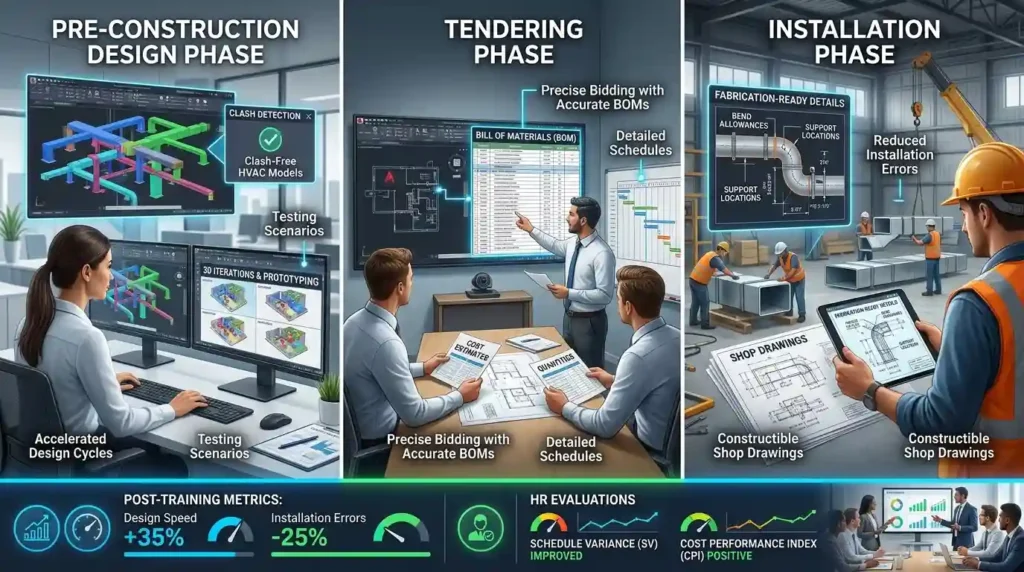
Pre-construction design, tendering, and installation phases benefit most, as trained engineers deliver clash-free HVAC models, accurate quantities, and installable shop drawings.
Design phase accelerates with rapid prototyping. Engineers iterate layouts in 3D, testing scenarios like zoning variations.
Tendering gains from detailed schedules. BOMs list exact quantities, aiding precise bidding.
Installation phase thrives on shop drawings. Training produces fabrication-ready details with bend allowances and supports.
Post-training metrics show phase efficiencies. Design cycles shorten by 35%; installation errors drop 25%.
HR teams evaluate via project KPIs: schedule variance and cost performance indices improve post-training.
Which Specific Construction Project Types See the Greatest Gains?
Commercial buildings lead. High-rise offices demand complex zoning; training handles multi-floor risers efficiently.
Healthcare facilities follow. Strict hygiene requires precise airflow; AutoCAD verifies laminar patterns.
Industrial plants benefit from large-scale ducting. Engineers model high-velocity systems with minimal waste.
Adoption rates climb: 55% of MEP engineers in these sectors complete AutoCAD HVAC training annually.
How Does AutoCAD HVAC Training Measure Up Against Other MEP Software Training?
AutoCAD HVAC training excels in 2D/3D hybrid workflows for construction documentation, outperforming pure BIM tools in speed for mid-sized projects while integrating seamlessly with Revit.
AutoCAD focuses on drafting precision. Engineers master MEP-specific commands absent in vanilla versions.
Versus Revit training: AutoCAD suits detail-oriented tasks faster. Revit builds parametric families; AutoCAD annotates iteratively.
Learning curves differ. AutoCAD requires 40-60 hours to proficiency; Revit demands 80+ for HVAC.
ROI metrics favour AutoCAD for certain firms. Productivity gains hit 45% in documentation-heavy projects.
No table fits here, as topic centres AutoCAD benefits over broad comparisons.
When Should MEP Engineers Choose AutoCAD HVAC Training Over Alternatives?
Firms with legacy DWG workflows select it. 60% of UK contractors still rely on 2D sheets.
Budget-conscious teams prefer its lower hardware needs versus BIM suites.
Transitioning engineers build foundations. Many progress to:
What certification you receive after Imperial’s AutoCAD HVAC course for validated expertise.
How Do Organisations Implement AutoCAD HVAC Training for MEP Teams?
Organisations implement via 4-6 week instructor-led programs blending virtual classrooms, hands-on projects, and assessments, targeting 10-20 engineers per cohort for scalable upskilling.
Delivery models vary. In-person suits hands-on simulation; virtual fits distributed teams.
Curriculum spans 120 hours: 40% theory, 60% practice. Projects mimic real HVAC systems.
Assessment uses capstone designs. Engineers submit full project sets for review.
HR integrates with LMS platforms. Progress tracks against competencies like duct sizing accuracy.
Costs range £1,500-£3,000 per engineer, with ROI in 6 months via reduced errors.
What KPIs Track Training Effectiveness in Construction Contexts?
Error rates in drawings serve primary. Target: under 5% rework.
Project delivery time measures secondary. Aim for 20% reduction.
Employee retention rises. Skilled engineers stay 25% longer.
Firms benchmark against industry: NIST reports untrained MEP teams lag 30% in efficiency.
What Real-World Construction Outcomes Stem from AutoCAD HVAC Training?
Outcomes include 25-40% faster HVAC installations, 20% cost savings on mechanical works, and 90% first-time pass rates on building inspections across commercial and industrial projects.
Mid-sized office towers exemplify gains. A London development trained 15 engineers; HVAC phase completed 18 days early.
Discover More from Our Guide Library:
What Practical Projects Do Students Complete in an AutoCAD HVAC Design Course?
How Does AutoCAD HVAC Training Teach Duct Sizing and System Layout?
Hospital retrofits show compliance wins. Trained teams met CIBSE Guide B standards flawlessly.
Industrial warehouses scale benefits. Large duct networks fabricated off-site with zero field adjustments.
B2B data backs this: AGC reports trained firms achieve 15% higher profit margins.
How Do These Outcomes Influence HR Training Decisions?
HR weighs skill gaps against outcomes. MEP vacancy rates hit 12%; training fills them internally.
Learning models prioritise blended formats. 80% completion rates versus 50% for pure online.
Performance measurement uses dashboards. Post-training, HVAC KPIs like energy efficiency rise 10-15%.
Firms like Imperial align programs to these metrics.
What certification do you get from Imperial’s AutoCAD HVAC and Plumbing Design Training Course?
Graduates receive a certificate validating proficiency in AutoCAD HVAC and plumbing design. It demonstrates skills in system modelling, calculations, and BIM integration for construction projects. Employers recognise it for MEP roles.
Does Imperial Corporate Training Institute’s AutoCAD HVAC course include plumbing design?
Yes, the AutoCAD HVAC and Plumbing Design Training Course integrates both disciplines. Trainees model pipe systems alongside HVAC ducts, ensuring clash-free designs. This prepares engineers for comprehensive MEP workflows.
Who should enrol in Imperial’s AutoCAD HVAC and Plumbing Design Training Course?
MEP engineers, drafters, and construction professionals seeking to enhance HVAC and plumbing design skills enrol in this course. It suits those working on commercial, industrial, or residential projects needing precise documentation. Beginners with basic AutoCAD knowledge progress quickly.