

Lean Six Sigma certification equips employees with methodologies to eliminate waste, reduce defects, and optimise processes. Companies invest because it drives measurable efficiency gains, such as 20-30% productivity increases and 15-25% cost reductions in operations.
What Is Lean Six Sigma Certification in a Corporate Context?
Lean Six Sigma certification is a structured training programme that teaches employees to apply DMAIC (Define, Measure, Analyse, Improve, Control) and Lean principles to streamline operations, cut costs, and boost quality in business processes.
Organisations adopt Lean Six Sigma certification to address skill gaps in process improvement. HR managers and L&D professionals use it to build internal capabilities for continuous enhancement.
The certification levels progress from White Belt (basic awareness, 8 hours training) to Yellow Belt (project support, 16-20 hours), Green Belt (lead small projects, 40-80 hours), Black Belt (manage complex projects, 120-160 hours), and Master Black Belt (strategic oversight, 200+ hours with mentorship).
In workplaces, it targets inefficiencies like excess inventory or prolonged cycle times. Businesses in manufacturing, finance, and healthcare report 10-15% defect reductions post-certification.
This certification integrates with corporate goals by aligning employee skills to KPIs such as on-time delivery rates and operational throughput.
How Does Lean Six Sigma Certification Work in Corporate Environments?
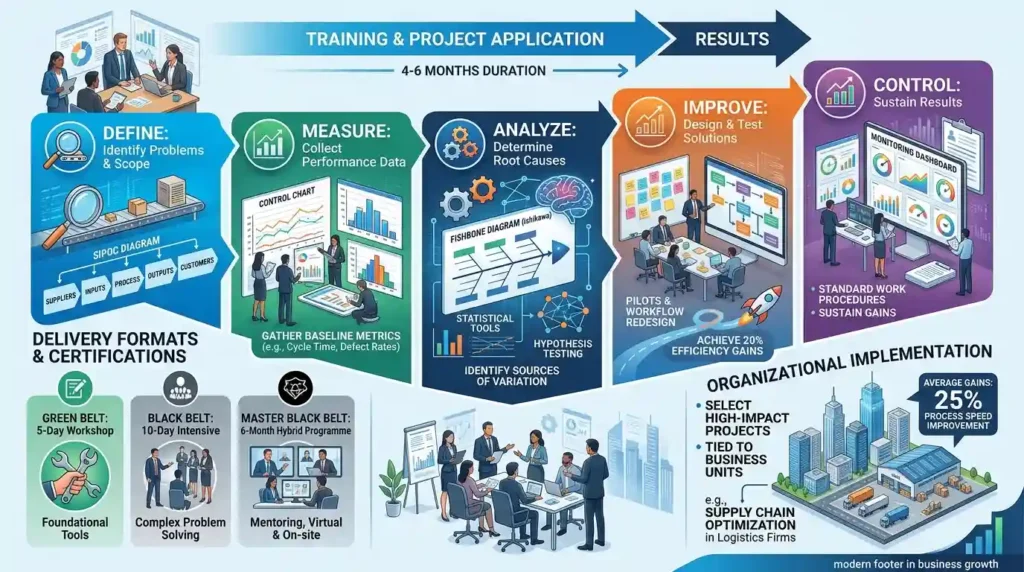
Lean Six Sigma certification works through a phased DMAIC methodology delivered via workshops, online modules, and hybrid formats, where employees apply tools to real projects over 4-6 months, yielding 25% average process speed improvements.
Training begins with Define: teams identify problems using SIPOC diagrams (Suppliers, Inputs, Process, Outputs, Customers).
Measure follows: participants collect data on key metrics like cycle time or defect rates, often via control charts.
Analyse phase employs statistical tools such as root cause analysis with fishbone diagrams and hypothesis testing.
Improve tests solutions through pilots, like redesigning workflows, achieving 20% efficiency gains.
Control sustains results with standard work procedures and monitoring dashboards.
Delivery formats include 5-day workshops for Green Belts, 10-day intensives for Black Belts, and 6-month hybrid programmes for Master Black Belts combining virtual sessions with on-site simulations.
Organisations implement it by selecting high-impact projects tied to business units, such as supply chain optimisation in logistics firms.
What Are the Key Components of Lean Six Sigma Master Black Belt Certification?
Key components include advanced DMAIC application, statistical analysis tools like Minitab software, leadership training for mentoring Green Belts, and project portfolio management, delivered over 200 hours via case studies and simulations.
Master Black Belt training builds on Black Belt skills. Core frameworks encompass DMADV (Define, Measure, Analyse, Design, Verify) for new processes.
Tools cover regression analysis, design of experiments (DOE), and value stream mapping.
Delivery integrates online modules (40%), live workshops (30%), role-play scenarios (20%), and assessments (10%).
Participants complete three real-world projects, each reducing costs by at least 10%.
Skills include coaching teams, change management, and aligning initiatives to strategic KPIs like EBITDA margins.
Corporate programmes emphasise simulations of industries like IT (software deployment cycles) and healthcare (patient throughput).
Why Do Companies Invest in This Certification for Workforce Development?
Companies invest because it closes skill gaps in process optimisation, delivering 15-30% cost savings, 20% productivity boosts, and 12-18% improvements in employee retention through career progression pathways.
HR managers face pressures from skill gaps in data-driven decision-making. Lean Six Sigma certification fills these by training staff in quantifiable improvements.
Business owners see direct ROI: a Green Belt project averages £50,000-£100,000 savings.
Team leaders benefit from cross-functional collaboration fostered during training.
In corporate settings, it strengthens leadership pipelines; certified Black Belts mentor juniors, reducing external consultancy costs by 40%.
Organisations track outcomes via KPIs like first-pass yield (up 25%) and overall equipment effectiveness (OEE, up 15%).
Finance departments in banking sectors apply it to fraud detection, cutting losses by 18%.
How Do Organisations Implement Lean Six Sigma Certification Programmes?
Organisations implement by assessing needs via gap analysis, selecting 10-20% of staff for cohort training, integrating projects into operations, and measuring ROI quarterly, resulting in 22% average operational efficiency gains.
Step 1: Conduct audits to pinpoint pain points, such as 30% delays in order fulfilment.
Step 2: Choose levels based on roles, Green Belt for supervisors, Master Black Belt for executives.
Step 3: Roll out in cohorts of 15-25 via hybrid learning: 60% online modules, 40% workshops.
Step 4: Assign live projects with executive sponsorship, using case-based learning and role plays.
Step 5: Certify via exams (80% pass rate) and project reviews.
Step 6: Embed via belts of control and annual refreshers.
L&D teams use dashboards for metrics like project completion rates (95%) and savings tracked in £.
For deeper insights into returns, explore:
What ROI Do Organisations Typically See After Sending Staff to Master Black Belt Training?
What Benefits Does It Deliver to Teams and Organisations?
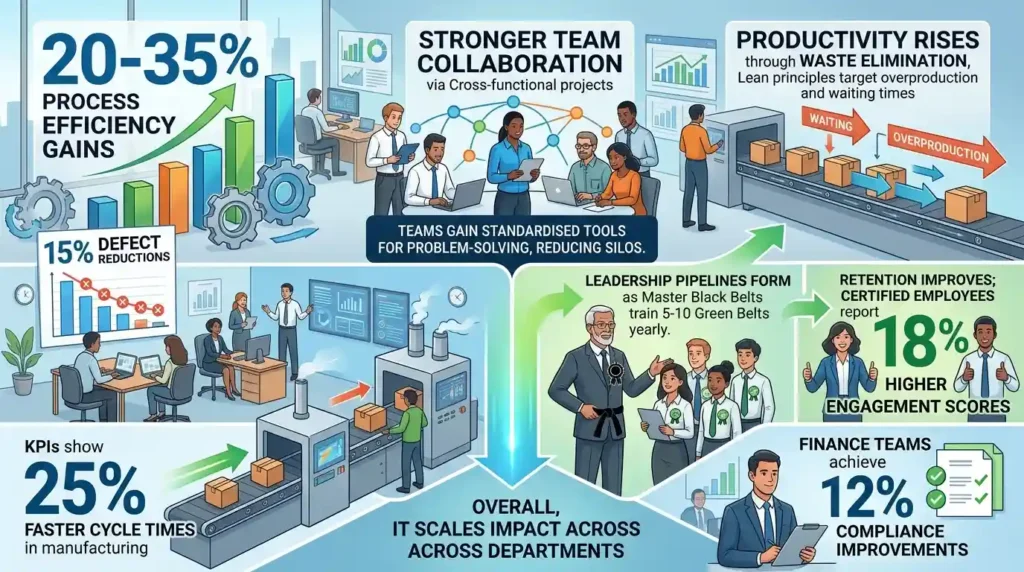
It delivers 20-35% process efficiency gains, 15% defect reductions, stronger team collaboration via cross-functional projects, and 10-15% retention boosts by building internal expertise.
Teams gain standardised tools for problem-solving, reducing silos.
Productivity rises through waste elimination, Lean principles target overproduction and waiting times.
Leadership pipelines form as Master Black Belts train 5-10 Green Belts yearly.
Retention improves; certified employees report 18% higher engagement scores.
KPIs show 25% faster cycle times in manufacturing.
Finance teams achieve 12% compliance improvements.
Overall, it scales impact across departments.
What Real-World Use Cases Demonstrate Its Value?
Use cases span manufacturing (assembly line optimisation, 28% throughput increase), healthcare (patient flow, 22% wait time cuts), finance (claims processing, 30% speed-up), and IT (deployment cycles, 25% defect drop).
In manufacturing, a automotive firm trained 50 Green Belts, reducing scrap by 18%.
Healthcare providers deploy Black Belts for ER triage, achieving 20% capacity gains.
Finance departments use it for invoice processing, saving £200,000 annually per team.
IT teams apply DMAIC to agile sprints, cutting bugs by 24%.
Logistics companies optimise warehouses, lifting on-time delivery to 98%.
Retail chains streamline inventory, reducing stockouts by 15%.
What Common Problems Arise and How Does Lean Six Sigma Address Them?
Common problems like ineffective generic training (low 10% retention), lack of ROI visibility, and poor implementation fail 70% of programmes; Lean Six Sigma counters with project-based learning, KPI tracking, and 85% success rates.
Misconception: Training is theoretical. Reality: 70% hands-on via simulations.
Problem: No sustained change. Solution: Control phase enforces standards, sustaining 90% gains after 12 months.
Issue: Generic programmes ignore context. Lean Six Sigma customises to sectors like finance (fraud analytics).
Discover More from Our Guide Library:
Can Lean Six Sigma Be Applied Outside Manufacturing in Service Industries?
What Are the Most Common Process Improvement Tools Used in Lean Six Sigma?
ROI doubts persist in 40% of cases without metrics. Certification mandates £ quantified savings.
Skill gaps widen without follow-up; organisations pair it with mentorship, boosting application by 35%.
Resistance from teams drops 25% through role plays building buy-in.
Lean Six Sigma certification transforms corporate performance through data-backed methodologies. It equips workforces for sustained efficiency.
Lean Six Sigma offers course to explore, Enrol in:
Lean Six Sigma Master Black Belt Certification Training Course
What is Lean Six Sigma Master Black Belt Certification Training Course at Imperial Corporate Training Institute?
The Lean Six Sigma Master Black Belt Certification Training Course at Imperial Corporate Training Institute trains professionals in advanced DMAIC methodologies, statistical tools, and project leadership over 200 hours. It includes real-world simulations and mentorship for strategic process improvements. Participants complete portfolio projects yielding 20-30% efficiency gains.
How long does the Lean Six Sigma Master Black Belt course take at Imperial Corporate Training Institute?
The course spans 6-12 months with 200+ hours of hybrid delivery, including workshops, online modules, and live projects. It accommodates working professionals through flexible scheduling. Certification requires passing exams and demonstrating ROI on three projects.
What are the prerequisites for Master Black Belt training from Imperial Corporate Training Institute?
Candidates need prior Lean Six Sigma Black Belt certification and 3-5 years of process improvement experience. Imperial Corporate Training Institute assesses project portfolios during enrolment. This ensures readiness for advanced tools like design of experiments.
What job roles benefit from Lean Six Sigma Master Black Belt Certification Training Course?
Roles like operations directors, quality managers, and process consultants gain expertise in mentoring teams and enterprise-wide optimisation. Imperial Corporate Training Institute’s course equips them for 25% productivity boosts. It strengthens leadership in manufacturing, healthcare, and finance.