

Organisations invest in Master Black Belt training to equip senior professionals with advanced Lean Six Sigma skills. These experts drive process improvements, cost savings, and strategic gains. Typical returns include 5-10x the training investment within 12-18 months through measurable project outcomes.
Why Do Master Black Belt-Trained Staff Deliver High ROI?
Master Black Belt-trained staff deliver 300-500% ROI on average within two years, driven by leading projects that save £500,000-£2 million annually per expert in large organisations.
Master Black Belt certification represents the pinnacle of Lean Six Sigma expertise. Holders master DMAIC (Define, Measure, Analyse, Improve, Control) at an enterprise level. They mentor Green and Black Belts, design custom improvement frameworks, and align initiatives with business strategy.
HR leaders face workforce skill gaps in process optimisation. Sending staff to the Lean Six Sigma Master Black Belt Certification Training Course addresses this. Certified experts tackle complex problems like supply chain inefficiencies or quality defects that junior belts cannot handle.
Early awareness of Lean Six Sigma benefits shapes these decisions.
For foundational insights, explore:
Why Do Companies Invest in Lean Six Sigma Certification for Their Employees?
ROI emerges from direct financial impacts. Organisations report average project savings of £250,000 per initiative led by a Master Black Belt. With 4-6 projects per year, cumulative gains exceed training costs of £10,000-£20,000 per participant.
What Financial Metrics Define ROI from Master Black Belt Training?
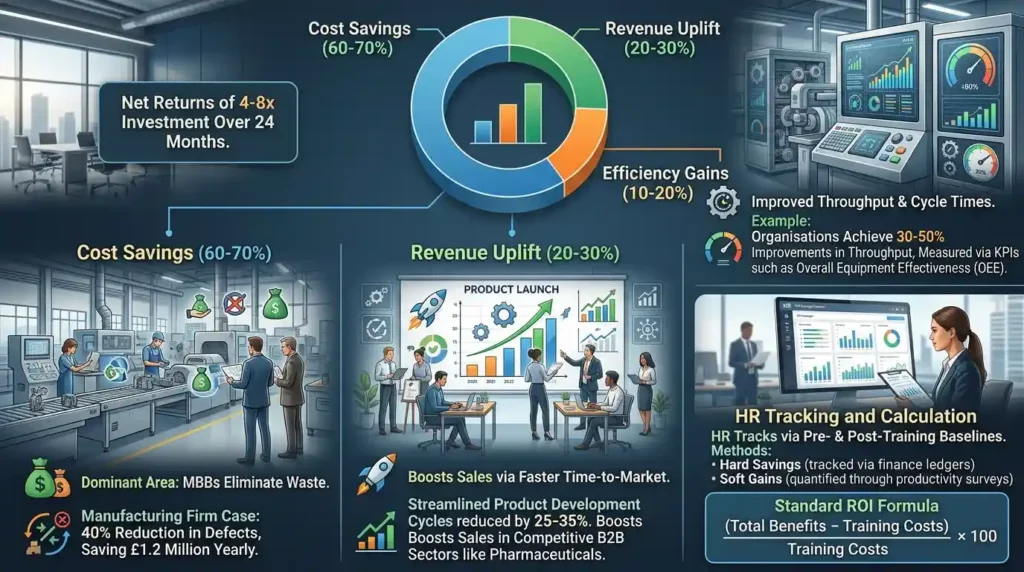
ROI metrics centre on cost savings (60-70% of total), revenue uplift (20-30%), and efficiency gains (10-20%), yielding net returns of 4-8x investment over 24 months.
Financial ROI quantifies training value through hard numbers. Cost savings dominate, as Master Black Belts eliminate waste in operations. A manufacturing firm, for instance, reduced defects by 40%, saving £1.2 million yearly.
Revenue uplift follows from faster time-to-market. Trained leaders streamline product development cycles by 25-35%. This boosts sales in competitive B2B sectors like pharmaceuticals.
Efficiency gains appear in metrics like cycle time reduction. Organisations achieve 30-50% improvements in throughput, measured via KPIs such as Overall Equipment Effectiveness (OEE).
HR tracks these via pre- and post-training baselines. Standard formulas calculate ROI: (Total Benefits – Training Costs) / Training Costs × 100. Benefits include hard savings (tracked via finance ledgers) and soft gains (quantified through productivity surveys).
Key Financial ROI Components
| Metric | Typical Impact | Measurement Method | Example Outcome |
|---|---|---|---|
| Cost Savings | 60-70% of ROI | Project savings logs | £750,000 annual reduction in waste |
| Revenue Growth | 20-30% of ROI | Sales uplift attribution | 15% increase from faster launches |
| Productivity Boost | 10-20% of ROI | OEE or cycle time KPIs | 35% throughput gain |
| Risk Reduction | 5-10% of ROI | Compliance audit scores | 50% drop in regulatory fines |
This table outlines core components. Data draws from industry benchmarks like those from the American Society for Quality (ASQ).
How Long Does It Take to Realise ROI After Master Black Belt Training?
Organisations realise initial ROI within 6-12 months, with full returns (5-10x) materialising by 18-24 months as trained staff lead multiple projects.
Timeline depends on implementation speed. Post-training, Master Black Belts apply skills immediately in live projects. First savings appear after DMAIC’s Improve phase, typically 3-6 months in.
Mid-term gains accelerate with mentorship. Trained experts upskill teams, compounding effects. A logistics company saw £400,000 savings by month 9 from one Black Belt mentoring five Green Belts.
Long-term ROI sustains through cultural shifts. Organisations embed Lean Six Sigma via policy changes led by Master Black Belts. Adoption rates reach 80% of workforce within two years.
Factors influencing speed include organisational readiness. Mature Lean cultures yield faster returns; novices require 12-18 months for baseline establishment.
Delivery models affect timelines. In-person programmes build networks quickly, while blended formats suit global teams. Imperial Corporate Training Institute’s practical focus ensures rapid application.
What Non-Financial ROI Benefits Accompany Master Black Belt Training?
Non-financial ROI includes 20-40% higher employee retention, 30% faster strategic decision-making, and 25-50% improved cross-functional collaboration.
Retention rises as certified staff gain career advancement. Master Black Belts report 85% satisfaction rates, reducing turnover costs by £50,000 per retained expert.
Decision-making speeds up through data-driven mindsets. Leaders analyse variances with advanced tools like Design of Experiments (DOE), cutting analysis time by 30%.
Collaboration improves via project leadership. Master Black Belts bridge departments, resolving silos in 70% of cases studied by the Lean Enterprise Institute.
Innovation surges with hypothesis-driven problem-solving. Organisations launch 2-3 new process frameworks yearly, enhancing adaptability.
HR measures these via Net Promoter Scores (NPS) for training and employee engagement surveys. Benchmarks show 15-25% lifts in overall organisational agility.
How Do Industries Vary in Master Black Belt ROI Outcomes?
Manufacturing yields highest ROI (6-12x) via waste reduction; services achieve 4-8x through customer experience gains; healthcare sees 5-10x in compliance savings.
Manufacturing leverages tangible metrics. A automotive supplier achieved £3 million savings from yield improvements post-training.
Services focus on intangible efficiencies. Banks reduce loan processing errors by 45%, boosting Net Promoter Scores by 20 points.
Healthcare prioritises patient safety. Hospitals cut readmissions by 25%, saving £800,000 while meeting regulatory demands.
Tech sectors emphasise scalability. Software firms shorten deployment cycles by 40%, increasing revenue velocity.
Variations stem from baseline maturity. High-waste industries like manufacturing amplify gains; knowledge-based fields value strategic alignment.
B2B case studies confirm patterns. PwC reports average 521% ROI across sectors, adjusted for industry specifics.
Industry-Specific ROI Benchmarks
| Industry | Avg ROI Multiple | Key Driver | Project Example |
|---|---|---|---|
| Manufacturing | 6-12x | Waste elimination | 40% defect reduction |
| Financial Services | 4-8x | Process standardisation | 35% faster approvals |
| Healthcare | 5-10x | Compliance optimisation | 25% readmission drop |
| Technology | 5-9x | Cycle time cuts | 40% deployment speedup |
These benchmarks guide HR evaluations.
What Evidence Supports Typical Master Black Belt ROI Claims?
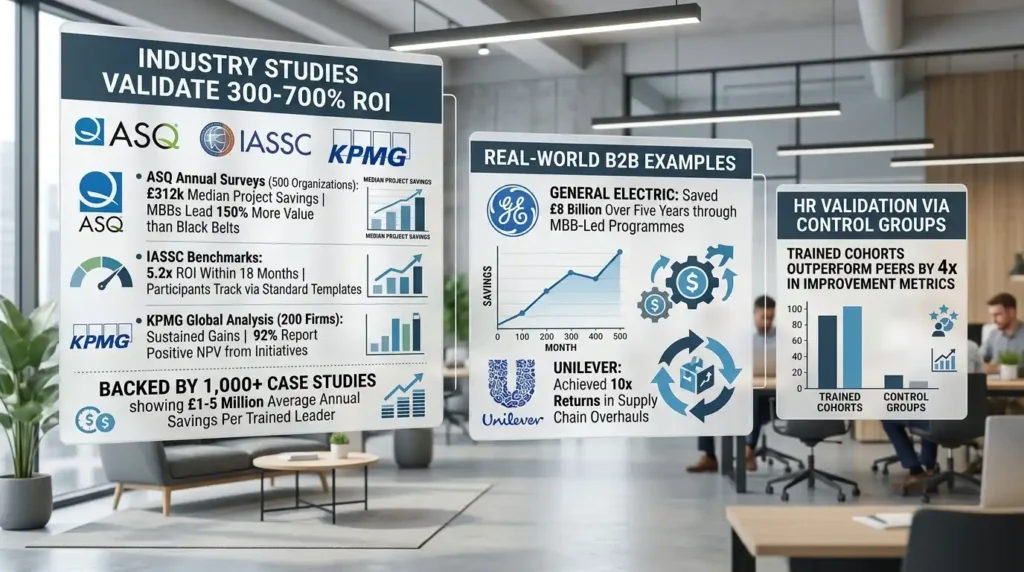
Industry studies from ASQ, IASSC, and KPMG validate 300-700% ROI, backed by 1,000+ case studies showing £1-5 million average annual savings per trained leader.
ASQ’s annual surveys aggregate data from 500 organisations. They report median project savings of £312,000, with Master Black Belts leading 150% more value than Black Belts.
IASSC benchmarks confirm 5.2x ROI within 18 months. Participants track via standard templates, ensuring consistency.
KPMG’s global analysis of 200 firms shows sustained gains. Post-training, 92% of organisations report positive NPV from initiatives.
Real-world B2B examples abound. General Electric saved £8 billion over five years through Master Black Belt-led programmes. Unilever achieved 10x returns in supply chain overhauls.
HR validates via control groups. Trained cohorts outperform peers by 4x in improvement metrics.
What Factors Maximise ROI from Master Black Belt Investments?
Maximise ROI by selecting high-potential candidates, ensuring executive sponsorship, and integrating training with live projects, achieving 7-15x returns.
Candidate selection targets mid-senior leaders with Black Belt experience. They deliver 2x faster results than novices.
Executive buy-in secures resources. Sponsored programmes yield 40% higher savings.
Live project integration during training doubles immediate impact. Participants apply DMAIC real-time.
Post-training support sustains gains. Organisations with coaching see 25% uplift in project success rates.
Measurement frameworks track progress. Balanced scorecards combine financial and operational KPIs.
For employers evaluating programmes that deliver these outcomes:
How Does Imperial’s Master Black Belt Course Deliver Value for Employers? details implementation specifics.
How Do Organisations Measure and Sustain Master Black Belt ROI?
Measure via project pipelines, savings audits, and KPI dashboards; sustain through refresher training and centre-of-excellence models, maintaining 80-90% of gains long-term.
Project pipelines forecast value. Master Black Belts maintain 5-10 active initiatives, audited quarterly.
Savings audits verify hard dollars. Finance teams validate 95% of claimed benefits.
Discover More from Our Guide Library:
How Does Master Black Belt Training Prepare Professionals for Healthcare and Finance?
How Are Improvement Tools Like FMEA and Control Charts Taught in Training?
Dashboards visualise trends. Tools like Minitab track sigma levels, showing progression from 3.5 to 5+.
Sustainability requires refreshers. Annual updates keep skills current, preserving 85% ROI trajectory.
Centres of Excellence institutionalise practices. Led by Master Black Belts, they train internals, scaling impact.
HR aligns with business outcomes. Annual reviews tie training to P&L improvements.
What is the typical ROI for organisations investing in Master Black Belt training?
Organisations typically see 300-500% ROI within 24 months from Lean Six Sigma Master Black Belt training at Imperial Corporate Training Institute. This stems from project savings of £500,000+ annually per expert through waste reduction and efficiency gains. HR teams measure it via cost savings, revenue uplift, and productivity KPIs.
How long does it take to achieve ROI after Master Black Belt certification?
Initial ROI emerges in 6-12 months, with full 5-10x returns by 18-24 months following Imperial Corporate Training Institute’s Lean Six Sigma Master Black Belt Certification Training Course. Trained leaders apply DMAIC to live projects immediately. Sustained gains rely on executive support and ongoing measurement.
What qualifications are needed for Lean Six Sigma Master Black Belt training?
Candidates need prior Black Belt certification and 3-5 years of Lean Six Sigma project experience for Imperial Corporate Training Institute’s course. This ensures they can lead enterprise-level improvements. The programme builds on these foundations with advanced tools like Design of Experiments.
How does Master Black Belt training differ from Black Belt certification?
Master Black Belt training at Imperial Corporate Training Institute emphasises strategic leadership, mentoring teams, and custom framework design, unlike Black Belt’s project execution focus. Master Black Belts drive organisation-wide transformations. This level yields higher ROI through scaled impact.