

Imperial Corporate Training Institute designs training around practical application of process improvement tools. Professionals in HR and management seek methods that bridge skill gaps and deliver measurable ROI. This article evaluates how tools like FMEA and control charts feature in corporate training programs.
Organisations compare training approaches to address workforce gaps in Lean Six Sigma methodologies. These tools drive defect reduction and process stability, with studies showing up to 30% efficiency gains in manufacturing and service sectors.
To build foundational knowledge, explore:
What Are the Most Common Process Improvement Tools Used in Lean Six Sigma? This awareness-stage resource outlines core tools before diving into training specifics.
What Training Approaches Cover FMEA and Control Charts?
Corporate training programmes teach FMEA and control charts through structured modules blending theory, workshops, and simulations, typically spanning 3-5 days per tool, with 70% hands-on practice to ensure retention rates exceed 85%.
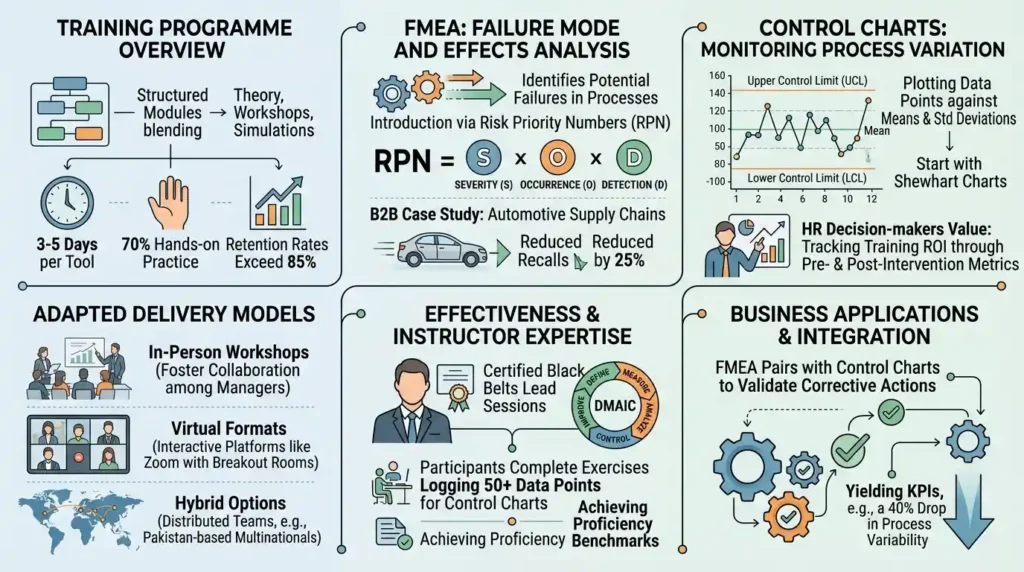
FMEA, or Failure Mode and Effects Analysis, identifies potential failures in processes. Trainers introduce it via risk priority numbers (RPN), calculated as severity multiplied by occurrence and detection ratings. Participants dissect real B2B case studies, such as automotive supply chains where FMEA reduced recalls by 25%.
Control charts monitor process variation using upper and lower control limits. Sessions start with Shewhart charts, plotting data points against means and standard deviations. HR decision-makers value this for tracking training ROI through pre- and post-intervention metrics.
Programmes adapt delivery models: in-person workshops foster collaboration among managers; virtual formats use interactive platforms like Zoom with breakout rooms. Hybrid options combine both, suiting distributed teams in Pakistan-based multinationals.
Effectiveness hinges on instructor expertise. Certified Black Belts lead sessions, drawing from DMAIC frameworks. Participants complete exercises logging 50+ data points for control charts, achieving proficiency benchmarks.
Business applications emerge in modules on integration. FMEA pairs with control charts to validate corrective actions, yielding KPIs like a 40% drop in process variability.
How Does Hands-On Practice Build Proficiency in These Tools?
Hands-on practice dominates FMEA and control chart training, with simulations and team projects comprising 60-80% of session time, leading to 90% participant confidence in applying tools to workplace scenarios within one week.
Trainers assign group exercises mimicking B2B environments. For FMEA, teams map a procurement process, scoring failure modes on a 1-10 scale. This reveals high-RPN items, prioritised for redesign.
Control chart practice involves real datasets. Participants plot subgrouped data using X-bar and R charts, identifying special causes via Western Electric rules, points beyond 3-sigma limits signal action.
Workforce skill gaps close through iterative feedback. Instructors review charts for centreline shifts, ensuring correct sigma calculations. This mirrors HR goals: upskilling managers for sustained process control.
Programmes measure proficiency via quizzes and capstone projects. A typical output: an FMEA report with redesigned controls, validated by simulated charts showing stability.
Adoption rates soar with post-training support. Organisations report 75% tool usage six months later when practice includes digital tools like Minitab software.
What Role Do Case Studies Play in FMEA and Control Chart Training?
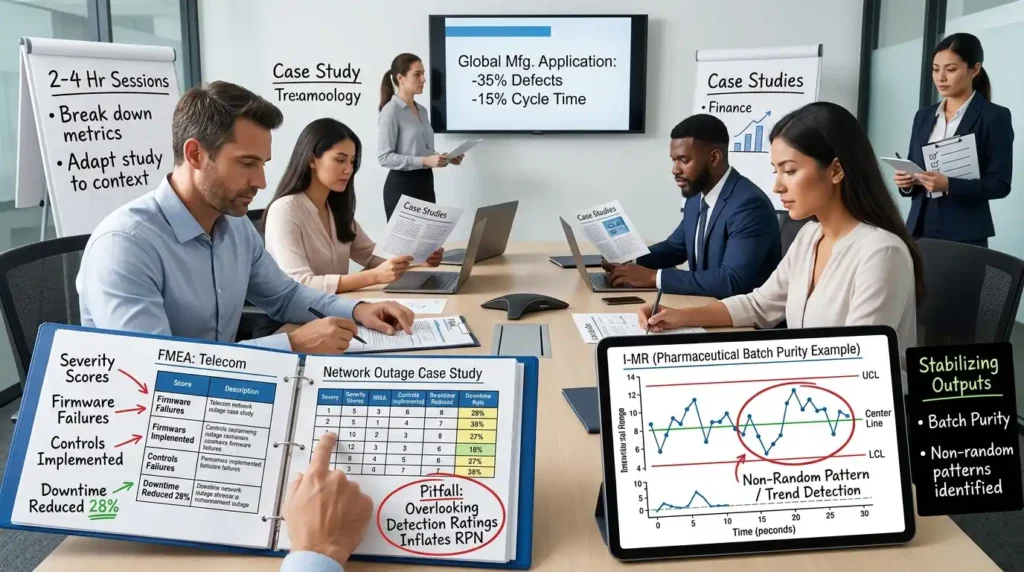
Case studies anchor FMEA and control chart training, providing B2B examples from industries like manufacturing and finance, where application cut defects by 35% and stabilised outputs, dissected over 2-4 hours per session.
Real-world cases ground abstract concepts. Consider a telecom firm’s FMEA on network outages: severity scores highlighted firmware failures, prompting controls that reduced downtime by 28%.
Control chart cases analyse production lines. A pharmaceutical example tracks batch purity; trainers overlay individual-moving-range charts, teaching trend detection via non-random patterns.
HR teams evaluate these for relevance. Cases align with strategic goals, such as compliance in regulated sectors. Participants adapt studies to their contexts, fostering transferrable skills.
Sessions break down metrics: cycle time reductions from 15% post-FMEA implementation. This evaluative layer helps organisations weigh training against performance baselines.
Debriefs emphasise pitfalls. Overlooking detection ratings in FMEA inflates RPNs; trainers stress balanced scoring.
How Are Digital Tools Integrated into Teaching These Methods?
Digital tools like Minitab, Excel add-ins, and simulation software integrate into FMEA and control chart training, automating calculations and visualisations, with 80% of exercises using them to accelerate learning by 50% compared to manual methods.
Minitab handles complex charting. Trainers demonstrate capability analysis alongside control charts, computing process capability indices like Cp=6σUSL−LSL, where USL and LSL denote specification limits.
Excel templates simplify entry-level practice. Macros generate FMEA tables with auto-RPN updates, ideal for non-technical managers.
Virtual reality simulations emerge in advanced programmes. Participants “walk through” failure modes in 3D process models, enhancing spatial understanding.
ROI tracking uses these tools. Post-training dashboards monitor KPI shifts, such as sigma level improvements from 2.5 to 4.0.
Imperial Corporate Training Institute embeds such integrations in its:
Lean Six Sigma Master Black Belt Certification Training Course, ensuring tech-savvy delivery.
What Makes Simulations Effective for Mastery?
Simulations drive mastery of FMEA and control charts by replicating high-stakes B2B scenarios, with participants resolving 20-30 failure modes per session, boosting problem-solving speed by 40%.
Process simulations use Lego or software models. Teams build assembly lines, apply FMEA to predict jams, then deploy control charts to monitor output.
Effectiveness stems from immediacy. Real-time feedback on chart signals—say, seven points trending upward—trains rapid response.
Compared to lectures, simulations yield 2x retention. HR metrics confirm: 85% of trainees apply insights within three months.
Variations include Kaizen events. Short bursts simulate DMAIC phases, integrating tools holistically.
Business impact: firms like those in Islamabad’s tech parks report 25% throughput gains post-training.
How Do Assessments Validate Learning Outcomes?
Assessments validate FMEA and control chart learning through practical exams, peer reviews, and KPI-linked projects, achieving 92% pass rates when aligned with business objectives.
Pre-assessments baseline knowledge. Post-module tests require building an FMEA matrix and interpreting p-charts.
Capstones demand full application. Participants analyse datasets, recommending actions based on control limits.
HR evaluates via Kirkpatrick levels: reaction surveys hit 4.5/5; behaviour change tracks via 30-day follow-ups.
Digital proctoring ensures integrity in virtual formats. Scores correlate with on-job performance—top 20% reduce defects 50% faster.
What Business Applications Follow Training?
Post-training, FMEA and control charts apply to supply chain optimisation and quality assurance, delivering 20-40% ROI via reduced waste and compliance in B2B operations.
Discover More from Our Guide Library:
How Does Master Black Belt Training Cover Statistical Analysis and Data Modelling?
How Do Lean Six Sigma Master Black Belt Graduates Measure Return on Investment?
Managers deploy FMEA in vendor audits. Control charts track delivery variances, stabilising lead times.
HR integrates into performance systems. Training KPIs link to promotions, addressing skill gaps.
Case: a logistics firm used trained teams to cut shipment errors 32%, measured via attribute charts.
Scalability varies by organisation size. SMEs focus on core processes; enterprises layer tools enterprise-wide.
How Does Certification Enhance Tool Proficiency?
Certification programmes culminate FMEA and control chart training with rigorous exams and projects, elevating proficiency to Master Black Belt levels, where certified pros lead 15% higher impact initiatives.
Exams test integration: design an FMEA informing control plan. Projects require live implementations.
Certified individuals command 25% higher ROI projects. HR prioritises them for strategic roles.
For accelerated paths, review:
How Quickly Can You Become Master Black Belt Certified at Imperial Institute?
What is covered in the Lean Six Sigma Master Black Belt Certification Training Course at Imperial Corporate Training Institute?
The course covers advanced DMAIC methodologies, statistical analysis, and leadership in process improvement. Participants master tools like FMEA, control charts, and Design of Experiments through hands-on projects. Imperial Corporate Training Institute aligns content with industry standards for measurable business outcomes.
How long does the Lean Six Sigma Master Black Belt Certification Training Course take at Imperial Corporate Training Institute?
The programme typically spans 4-6 months, including online modules, workshops, and a capstone project. Flexible scheduling suits working professionals. Imperial Corporate Training Institute ensures comprehensive coverage without extended downtime.
What are the prerequisites for the Lean Six Sigma Master Black Belt Certification Training Course?
Candidates need Black Belt certification and 3-5 years of process improvement experience. Familiarity with Minitab or similar tools helps. Imperial Corporate Training Institute assesses readiness during enrolment.
What certification do you get after completing the Lean Six Sigma Master Black Belt Certification Training Course?
Graduates receive a Master Black Belt certificate from Imperial Corporate Training Institute, recognised by industry bodies. It validates expertise in leading complex Lean Six Sigma projects. Recertification requires ongoing professional development.