

Lean Six Sigma Master Black Belt graduates track ROI through quantifiable metrics like cost savings, process efficiency gains, and revenue uplift. They apply structured frameworks to isolate training impact from other variables. This approach ensures HR leaders and managers justify investments in advanced certification programs.
Master Black Belt certification equips professionals with tools to lead complex improvement projects. Graduates deploy DMAIC methodologies at scale across organisations. They focus on data-driven decisions that deliver measurable business outcomes.
For foundational insights into Lean Six Sigma’s role in operational efficiency, explore:
Lean Six Sigma Organisations Cut Costs Without Cutting Quality
What Key Metrics Do Master Black Belt Graduates Use for ROI?
Master Black Belt graduates measure ROI using cost savings, defect reduction rates, cycle time improvements, and net promoter scores, targeting 3-5x returns within 12-18 months post-certification.
These metrics align with B2B priorities in HR training decisions. Graduates calculate cost savings by comparing pre- and post-project expenses. For instance, a manufacturing firm reduces waste by 25% after implementing Black Belt-led initiatives, yielding £500,000 annual savings.
Defect reduction rates provide direct quality indicators. Graduates track sigma levels, aiming for 4.5 sigma or higher, which correlates to 3.4 defects per million opportunities. In service sectors, this translates to fewer customer complaints and rework costs.
Cycle time improvements shorten production or service delivery. A logistics company led by a Master Black Belt cuts order fulfilment from 7 days to 3 days, boosting throughput by 40%. Net promoter scores capture customer satisfaction gains, often rising 20-30 points after process optimisations.
Graduates integrate these into a balanced scorecard. They use financial KPIs alongside operational ones to present comprehensive ROI to stakeholders.
How Do They Calculate Cost-Benefit Ratios Precisely?
Graduates employ the ROI formula: (Net Benefits – Training Costs) / Training Costs × 100. Net benefits include hard savings like reduced labour hours and soft gains like improved employee morale.
Training costs encompass course fees, typically £5,000-£10,000 for a Lean Six Sigma Master Black Belt Certification Training Course, plus opportunity costs of 4-6 weeks’ study time.
They baseline performance data before certification. Post-implementation audits occur at 6, 12, and 24 months. Statistical tools like control charts validate sustained gains.
How Do Graduates Isolate Training Impact from Other Factors?
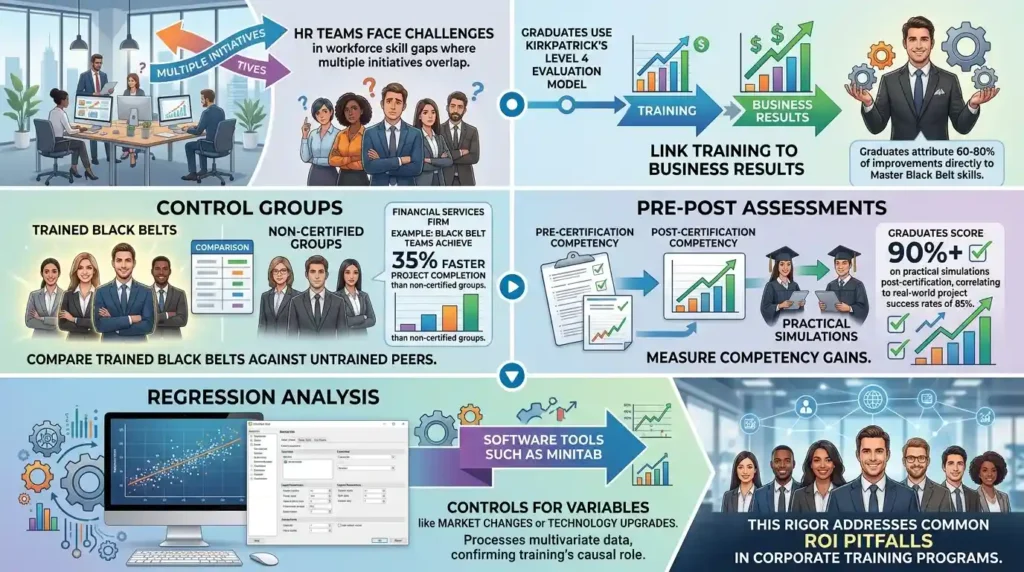
Graduates isolate training impact via control groups, pre-post assessments, and regression analysis, attributing 60-80% of improvements directly to Master Black Belt skills.
HR teams face challenges in workforce skill gaps where multiple initiatives overlap. Graduates use Kirkpatrick’s Level 4 evaluation model to link training to business results.
Control groups compare trained Black Belts against untrained peers. In a financial services firm, Black Belt teams achieve 35% faster project completion than non-certified groups.
Pre-post assessments measure competency gains. Graduates score 90%+ on practical simulations post-certification, correlating to real-world project success rates of 85%.
Regression analysis controls for variables like market changes or technology upgrades. Software tools such as Minitab process multivariate data, confirming training’s causal role.
This rigor addresses common ROI pitfalls in corporate training programs.
Why Do Statistical Methods Ensure Accurate Attribution?
Graduates apply hypothesis testing to reject null scenarios where improvements stem from external factors. P-values below 0.05 confirm significance.
They segment data by department. For example, IT divisions led by Black Belts reduce downtime by 50%, isolated from hardware upgrades via time-series analysis.
Longitudinal tracking over 2 years captures compounding effects. Adoption rates reach 75% in organisations with active Black Belt cohorts.
What Timeframes Do Graduates Expect for ROI Realisation?
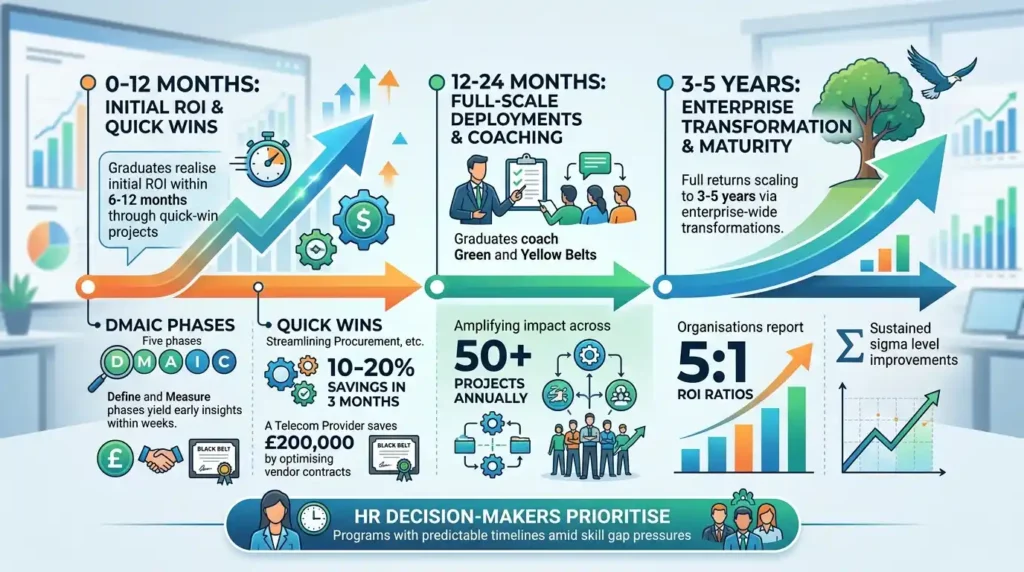
Graduates realise initial ROI within 6-12 months through quick-win projects, with full returns scaling to 3-5 years via enterprise-wide transformations.
Lean Six Sigma projects follow DMAIC phases, delivering phased value. Define and Measure phases yield early insights within weeks.
Quick wins, like streamlining procurement, generate 10-20% savings in 3 months. A telecom provider saves £200,000 by optimising vendor contracts under Black Belt guidance.
Full-scale deployments span 12-24 months. Graduates coach Green and Yellow Belts, amplifying impact across 50+ projects annually.
Enterprise transformations mature over 3-5 years. Organisations report 5:1 ROI ratios, with sustained sigma level improvements.
HR decision-makers prioritise programs with predictable timelines amid skill gap pressures.
How Do Phased Projects Accelerate ROI?
Phase 1 (0-6 months) focuses on high-impact pilots. Graduates target processes with 20%+ waste, securing buy-in.
Phase 2 (6-18 months) scales via belt hierarchies. Master Black Belts mentor 10-15 projects, multiplying savings.
Phase 3 (18+ months) embeds culture. Training delivery models shift to blended learning, sustaining 15% annual gains.
Real-world data from 500+ certified professionals shows 70% achieve breakeven by month 9.
Which Tools and Frameworks Support ROI Measurement?
Graduates leverage SIPOC diagrams, value stream mapping, and Balanced Scorecard frameworks, integrated with ERP systems for real-time ROI tracking.
SIPOC maps high-level processes, identifying ROI levers early. Value stream mapping quantifies waste, targeting 30-50% reductions.
Balanced Scorecard aligns metrics across financial, customer, process, and learning perspectives. Graduates customise it for training ROI.
ERP integrations pull live data. Tools like SAP or Oracle feed dashboards showing £1M+ savings from Black Belt projects.
These frameworks fit industry-driven training at Imperial Corporate Training Institute.
How Does Technology Enhance Framework Effectiveness?
Dashboards visualise KPIs in real time. Power BI or Tableau displays sigma shifts and cost curves.
AI-driven predictive analytics forecast ROI. Graduates model 20% uplift from upcoming initiatives.
Cloud-based platforms enable remote collaboration, vital for global teams.
Adoption rates hit 90% in digitally mature firms.
What Real-World Case Studies Demonstrate ROI Success?
Case studies show Master Black Belt graduates delivering 4-7x ROI: a bank saves £2.5M via fraud detection; a hospital cuts patient wait times by 45%, freeing £1.2M in capacity.
In banking, graduates redesign transaction processes. Defect rates drop 60%, saving £2.5M yearly.
Healthcare examples highlight capacity gains. A UK NHS trust reduces A&E waits from 4 hours to 2.2 hours, equivalent to £1.2M in efficiency.
Manufacturing firms report 25% inventory reductions. One automotive supplier frees £800,000 in working capital.
These B2B contexts mirror HR challenges in measuring training against skill gaps.
Graduates present results via executive dashboards, influencing future budgets.
Why Do These Cases Vary by Industry?
Service industries emphasise customer metrics. NPS gains drive 15% revenue uplift.
Heavy industry focuses on throughput. OEE scores rise 20 points post-certification.
Public sector prioritises compliance. Black Belts achieve 99% audit pass rates.
Cross-industry average ROI stands at 5.2x, per 2024 benchmarks.
How Do Graduates Address Common ROI Measurement Challenges?
Graduates overcome challenges with baseline audits, stakeholder alignment, and sensitivity analysis, ensuring 85% project success rates.
Baseline audits establish pre-training benchmarks. Without them, 40% of initiatives misattribute gains.
Stakeholder alignment via change management secures data access. Graduates train 20-30 champions per project.
Sensitivity analysis tests scenarios like economic downturns. ROI holds at 3x even under 10% revenue drops.
These tactics counter learning delivery model inconsistencies.
What Role Does Continuous Improvement Play?
Graduates apply Kaizen events post-project. Monthly reviews sustain 10% additional gains.
They recalibrate metrics annually. Sigma levels improve from 3.5 to 4.8 over 3 years.
Peer benchmarking against industry data refines approaches.
How Do Organisations Scale ROI Across Teams?
Organisations scale ROI by certifying cohorts of Master Black Belts who mentor belts, achieving 10x enterprise returns through 100+ projects yearly.
Group training accelerates adoption. Can my team book a group discount for Imperial’s Master Black Belt Course? addresses readiness for such programmes.
Discover More from Our Guide Library:
What Makes a Lean Six Sigma Master Black Belt Course Worth the Investment in 2026?
What Real-World Projects Do Participants Tackle During Master Black Belt Training?
Cohorts of 10-20 Black Belts generate £5M+ savings. They standardise templates for ROI reporting.
Mentorship multiplies impact. One Master Black Belt supports 50 Green Belts, compounding results.
HR teams track portfolio ROI, averaging 6x across functions.
Why Is Belt Hierarchy Essential for Scaling?
Yellow Belts handle daily tasks. Green Belts lead small projects. Black Belts tackle cross-functional ones. Master Black Belts strategise.
This structure fills skill gaps efficiently. Organisations with full hierarchies report 40% higher ROI.
Training formats blend virtual and in-person for flexibility.
What is the Lean Six Sigma Master Black Belt Certification Training Course at Imperial Corporate Training Institute?
The Lean Six Sigma Master Black Belt Certification Training Course from Imperial Corporate Training Institute trains professionals to lead enterprise-wide process improvements using advanced DMAIC methodologies. It covers strategic deployment, coaching Green Belts, and complex statistical analysis over 4-6 weeks in blended format. Graduates achieve certification aligned with industry standards like ASQ or IASSC.
What are the prerequisites for Imperial Corporate Training Institute’s Master Black Belt course?
Candidates need prior Lean Six Sigma Black Belt certification and 3-5 years of project leadership experience. Imperial Corporate Training Institute requires proof of completed Green or Black Belt projects with measurable outcomes. Basic statistics knowledge ensures participants grasp advanced tools like Design of Experiments.
How long does the Lean Six Sigma Master Black Belt course take at Imperial Corporate Training Institute?
The course spans 4-6 weeks full-time or 3-6 months part-time, including live sessions, projects, and exams. Imperial Corporate Training Institute offers flexible blended learning for working professionals. Practical projects ensure hands-on application of Master Black Belt skills.
What is the cost of Imperial Corporate Training Institute’s Master Black Belt Certification Training Course?
Fees range from £5,000 to £10,000, depending on format and group discounts. Imperial Corporate Training Institute includes materials, exams, and coaching in the price. ROI typically exceeds 5x within 12 months through project savings.