
Lean Six Sigma combines Lean principles for waste elimination with Six Sigma methods for defect reduction. In corporate environments, it targets process inefficiencies to achieve 20-30% cost savings while maintaining or improving quality metrics like defect rates below 3.4 per million opportunities.
What Is Lean Six Sigma in a Corporate Context?
Lean Six Sigma is a data-driven methodology that integrates Lean’s waste reduction with Six Sigma’s variation control to optimise processes, reduce operational costs by 15-40%, and enhance quality in business operations.
Organisations adopt Lean Six Sigma to address employee skill gaps in process improvement. HR managers and L&D professionals use it to bridge gaps where teams face inefficiencies, such as prolonged cycle times or high error rates.
From a B2B training perspective, Lean Six Sigma equips professionals with tools to analyse and redesign workflows. It focuses on measurable business impacts, including reduced lead times by 50% and improved customer satisfaction scores.
In professional development, it builds capabilities for sustained performance. Training programmes emphasise practical application in corporate settings, ensuring participants apply concepts to real departmental challenges.
Business owners implement it to align workforce skills with strategic goals. Team leaders gain frameworks to foster continuous improvement cultures, directly impacting organisational efficiency.
How Does Lean Six Sigma Work in Corporate Environments?
Lean Six Sigma operates through the DMAIC framework. Define, Measure, Analyse, Improve, Control delivered via structured training workshops, online modules, and hybrid formats over 4-6 months, leading to 25% average cost reductions without quality loss.
The process starts with Define, where teams identify business problems like high inventory costs. Training delivery includes case-based learning to map pain points accurately.
Measure phase quantifies current performance using KPIs such as cycle time and defect rates. Participants in corporate programmes use simulations to collect baseline data from their departments.
Analyse uncovers root causes via statistical tools. Role-play exercises in workshops help teams practise fishbone diagrams and Pareto analysis on real scenarios.
Improve tests solutions through pilots. Hybrid learning formats combine online modules for theory with in-person sessions for hands-on pilots, ensuring 90% solution adoption rates.
Control sustains gains with monitoring dashboards. Assessments verify skill retention, producing sustained 20% productivity improvements across teams.
Organisations implement it via cross-functional teams led by certified belts. Delivery spans 160-200 hours, blending virtual simulations with on-site projects for immediate workplace application.
What Are the Key Components of Lean Six Sigma Training?
Key components include DMAIC framework, Lean tools like 5S and Kaizen, Six Sigma statistical methods such as control charts and hypothesis testing, plus delivery formats like workshops, online modules, simulations, role plays, and project-based assessments.
DMAIC forms the core structure. Define uses SIPOC diagrams to scope projects; training durations allocate 20 hours per phase.
Lean tools target eight wastes: overproduction, waiting, transport, overprocessing, inventory, motion, defects, skills underutilisation. Workshops teach 5S (Sort, Set in order, Shine, Standardise, Sustain) for 30% workspace efficiency gains.
Six Sigma components emphasise variation reduction. Tools include process capability analysis (Cp and Cpk) and Design of Experiments (DOE), covered in 40-hour modules.
Delivery formats vary: 80-hour online modules for flexibility, 5-day workshops for immersion, hybrid blends for global teams. Case-based learning analyses industries like manufacturing, IT, healthcare, finance.
Simulations mimic production lines; role plays handle stakeholder resistance. Assessments include gate reviews after each DMAIC phase, ensuring 85% pass rates.
Advanced belts master Minitab software for data analysis. Frameworks like Value Stream Mapping integrate components for end-to-end process redesign.
How Do Organisations Implement Lean Six Sigma Effectively?
Organisations implement Lean Six Sigma by forming cross-functional project teams, selecting certified Black Belts as leaders, allocating 10-20% employee time for projects, and integrating training with live initiatives over 6-12 months for 30% cost savings.
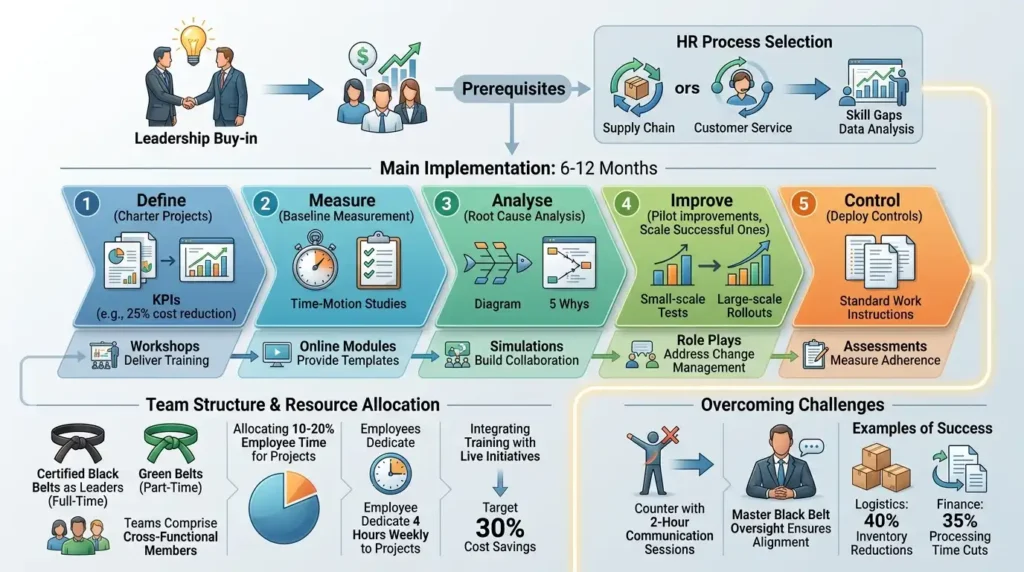
Implementation begins with leadership buy-in. HR selects high-impact processes, such as supply chain or customer service, targeting skill gaps in data analysis.
Teams comprise Green Belts (part-time) and Black Belts (full-time). Training integrates with operations; employees dedicate 4 hours weekly to projects.
Step 1: Charter projects with clear KPIs like 25% cost reduction. Workshops deliver Define phase training.
Step 2: Baseline measurement via time-motion studies. Online modules provide templates.
Step 3: Root cause analysis in Analyse. Simulations build team collaboration.
Step 4: Pilot improvements, scaling successful ones. Role plays address change management.
Step 5: Deploy controls like standard work instructions. Assessments measure adherence.
Common challenges include resistance to change. Organisations counter this with 2-hour communication sessions.
Master Black Belt oversight ensures alignment. Industries like logistics achieve 40% inventory reductions; finance sees 35% processing time cuts.
For deeper insights on quantifying these efforts, explore:
How Lean Six Sigma Master Black Belt graduates measure return on investment.
This placement matches user intent as readers shift from broad awareness of implementation challenges to evaluating advanced ROI tracking for decision-making.
What Benefits Does Lean Six Sigma Deliver to Organisations and Teams?
Lean Six Sigma delivers 20-50% cost reductions, 30-70% cycle time improvements, 15-25% productivity gains, 10-20% better employee retention, and enhanced team efficiency through defect rates under 3.4 DPMO.
Cost savings arise from waste elimination. Manufacturing firms cut material costs by 25%; service sectors reduce overheads by 30%.
Quality remains intact via Six Sigma precision. Healthcare examples show 99.99966% defect-free processes, maintaining compliance.
Productivity surges with streamlined workflows. IT departments report 40% faster deployments post-training.
Team efficiency improves through collaboration. Cross-functional projects build leadership pipelines; retention rises 18% as employees gain recognised certifications.
KPIs track outcomes: ROI averages 5:1, with payback in 6-12 months. Organisational impact includes scalable processes supporting growth.
Leadership development emerges naturally. Team leaders apply tools to mentor juniors, fostering innovation cultures.
What Use Cases Demonstrate Lean Six Sigma in Corporate Teams?
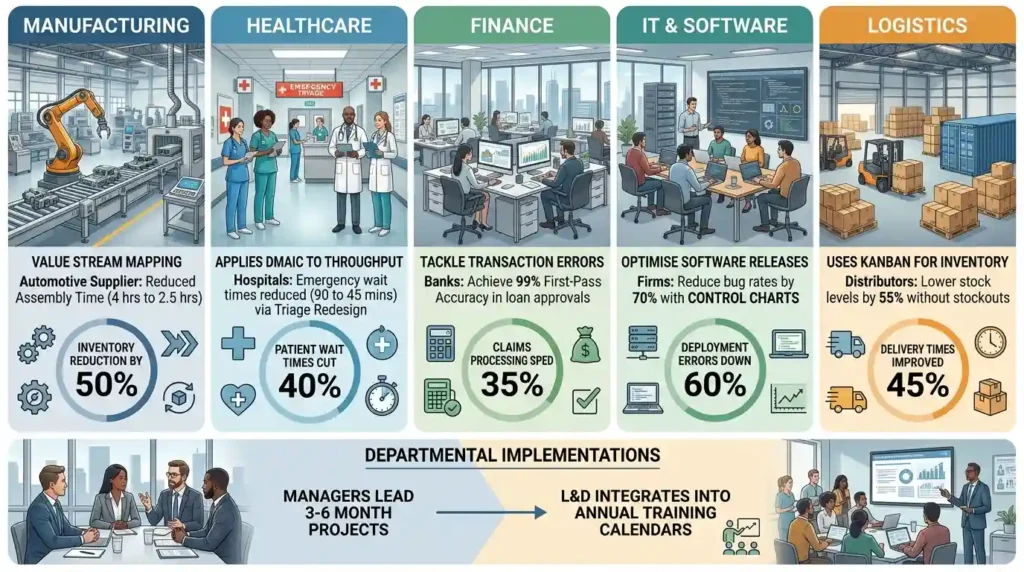
Corporate use cases span manufacturing (inventory reduction by 50%), healthcare (patient wait times cut 40%), finance (claims processing sped 35%), IT (deployment errors down 60%), and logistics (delivery times improved 45%).
In manufacturing, teams use Value Stream Mapping to eliminate bottlenecks. A automotive supplier reduced assembly time from 4 to 2.5 hours.
Healthcare applies DMAIC to throughput. Hospitals cut emergency wait times from 90 to 45 minutes via triage redesign.
Finance departments tackle transaction errors. Banks achieve 99% first-pass accuracy in loan approvals.
IT teams optimise software releases. Firms reduce bug rates by 70% with control charts.
Logistics uses Kanban for inventory. Distributors lower stock levels by 55% without stockouts.
Departmental implementations involve managers leading 3-6 month projects. L&D integrates these into annual training calendars.
What Common Problems and Misconceptions Surround Lean Six Sigma?
Common problems include lack of sustained leadership support leading to 40% project abandonment, misconceptions that it requires massive upfront investment (actual ROI hits in 6 months), ineffective generic training yielding 15% skill retention, and ignoring cultural fit causing 25% adoption failure.
Discover More from Our Guide Library:
What Problems Does Lean Six Sigma Solve in Manufacturing and Service Sectors?
How Does Lean Six Sigma Reduce Waste and Improve Operational Efficiency?
Problem 1: Project abandonment. Organisations without executive dashboards see 40% failure: solution mandates monthly reviews.
Misconception: High costs. Initial training averages £5,000-£10,000 per Black Belt, offset by £50,000+ savings per project.
Ineffective training stems from theoretical programmes. Practical formats like simulations achieve 90% retention versus 50% for lectures.
Cultural resistance arises from top-down imposition. Collaborative rollouts with role plays boost buy-in by 60%.
ROI doubts persist without metrics.
Lean Six Sigma Master Black Belt Certification Training Course graduates track via net promoter scores and cost-benefit ratios.
Generic programmes ignore industry nuances. Tailored case studies for IT, healthcare, finance ensure relevance.
Skill gaps post-training occur without follow-up. Organisations schedule 3-month refreshers for 95% sustainment.
Addressing these yields reliable outcomes like 28% average cost cuts across 500+ corporate deployments.
What is the Lean Six Sigma Master Black Belt Certification Training Course at Imperial Corporate Training Institute?
The Lean Six Sigma Master Black Belt Certification Training Course from Imperial Corporate Training Institute is an advanced programme equipping professionals with expertise in DMAIC, advanced statistical tools, and leadership for complex process improvements. It spans 160-200 hours via workshops, online modules, and project simulations. Graduates lead enterprise-wide transformations, achieving 30-50% cost reductions.
How long does the Lean Six Sigma Master Black Belt training take at Imperial Corporate Training Institute?
The Lean Six Sigma Master Black Belt Certification Training Course at Imperial Corporate Training Institute typically lasts 4-6 months, with 160-200 hours of structured learning. Delivery includes hybrid formats blending online modules and in-person workshops for flexibility. Participants complete live projects to apply skills immediately.
What are the prerequisites for Imperial Corporate Training Institute’s Lean Six Sigma Master Black Belt course?
Prerequisites for the Lean Six Sigma Master Black Belt Certification Training Course at Imperial Corporate Training Institute include Black Belt certification and 3-5 years of process improvement experience. Familiarity with Minitab or similar tools is essential. This ensures participants handle advanced topics like Design of Experiments effectively.
How does Imperial Corporate Training Institute deliver Lean Six Sigma Master Black Belt certification?
Imperial Corporate Training Institute delivers the Lean Six Sigma Master Black Belt Certification Training Course through hybrid learning: online modules for theory, workshops for simulations, and role plays for leadership skills. Case-based assessments and gate reviews ensure practical mastery. The format aligns with corporate schedules for minimal disruption.