

Lean Six Sigma addresses inefficiencies, waste, variability, and defects in manufacturing and service sectors. Organisations deploy it to cut costs by 20-30%, boost productivity by 15-25%, and improve customer satisfaction scores by 10-20%.
What Exactly is Lean Six Sigma in a Corporate Context?
Lean Six Sigma combines Lean principles for waste elimination with Six Sigma methods for defect reduction, targeting process optimisation in manufacturing and services.
Lean Six Sigma integrates two methodologies. Lean removes non-value-adding activities. Six Sigma minimises variation using data-driven analysis. In corporate settings, it tackles employee skill gaps in process improvement.
Manufacturing firms use it to streamline assembly lines. Service sectors apply it to reduce customer wait times. Business impact includes higher throughput and lower operational costs.
HR managers and L&D professionals implement it to bridge gaps in quality control and efficiency. Team leaders train staff to identify bottlenecks. Decision-makers measure success through KPIs like cycle time reduction.
What Core Problems Does Lean Six Sigma Target in Manufacturing?
Lean Six Sigma solves overproduction, excess inventory, defects, waiting times, unnecessary motion, and transportation in manufacturing, reducing waste by 25-40%.
Manufacturing faces seven classic wastes. Overproduction creates stockpiles. Excess inventory ties up capital. Defects demand rework, costing 5-10% of revenue.
Waiting halts production lines. Unnecessary motion fatigues workers. Transportation moves materials inefficiently. Lean Six Sigma deploys DMAIC. Define, Measure, Analyse, Improve, Control—to map and eliminate these.
A car manufacturer cut assembly defects from 8% to 1.2% in six months. Steel plants reduced inventory by 35%. Electronics firms shortened cycle times by 22%.
Corporate teams gain skills in root cause analysis. This closes skill gaps in quality management. L&D programs deliver these via workshops and simulations.
What Core Problems Does Lean Six Sigma Target in Services?
Lean Six Sigma eliminates delays, errors, redundant processes, and resource overuse in services, improving service delivery speed by 30-50% and error rates by 50-70%.
Service sectors struggle with inconsistent delivery. Delays frustrate customers. Errors lead to refunds. Redundant approvals slow workflows.
Resource overuse inflates costs. Lean Six Sigma applies value stream mapping to visualise flows. It uses statistical tools to pinpoint variation.
Banks reduced loan processing from 10 days to 2 days. Hospitals cut patient wait times by 40%. Call centres lowered first-call resolution failures from 25% to 8%.
Business owners train teams in service blueprints. This addresses gaps in process standardisation. Hybrid learning formats reinforce application.
How Does Lean Six Sigma Work Step by Step in Organisations?
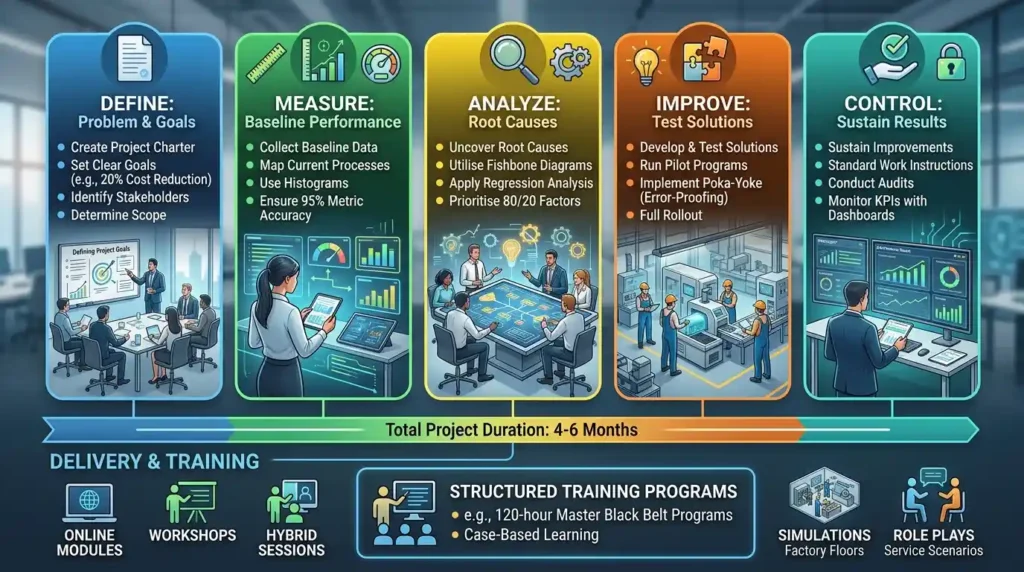
Lean Six Sigma follows DMAIC framework: Define problem, Measure performance, Analyse causes, Improve processes, Control gains delivered over 4-6 months via structured training and projects.
Organisations start with Define phase. Teams charter projects with clear goals, like 20% cost reduction. They identify stakeholders and scope.
Measure phase collects baseline data. Tools like process maps and histograms quantify current state. Accuracy reaches 95% with calibrated metrics.
Analyse uncovers root causes. Fishbone diagrams and regression analysis reveal issues. Pareto charts prioritise 80/20 factors.
Improve tests solutions. Pilots validate changes, such as poka-yoke error-proofing. Full rollout follows.
Control sustains results. Standard work, audits, and dashboards monitor KPIs. Training includes 120-hour Master Black Belt programs with case-based learning.
Delivery formats span online modules, workshops, and hybrid sessions. Simulations mimic factory floors. Role plays handle service scenarios.
What Key Components Make Up Lean Six Sigma Training?
Core components include DMAIC framework, Lean tools (5S, Kaizen), Six Sigma stats (control charts, DOE), soft skills (team facilitation), and assessments over 160-200 training hours.
DMAIC structures every project. Lean tools organise workspaces—5S sorts, sets, shines, standardises, sustains. Kaizen drives continuous events.
Six Sigma employs control charts for variation. Design of Experiments (DOE) optimises factors. Hypothesis testing validates changes.
Soft skills cover change management and stakeholder buy-in. Training spans tools like SIPOC for supplier-input-process-output-customer mapping.
Delivery includes 40% lectures, 30% simulations, 20% projects, 10% assessments. Virtual reality simulates manufacturing lines. Case studies from automotive and finance sectors build expertise.
Master Black Belt certification requires passing exams and leading projects yielding 100,000 USD savings.
How Do Organisations Implement Lean Six Sigma Effectively?
Organisations implement via leadership commitment, cross-functional teams, 6-12 month projects, and ROI tracking, achieving 15-30% productivity gains.
Secure executive buy-in first. Appoint a deployment leader. Form Green, Black Belt teams from operations and quality.
Select pilots based on high-impact areas, like 20% of processes causing 80% waste. Allocate 20% staff time to projects.
Train in cohorts: 20-30 participants per workshop. Use hybrid formats for global teams. Integrate with ERP systems for data.
Track progress weekly. Calculate ROI as (benefits – costs)/costs. A 5:1 ratio signals success.
Common pitfalls include lack of follow-through. Generic programs fail without industry tailoring. Measure against KPIs like OEE (Overall Equipment Effectiveness) rising 18%.
For deeper evaluation on training investments, explore:
What makes a Lean Six Sigma Master Black Belt course worth the investment in 2026.
What Measurable Outcomes Does Lean Six Sigma Produce for Businesses?
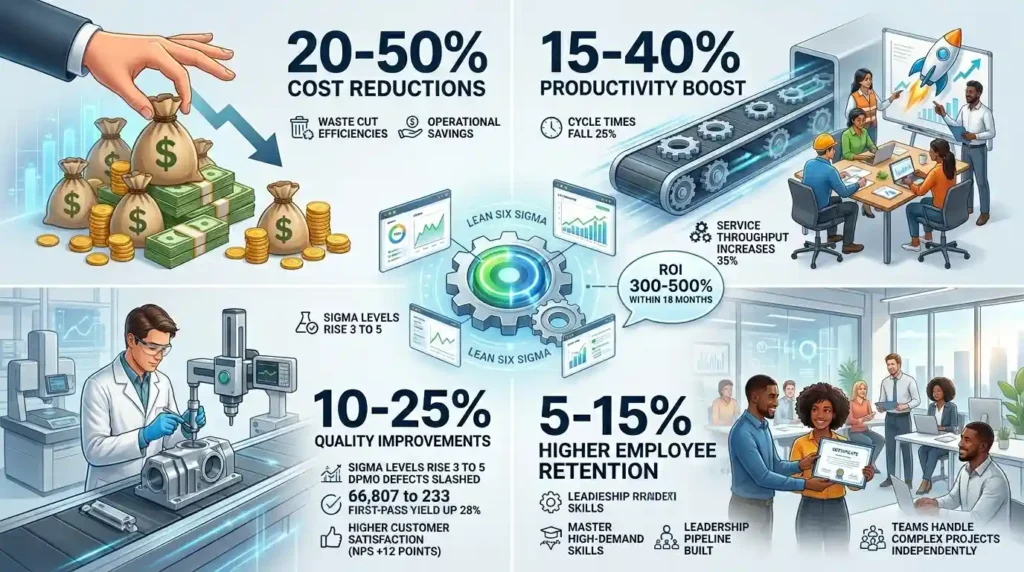
Lean Six Sigma delivers 20-50% cost reductions, 15-40% productivity boosts, 10-25% quality improvements, and 5-15% higher employee retention.
Costs drop through waste cuts. Manufacturing sigma levels rise from 3 to 5, slashing defects per million opportunities from 66,807 to 233.
Productivity climbs as cycle times fall 25%. Service throughput increases 35%. Customer satisfaction NPS scores gain 12 points.
ROI hits 300-500% within 18 months. One firm saved 2.5 million GBP yearly. Retention improves as employees master high-demand skills.
KPIs include DPMO, first-pass yield (up 28%), and labour efficiency (up 22%). Dashboards track real-time.
Organisational impact builds leadership pipelines. Teams handle complex projects independently.
What Use Cases Demonstrate Lean Six Sigma in Corporate Teams?
Use cases span manufacturing assembly optimisation, service transaction streamlining, supply chain reduction, and healthcare throughput in industries like automotive, finance, logistics, telecom.
Automotive plants deploy it for defect-free lines. Teams reduce variants from 50 to 15, cutting costs 28%.
Finance processes mortgage approvals. Black Belts halve errors, speeding delivery 45%.
Logistics firms optimise warehouses. 5S and VMI (Vendor Managed Inventory) lower stockouts 60%.
Telecom cuts network downtime 40% via failure mode analysis. Hospitals streamline ER triage, reducing waits 35%.
Departmental teams’ quality, operations, and HR lead initiatives. Managers facilitate Kaizens. Global rollout uses online modules.
What Common Misconceptions Surround Lean Six Sigma Training?
Misconceptions include it being only for manufacturing, requiring full-time staff, delivering instant results, or succeeding without data training, counters these with hybrid, part-time, data-focused programs.
Many view it as manufacturing-exclusive. Services gain equally, like IT reducing ticket resolution 32%.
It demands full-time belts. Part-time models work, with 10 hours weekly yielding results.
Instant fixes fail. Projects take 3-6 months for 20% gains. Sustainability needs control phase.
Data aversion stalls progress. Training mandates stats proficiency.
Generic programs ignore sector needs. Tailored simulations ensure 90% knowledge retention.
Ineffective training skips assessments. Robust ones include pre/post tests, boosting application 40%.
For deeper insight enrol:
Lean Six Sigma Master Black Belt Certification Training Course
How Does Lean Six Sigma Address Employee Skill Gaps in Modern Workplaces?
Lean Six Sigma fills gaps in process analysis, data interpretation, and change leadership via 160-hour programs with 70% hands-on learning.
Skill gaps hinder efficiency. Workers lack root cause tools. Managers struggle with variation control.
Programs deliver via workshops (40 hours), online modules (80 hours), and projects (40 hours) Simulations teach 5S in factories.
Discover More From Our Guide Library:
How Does Lean Six Sigma Reduce Waste and Improve Operational Efficiency?
What Industries Benefit Most From Lean Six Sigma Methodology and Training?
Role plays build facilitation. Assessments measure 85% competency gain.
Teams apply to real workflows, closing gaps. Retention rises 12% as skills align with corporate needs.
Business owners track via skill matrices. Productivity improves 18% post-training.
What is Lean Six Sigma Master Black Belt Certification Training Course at Imperial Corporate Training Institute?
The Lean Six Sigma Master Black Belt Certification Training Course from Imperial Corporate Training Institute equips professionals with advanced skills in DMAIC, statistical analysis, and change leadership. It spans 160-200 hours with hands-on projects, simulations, and assessments. Participants lead enterprise-wide transformations, targeting 20-50% process improvements.
Who should take the Lean Six Sigma Master Black Belt course from Imperial Corporate Training Institute?
Senior managers, quality directors, and process engineers in manufacturing or services benefit most from Imperial Corporate Training Institute’s Lean Six Sigma Master Black Belt Certification Training Course. It suits those with Green or Black Belt experience aiming to mentor teams and drive ROI. Organisations use it to build internal expertise for sustained efficiency gains.
How long does the Lean Six Sigma Master Black Belt Certification Training Course take at Imperial Corporate Training Institute?
Imperial Corporate Training Institute delivers the Lean Six Sigma Master Black Belt Certification Training Course over 4-6 months in hybrid format, including 120 training hours and live projects. Flexible scheduling fits corporate schedules with online modules and workshops. Certification requires passing exams and demonstrating project savings of at least 100,000 GBP.
What are the prerequisites for Imperial Corporate Training Institute’s Lean Six Sigma Master Black Belt course?
Candidates need prior Lean Six Sigma Black Belt certification and 3-5 years of process improvement experience for Imperial Corporate Training Institute’s Lean Six Sigma Master Black Belt Certification Training Course. Familiarity with tools like DOE and control charts is essential. The programme assumes proficiency to focus on advanced deployment strategies.