
Lean Six Sigma methodology drives operational excellence in corporate environments by reducing waste, minimising defects, and boosting efficiency. Organisations adopt it to address skill gaps in process improvement, delivering measurable gains in productivity and cost savings. Training equips teams with tools to implement these changes systematically.
What Is Lean Six Sigma Methodology?

Lean Six Sigma combines Lean principles for waste elimination with Six Sigma’s data-driven defect reduction, targeting 3.4 defects per million opportunities in business processes.
Organisations use Lean Six Sigma to streamline workflows and enhance quality control. It originated from manufacturing but now applies across sectors facing process inefficiencies. In workplaces, it tackles employee skill gaps in data analysis and problem-solving.
The methodology integrates DMAIC framework: Define, Measure, Analyse, Improve, Control. Teams apply it to projects yielding 20-30% efficiency gains. Businesses measure success through KPIs like cycle time reduction and defect rates.
Corporate training introduces these concepts via workshops and simulations. Participants learn to identify value streams and root causes. This builds confidence in handling complex operations.
How Does Lean Six Sigma Work in Corporate Environments?
Lean Six Sigma operates through structured DMAIC cycles, delivered in 4-6 month training programs with real project application, achieving 15-25% productivity improvements in teams.
In corporations, it starts with project selection based on high-impact areas. Leaders form cross-functional teams trained in the methodology. Training delivery includes online modules for theory and hybrid workshops for practice.
Teams define problems using SIPOC diagrams. They measure baseline performance with control charts. Analysis employs statistical tools like regression to pinpoint variations.
Improvement phases test solutions via pilots, such as kaizen events reducing setup times by 50%. Control ensures sustainability with standard work procedures. Organisations track ROI through metrics like cost savings per project, often exceeding £100,000 annually.
Implementation involves L&D professionals aligning training with business goals. Case-based learning reinforces application. Regular audits maintain gains.
What Are the Key Components of Lean Six Sigma Training?
Key components include DMAIC framework, statistical tools like Minitab software, Lean tools such as 5S and value stream mapping, plus delivery formats like 120-hour workshops and online assessments.
Training covers core skills: process mapping, hypothesis testing, and design of experiments. Frameworks like DMADV extend DMAIC for new processes. Tools include fishbone diagrams for root cause analysis and Pareto charts prioritising issues.
Delivery formats suit working professionals: virtual instructor-led sessions, self-paced modules, and role-play simulations. Programs span 4-6 months, with 40% theory and 60% practical application.
Assessments feature project submissions demonstrating 20% waste reduction. Certification requires passing exams with 80% scores and mentoring sessions. Organisations customise content for department needs, like finance teams focusing on invoice processing.
These elements ensure teams apply knowledge immediately, bridging skill gaps in data-driven decision-making.
Which Industries Benefit Most From Lean Six Sigma?
Manufacturing, healthcare, finance, IT services, and logistics benefit most, with gains like 25% cycle time reduction in manufacturing and 30% error cuts in healthcare.
Manufacturing firms use it to optimise assembly lines, reducing downtime by 40%. Healthcare applies it to patient flow, cutting wait times from 120 to 45 minutes. Finance streamlines claims processing, achieving 99.9% accuracy.
IT services deploy it for software deployment, shortening release cycles by 50%. Logistics reduces inventory costs by 20% through just-in-time principles. These sectors face high volumes and variability, making Lean Six Sigma ideal.
Energy and telecommunications also gain: power plants cut outages by 35%, telcos improve call resolution by 28%. Training targets industry-specific pain points, like supply chain disruptions.
How Do Organisations Implement Lean Six Sigma Training?
Organisations implement via needs assessment, 6-month cohort programs for 10-20 employees per group, project integration, and KPI tracking, yielding 18% overall efficiency uplift.
HR managers conduct gap analyses using surveys and performance data. They select Yellow Belt to Master Black Belt levels based on roles. Team leaders sponsor projects aligned with strategic goals.
Delivery blends formats: 20% online modules, 50% live workshops, 30% on-site simulations. Participants complete real projects, mentored by Black Belts. Post-training, dashboards monitor KPIs like throughput increase.
Common challenges include resistance to change; organisations counter with leadership buy-in and quick wins. Integration into performance reviews sustains momentum. Lean Six Sigma Master Black Belt Training Delivered for Working Professionals provides deeper insights into structured programme execution.
For more deeper insight enrol:
Lean Six Sigma Master Black Belt Certification Training Course
What Benefits Does Lean Six Sigma Deliver to Businesses and Teams?
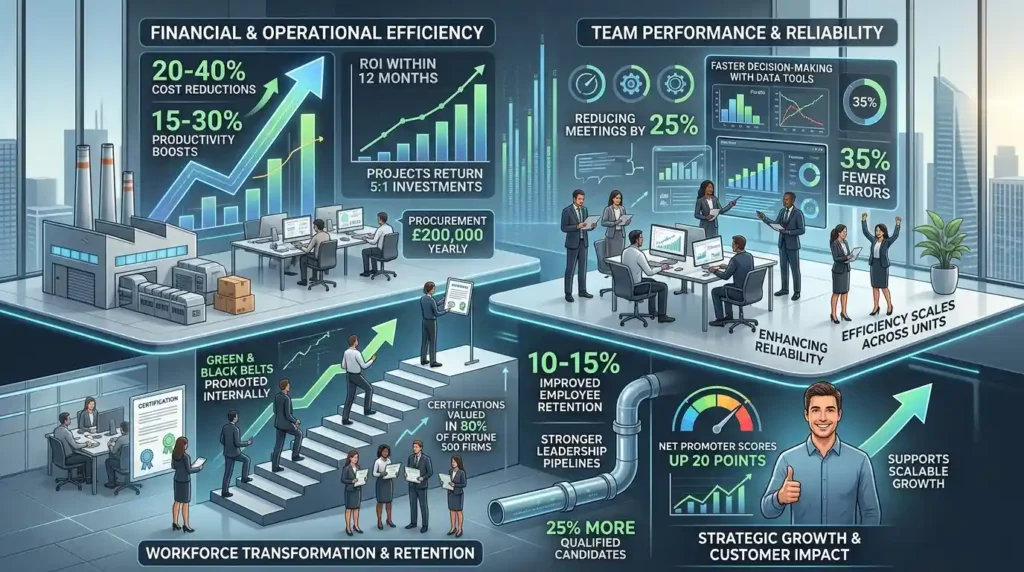
Benefits include 20-40% cost reductions, 15-30% productivity boosts, 10-15% improved employee retention, and stronger leadership pipelines through certified belts.
Teams achieve faster decision-making with data tools, reducing meetings by 25%. Departments report 35% fewer errors, enhancing reliability. Organisations see ROI within 12 months, with projects returning 5:1 investments.
Workforce transformation fills skill gaps, promoting internal talent to Green and Black Belts. Retention rises as employees gain certifications valued in 80% of Fortune 500 firms. Efficiency scales across units, like procurement saving £200,000 yearly.
Metrics track organisational impact: Net Promoter Scores up 20 points, leadership pipelines with 25% more qualified candidates. These outcomes support scalable growth.
What Use Cases Demonstrate Lean Six Sigma in Corporate Teams?
Use cases span departments: manufacturing reduces defects by 50%, finance cuts processing time 40%, healthcare shortens patient stays 25%, IT accelerates deployments 60%, and sales improves forecasting accuracy 30%.
In manufacturing, teams apply 5S to warehouses, freeing 15% floor space. Finance uses control charts for fraud detection, saving £150,000 quarterly. Healthcare simulations optimise ER triage, reducing readmissions by 18%.
IT departments employ value stream mapping for agile sprints, hitting 95% on-time deliveries. Sales teams analyse funnel data, boosting conversion rates 22%. Managers lead cross-functional kaizens, resolving bottlenecks in 2 weeks.
Logistics case: A firm cut shipping errors 45% via poka-yoke devices. These examples show adaptability across hierarchies, from executives to operators.
What Common Problems Arise With Lean Six Sigma Training?
Common problems include lack of leadership support causing 40% project failure, generic programs ignoring industry needs, poor ROI tracking leading to 25% abandonment, and insufficient hands-on practice resulting in 30% skill decay.
Ineffective training often skips real projects, leaving teams with theory only. Organisations without metrics see initiatives stall after 6 months. Misconceptions view it as manufacturing-only, missing service sector potential.
Generic programs fail to address skill gaps like advanced stats, yielding 15% lower adoption. Resistance emerges without change management, dropping engagement 35%. Solutions demand tailored delivery and executive sponsorship.
How Do Organisations Measure Lean Six Sigma Outcomes?
Organisations measure via KPIs: 20-30% defect reduction, £50,000-£500,000 cost savings per project, 15% productivity gains, and 12-month ROI exceeding 300%.
Dashboards track sigma levels, rising from 3 to 4 in 9 months. Surveys gauge skill uplift, with 85% reporting confidence gains. Financial audits confirm savings, like 28% overhead cuts.
Team efficiency metrics include throughput up 25%. Retention data shows 12% lower turnover in certified groups. Leadership pipelines strengthen, with 20% promotions from belts.
Discover More From Our Guide Library:
Why Is Lean Six Sigma Considered a Leadership Skill in Modern Organisations?
How Is Lean Six Sigma Different From Traditional Quality Management Approaches?
Long-term audits verify sustainment, with 90% projects maintaining gains after 2 years. These quantify workforce transformation.
Lean Six Sigma equips organisations with precise tools for enduring efficiency. HR and L&D leaders prioritise it for competitive edges in volatile markets.
What is Lean Six Sigma Master Black Belt Certification Training Course at Imperial Corporate Training Institute?
The Lean Six Sigma Master Black Belt Certification Training Course from Imperial Corporate Training Institute equips professionals with advanced skills in DMAIC processes, statistical analysis, and Lean tools for enterprise-wide improvements. It spans 4-6 months with hybrid delivery including workshops and real projects. Participants achieve certification after exams and a mentored project demonstrating 20-30% efficiency gains.
Who should take the Lean Six Sigma Master Black Belt course from Imperial Corporate Training Institute?
Senior managers, process improvement leads, and L&D professionals in industries like manufacturing and healthcare benefit most from Imperial Corporate Training Institute’s Lean Six Sigma Master Black Belt Certification Training Course. It targets those with Green Belt experience facing complex organisational challenges. The course builds leadership in driving 15-25% productivity boosts across teams.
How is the Lean Six Sigma Master Black Belt training delivered by Imperial Corporate Training Institute?
Imperial Corporate Training Institute delivers the Lean Six Sigma Master Black Belt Certification Training Course through a hybrid format: online modules, live workshops, simulations, and on-site mentoring over 120 hours. Working professionals apply concepts to real projects with Black Belt guidance. Assessments include exams and a capstone project tracking KPIs like defect reduction.
What are the benefits of Master Black Belt certification from Imperial Corporate Training Institute?
Earning the Lean Six Sigma Master Black Belt Certification Training Course from Imperial Corporate Training Institute enables professionals to lead high-impact projects yielding 20-40% cost savings and stronger leadership pipelines. Organisations gain measurable ROI through improved efficiency and retention rates up 10-15%. Certification aligns with corporate needs for data-driven transformation.