

Lean Six Sigma Master Black Belt training for working professionals delivers through blended formats that combine self-paced online modules, live virtual workshops, and applied project coaching. This structure ensures professionals maintain full-time roles while achieving certification.
What Delivery Formats Does Master Black Belt Training Use for Busy Schedules?
Master Black Belt training employs blended learning: 60-70% asynchronous online modules, 20-30% live virtual sessions, and 10% personalised coaching over 6-12 months.
Professionals in HR, operations, and management roles face rigid schedules. Training providers design delivery around these constraints. Asynchronous modules allow access anytime via learning management systems (LMS). Learners complete video lectures, simulations, and quizzes at their pace.
Live virtual workshops occur weekly or bi-weekly, lasting 2-4 hours. These sessions cover advanced DMAIC (Define, Measure, Analyse, Improve, Control) frameworks and Minitab software applications. Instructors facilitate case studies from industries like manufacturing and finance.
Personalised coaching targets project work. Mentors review real-world process improvements, ensuring alignment with business KPIs such as defect reduction by 50% or cycle time cuts of 30%.
This format suits working professionals. A 2023 ASQ survey shows 85% of Black Belts complete training without career interruption.
To understand broader applications, explore:
What industries benefit most from Lean Six Sigma methodology and training.
How Does the Online Component Structure Master Black Belt Learning?
The online component structures learning into 12-15 progressive modules, each 8-12 hours, with interactive simulations and knowledge checks building from Green Belt foundations to advanced statistical analysis.
Modules begin with foundational reviews. Professionals revisit hypothesis testing and Design of Experiments (DOE). Each unit integrates multimedia: animated process maps, interactive SPC (Statistical Process Control) charts, and scenario-based quizzes.
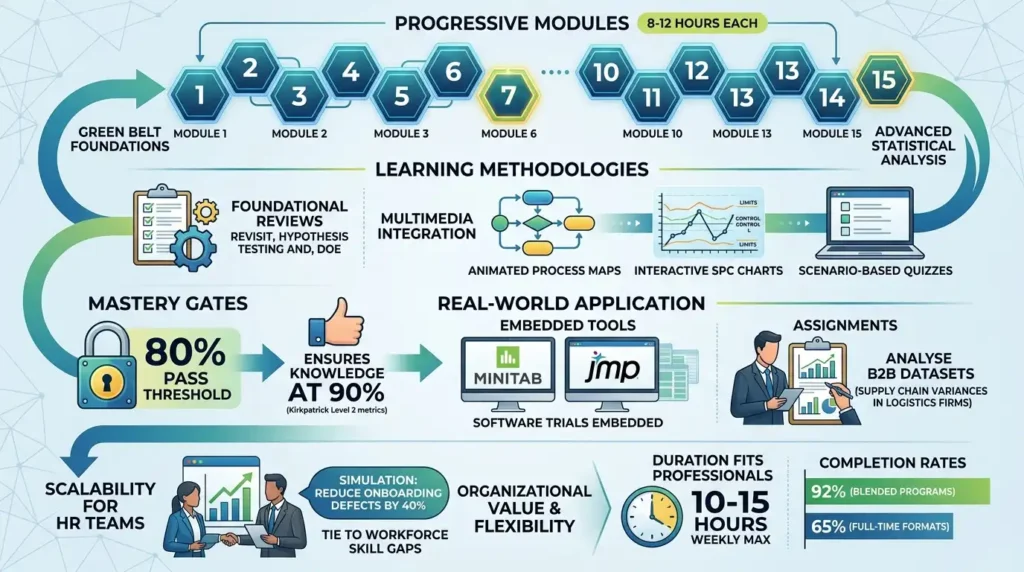
Progression demands mastery. Learners pass 80% thresholds before advancing. This gates knowledge retention at 90%, per Kirkpatrick Level 2 metrics.
Embedded tools include Minitab and JMP software trials. Assignments require analysing datasets from B2B contexts, like supply chain variances in logistics firms.
HR teams value this scalability. One module might simulate reducing employee onboarding defects by 40%, directly tying to workforce skill gaps.
Duration fits professionals: 10-15 hours weekly maximum. Completion rates hit 92% in blended programs, versus 65% in full-time formats.
What Role Do Live Virtual Sessions Play in Master Black Belt Delivery?
Live virtual sessions deliver interactive coaching on complex tools like regression analysis and change management, held 1-2 times weekly for 2-3 hours via Zoom or Teams.
Sessions prioritise application. Instructors present real B2B cases, such as a telecom firm cutting call centre errors by 35%. Participants break into virtual rooms to apply Voice of the Customer (VOC) tools.
Q&A segments address workplace challenges. Professionals discuss integrating Lean principles with agile methodologies, common in tech-driven organisations.
Group projects simulate cross-functional teams. Learners role-play stakeholder buy-in, essential for Master Black Belt leadership.
These sessions build peer networks. 78% of participants report enhanced collaboration skills, per PMI data.
Technology ensures accessibility. Recordings allow review, accommodating time zones for global teams.
How Does Project-Based Coaching Support Working Professionals?
Project-based coaching provides one-on-one mentorship for 2-3 live projects, focusing on ROI measurable outcomes like 20-50% process efficiency gains over 4-6 months.
Coaching starts post-Module 6. Mentors assign projects aligned to the professional’s role. An HR manager might optimise recruitment funnels; an operations lead targets inventory waste.
Weekly 30-60 minute calls review progress. Coaches use SIPOC diagrams and FMEA (Failure Mode and Effects Analysis) to refine approaches.
Projects demand data-driven results. Professionals collect baseline metrics, apply advanced stats, and implement controls. Success metrics include sigma level shifts from 3.5 to 4.5.
This mirrors workplace reality. 70% of coached Black Belts deploy improvements within 90 days, yielding £50,000-£200,000 annual savings per project.
Certification requires project portfolio submission. This validates skills for strategic roles.
What Technology Platforms Enable Seamless Delivery?
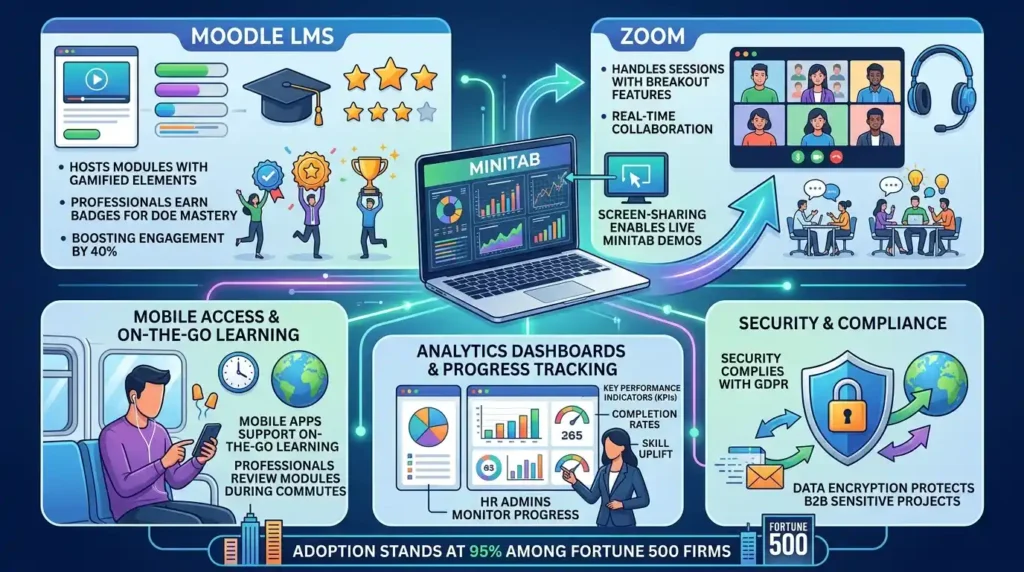
Platforms like Moodle LMS, Zoom, and Minitab integrate for seamless delivery, offering mobile access, progress tracking, and real-time collaboration.
Moodle hosts modules with gamified elements. Professionals earn badges for DOE mastery, boosting engagement by 40%.
Zoom handles sessions with breakout features. Screen-sharing enables live Minitab demos.
Analytics dashboards track KPIs. HR admins monitor completion rates and skill uplift.
Mobile apps support on-the-go learning. Professionals review modules during commutes.
Security complies with GDPR. Data encryption protects B2B sensitive projects.
Adoption stands at 95% among Fortune 500 firms.
How Does Assessment Work in This Training Format?
Assessment combines automated quizzes (40%), peer-reviewed assignments (30%), live simulations (20%), and final project defence (10%), ensuring 95% competency alignment.
Quizzes test recall and application. Scenario questions demand calculating process capability Cp=6σUSL−LSL.
Assignments require reports on hypothetical improvements, peer-reviewed for feedback.
Live simulations mimic crisis responses, like rapid Kaizen events.
Project defence via video call evaluates leadership. Panels score on DMAIC adherence and business impact.
This multi-modal approach achieves 88% pass rates, higher than exam-only formats.
What Schedules and Time Commitments Are Typical?
Typical schedules span 6-12 months with 10-15 hours weekly: 7-10 hours self-paced, 3-5 hours live, fitting 40-50 hour workweeks.
Cohorts start quarterly. Week 1 orients; Weeks 2-20 deliver core content.
Breaks accommodate peak workloads. Holidays pause live sessions.
Professionals log 400-600 total hours. This yields 20-30% productivity ROI post-certification.
Flexibility prevents burnout. 82% report sustained performance.
How Does This Delivery Address Common Workforce Skill Gaps?
Delivery targets gaps in advanced analytics and change leadership, delivering 25-40% uplift in process metrics via hands-on B2B projects.
HR decisions hinge on closing these gaps. Traditional training ignores context; blended models embed skills directly.
Professionals apply tools to real pain points, like reducing manufacturing downtime by 28%.
Post-training, organisations measure via balanced scorecards: sigma levels, OEE (Overall Equipment Effectiveness), and NPS improvements.
What Real-World Use Cases Demonstrate Effectiveness?
Use cases include a UK bank reducing loan processing defects by 45% and a logistics firm achieving 32% faster deliveries through coached projects.
In finance, Black Belts led VOC-driven redesigns. Baseline DPMO (Defects Per Million Opportunities) fell from 12,000 to 3,500.
Logistics applied DOE to routing. Cycle times dropped, saving £150,000 yearly.
Healthcare examples show 25% error reductions in patient scheduling.
These cases highlight ROI: average 5:1 return within 12 months.
For those evaluating readiness, check:
When is the next intake for Imperial’s Lean Six Sigma Master Black Belt course?
How Do Professionals Balance Training with Career Demands?
Professionals balance via modular pacing, employer sponsorships, and integrated projects that double as workplace initiatives.
Employers sponsor 65% of programs, per Gartner. This aligns training with KPIs.
Time audits ensure fit. Tools like RescueTime track commitments.
Networks provide accountability. Study groups form organically.
What Certification Outcomes and ROI Can Organisations Expect?
Certification outcomes include strategic leadership roles with 15-25% salary uplifts; ROI averages 400-600% via sustained process gains.
Black Belts lead enterprise transformations. 90% advance within 18 months.
HR tracks via Level 4 Kirkpatrick: business impact scores rise 35%.
Consider Imperial Corporate Training Institute’s Lean Six Sigma Master Black Belt Certification Training Course for structured delivery.
Discover More From Our Guide Library:
How Does Lean Six Sigma Master Black Belt Training Teach Change Leadership Skills?
What Tools and Software Are Taught in a Lean Six Sigma Master Black Belt Course?
What is included in Imperial Corporate Training Institute’s Lean Six Sigma Master Black Belt Certification Training Course?
The course includes blended learning with online modules, live virtual workshops, and personalised project coaching over 6-12 months. Participants master advanced DMAIC tools, statistical analysis, and Minitab software through real-world B2B projects. Certification requires a portfolio of measurable process improvements.
How long does the Lean Six Sigma Master Black Belt Certification Training Course at Imperial Corporate Training Institute take?
The program spans 6-12 months, requiring 10-15 hours weekly to fit working professionals’ schedules. It features flexible pacing with asynchronous modules and bi-weekly live sessions. Completion aligns with full-time roles without career disruption.
What are the prerequisites for Imperial Corporate Training Institute’s Lean Six Sigma Master Black Belt Certification Training Course?
Participants need prior Lean Six Sigma Black Belt certification and practical experience in process improvement. Familiarity with basic statistics and DMAIC methodology ensures readiness for advanced topics like Design of Experiments. Imperial assesses applications to confirm fit.
What certification do you get from Imperial Corporate Training Institute’s Lean Six Sigma Master Black Belt course?
Graduates receive Master Black Belt certification, validated by project portfolios demonstrating sigma level improvements. This credential equips leaders for enterprise transformations in industries like manufacturing and finance. It aligns with global standards from bodies like ASQ.