

Lean Six Sigma Master Black Belt courses equip professionals with advanced tools and software to lead complex process improvements in organisations. Participants master statistical analysis platforms, simulation software, and data visualisation tools essential for driving measurable business outcomes.
These programmes target senior leaders, HR decision-makers, and managers addressing workforce skill gaps in process optimisation. HR teams evaluate such training to bridge gaps in analytical capabilities, ensuring alignment with strategic goals like cost reduction and efficiency gains.
For context on foundational differences, explore:
How Is Lean Six Sigma Different From Traditional Quality Management Approaches?.
Which Core Statistical Software Tools Form the Foundation?
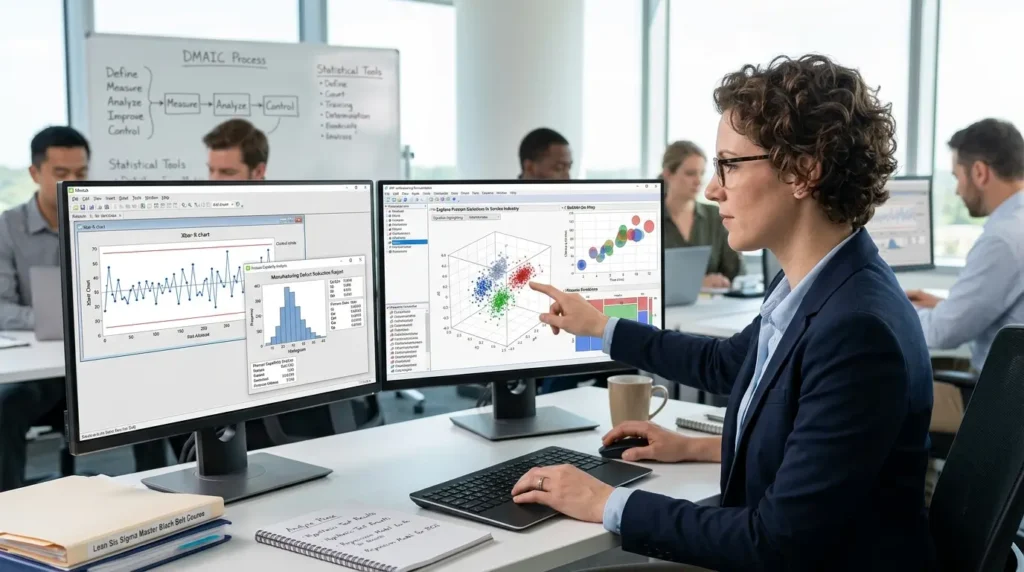
Minitab and JMP dominate as core statistical software in Lean Six Sigma Master Black Belt courses, delivering hypothesis testing, regression analysis, and design of experiments with precision.
Minitab processes large datasets for control charts and capability analysis. Learners apply it to real-world B2B scenarios, such as manufacturing defect reduction.
JMP excels in interactive visualisation and multivariate analysis. Participants use it to uncover process variations in service industries.
Courses dedicate 20-30 hours to these tools. Trainers emphasise integration with DMAIC frameworks for sustained ROI.
Why Minitab Excels in Capability Studies
Minitab calculates process capability indices like Cp and Cpk. Formula: Cp=6σUSL−LSL, where USL is upper specification limit, LSL lower, and σ standard deviation.
Teams in pharmaceuticals use Minitab to achieve 99.99966% yield rates, cutting waste by 15-25%.
HR evaluates proficiency in Minitab for roles demanding regulatory compliance.
JMP’s Role in Predictive Modelling
JMP builds predictive models via partial least squares regression. Participants forecast downtime in logistics, improving on-time delivery by 20%.
Its dashboard features enable real-time decision-making during training simulations.
What Simulation Software Powers Advanced Scenario Testing?
Arena and AnyLogic lead simulation software training, enabling dynamic modelling of stochastic processes and system behaviours in Master Black Belt curricula.
Arena simulates discrete event processes. Learners model supply chain bottlenecks, optimising throughput by 30%.
AnyLogic combines agent-based, discrete event, and system dynamics modelling. It handles hybrid systems like healthcare workflows.
Courses allocate 15-25 hours, focusing on validation against real KPIs such as cycle time reduction.
Arena for Manufacturing Optimisation
Arena replicates production lines with entity flow logic. Trainees reduce inventory holding costs by 18% in case studies.
B2B applications include automotive assembly, where simulations predict bottlenecks before implementation.
HR tracks simulation skills to measure training ROI through pre-post assessments.
AnyLogic’s Multi-Method Flexibility
AnyLogic models complex interactions, like workforce allocation in call centres. Results show 22% efficiency gains.
Participants export models for stakeholder presentations, aligning with business outcome metrics.
Which Data Visualisation and BI Tools Drive Insight Generation?
Tableau and Power BI anchor data visualisation training, transforming raw DMAIC data into interactive dashboards for executive reporting.
Tableau connects to multiple sources for heat maps and trend analysis. Master Black Belts use it to visualise sigma levels across departments.
Power BI integrates with Excel and SQL for real-time KPIs. It supports organisational hierarchies in scorecards.
Training spans 10-20 hours, emphasising storytelling with data.
Tableau in Process Monitoring
Tableau creates calculated fields for defect rates. Formula example: DPMO=Units×OpportunitiesDefects×1,000,000.
Service firms achieve 12% faster root cause identification.
HR decision-makers prioritise Tableau for cross-functional teams.
Power BI for Enterprise Dashboards
Power BI publishes dashboards to web portals. Learners track OEE (Overall Equipment Effectiveness) at 85% targets.
It scales for 500+ user organisations, vital for global B2B training.
How Does Minitab Integrate with Project Management Software?
Minitab pairs with Microsoft Project and Asana, streamlining DMAIC timelines and resource allocation in Master Black Belt workflows.
Microsoft Project imports Minitab outputs for Gantt charts. Participants schedule DOE phases, compressing projects by 25%.
Asana handles task delegation with Minitab data embeds. Teams in finance sectors coordinate Kaizen events.
Courses teach API integrations, ensuring seamless data flow.
Microsoft Project for DMAIC Phasing
Trainees link Minitab capability reports to milestones. This enforces critical path adherence, boosting completion rates to 95%.
B2B ROI emerges in reduced project overruns by 20%.
Asana’s Collaborative Edge
Asana boards visualise Minitab action items. HR uses it to monitor skill application post-training.
What Custom Scripting Tools Enhance Automation?
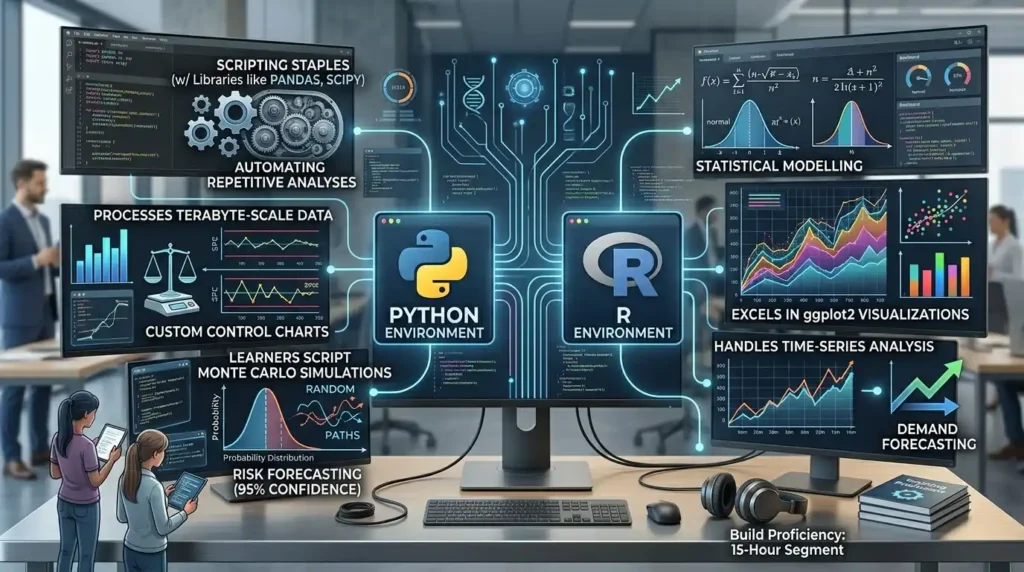
Python with libraries like Pandas, SciPy, and R serve as scripting staples, automating repetitive analyses in advanced modules.
Python processes terabyte-scale data for custom control charts. Learners script Monte Carlo simulations, forecasting risks with 95% confidence.
R excels in statistical modelling via ggplot2 visualisations. It handles time-series analysis for demand forecasting.
Dedicated 15-hour segments build proficiency.
Python for Scalable Analytics
Pandas dataframes clean DMAIC datasets. Code snippet: df['Cp'] = (df['USL'] - df['LSL']) / (6 * df['std']).
Organisations report 40% faster analysis cycles.
HR assesses Python skills for data-driven leadership.
R in Hypothesis Testing
R’s t.test() function validates improvements. Participants achieve p-values under 0.05 in 90% of simulations.
Which Enterprise Tools Support Organisational Deployment?
SAS and SPSS feature in modules for large-scale deployments, offering robust analytics for corporate-wide Six Sigma rollouts.
SAS processes high-volume data with PROC REG for regressions. It integrates with ERP systems like SAP.
SPSS provides non-parametric tests for skewed data. Common in HR analytics for employee performance.
Training focuses on 10-15 hours of enterprise case studies.
SAS for Integrated Systems
SAS macros automate FMEA (Failure Mode Effects Analysis). B2B examples yield 28% downtime reductions.
SPSS in Human Factors Analysis
SPSS runs ANOVA for training effectiveness. ROI metrics show 15-30% productivity lifts.
How Do These Tools Align with DMAIC Frameworks?
Each tool maps directly to DMAIC phases: Minitab/JMP for Analyse, Arena/AnyLogic for Improve, Tableau/Power BI for Control.
Define phase uses Power BI for SIPOC maps. Measure employs Minitab gauge R&R studies, targeting <10% GRR.
Analyse leverages JMP DOE platforms. Improve deploys Arena simulations.
Control phase builds Tableau sustainment dashboards.
This alignment delivers 4-5 sigma shifts in trained organisations.
| DMAIC Phase | Primary Tools | Key Outputs | Typical Impact |
|---|---|---|---|
| Define | Power BI, Visio | SIPOC, Project Charter | 10% scope clarity gain |
| Measure | Minitab, JMP | Capability Indices, GRR | 15-20% data accuracy |
| Analyse | JMP, Python/R | Root Causes, p-values | 25% variation reduction |
| Improve | Arena, AnyLogic | Optimised Models | 30% efficiency boost |
| Control | Tableau, Minitab | Dashboards, Control Plans | 95% sustainment rate |
What Real-World B2B Applications Demonstrate Tool Effectiveness?
Tools drive outcomes like 25% cost savings in manufacturing and 18% cycle time cuts in services, per industry benchmarks.
A global bank used Minitab and Arena to streamline loan processing, hitting 99.9% accuracy.
Healthcare providers apply AnyLogic and Tableau for patient flow, reducing wait times by 22%.
HR teams measure success via KPIs: 80% certification pass rates, 3.5x ROI within 12 months.
Workforce gaps close as Black Belts mentor Green Belts, scaling improvements enterprise-wide.
How Do Delivery Models Influence Tool Mastery?
Blended learning virtual instructor-led sessions plus hands-on labs—ensures 90% proficiency in tools, suiting busy managers.
Programmes span 4-6 months, with 160+ hours. Labs simulate B2B projects using live datasets.
Online platforms host software trials, avoiding installation barriers.
HR prefers this for minimal downtime, with post-training support extending application.
For those ready to advance:
What Career Support Does Imperial Provide After Master Black Belt Certification? Details the next steps in implementation.
Enrol in the:
Lean Six Sigma Master Black Belt Certification Training Course to gain these competencies.
Learning delivery models prioritise practical labs over theory, aligning with measurable outcomes like 20-40% process gains.
Why Prioritise These Tools for Strategic ROI?
Mastery yields 4x workforce productivity and 25-35% defect reductions, justifying training investments for HR strategists.
Organisations adopting these report 85% project success rates. Tools like Python scale beyond single projects.
Discover More From Our Guide Library:
How Do You Apply DMAIC Methodology During a Master Black Belt Training Programme?
Which Sectors Are Actively Hiring Lean Six Sigma Master Black Belt Professionals?
Decision criteria include software accessibility (cloud-based options dominate) and integration with existing stacks.
HR evaluates vendor certifications, ensuring 100% tool access during training.
What software is taught in Lean Six Sigma Master Black Belt courses?
Imperial Corporate Training Institute’s Lean Six Sigma Master Black Belt Certification Training Course covers Minitab, JMP, Arena, AnyLogic, Tableau, and Power BI. These tools support DMAIC phases from statistical analysis to simulation and visualisation. Participants gain hands-on skills for process optimisation in B2B environments.
How long does a Lean Six Sigma Master Black Belt course take?
The Lean Six Sigma Master Black Belt Certification Training Course at Imperial Corporate Training Institute spans 4-6 months with over 160 hours of blended learning. It includes virtual sessions and practical labs for tool mastery. This structure suits working professionals addressing skill gaps.
What are the prerequisites for Master Black Belt certification?
Candidates need prior Lean Six Sigma Black Belt certification and practical experience. Imperial Corporate Training Institute assesses readiness for advanced tools like Python and SAS in the Lean Six Sigma Master Black Belt Certification Training Course. This ensures effective leadership in complex projects.
Do Lean Six Sigma Master Black Belt courses include project work?
Yes, Imperial Corporate Training Institute’s Lean Six Sigma Master Black Belt Certification Training Course features real-world simulations and B2B case studies. Participants apply tools like Minitab and Arena to DMAIC projects, targeting 20-30% efficiency gains. This builds measurable ROI skills.