

Lean Six Sigma gives leaders a structured way to remove waste, reduce defects, and improve processes, so they increase productivity by up to 35%, cut costs by 25–30%, and build a culture of continuous improvement across teams and functions.
Lean Six Sigma combines Lean’s focus on eliminating non‑value‑adding activities with Six Sigma’s focus on reducing variation to near‑zero defects. In corporate environments, leaders use this methodology to align day‑to‑day operations with strategic goals such as margin improvement, customer satisfaction, and scalable growth.
From a workforce development perspective, Lean Six Sigma functions as a leadership discipline rather than just a process toolkit. Leaders learn to define problems precisely, measure performance objectively, analyse root causes rigorously, improve processes with data, and control outcomes using standard work and governance. Organisations across sectors such as manufacturing, healthcare, IT, and financial services use this approach to address skill gaps in analytical thinking, cross‑functional collaboration, and evidence‑based decision‑making.
Lean Six Sigma also reshapes leadership behaviour. Leaders trained in this discipline communicate clearly, set measurable expectations, and guide teams through structured change rather than ad‑hoc initiatives. This shift reduces initiative fatigue, increases trust, and turns continuous improvement into a repeatable management system instead of one‑off projects.
Why is Lean Six Sigma described as a leadership skill rather than a technical certification?
Lean Six Sigma is described as a leadership skill because leaders use it to set direction, influence stakeholders, lead improvement teams, manage change resistance, and align process optimisation with organisational strategy and measurable business outcomes.
Leadership in Lean Six Sigma involves more than knowledge of tools such as control charts or process maps. Green Belts, Black Belts, and Master Black Belts are expected to lead cross‑functional projects, manage resources, and motivate diverse teams. They operate as change agents who translate high‑level strategy into practical initiatives that front‑line employees can execute.
Core leadership behaviours embedded in Lean Six Sigma include clear communication, stakeholder engagement, and conflict resolution. Leaders must explain complex analyses in accessible language, tailor messages to different audiences such as executives, middle managers, and operational staff, and secure commitment to process changes. They also model discipline by using data and agreed metrics instead of opinion‑based decisions.
Lean Six Sigma leaders take ownership of outcomes. They define financial and non‑financial KPIs before projects start, track progress during implementation, and sustain results through control plans and standard operating procedures. This accountability mindset differentiates Lean Six Sigma leadership from generic “soft skills” programmes that do not link behaviour change to hard business results.
How does Lean Six Sigma leadership work in corporate environments?
In corporate environments, Lean Six Sigma leadership works through structured projects, cross‑functional teams, defined roles, and governance that connect process improvements to strategic KPIs, cost savings, and customer outcomes.
Organisations typically embed Lean Six Sigma into their operating model by defining roles such as Champions, Sponsors, Green Belts, Black Belts, and Master Black Belts. Senior leaders act as Sponsors who set priorities and provide resources. Master Black Belts advise on project selection, coach project leads, and ensure alignment with strategy. Operational managers and subject‑matter experts participate as team members who understand local processes and constraints.

Projects follow the DMAIC cycle: Define, Measure, Analyse, Improve, and Control. In the Define phase, leaders agree on the problem statement, scope, expected benefits, and stakeholder map. The Measure and Analyse phases require leaders to guide teams through data collection and statistical analysis to identify root causes, rather than relying on assumptions.
In the Improve and Control phases, leadership capability becomes visible. Leaders facilitate solution design workshops, prioritise improvements using impact‑effort matrices, and secure approvals for process changes or technology upgrades. They also establish control charts, dashboards, and standard procedures so gains remain stable over time and do not degrade when attention shifts.
From an L&D standpoint, this environment creates a live laboratory for leadership development. HR and learning teams use real business projects as vehicles for practising stakeholder engagement, negotiation, data storytelling, and performance management. This integration of learning and work aligns with corporate expectations for practical, outcome‑based training.
How is Lean Six Sigma training delivered step by step in organisations?
Lean Six Sigma training in organisations follows a structured sequence: needs analysis, programme design, training delivery, project execution, coaching, assessment, and post‑implementation measurement using financial and operational KPIs.
What are the stages of a typical Lean Six Sigma training rollout?
The process starts with a skills and performance needs analysis. HR, L&D, and business leaders identify critical bottlenecks such as service delays, error‑prone processes, or high rework rates, and map existing competency levels in problem‑solving, data literacy, and change management. This analysis informs which levels of training (e.g. Yellow, Green, Black, Master Black Belt) are required.
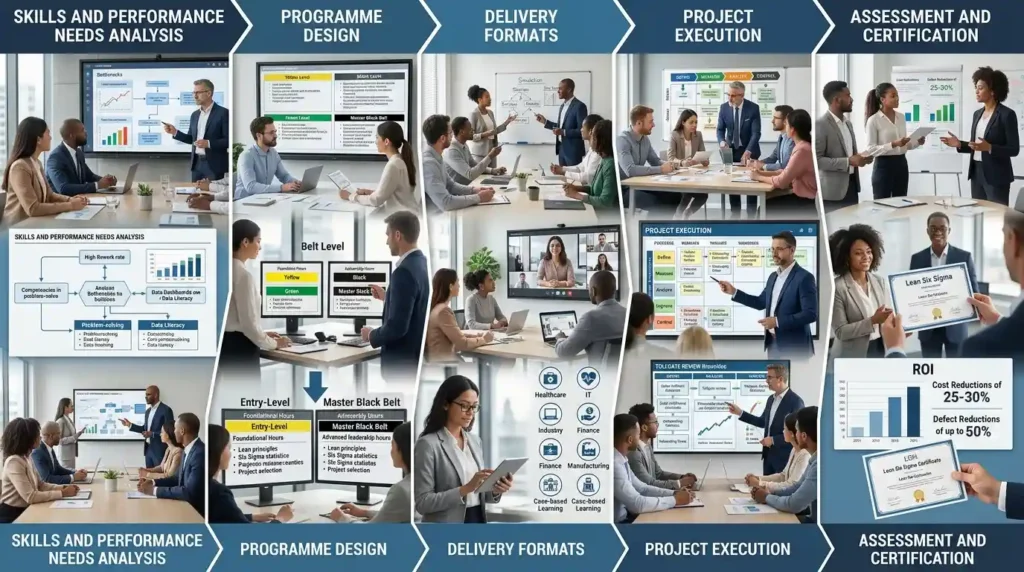
Programme design translates needs into structured curricula. For corporate cohorts, training often combines 16–20 hours of foundational content for entry‑level practitioners and 80–120 hours for advanced leaders. Content spans Lean principles, Six Sigma statistics, project selection, stakeholder management, and leadership behaviours aligned with continuous improvement culture.
Delivery formats are blended to accommodate busy managers and distributed teams. Organisations use classroom workshops for simulations and role play, virtual sessions for concept delivery, self‑paced e‑learning modules for theory reinforcement, and hybrid models for global teams. Case‑based learning uses scenarios from industries such as healthcare, IT, finance, and manufacturing to illustrate application.
Project execution sits at the centre of effective Lean Six Sigma leadership development. Participants apply DMAIC to real processes such as onboarding, order fulfilment, claims handling, or product development. Master Black Belts and senior practitioners coach participants through tollgates, ensuring that each phase meets defined quality criteria and links to measurable benefits.
Assessment and certification combine knowledge tests, project reviews, and behavioural observation. Participants must demonstrate mastery of tools, correct application to data, and leadership behaviours like facilitating cross‑functional workshops and influencing stakeholders. After project completion, organisations track financial impact, such as cost reductions of 25–30%, and defect reductions of up to 50%, to confirm ROI.
What are the key components of Lean Six Sigma as a leadership capability?
Key components include process improvement frameworks like DMAIC, Lean tools, advanced analytics, change management, communication, coaching, and governance mechanisms that make leaders accountable for sustained performance gains.
Core frameworks include DMAIC for improvement and sometimes DMADV (Define, Measure, Analyse, Design, Verify) for design work. Leaders use these frameworks to structure thinking and maintain discipline across complex projects. Lean tools such as value stream mapping, 5S, and visual management help leaders see waste and design more efficient workflows.
Data and analytics form another component. Leaders learn statistical techniques for hypothesis testing, regression, capability analysis, and control charting to quantify performance and validate improvements. They also develop competence in using software tools that support analysis, dashboards, and reporting.
Change management and communication skills ensure improvements translate into behaviour change. Leaders learn to identify stakeholders, assess readiness, manage resistance, and communicate the “why” behind changes in language relevant to each audience. Coaching and mentoring skills enable Master Black Belts to build internal capability by developing Green and Black Belts.
Governance completes the leadership system. Organisations set up steering committees, project selection criteria, and performance dashboards that track key metrics such as cycle time, defect rates, rework levels, and financial savings. Leaders use these structures to review progress, remove roadblocks, and ensure improvement work remains aligned with strategy.
What benefits does Lean Six Sigma leadership produce for organisations and teams?
Lean Six Sigma leadership increases productivity by up to 35%, delivers cost reductions of 25–30%, reduces defects by up to 50%, improves communication, and strengthens the leadership pipeline that sustains continuous improvement and higher employee retention.
For organisations, the financial benefits are direct and measurable. Studies show average productivity increases of up to 35% when companies optimise processes using Lean and Six Sigma methods. Cost reductions typically range from 25% to 30% through waste elimination, reduced rework, and lower material consumption. Defect reductions of up to 50% improve quality, customer satisfaction, and brand perception.
Lean Six Sigma projects frequently deliver substantial returns per initiative. Some sources report average returns of around 4.5–6 times the training investment and approximately 230,000 USD per project in savings or value creation, depending on project scope and industry. These returns make the methodology attractive to executive sponsors who require clear justification for training and change programmes.
For teams, Lean Six Sigma leadership improves collaboration, clarity, and engagement. Teams share a common language for problems and use standard tools for mapping processes, prioritising issues, and testing solutions. This reduces friction between departments such as operations, IT, finance, and customer service, because discussions are grounded in data.
Leadership development benefits are equally important. Green Belts, Black Belts, and Master Black Belts develop strong project and time management skills, better communication, and more strategic thinking. Organisations that invest in this training often experience higher engagement and lower turnover, because employees feel equipped to make meaningful changes and see the results of their work.
How do different industries and corporate functions use Lean Six Sigma as a leadership discipline?
Industries and functions use Lean Six Sigma leadership to manage cross‑functional projects, improve service quality, shorten cycle times, and align operations with customer and regulatory expectations across domains such as healthcare, IT, finance, manufacturing, and shared services.
In manufacturing, leaders apply Lean Six Sigma to reduce defects in production lines, optimise equipment utilisation, and stabilise supply chain performance. For example, a supplier referenced in research achieved a 25% output increase and 60% defect reduction after a Lean Six Sigma project. Leadership in this context involves coordinating engineering, quality, logistics, and procurement teams around shared process metrics.
In healthcare, leaders use Lean Six Sigma to reduce waiting times, minimise medication errors, and improve clinical and administrative workflows. Projects might focus on appointment scheduling, patient throughput, or laboratory turnaround times, with leadership teams coordinating clinicians, nurses, administrators, and IT. Data‑driven decision‑making supports compliance with regulatory standards and patient safety requirements.
In IT and digital services, Lean Six Sigma leadership supports incident reduction, faster release cycles, and improved service desk performance. Leaders integrate process improvement with agile practices and DevOps pipelines, using metrics such as deployment frequency, change failure rate, and mean time to resolution. This alignment ensures that technical change supports business outcomes like customer retention and revenue protection.
In finance and shared services, leaders use Lean Six Sigma to streamline processes such as invoicing, reconciliations, claims processing, and onboarding. Projects help reduce errors, improve compliance, shorten cycle times, and reduce manual effort. Because these processes cross departments, leaders need strong stakeholder management and negotiation skills to implement changes that affect policy, systems, and roles.
What common problems and misconceptions reduce the impact of Lean Six Sigma leadership training?
Common problems include treating Lean Six Sigma as tool training without projects, running generic programmes without business alignment, neglecting change management, and failing to track ROI, which leads to low adoption and limited leadership behaviour change.
One misconception is that Lean Six Sigma equals statistical tools. Organisations that deliver theory‑heavy courses without real projects or leadership practice see little behaviour change. Leaders struggle to translate classroom knowledge into decisions because they have not applied the methodology to their own processes. This gap reinforces the belief that Lean Six Sigma is technical, not managerial.
Another issue is misalignment with strategy. When project selection ignores strategic priorities, teams work on low‑impact problems. Executives then perceive Lean Six Sigma as peripheral rather than central to performance, which reduces sponsorship and resource support. High‑quality programmes emphasise strategic planning and alignment as core outcomes, especially at Master Black Belt level.
Many organisations underestimate the importance of change management. Leaders receive training on analysis tools but not on stakeholder engagement, communication, and resistance management. This omission leads to technically sound solutions that staff do not adopt or sustain. Effective leadership‑oriented training includes structured approaches to communication planning, role definition, and reinforcement.
Finally, some organisations neglect measurement of training impact. Without baselines and agreed KPIs such as cycle time, defect rate, customer satisfaction, and financial savings, they cannot quantify ROI. This absence of evidence undermines confidence in Lean Six Sigma as a leadership investment, even when improvements exist. Mature programmes build performance measurement and evaluation into the training design from the outset.
How does Master Black Belt‑level training develop advanced change leadership skills?
Master Black Belt training develops advanced change leadership by focusing on enterprise‑level strategy alignment, coaching, change management, and performance measurement, enabling leaders to design, govern, and sustain organisation‑wide Lean Six Sigma initiatives.
At this level, the emphasis shifts from executing individual projects to designing and leading improvement systems. Master Black Belts learn strategic planning methodologies that link Lean Six Sigma portfolios to corporate objectives such as market expansion, digital transformation, and operational resilience. They participate in or advise steering committees that prioritise high‑value opportunities across functions and regions.
Discover More From Our Guide Library:
How Is Lean Six Sigma Different From Traditional Quality Management Approaches?
What Is the DMAIC Process and How Does It Improve Business Performance?
Change management expertise is central. Master Black Belts study frameworks for managing resistance, building sponsorship, and sustaining cultural change. They practice designing communication strategies, leadership engagement plans, and reinforcement mechanisms that embed continuous improvement into everyday management routines. This capability turns them into internal consultants and advisors to senior leadership.
Coaching and mentoring responsibilities expand significantly. Master Black Belts are expected to train and coach Black and Green Belts, review projects, and ensure methodological rigour. They run communities of practice, facilitate learning from completed projects, and help codify best practices into standards, templates, and playbooks.
Performance measurement and evaluation complete the profile. Master Black Belt learners study how to design KPI frameworks, track benefits across portfolios, and communicate results in financial and strategic language that boards and executives recognise. This focus on measurable impact aligns directly with decision‑maker expectations and supports informed evaluation of training options such as a Lean Six Sigma Master Black Belt Certification Training Course.
This is the natural point in the buyer journey to introduce content explaining in detail how advanced training deepens change leadership capability.
For example when discussing:
How advanced Lean Six Sigma programmes teach structured change leadership skills, “structured change leadership with Master Black Belt training” that connects awareness of leadership needs with evaluation of specific training approaches.
Enrol in:
Lean Six Sigma Master Black Belt Certification Training Course
What is Lean Six Sigma Master Black Belt Certification Training Course at Imperial Corporate Training Institute?
The Lean Six Sigma Master Black Belt Certification Training Course at Imperial Corporate Training Institute equips senior leaders with advanced process improvement and change management skills. Participants master enterprise-level strategy alignment, coaching Black Belts, and sustaining organisation-wide improvements through DMAIC frameworks. Training combines workshops, simulations, and real projects for practical application.
How long does Lean Six Sigma Master Black Belt training take?
Lean Six Sigma Master Black Belt training typically spans 80–120 hours over 4–6 months, delivered via blended formats including workshops and online modules. Imperial Corporate Training Institute structures it around project execution and coaching milestones to fit corporate schedules. Certification requires completing a strategic portfolio project with measurable ROI.
What are the prerequisites for Master Black Belt certification?
Prerequisites include Lean Six Sigma Black Belt certification and 3–5 years leading improvement projects. Imperial Corporate Training Institute requires proof of prior project savings, such as £50,000+ in benefits, plus basic statistical proficiency. Candidates demonstrate leadership through stakeholder management and team coaching experience.
What skills does Master Black Belt training develop for corporate leaders?
Master Black Belt training develops skills in change leadership, advanced analytics, and governance of Lean Six Sigma deployments. Leaders learn to design KPI frameworks, coach cross-functional teams, and align improvements with business strategy at Imperial Corporate Training Institute. Outcomes include 25–30% cost reductions and stronger internal capability.