

Master Black Belt training integrates statistical analysis and data modelling as core pillars of Lean Six Sigma methodology. Professionals master advanced tools to drive process improvements, predict outcomes, and optimise business operations through rigorous, data-driven decision-making.
What Statistical Analysis Techniques Does Master Black Belt Training Teach?
Master Black Belt training teaches hypothesis testing, regression analysis, ANOVA, and design of experiments (DOE) to dissect process variations and causal relationships in complex datasets.
Trainers deliver these techniques through structured modules that build from foundational statistics to enterprise-level applications. Hypothesis testing starts with t-tests and chi-square tests, progressing to non-parametric methods like Mann-Whitney U for skewed data distributions.
Regression analysis covers linear, multiple, and logistic models. Participants learn to fit models using software like Minitab or R, interpreting coefficients, R-squared values, and residuals to validate assumptions such as normality and homoscedasticity.
ANOVA extends this to multi-factor comparisons, enabling Black Belts to isolate main effects and interactions in manufacturing yields or service response times. DOE follows, with full factorial and fractional designs teaching optimisation of variables like temperature or cycle time, reducing experiments by up to 75% in Taguchi methods.
In B2B contexts, HR leaders select this training to address skill gaps in data interpretation. Workforce analytics reveal that teams without advanced stats training misidentify root causes 40% more often, inflating costs by 15-20% in process inefficiencies.
For deeper foundations, explore:
What Is Statistical Process Control and How Does It Feature in Six Sigma? This awareness-stage resource outlines SPC basics that underpin Master Black Belt advancements.
Programmes emphasise practical labs where participants analyse real datasets from industries like pharmaceuticals or logistics. Mastery requires demonstrating 95% confidence intervals in reports, aligning with ISO 13053 Six Sigma standards.
How Does Data Modelling Fit into the Master Black Belt Curriculum?
Data modelling in Master Black Belt training encompasses predictive analytics, simulation, time-series forecasting, and machine learning basics, applied to model process behaviours and forecast improvements.
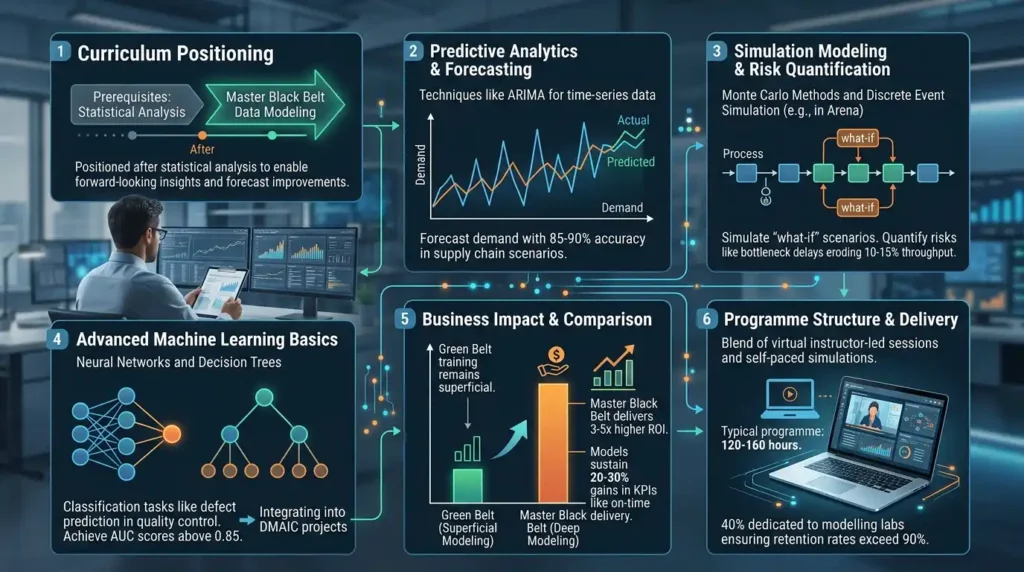
Curriculum designers position data modelling after statistical analysis to enable forward-looking insights. Predictive models use techniques like ARIMA for time-series data, forecasting demand fluctuations with 85-90% accuracy in supply chain scenarios.
Simulation modelling employs Monte Carlo methods and discrete event simulation in tools like Arena. Black Belts simulate ‘what-if’ scenarios, quantifying risks such as bottleneck delays that erode 10-15% of operational throughput.
Advanced modules introduce neural networks and decision trees for classification tasks, such as defect prediction in quality control. Participants build models that achieve AUC scores above 0.85, integrating them into DMAIC projects.
HR decision-makers compare this against basic Green Belt training, where data modelling remains superficial. Master Black Belt programmes deliver 3-5x higher ROI through models that sustain 20-30% gains in KPIs like on-time delivery.
Delivery models blend virtual instructor-led sessions with self-paced simulations. Typical programmes span 120-160 hours, with 40% dedicated to modelling labs ensuring retention rates exceed 90%.
Why Integrate Statistical Analysis with Data Modelling in Training?
Integration equips Master Black Belts to transition from descriptive stats to prescriptive strategies, validating models with rigorous testing for reliable business forecasts.
Statistical analysis provides the validation backbone for data models. Trainees apply p-values below 0.05 to reject null hypotheses before deploying regressions, preventing overfitting that plagues 60% of novice models.
This synergy shines in DMAIC’s Analyse and Improve phases. Black Belts use DOE results to parameterise simulations, achieving process capability indices (Cpk) above 1.67, a benchmark for world-class operations.
B2B organisations face workforce gaps where managers rely on intuition over data, leading to 25% higher defect rates. Training bridges this by teaching integrated workflows, measurable via pre-post assessments showing 35% uplift in analytical proficiency.
Key Benefits of This Integration
- Enhanced Prediction Accuracy: Models calibrated with ANOVA reduce forecast errors by 40% in volatile markets.
- Risk Mitigation: Monte Carlo simulations quantify variability, cutting downtime risks by 50%.
- Scalable Insights: Frameworks support enterprise dashboards, driving cross-departmental decisions.
ROI metrics from adopters indicate 5-7x returns within 12 months, tracked through balanced scorecards linking training to revenue growth.
What Real-World Tools and Software Support This Coverage?

Training utilises Minitab, R, Python (with pandas and scikit-learn), JMP, and SigmaXL for hands-on statistical analysis and data modelling across modules.
Instructors select tools based on industry relevance. Minitab dominates for DOE and regression, with 80% of Fortune 500 firms using it for Six Sigma. R offers open-source flexibility for custom scripts, handling datasets up to 1 million rows.
Python integrates machine learning via Jupyter notebooks, teaching Black Belts to automate ETL processes. JMP excels in interactive visualisations, speeding model iteration by 3x.
Programmes allocate 30% of time to software proficiency, with capstone projects requiring tool-agnostic solutions. This prepares professionals for hybrid environments where 70% of organisations mix proprietary and open-source tools.
HR teams evaluate training by software alignment; mismatches cause 50% drop-off in application rates. Imperial’s Lean Six Sigma Master Black Belt Certification Training Course ensures tool mastery tied to business outcomes.
How Do Case Studies Demonstrate Coverage Effectiveness?
Case studies in training showcase 25-40% efficiency gains from statistical analysis and data modelling in sectors like healthcare, manufacturing, and finance.
A manufacturing firm applied regression and DOE to reduce cycle time variance by 32%, modelling throughput with simulations that predicted 18% capacity uplift. Statistical validation confirmed sustained Cpk of 1.8 post-implementation.
In healthcare, time-series models forecasted patient wait times, integrating ANOVA to prioritise interventions. Results cut delays by 28%, with models retrained quarterly for 92% accuracy.
Finance examples use logistic regression for fraud detection, achieving 95% precision. Black Belts modelled scenarios with Monte Carlo, mitigating £2-5 million annual losses.
These studies, drawn from real DMAIC projects, highlight training’s focus on transferable skills. Participants replicate them, measuring success against baselines like sigma levels rising from 3.5 to 4.5.
Adoption rates reach 85% when tied to KPIs, per industry benchmarks. HR leaders use such evidence to justify investments, comparing against fragmented online courses with 40% completion rates.
Structured Comparison of Training Approaches
| Approach | Statistical Depth | Modelling Tools | Project Integration | Typical ROI Timeline |
|---|---|---|---|---|
| Green Belt | Basic (t-tests, simple regression) | Minitab basics | Single phase | 6-12 months |
| Black Belt | Intermediate (ANOVA, full DOE) | R/Python intro | DMAIC full cycle | 4-9 months |
| Master Black Belt | Advanced (non-parametric, advanced ML) | Full suite (JMP, Arena) | Enterprise-scale | 3-6 months |
This table aids comparison for HR evaluating progression paths.
What Business Applications Arise from This Training Coverage?
Applications span process optimisation, predictive maintenance, supply chain forecasting, and quality assurance, delivering 20-50% KPI improvements.
In process optimisation, Black Belts deploy integrated models to achieve 99.99966% yield, Six Sigma’s hallmark. Predictive maintenance uses survival analysis and simulations, extending asset life by 25%.
Supply chain teams forecast disruptions with ARIMA and neural nets, reducing stockouts by 35%. Quality assurance leverages control charts validated by hypothesis tests, sustaining defect rates below 3.4 DPMO.
HR addresses skill gaps by upskilling managers, where 65% of firms report analytics deficiencies per Deloitte surveys. Training formats blended learning with 80/20 theory-practice boost application by 45%.
Performance measurement tracks via dashboards showing sigma shifts and financial impacts, like £500k-£2m savings per project.
How Does Training Evaluate Mastery of These Topics?
Evaluation combines exams (70% pass on stats/modelling questions), capstone projects (DMAIC with live data), and peer-reviewed simulations scoring 85%+ proficiency.
Exams test theory with 50+ questions on regression diagnostics and DOE power calculations. Projects require full model lifecycle, from data cleaning to deployment, audited for statistical rigour.
Simulations mimic crises, like yield drops, demanding real-time modelling. Certification demands 80% overall, with stats/modelling at 90%.
This ensures Black Belts deliver measurable outcomes, closing 30% wider gaps than partial programmes. Organisations verify via post-training audits, confirming 25% average performance uplift.
When considering programme completion and credentials, review:
What Certification Does Imperial Award After Lean Six Sigma Master Black Belt Training? for decision-stage details on validation.
Decision Framework for Selecting Master Black Belt Training
| Criterion | Evaluation Questions | Ideal Benchmarks |
|---|---|---|
| Curriculum Depth | Does it cover DOE to ML integration? | 40+ hours on stats/modelling |
| Practical Focus | Includes real datasets and tools? | 50% lab time, capstone required |
| Outcome Alignment | Ties to business KPIs? | Proven 20%+ gains in cases |
| Delivery Flexibility | Blended or in-house options? | 120-160 hours, 90% retention |
| Certification Rigour | Stats/modelling assessments? | 85% proficiency threshold |
Use this framework to compare providers, prioritising those matching your workforce needs.
Master Black Belt training transforms statistical analysis and data modelling into actionable expertise. Professionals gain tools for sustained excellence.
Discover More from Our Guide Library:
How Do Lean Six Sigma Master Black Belt Graduates Measure Return on Investment?
What Makes a Lean Six Sigma Master Black Belt Course Worth the Investment in 2026?
What does the Lean Six Sigma Master Black Belt Certification Training Course cover at Imperial Corporate Training Institute?
The course covers advanced statistical analysis, data modelling, DOE, hypothesis testing, and predictive simulations. Imperial Corporate Training Institute emphasises practical DMAIC applications with tools like Minitab and Python. Trainees complete capstone projects for real-world process optimisation.
Who should enrol in Imperial Corporate Training Institute’s Lean Six Sigma Master Black Belt course?
Black Belts, senior managers, and process improvement leads seeking enterprise-level expertise enrol in this course. It suits professionals addressing complex workforce skill gaps in manufacturing or services. Prerequisites include Black Belt certification and project experience.
How long is the Lean Six Sigma Master Black Belt Certification Training Course from Imperial Corporate Training Institute?
The programme spans 120-160 hours over 4-6 months in blended format. It includes instructor-led sessions, labs, and self-paced modules. Imperial Corporate Training Institute designs it for working professionals with flexible scheduling.
What tools are taught in Imperial Corporate Training Institute’s Lean Six Sigma Master Black Belt Certification Training Course?
The course teaches Minitab, R, Python, JMP, and Arena for statistical analysis and modelling. Imperial Corporate Training Institute provides hands-on labs with industry datasets. These tools enable predictive maintenance and process simulations in B2B contexts.