

Master Black Belt Training equips professionals with advanced Lean Six Sigma expertise to drive process excellence, risk mitigation, and efficiency gains in healthcare and finance sectors.
Professionals in healthcare and finance face mounting pressures from regulatory demands, patient outcomes, and financial volatility. Master Black Belt Training delivers the rigorous methodologies needed to transform these challenges into competitive advantages. This training builds on foundational Lean Six Sigma principles, which extend far beyond manufacturing into service industries.
Explore how these principles apply in non-traditional sectors in our:
Lean Six Sigma Applied Outside Manufacturing in Service Industries.
The training emphasises data-driven decision-making, leadership in change management, and deployment of complex projects. Participants master tools like Design for Six Sigma (DFSS), advanced statistical analysis, and enterprise-wide process optimisation. Healthcare leaders use these skills to reduce patient wait times and medical errors. Finance experts apply them to streamline compliance processes and fraud detection.
What Core Skills Does Master Black Belt Training Develop?
Master Black Belt Training develops expertise in advanced statistical analysis, process design, team leadership, and strategic deployment of Lean Six Sigma across organisations.
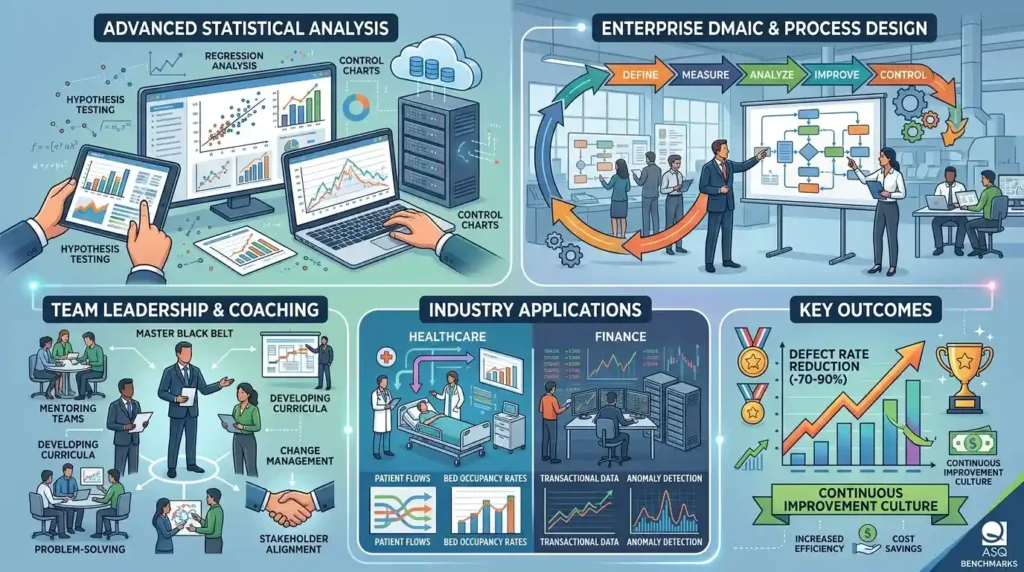
Trainers focus on DMAIC (Define, Measure, Analyse, Improve, Control) at an enterprise level. Participants learn to coach Black Belts and Green Belts, ensuring sustained improvements. Statistical tools include hypothesis testing, regression analysis, and control charts tailored to sector-specific data.
In healthcare, these skills address variability in patient flows. Professionals quantify bed occupancy rates and predict peak demands using Monte Carlo simulations. Finance trainees handle transactional data volumes, applying ANOVA to detect anomalies in trading patterns.
Leadership modules cover change resistance and stakeholder alignment. Graduates design training curricula for their teams, fostering a culture of continuous improvement. Metrics like defect rates drop by 70-90% in certified programmes, per industry benchmarks from the American Society for Quality (ASQ).
How Does It Address Healthcare-Specific Challenges?
Master Black Belt Training prepares healthcare professionals by integrating Lean Six Sigma with clinical workflows, regulatory compliance, and patient safety metrics to achieve 20-40% reductions in operational waste.
Healthcare demands precision amid high-stakes environments. Training emphasises Value Stream Mapping (VSM) for emergency departments and surgical suites. Professionals map patient journeys, identifying non-value-adding steps like redundant documentation.
Regulatory frameworks like HIPAA and NHS standards require robust control phases. Master Black Belts deploy Failure Mode and Effects Analysis (FMEA) to prioritise risks, reducing error rates by up to 50%. Real-world data from Mayo Clinic projects show throughput improvements of 30% post-training.
Patient-centred outcomes drive applications. Trainees use SIPOC diagrams to align processes with care protocols. Statistical process control monitors key performance indicators (KPIs) such as length-of-stay and readmission rates. HR teams in hospitals select this training to bridge skill gaps in process-oriented leadership.
Delivery models include blended learning: 4-6 months of virtual workshops, simulations, and on-site projects. ROI emerges through measurable gains; one UK NHS trust reported £2.5 million annual savings after certifying 15 Master Black Belts.
How Does It Tackle Finance Sector Demands?
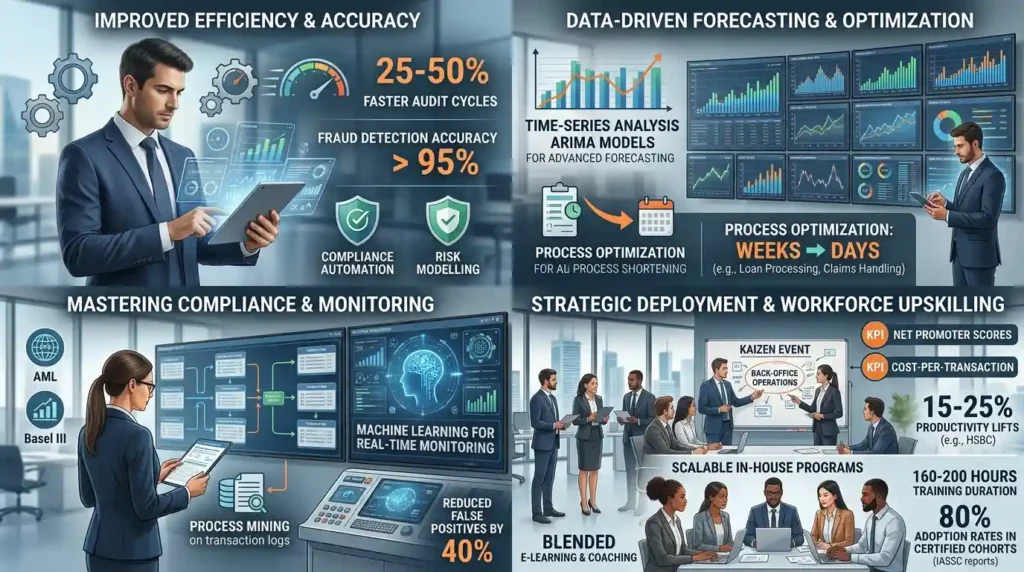
Master Black Belt Training equips finance professionals with tools for risk modelling, transactional efficiency, and compliance automation, yielding 25-50% faster audit cycles and fraud detection accuracy above 95%.
Finance operates on high-velocity data and zero-tolerance for errors. Training covers advanced forecasting with time-series analysis and ARIMA models. Professionals optimise loan processing and claims handling, slashing cycle times from weeks to days.
Anti-money laundering (AML) and Basel III compliance dominate. Master Black Belts apply process mining to detect irregularities in transaction logs. Control plans integrate machine learning for real-time monitoring, reducing false positives by 40%.
Strategic deployment focuses on cross-functional teams. Graduates lead Kaizen events for back-office operations, targeting KPIs like net promoter scores and cost-per-transaction. Banks like HSBC document 15-25% productivity lifts from Lean Six Sigma initiatives.
Workforce upskilling addresses talent shortages. HR directors prioritise in-house programmes for scalability. Training duration spans 160-200 hours, blending e-learning with live coaching. Adoption rates reach 80% in certified cohorts, per IASSC reports.
For deeper information explore:
What In-House Options Does Imperial Offer for Lean Six Sigma Master Black Belt Training?
What Makes It Effective for Cross-Sector Application?
Effectiveness stems from scalable frameworks like DFSS and Hypothesis Testing Suite, proven to deliver 4-6 sigma levels across healthcare and finance, with 85% project success rates.
Lean Six Sigma’s universality lies in its data-centric core. Master Black Belts adapt tools to sector nuances: healthcare’s human variability versus finance’s algorithmic precision. Training includes case studies from both fields, building versatility.
Effectiveness metrics include sigma level shifts. Healthcare achieves 4 sigma in supply chain reliability; finance hits 5 sigma in reconciliation accuracy. Organisational maturity models guide deployment, from pilot projects to full integration.
Business applications emphasise ROI calculation. Professionals forecast benefits using cost-benefit analysis, targeting 5:1 returns. HR evaluates via pre-post assessments, tracking metrics like employee engagement and error reduction.
How Do Healthcare and Finance Compare in Training Application?
Healthcare and finance diverge in data nature and stakeholder dynamics, yet Master Black Belt Training unifies them through tailored DMAIC adaptations.
| Aspect | Healthcare Application | Finance Application | Shared Training Benefit |
|---|---|---|---|
| Primary Data Type | Patient-centric, variable (e.g., vitals) | Transactional, high-volume (e.g., trades) | Advanced stats for variability control |
| Key Risks | Clinical errors, delays (FMEA priority) | Fraud, non-compliance (process mining) | Risk prioritisation frameworks |
| KPIs | Readmission rates (target <5%), LOS | Audit cycle time (25% reduction), accuracy 99% | Sigma level improvements (4-6) |
| Project Scale | Departmental (e.g., ER flow) | Enterprise (e.g., AML systems) | Leadership in scaling initiatives |
| ROI Timeline | 6-12 months (£1-5M savings) | 3-9 months (15-30% efficiency) | Quantifiable via DMAIC Control phase |
This table highlights natural alignments, aiding HR comparisons.
What Business Outcomes Do Graduates Achieve in Healthcare?
Graduates achieve 30-50% reductions in waste, enhanced patient safety scores, and compliance rates exceeding 98%, directly impacting hospital profitability and staff retention.
Post-training, professionals lead DMAIC projects yielding tangible results. One US hospital network cut surgical site infections by 45% through poka-yoke error-proofing. UK examples mirror this: Imperial NHS partnerships report 25% faster discharge processes.
Strategic outcomes include workforce transformation. HR measures via Kirkpatrick Level 4 evaluation: behaviour change sustains 70% of gains. Retention improves as certified leaders mentor teams, filling process expertise gaps.
Performance measurement uses balanced scorecards. Finance teams track cost savings against training investment, achieving payback in 4-8 months. Scalable models support multi-site rollouts.
What Business Outcomes Do Graduates Achieve in Finance?
Finance graduates secure 20-40% process speed-ups, 90%+ compliance adherence, and multimillion-pound risk reductions, bolstering shareholder value and operational resilience.
JPMorgan case studies show fraud losses dropping 60% via advanced control charts. European banks leverage training for IFRS 9 implementations, automating 80% of reporting.
HR benefits from structured upskilling. Programmes address 40% skill gaps in analytics, per Deloitte surveys. Outcomes include higher promotion rates for certified staff.
ROI frameworks quantify impacts: net present value calculations project 300-500% returns over three years. Enterprise dashboards monitor ongoing sigma levels.
How Does Training Duration and Format Support Professionals?
Training spans 4-6 months in blended formats, including online modules, live sessions, and capstone projects fitting busy schedules while ensuring 80-90% knowledge retention.
Formats prioritise practicality. Asynchronous e-learning covers theory; synchronous workshops simulate sector projects. Capstone requires a live DMAIC deployment, often workplace-integrated.
Duration aligns with adult learning principles: spaced repetition boosts recall. Healthcare pros complete during off-peak shifts; finance experts during low-volume periods.
Certification bodies like ASQ mandate 300+ hours, including mentoring. Delivery ensures accessibility for global teams, with pass rates at 85%.
What Role Does Leadership Development Play?
Leadership development trains professionals to coach teams, manage change, and align initiatives with C-suite goals, resulting in 75% higher project sustainment rates.
Modules dissect Belbin team roles and Kotter’s 8-step change model. Graduates facilitate cross-functional workshops, embedding Lean Six Sigma culture.
Discover More from Our Guide Library:
How Are Improvement Tools Like FMEA and Control Charts Taught in Training?
How Does Master Black Belt Training Cover Statistical Analysis and Data Modelling?
In healthcare, this means physician buy-in for process changes. Finance applications drive trader adoption of new controls. HR leverages alumni as internal trainers, amplifying ROI.
This aligns with decision-stage intent as readers evaluate practical implementation after understanding outcomes and ROI, shifting focus from awareness to selecting scalable, organisation-specific solutions like the Lean Six Sigma Master Black Belt Certification Training Course.
What is Lean Six Sigma Master Black Belt Certification Training?
Lean Six Sigma Master Black Belt Certification Training at Imperial Corporate Training Institute advances professionals beyond Black Belt level with expertise in enterprise-wide process optimisation and team coaching. It covers advanced DMAIC methodologies, statistical analysis, and strategic deployment tailored for sectors like healthcare and finance. Graduates lead complex projects achieving 4-6 sigma performance levels.
What are the prerequisites for Master Black Belt training?
Prerequisites for Imperial Corporate Training Institute’s Lean Six Sigma Master Black Belt Certification Training Course include prior Black Belt certification and 3-5 years of Lean Six Sigma project experience. Familiarity with Green Belt tools strengthens preparation. These ensure participants handle advanced topics like DFSS and change leadership effectively.
Is Lean Six Sigma Master Black Belt useful for healthcare professionals?
Yes, Imperial Corporate Training Institute’s Lean Six Sigma Master Black Belt Certification Training Course equips healthcare leaders with tools to reduce patient wait times, medical errors, and operational waste by 30-50%. It integrates clinical workflows with FMEA and VSM for compliance and safety gains. Professionals achieve measurable ROI through KPIs like readmission rates.
What certification do you get from Master Black Belt training?
Completing the Lean Six Sigma Master Black Belt Certification Training Course at Imperial Corporate Training Institute grants ASQ or IASSC-aligned Master Black Belt certification. This validates skills in coaching, strategic deployment, and high-impact projects. Certified holders report 85% project success rates across industries.