

Lean Six Sigma transforms corporate operations by eliminating waste and reducing variability. In service industries, it boosts efficiency, cuts costs by 20-30%, and improves customer satisfaction scores by 15-25%. HR managers and L&D professionals use it to address skill gaps in process optimisation.
What Is Lean Six Sigma in a Service Industry Context?
Lean Six Sigma combines Lean principles for waste reduction with Six Sigma methods for defect minimisation, delivering 20-40% efficiency gains in services like healthcare, finance, and IT through data-driven process improvements.
Lean Six Sigma integrates two methodologies. Lean targets non-value-adding activities. Six Sigma focuses on variation control using statistical tools. In service sectors, it shifts from manufacturing roots to handle intangible processes such as patient scheduling or loan approvals.
Businesses apply it to close employee skill gaps in data analysis and process mapping. Training equips teams to identify bottlenecks, reducing cycle times by 25% on average. Corporate impact includes higher throughput in call centres and fewer errors in banking transactions.
Programmes last 4-6 months, blending workshops and online modules. Participants master DMAIC framework: Define, Measure, Analyse, Improve, Control. This structure ensures sustained gains, with organisations reporting 15% productivity rises post-implementation.
How Does Lean Six Sigma Work in Corporate Service Environments?
Lean Six Sigma operates via the DMAIC cycle, implemented through cross-functional teams in 4–6-month projects, yielding 20-35% cost reductions and 90% defect elimination in services like finance and healthcare.
Teams form around specific processes. They define problems using customer data. Measurement phase collects baseline metrics, such as average handling time in IT support. Analysis uncovers root causes with tools like fishbone diagrams.
Improvement tests solutions via pilots. Control phase embeds changes with dashboards. Delivery formats include hybrid learning: 40% classroom workshops, 60% online simulations. Organisations rollout via department pilots, scaling to enterprise-wide after proving ROI.
In finance, teams reduce loan processing from 7 days to 2 days. Healthcare applications shorten patient wait times by 30%. Metrics track KPIs like first-pass yield, rising from 70% to 95%.
What Are the Key Components of Lean Six Sigma Training for Service Professionals?
Key components include DMAIC framework, statistical tools like control charts, Lean techniques such as value stream mapping, and delivery via 120-hour hybrid programmes with case studies and simulations.
DMAIC forms the core structure. Define phase sets project charters. Measure establishes baselines. Analyse employs hypothesis testing. Improve designs experiments. Control deploys standard work.
Tools encompass SIPOC diagrams for process scoping, Pareto charts for prioritisation, and regression analysis for correlations. Lean elements cover 8 wastes: defects, overproduction, waiting, non-utilised talent, transportation, inventory, motion, extra processing.
Training spans 120 hours over 4 months. Formats mix 50-hour workshops, 40-hour online modules, and 30-hour role plays. Assessments include project submissions achieving 1.5 sigma shifts.
Frameworks like Kaizen events drive rapid improvements. Certifications require passing exams and completing a service-based project, ensuring real-world readiness.
How Do Organisations Implement Lean Six Sigma in Non-Manufacturing Departments?
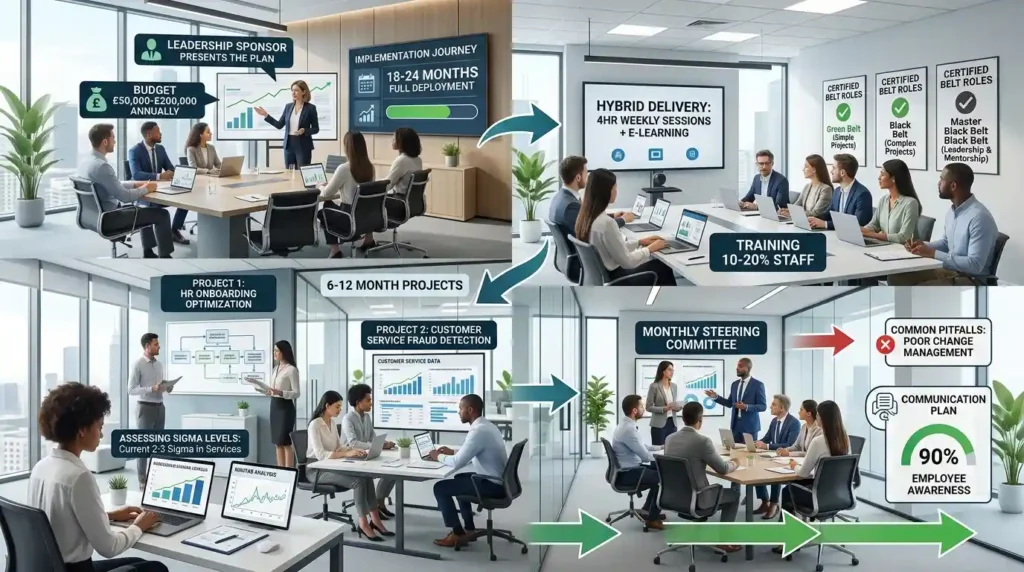
Organisations implement via certified belts, Green, Black, Master Black Belt leading 6–12-month projects, starting with leadership buy-in, training 10-20% of staff, and tracking ROI through dashboards.
Leadership sponsors initiatives, allocating budgets of £50,000-£200,000 annually. They select high-impact areas like HR onboarding or customer service. Green Belts handle simple projects; Black Belts complex ones.
Implementation steps: Assess current sigma levels (typically 2-3 in services). Train 15% of workforce. Launch 5-10 projects yearly. Use software like Minitab for analysis.
Hybrid delivery suits corporate schedules: Weekly 4-hour sessions plus e-learning. Case-based learning reviews finance fraud detection. Simulations mimic IT ticket resolution.
Progress via monthly steering committees. Common pitfalls include poor change management, addressed by communication plans reaching 90% employee awareness. Success scales to full deployment in 18-24 months.
For deeper preparation on advanced roles, explore:
How Does Master Black Belt Training Prepare Professionals for Healthcare and Finance?
What Measurable Outcomes Does Lean Six Sigma Produce in Service Teams?
Lean Six Sigma delivers 20-40% cost savings, 25-50% cycle time reductions, 15-30% productivity gains, and 10-20% retention improvements, measured via KPIs like sigma levels and ROI exceeding 300%.
Financial metrics show ROI of 3-5x within 12 months. Cost of poor quality drops 30%. Productivity rises as teams handle 25% more volume.
Customer KPIs improve: Net Promoter Scores increase 20 points. First-contact resolution hits 90%. Employee metrics include 15% lower turnover, as skill development fills gaps.
Organisations track via balanced scorecards. Sigma levels advance from 3 to 4, equating to 99.38% defect-free processes. Case: A bank saved £1.2 million yearly by streamlining claims.
Long-term, leadership pipelines strengthen. Master Black Belts mentor, building internal expertise and reducing external consultancy needs by 50%.
What Use Cases Demonstrate Lean Six Sigma in Service Industries?
Use cases span healthcare (reducing ER wait times 35%), finance (cutting transaction errors 40%), IT (improving ticket resolution 28%), and HR (streamlining recruitment 22%), applied by department teams of 5-10 members.
Healthcare teams apply it to bed management, freeing 15% more capacity. Finance departments optimise compliance checks, processing 30% more audits. IT uses it for software deployment, slashing downtime 40%.
HR examples include talent acquisition, reducing time-to-hire from 45 to 28 days. Marketing refines campaign workflows, boosting lead conversion 25%.
Corporate teams of 8, led by Black Belts, complete projects in 3-6 months. Industries like logistics services cut delivery variances 20%. Simulations train on these scenarios.
What Common Misconceptions Hinder Lean Six Sigma Adoption in Services?
Misconceptions include it being manufacturing-only (false: 70% of projects now service-based), requiring heavy maths (tools automate 80%), delivering no ROI (averages 400%), and needing full-time staff (part-time yields 25% gains).
Many view it as factory-exclusive. Yet, 65% of global certifications occur in services. Generic training fails due to lack of industry cases; effective programmes use sector-specific simulations.
Ineffective rollouts stem from top-down mandates without buy-in, causing 50% failure rates. Solution: Collaborative pilots with 80% team involvement.
ROI doubts arise from poor measurement. Track pre-post KPIs for clarity. Overemphasis on stats ignores Lean simplicity, yet balanced use drives 30% efficiency.
Short programmes underdeliver; 120+ hour formats with assessments ensure 90% knowledge retention. Address by selecting outcome-based methodologies.
How Does Lean Six Sigma Address Employee Skill Gaps in Service Organisations?
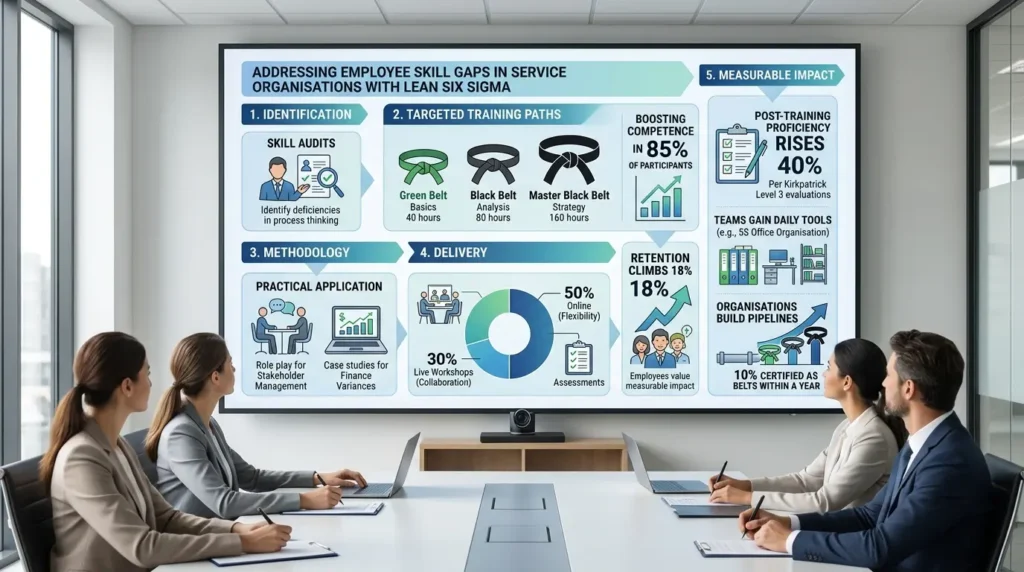
Lean Six Sigma closes gaps via targeted training, Green Belt for basics (40 hours), Black Belt for analysis (80 hours), Master Black Belt for strategy (160 hours) boosting competence in 85% of participants.
Skill audits identify deficiencies in process thinking. Training uses role play for stakeholder management, case studies for finance variances.
Discover More from Our Guide Library:
What Are the Most Common Process Improvement Tools Used in Lean Six Sigma?
What Is Statistical Process Control and How Does It Feature in Six Sigma?
Delivery mixes formats: 30% live workshops for collaboration, 50% online for flexibility, 20% assessments. Post-training, proficiency rises 40%, per Kirkpatrick Level 3 evaluations.
Teams gain tools for daily use, like 5S for office organisation. Retention climbs 18% as employees value measurable impact.
Organisations build pipelines: 10% certified as belts within a year.
Why Choose Lean Six Sigma Over Generic Process Training?
Lean Six Sigma outperforms generics with DMAIC structure, statistical rigour, and 25-40% superior results versus ad-hoc methods, via certified, project-based learning aligned to service KPIs.
Generic programmes lack frameworks, yielding 10% gains. Lean Six Sigma enforces data decisions, achieving 4 sigma.
It includes simulations for real risks, unlike lectures. ROI calculators project 300% returns. Certifications validate skills for promotions.
In services, it scales: Pilot projects expand enterprise-wide.
For deeper insight enrol in:
Lean Six Sigma Master Black Belt Certification Training Course
What is Lean Six Sigma Master Black Belt Certification Training Course at Imperial Corporate Training Institute?
The Lean Six Sigma Master Black Belt Certification Training Course at Imperial Corporate Training Institute equips professionals with advanced skills in DMAIC methodology, statistical analysis, and strategic process improvement for service industries. It spans 160 hours over 4-6 months in hybrid format, including simulations and real-world projects. Graduates lead enterprise-wide transformations, achieving 20-40% efficiency gains.
Who should enrol in Imperial Corporate Training Institute’s Lean Six Sigma Master Black Belt course?
Black Belts, senior managers, and L&D professionals in healthcare, finance, or IT seeking to mentor teams and drive large-scale Lean Six Sigma projects enrol in this course. It builds on Green and Black Belt knowledge to address complex skill gaps in corporate environments. Ideal for those targeting 4-5 sigma level improvements.
How long does the Master Black Belt Certification Training Course take at Imperial Corporate Training Institute?
Imperial Corporate Training Institute’s Lean Six Sigma Master Black Belt Certification Training Course lasts 160 hours over 4-6 months, delivered via hybrid learning with workshops, online modules, and project work. Participants complete a capstone project demonstrating ROI in service sectors. Flexible scheduling suits working professionals.
What are the prerequisites for Lean Six Sigma Master Black Belt training from Imperial Corporate Training Institute?
Candidates need prior Lean Six Sigma Black Belt certification and 3-5 years of project leadership experience for Imperial Corporate Training Institute’s Master Black Belt course. Familiarity with tools like Minitab and service industry applications strengthens preparation. This ensures readiness for coaching and strategic deployment.