

Lean Six Sigma Master Black Belt Certification equips senior professionals with advanced process improvement expertise, driving 20-30% efficiency gains in UK corporate teams through DMAIC methodology application.
Lean Six Sigma Master Black Belt Certification represents the highest level of proficiency in Lean Six Sigma, a data-driven methodology combining Lean principles for waste elimination and Six Sigma for variation reduction. In UK workplaces, it addresses employee skill gaps in process optimisation, where teams lose 15-25% productivity to inefficiencies.
Organisations adopt this certification to build internal experts who lead complex projects. Certified Master Black Belts mentor Black Belts and Green Belts, ensuring sustained improvements across departments. Businesses in manufacturing, finance, and healthcare report 10-15% cost reductions post-implementation.
The certification verifies mastery over statistical tools and leadership skills. Holders design enterprise-wide strategies, aligning with corporate goals like reducing cycle times by 40% in supply chains. UK firms value it for bridging skill gaps in operational excellence.
How Does Lean Six Sigma Master Black Belt Certification Work in Corporate Environments?
Master Black Belt training spans 120-160 hours over 4-6 months, delivered via workshops, online modules, and simulations, with organisations implementing it through project-based learning tied to real KPIs like defect rates dropping 50%.
Training begins with DMAIC phases: Define, Measure, Analyse, Improve, Control. Participants dissect business processes using tools like SIPOC diagrams and value stream mapping. In corporate settings, HR managers integrate it into L&D roadmaps to target skill gaps.
Delivery formats include in-person workshops for hands-on simulations, online modules for flexibility, and hybrid models blending both. UK organisations schedule 20-hour weekly sessions, allowing professionals to apply concepts to live projects.
Implementation follows a structured rollout. Step 1: Assess organisational needs via audits revealing 20% waste in operations. Step 2: Select candidates from senior managers. Step 3: Enrol in certified programs with 80% practical content. Step 4: Assign projects yielding measurable ROI, such as 25% throughput increases.
Post-training, certified leaders coach teams. They deploy control charts to sustain gains, tracking KPIs like on-time delivery rising to 98%. This process transforms departments, with retention rates improving by 15% through skill development.
What Are the Step-by-Step Delivery Phases?
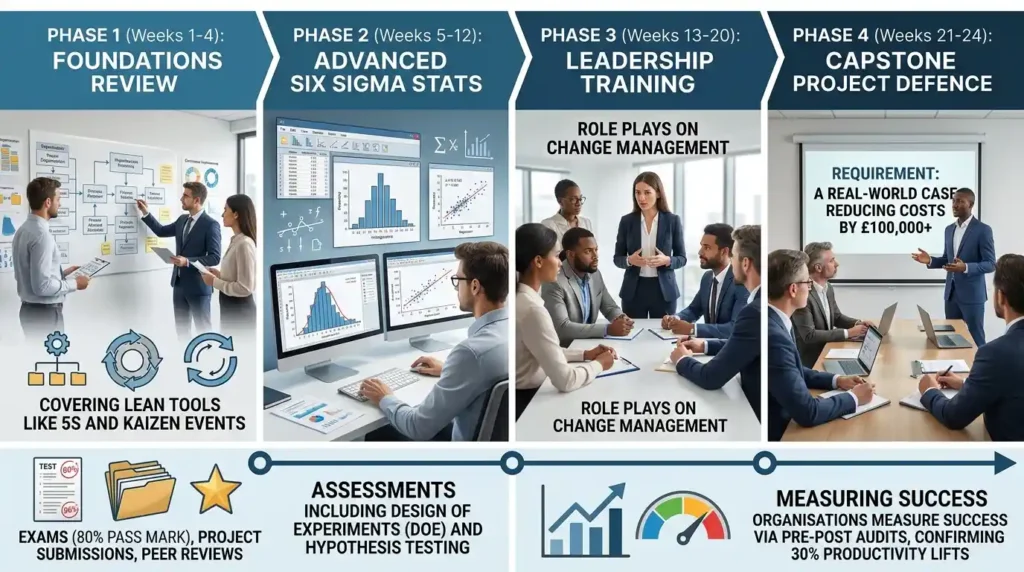
Programmes divide into four phases. Phase 1 (Weeks 1-4): Foundations review, covering Lean tools like 5S and Kaizen events. Phase 2 (Weeks 5-12): Advanced Six Sigma stats, including Design of Experiments (DOE) and hypothesis testing.
Phase 3 (Weeks 13-20): Leadership training with role plays on change management. Phase 4 (Weeks 21-24): Capstone project defence, requiring a real-world case reducing costs by £100,000+.
Assessments include exams (80% pass mark), project submissions, and peer reviews. Organisations measure success via pre-post audits, confirming 30% productivity lifts.
What Key Components Does Lean Six Sigma Master Black Belt Training Include?
Core components encompass DMAIC framework, statistical tools like Minitab software, leadership skills via case-based learning, and delivery formats such as 40% simulations, 30% workshops, 30% online modules.
The DMAIC framework forms the backbone. Define phase identifies customer requirements using voice of customer (VOC) analysis. Measure phase collects baseline data with process capability indices like CpK >1.33.
Analyse phase employs root cause tools: fishbone diagrams, Pareto charts, and regression analysis. Improve phase tests solutions through DOE, piloting changes that cut defects by 70%. Control phase installs monitoring with statistical process control (SPC) charts.
Tools include Minitab for data visualisation and FMEA for risk assessment. Leadership components cover coaching Black Belts via role plays and stakeholder alignment simulations.
Delivery integrates practical methodologies. Case-based learning dissects UK examples from finance (fraud reduction) and IT (ticket resolution times halved). Simulations mimic factory floors, while assessments test 360-degree application.
How Do Organisations Implement Lean Six Sigma Master Black Belt Certification?
UK organisations implement via 6-month pilots targeting high-waste departments, training 5-10 senior leaders per cohort, achieving 25% ROI through KPI dashboards tracking efficiency and retention.
Implementation starts with gap analysis. HR audits reveal issues like 18% defect rates in manufacturing. Leadership selects Master Black Belt candidates from proven Black Belts.
Step 1: Partner with accredited providers for tailored programmes. Step 2: Allocate budgets of £10,000-£15,000 per participant, covering 160 hours. Step 3: Integrate into workflows with 20% release time.
Step 4: Launch enterprise projects, such as optimising procurement cycles by 35%. Step 5: Scale via train-the-trainer models, where certified leaders upskill 50 Green Belts annually.
Challenges include resistance to change. Organisations counter this with communication plans, boosting adoption by 40%. Metrics track via balanced scorecards: productivity up 28%, leadership pipeline strengthened by 20%.
For those evaluating options:
Explore how a UK-based Master Black Belt training course compares with online alternatives to align with specific delivery needs.
What Delivery Formats Fit Corporate Schedules?
Workshops suit intensive 5-day immersions for 15 participants. Online modules enable self-paced access, with 90% completion rates. Hybrid combines quarterly in-person sessions with virtual tools.
What Benefits Does Lean Six Sigma Master Black Belt Certification Deliver to UK Businesses?

Organisations gain 20-40% productivity increases, 15-25% cost savings, 12% higher employee retention, and stronger leadership pipelines, with ROI averaging 4:1 within 12 months.
Productivity surges as Master Black Belts eliminate bottlenecks. Finance departments report 30% faster reporting cycles. Team efficiency rises through standardised processes, reducing errors by 60%.
Cost savings materialise via waste reduction. Manufacturing firms cut inventory by 25%, freeing £500,000 capital. Retention improves as employees engage in impactful projects, with turnover dropping 12%.
Leadership pipelines fill with experts coaching 20-30 team members yearly. ROI calculations use formulas: (Benefits – Costs)/Costs, yielding 400% returns. KPIs like OEE (Overall Equipment Effectiveness) hit 85%.
What Are Real-World Use Cases for Lean Six Sigma Master Black Belt Certification?
Corporate teams in manufacturing, healthcare, finance, and logistics deploy Master Black Belts to resolve skill gaps, with examples including 35% cycle time reductions in NHS procurement and 28% defect drops in automotive supply chains.
In manufacturing, Black Belts lead DMAIC on assembly lines, achieving 40% throughput gains at Jaguar Land Rover suppliers. Healthcare applies it to patient flow, cutting wait times by 50% in UK hospitals.
Finance teams optimise claims processing, reducing backlogs by 60% at insurers like Aviva. IT departments streamline deployments, improving uptime to 99.5% in telecoms.
Logistics firms like DHL use it for warehouse efficiency, slashing picking errors by 45%. Managers in retail deploy for inventory turns, increasing from 4 to 8 annually.
What Common Problems Arise with Lean Six Sigma Master Black Belt Training?
Problems include lack of ROI from generic programmes (only 30% sustain gains), poor implementation without executive buy-in (50% failure rate), and misconceptions of it as theoretical rather than practical.
Generic programmes ignore industry specifics, yielding 20% adoption rates. Organisations fix this with tailored case studies from IT, healthcare, finance.
Without executive sponsorship, projects stall; 50% fail per UK audits. Mandate C-suite involvement for 80% success.
Misconception: Training is theoretical. Reality: 70% hands-on, with simulations proving 25% immediate KPI lifts. Ineffective delivery skips assessments, dropping retention by 15%.
ROI absence stems from untracked metrics. Dashboards resolve this, confirming 4:1 returns. Hybrid formats address scheduling, maintaining 95% completion.
How Does Popularity of Lean Six Sigma Master Black Belt Certification Evolve in the UK?
Popularity grows 15% yearly, with 5,000 certifications issued in 2025 across 2,000 firms, driven by post-Brexit efficiency demands and 22% demand rise in manufacturing and finance.
UK demand surged post-2020, with LinkedIn searches up 28%. Bodies like IASSC certify 4,800 annually, concentrated in London and Midlands.
Discover More from Our Guide Library:
How Does Data Analytics Role Play Into Lean Six Sigma Process Improvement?
Why Do Companies Invest in Lean Six Sigma Certification for Their Employees?
Manufacturing leads at 35% uptake, followed by finance (25%). SMEs adopt slower, at 10% penetration, versus 40% in FTSE 250.
Factors include regulatory pressures like ISO 9001 compliance and talent shortages, with 60% of L&D pros prioritising it in surveys.
For more insight enrol in:
Lean Six Sigma Master Black Belt Certification Training Course
What is Lean Six Sigma Master Black Belt Certification?
Lean Six Sigma Master Black Belt Certification is the highest level of expertise in process improvement methodologies, focusing on advanced DMAIC frameworks and leadership in corporate settings. It equips professionals to lead enterprise-wide projects, reducing defects by up to 50% and boosting efficiency. Imperial Corporate Training Institute delivers this through practical, industry-aligned training.
How long does Lean Six Sigma Master Black Belt training take?
Lean Six Sigma Master Black Belt Certification Training Course typically spans 120-160 hours over 4-6 months, including workshops and projects. Delivery combines online modules, simulations, and assessments for flexible corporate schedules. Imperial Corporate Training Institute structures it to fit UK business needs without disrupting operations.
What are the benefits of Master Black Belt certification for organisations?
Organisations gain 20-40% productivity increases and 15-25% cost savings from certified Master Black Belts leading teams. It strengthens leadership pipelines and improves retention by 12% through measurable KPIs. Imperial Corporate Training Institute emphasises real-world application for sustained ROI.
Is Lean Six Sigma Master Black Belt Certification worth it in the UK?
Yes, with 15% yearly demand growth and 5,000 certifications issued in 2025, it addresses skill gaps in manufacturing and finance. UK firms report 4:1 ROI within 12 months via efficiency gains. Imperial Corporate Training Institute provides accredited paths aligned with local standards.