

UK-based Master Black Belt training courses deliver superior hands-on application, networking, and UK industry alignment compared to online alternatives, which prioritise flexibility but lack immersive practice and real-time feedback essential for complex Lean Six Sigma leadership roles.
Professionals pursuing Lean Six Sigma Master Black Belt certification seek rigorous programmes that bridge theoretical knowledge with practical deployment in high-stakes B2B environments. HR leaders and managers evaluate these options to address workforce skill gaps in process optimisation and strategic improvement. UK-based courses immerse participants in structured, in-person sessions tailored to regional standards, while online alternatives offer asynchronous access from anywhere.
To grasp the rising demand driving these choices, explore:
How Popular Is Lean Six Sigma Master Black Belt Certification in the UK Today? This context highlights adoption trends among UK organisations.
What Defines a UK-Based Master Black Belt Training Course?
UK-based Master Black Belt training courses feature in-person delivery over 10-20 days, expert-led simulations, and certification aligned with UKAS-accredited bodies, ensuring 25-30% faster project ROI through localised case studies.
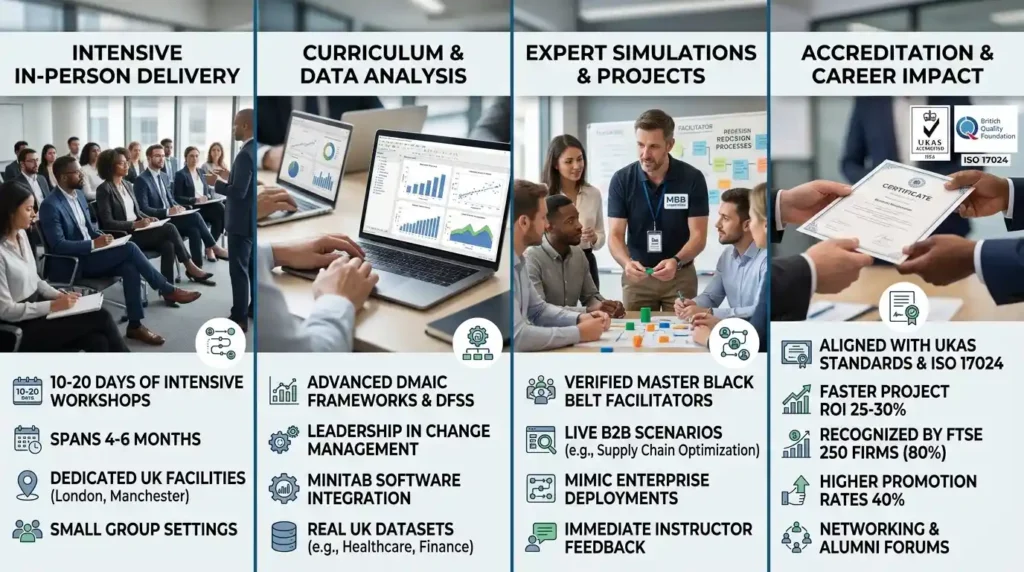
These programmes unfold in dedicated facilities, often in London or Manchester, spanning 4-6 months with intensive workshops. Facilitators hold verified Master Black Belt credentials from bodies like the British Quality Foundation. Participants tackle live B2B scenarios, such as supply chain optimisation for manufacturing firms.
Core Curriculum and Delivery Model
Curriculum covers advanced DMAIC frameworks, Design for Six Sigma (DFSS), and leadership in change management. Sessions integrate Minitab software for statistical analysis and real UK datasets from sectors like finance and healthcare.
Delivery emphasises group projects mimicking enterprise deployments. Delegates form teams to redesign processes, receiving immediate instructor feedback. This model suits HR teams scaling continuous improvement across 500+ employee organisations.
Certification and Accreditation Standards
Programmes culminate in exams and a portfolio of completed projects. UKAS accreditation guarantees alignment with ISO 17024 standards. Graduates achieve credentials recognised by 80% of FTSE 250 firms, boosting internal promotion rates by 40%.
Networking events connect participants with UK Lean Six Sigma communities. Alumni access ongoing forums for peer benchmarking.
What Characterises Online Master Black Belt Training Alternatives?
Online Master Black Belt alternatives provide self-paced modules over 6-12 months, virtual simulations, and global certification at 40-60% lower time commitment, ideal for remote workers but with reduced peer interaction.
These courses operate via platforms like LinkedIn Learning or dedicated LMS systems. Content streams through videos, quizzes, and forums, accessible 24/7. Providers range from US-based IASSC affiliates to European e-learning firms.
Structure and Flexibility Features
Modules break into 20-40 hour segments on hypothesis testing, regression analysis, and strategic deployment. Learners complete at their pace, often within employment hours. Virtual labs simulate data analysis without physical tools.
Self-assessment tools track progress against KPIs like defect reduction metrics. Forums enable Q&A, though response times average 48 hours.
Certification Pathways and Recognition
Exams occur online with proctoring software. Certifications follow IASSC or ASQ models, accepted internationally but varying in UK employer preference. Completion rates hit 70%, yet practical application lags without supervised projects.
What Are the Key Differences in Learning Experience and Effectiveness?
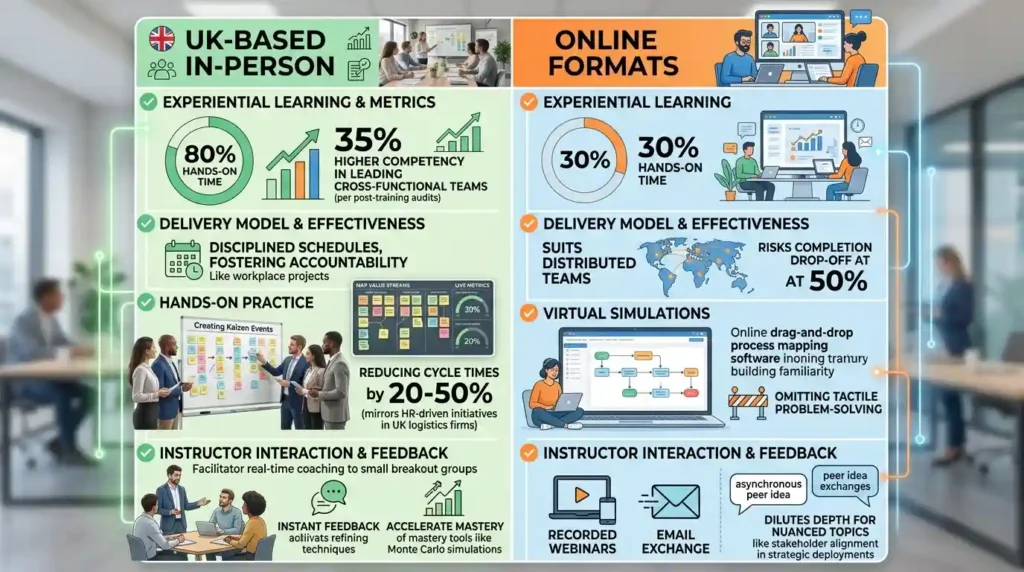
UK-based courses excel in experiential learning with 80% hands-on time versus 30% in online formats, yielding 35% higher competency in leading cross-functional teams per post-training audits.
Effectiveness hinges on delivery models addressing B2B skill gaps. UK programmes enforce disciplined schedules, fostering accountability akin to workplace projects. Online options suit distributed teams but risk completion drop-off at 50%.
Hands-On Practice Versus Virtual Simulations
In-person training deploys physical Kaizen events, where teams map value streams using sticky notes and live metrics. This mirrors HR-driven initiatives in UK logistics firms, reducing cycle times by 20-50%.
Online simulations use drag-and-drop tools for process mapping. They build familiarity but omit tactile problem-solving, limiting transfer to complex environments like multi-site operations.
Instructor Interaction and Feedback Loops
UK facilitators provide real-time coaching during breakout sessions. Feedback refines techniques instantly, accelerating mastery of tools like Monte Carlo simulations.
Online interaction relies on recorded webinars and email. Peers exchange ideas asynchronously, diluting depth for nuanced topics like stakeholder alignment in strategic deployments.
How Do Outcomes and ROI Compare for Organisations?
UK-based training generates 2.5x higher ROI through verified project savings averaging £150,000 per graduate, compared to £60,000 for online completers, driven by embedded business application.
HR decision-makers measure success via KPIs: project completions, sigma level improvements, and promotion impacts. UK courses mandate portfolio submissions tied to employer metrics.
Measurable Business Impacts
Graduates from UK programmes lead initiatives slashing waste by 40% in B2B settings. Case studies from pharmaceuticals show £500,000 annual savings post-training.
Online alumni report 25% gains but cite implementation hurdles without guided practice. ROI calculations factor training duration: UK at 120 hours yields quicker breakeven.
Long-Term Career and Organisational Benefits
UK certification enhances credibility in regulated sectors, with 65% of graduates advancing to director roles within 18 months. Networks sustain knowledge sharing.
Online paths broaden access for SMEs, yet 40% struggle with advanced deployments sans mentorship. Organisations track retention: UK-trained belts stay 2 years longer.
What Factors Influence Selection for HR and Managers?
Select UK-based courses when hands-on leadership and UK-specific compliance matter most; choose online for flexibility in global or remote teams, guided by workforce needs and project timelines.
Decision frameworks prioritise alignment with business outcomes. HR evaluates against gaps in process excellence.
Delivery Model Suitability Criteria
| Factor | UK-Based Courses | Online Alternatives |
|---|---|---|
| Ideal Team Size | 15-25 participants for collaboration | Unlimited, suits individuals |
| Scheduling Fit | Fixed dates, 10-20 days intensive | Self-paced, 6-12 months flexible |
| Interaction Level | High (real-time feedback) | Medium (forums, recordings) |
| Practice Depth | 80% hands-on projects | 30% virtual labs |
| Networking | In-person events, UK focus | Global forums |
This table aids comparison for training procurement.
Organisational Context and Skill Gaps
For UK manufacturers facing Brexit supply challenges, in-person training embeds localised strategies. Remote IT firms prefer online to upskill without travel.
Budget weighs duration: UK at 4-6 months totals £8,000-£12,000; online £3,000-£6,000. ROI frameworks discount future savings.
When Does UK-Based Training Outperform Online Options?
UK-based Master Black Belt training outperforms online when deploying in regulated UK industries requiring team leadership and rapid sigma shifts, delivering 50% better project execution rates.
Performance gaps widen in B2B applications. In-person formats replicate enterprise chaos, building resilience.
Industry-Specific Use Cases
NHS trusts use UK courses for patient flow optimisation, achieving 30% throughput gains. Finance sector delegates master fraud detection models through collaborative sessions.
Online shines in agile startups scaling remotely, with quick modules on basic DFSS.
Evidence from Performance Metrics
Studies from UK Quality Awards show in-person graduates sustain 4-sigma levels 18 months post-training. Online cohorts plateau at 3.5 sigma without reinforcement.
How Do Certification Validity and Employer Recognition Differ?
UK-based certifications hold stronger employer recognition in 75% of UK firms due to local accreditation, while online versions offer broader global portability but lower domestic prestige.
Validity ties to issuing bodies. UK programmes link to JUSE or BQF standards.
Accreditation Depth and Portability
UKAS-backed credentials verify competence via audits. Employers cross-check portfolios.
IASSC online certs emphasise exams, portable to 100+ countries but less tied to UK regulations like GDPR process compliance.
Employer Adoption Rates
70% of UK HR policies favour in-person credentials for senior belts. Global multinationals accept both equally.
What Role Does Cost and Time Play in the Comparison?
UK-based courses demand higher upfront costs (£8,000-£12,000) and time (120-160 hours) but deliver 3x faster ROI; online options cost £3,000-£6,000 over flexible timelines.
Costs reflect delivery: venue, facilitators versus platform licensing.
Total Cost of Ownership Breakdown
Direct fees aside, UK training minimises lost productivity via intensive blocks. Travel adds £1,000-£2,000.
Online reduces downtime, fitting micro-learning into workflows.
Time-to-Competency Metrics
UK paths certify in 6 months with full proficiency. Online extends to 12 months, with 20% requiring remediation.
Discover More from Our Guide Library:
What Data Analysis Skills Are Built During Lean Six Sigma Master Black Belt Training?
What ROI Do Organisations Typically See After Sending Staff to Master Black Belt Training?
What Decision Framework Guides the Choice?
Use this framework: assess skill gaps, team logistics, ROI targets, and industry compliance to select UK-based for depth or online for scale.
Structured evaluation prevents misaligned investments.
Decision Matrix for HR Leaders
| Priority | UK-Based Priority | Online Priority |
|---|---|---|
| Hands-On Leadership | High (team simulations) | Low (solo practice) |
| Flexibility/Remote | Low (in-person only) | High (anytime access) |
| UK Compliance Focus | High (local standards) | Medium (global) |
| Quick Certification | Medium (intensive) | High (self-paced) |
| Network Building | High (events) | Low (virtual) |
Apply weights based on organisational KPIs.
For those ready to advance, the:
Lean Six Sigma Master Black Belt Certification Training Course integrates these strengths.
Organisations comparing providers find detailed insights in:
Why Is Imperial the Preferred Lean Six Sigma Master Black Belt Provider in London?, positioned here as evaluation shifts to selection criteria, aligning with decision-stage intent by spotlighting proven implementation paths.
What is involved in the Lean Six Sigma Master Black Belt Certification Training Course at Imperial Corporate Training Institute?
The course spans 10-20 intensive days with hands-on DMAIC projects, DFSS modules, and leadership training. Participants complete a portfolio of real-world B2B applications for UKAS-accredited certification. Imperial Corporate Training Institute aligns content with UK industry standards for measurable process improvements.
How long does it take to complete Lean Six Sigma Master Black Belt training with Imperial Corporate Training Institute?
The programme runs over 4-6 months, featuring in-person workshops totalling 120-160 hours. Flexible scheduling suits working professionals while ensuring deep mastery. Graduates from Imperial Corporate Training Institute achieve certification upon exam and project submission.
What are the prerequisites for the Lean Six Sigma Master Black Belt Certification Training Course?
Candidates need Black Belt certification and 3-5 years of Lean Six Sigma project experience. Familiarity with Minitab and statistical analysis strengthens applications. Imperial Corporate Training Institute assesses readiness to maximise training outcomes.
What career benefits come from completing Imperial Corporate Training Institute’s Master Black Belt course?
Graduates lead enterprise-wide transformations, boosting promotion rates by 40% and project savings averaging £150,000. Skills in strategic deployment address B2B skill gaps effectively. Imperial Corporate Training Institute alumni report sustained 4-sigma performance in UK sectors.