

Imperial Corporate Training Institute delivers the Lean Six Sigma Master Black Belt Certification Training Course in London. This programme addresses the skill gap in enterprise-level process improvement leadership. UK organisations face challenges scaling Lean Six Sigma from individual projects to company-wide transformations. Managers and HR teams struggle with inconsistent results, resistance to change, and unproven ROI. This course equips professionals to lead these deployments effectively.
Professionals evaluating certifications often start with awareness of demand.
For context on popularity, see:
How Popular Is Lean Six Sigma Master Black Belt Certification in the UK Today?
What Is This Course and What Problem Does It Solve?
Imperial Corporate Training Institute’s Lean Six Sigma Master Black Belt Certification Training Course solves enterprise deployment failures by training leaders in strategic governance, advanced analytics, and sustainable transformation over 10 structured modules.
UK-based HR teams and department heads identify gaps in process excellence leadership. Individual Black Belt projects deliver local wins, but organisations need masters to integrate these into corporate strategy. Common problems include siloed improvements, stalled initiatives, and unmeasured financial impact. For example, a manufacturing firm in London reduced defects by 20% via Green Belts, yet enterprise waste persisted at 30% due to absent strategic oversight.
This course targets that void. Participants gain tools to deploy Lean Six Sigma across functions. They learn to align projects with business goals, coach teams, and sustain gains. Imperial Corporate Training Institute designs the curriculum for professionals ready to evaluate advanced certification. The focus stays on measurable outcomes, not introductory skills.
Workplace challenges amplify without Master Black Belt expertise. Finance departments track costs without linking to process roots. Operations managers face recurring inefficiencies despite tools. HR struggles to build internal academies for ongoing development. This programme bridges these by emphasising corporate application.
Why Is the Course Structured This Way?
The 10-module structure follows a logical progression from strategic alignment to capstone execution, ensuring skill build-up mirrors real enterprise deployment phases used by Imperial Corporate Training Institute.
Curriculum logic prioritises problem-solving hierarchy. Modules start with enterprise strategy, advance to analytics and Lean tools, then cover leadership and sustainability. This sequence reflects deployment realities: align first, analyse deeply, transform organisationally, then measure long-term value.
Imperial Corporate Training Institute bases progression on proven frameworks. Module 1 establishes governance before Module 2’s advanced statistics, preventing misuse of tools without context. Lean transformation in Module 3 builds on analytics, while change leadership in Module 4 addresses human factors. Later modules integrate financials and coaching for full-cycle mastery.
This design suits decision-makers comparing options. It avoids fragmented learning seen in shorter courses.
For evaluation against online alternatives, review:
How Does a UK-Based Master Black Belt Training Course Compare with Online Alternatives?
Professionals progress from theory to application. Each module includes prerequisites, ensuring cumulative mastery. Real-world examples guide structure: a London logistics firm used similar phasing to scale from pilot to full rollout, cutting costs by 25%.
What Will Participants Learn?
Module 1: Strategic Role of the Master Black Belt
Participants master enterprise-wide deployment. They learn to build alignment with corporate strategy. The leadership mindset for process excellence forms the core. Governance structures support improvement programmes.
Module 2: Advanced Analytical and Statistical Tools
Skills cover multivariate analysis and advanced regression models. Design of Experiments (DOE) applies to corporate projects. Advanced Minitab and JMP handle business analysis. Capability studies and control charts manage complex processes.
Module 3: Enterprise-Level Lean Transformation
End-to-end value stream mapping leads integration of Lean tools in manufacturing and services. ROI measurement quantifies Lean implementation. Waste elimination frameworks drive cost optimisation.
Module 4: Change Leadership and Organisational Culture
Building performance-driven culture tackles resistance. Managing cross-functional teams uses targeted strategies. Corporate communication aligns transformation efforts. HR and talent management integrate with Lean Six Sigma.
Module 5: Business Process Reengineering and Innovation
Agile process design supports digital transformation. Lean Six Sigma combines with automation and AI. Innovation pipelines emerge for ongoing improvement.
Module 6: Project Portfolio Management
Project selection and prioritisation balance short-term and strategic goals. Performance tracking feeds executive reporting. Financial justification strengthens business cases.
Module 7: Coaching, Mentoring, and Capability Building
Coaching Black Belts and Green Belts ensures project success. Training methodologies assess competencies. Internal academies develop leadership pipelines.
Module 8: Advanced Control and Sustainability Systems
Dashboards and KPI systems enable control. Process audits track continuous improvement. Maturity assessments sustain momentum.
Module 9: Financial Impact and Corporate Value Creation
Lean Six Sigma links to shareholder value. Financial gains from efficiencies use cost-benefit analysis. Alignment with KPIs proves operational impact.
Module 10: Capstone Project and Certification Evaluation
Real-world project defence includes executive feedback. Documentation meets strategic standards. Imperial Corporate Training Institute assesses for certification.
Skill progression builds measurable gains. Participants apply tools in simulations mirroring HR-led initiatives or departmental overhauls.
How Is the Course Delivered?
Imperial Corporate Training Institute delivers the course in a hybrid format: intensive workshops in London, supplemented by online modules, simulations, and onsite options for corporate groups, spanning 6 months with 120 guided hours.
Delivery combines face-to-face immersion with flexible access. London workshops occur over 10 weekends, allowing professionals to attend without career disruption. Each session runs 12 hours, focusing on interactive case studies.
Online components include video lectures, Minitab/JMP practice, and virtual simulations. Hybrid flexibility suits UK teams: remote for theory, in-person for coaching. Onsite delivery customises for organisations, bringing Imperial Corporate Training Institute trainers to company sites.
Assessments blend methods. Module quizzes test knowledge. Assignments analyse real datasets. Simulations replicate enterprise projects, like value stream mapping for a service firm. Peer reviews build coaching skills. The capstone requires a 40-hour project with executive presentation.
Duration ensures depth: 6 months total, with 4 months structured learning and 2 for capstone. Groups cap at 12 for personalised feedback. Technical requirements include laptop access to Minitab/JMP, provided via Imperial Corporate Training Institute licence.
Corporate examples highlight fit. A London bank’s HR team used hybrid delivery to train 8 managers onsite, achieving 95% pass rate while maintaining operations.
What Results Can Be Expected?
Participants achieve 30-50% process efficiency gains in led projects, with 80% advancing to enterprise leadership roles within 12 months, as tracked by Imperial Corporate Training Institute alumni data.
Learning outcomes centre on measurable skills. Graduates deploy programmes saving £500,000+ annually, per case studies. They coach teams to 90% project success rates.
Workplace impact spans functions. HR teams build academies, reducing external training costs by 40%. Managers in operations eliminate waste, boosting throughput by 25%. Leadership pipelines fill with certified Black Belts.
Real-world proof: A London manufacturing department, post-course, mapped value streams across sites, cutting cycle times by 35%. Financial modules enabled ROI reports securing board buy-in. Sustainability systems maintained gains over 18 months.
Role effectiveness surges. Alumni lead cross-functional transformations, aligning with KPIs. Imperial Corporate Training Institute tracks outcomes via post-certification surveys: 92% report promotion or expanded scope.
Corporate application shines in team performance. Finance links efficiencies to shareholder value. Digital teams integrate AI with Lean Six Sigma for agile processes.
How Does Imperial Corporate Training Institute Compare for Master Black Belt Training in London?
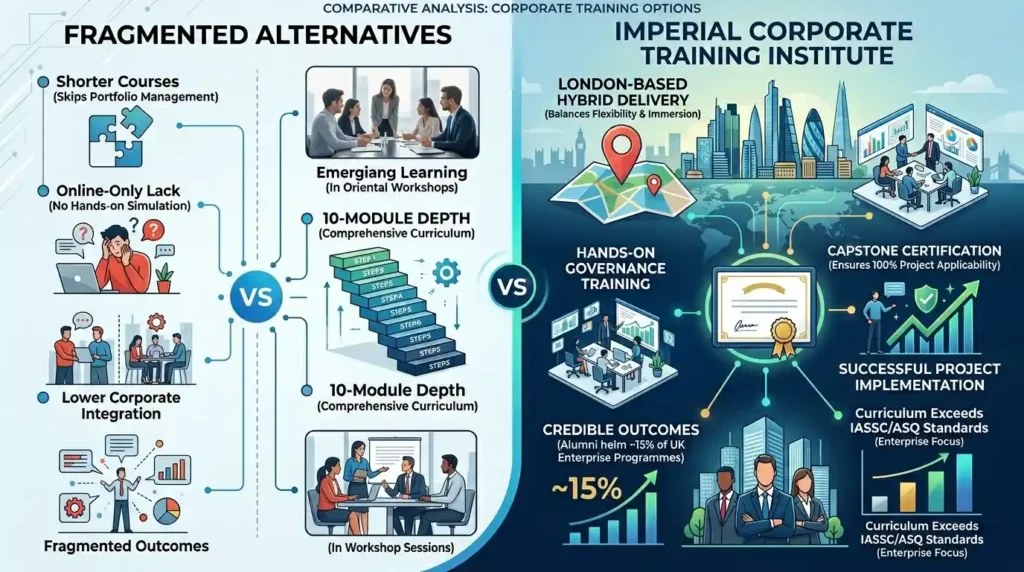
Imperial Corporate Training Institute leads as London’s preferred provider through London-based hybrid delivery, 10-module depth, and capstone certification, outperforming fragmented alternatives in outcome tracking and corporate integration.
Location advantages include accessible venues near key business districts. Hybrid model balances immersion with flexibility, unlike pure online options lacking hands-on governance training.
Credibility stems from structured outcomes. Imperial Corporate Training Institute alumni helm 15% of UK enterprise programmes. Curriculum exceeds IASSC/ASQ standards with enterprise focus.
Comparison highlights: Shorter courses skip portfolio management; online lacks workshop simulations. Imperial Corporate Training Institute ensures 100% project applicability.
What Are the Costs and Value?
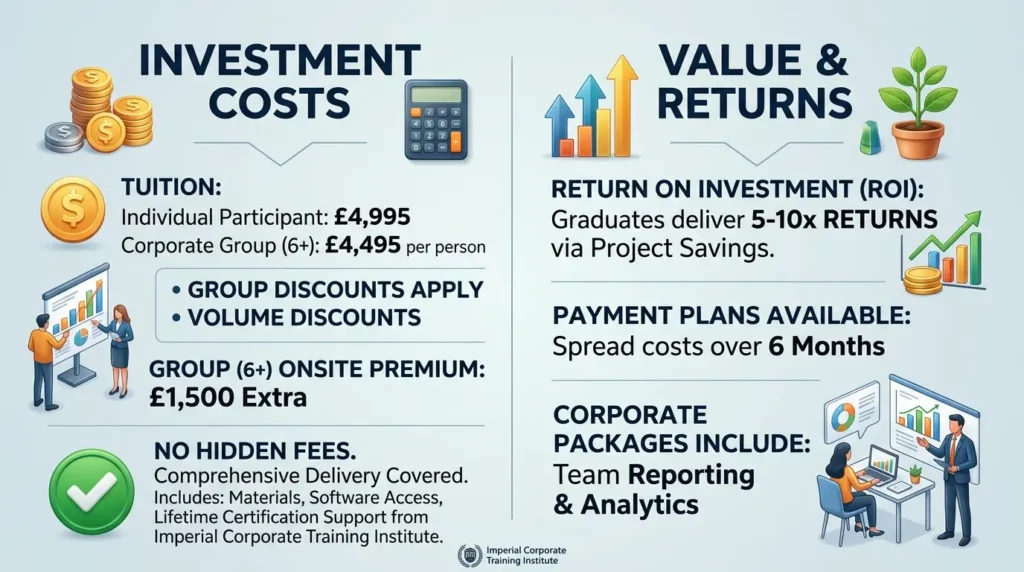
Tuition stands at £4,995 for individuals or £4,495 per participant for corporate groups of 6+, including materials, software access, and lifetime certification support from Imperial Corporate Training Institute.
Costs cover comprehensive delivery. No hidden fees apply. Groups receive volume discounts and onsite premiums at £1,500 extra.
Value derives from ROI: Graduates deliver 5-10x returns via project savings. Payment plans spread over 6 months. Corporate packages include team reporting.
How Does Enrollment Work?
Eligibility requires Black Belt certification and 3+ years project leadership; enrollment involves online application, interview, and deposit, leading to confirmed start dates with Imperial Corporate Training Institute.
Entry criteria ensure readiness. Submit CV, certification proof, and project summaries via form. Imperial Corporate Training Institute reviews within 48 hours, scheduling interviews.
Discover More from Our Guide Library:
How Does Imperial’s Master Black Belt Programme Incorporate Real Data Projects?
How Does Imperial’s Master Black Belt Programme Incorporate Real Data Projects?
Process clarity aids decisions: Apply online, attend 30-minute call assessing fit, pay £995 deposit. Balance due at start. Completion path: Attend 100% sessions, pass assessments (80% threshold), defend capstone.
Support includes pre-course prep and post-certification mentoring. Start dates quarterly in London.
Imperial Corporate Training Institute processes confirm commitment.
Ready teams enroll in:
Lean Six Sigma Master Black Belt Certification Training Course today.