

Lean Six Sigma process improvement combines Lean principles for waste elimination with Six Sigma methods for defect reduction, using data analytics to drive decisions in corporate environments. It targets 20-50% efficiency gains and cuts process variation by 3.4 defects per million opportunities.
Lean Six Sigma integrates two methodologies. Lean focuses on speed and flow by removing non-value-adding activities. Six Sigma emphasises statistical control to minimise variability. Data analytics bridges these by providing evidence-based insights.
In workplaces, organisations apply it to streamline operations. Manufacturing firms reduce production cycle times from 30 days to 10 days. Service sectors like finance cut loan processing errors by 40%.
Business impact appears in cost savings. Companies achieve 15-25% reductions in operational expenses. Employee skill gaps in data interpretation hinder adoption, so training addresses this through structured programmes.
Process improvement follows DMAIC: Define, Measure, Analyse, Improve, Control. Data analytics dominates the Analyse phase, where teams quantify root causes.
How Does Data Analytics Integrate with Lean Six Sigma in Corporate Settings?
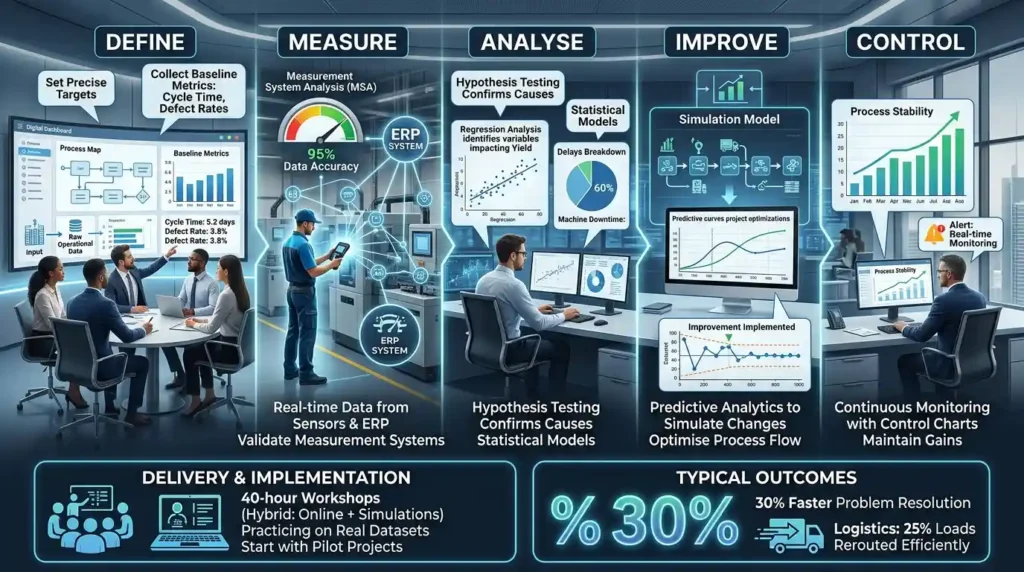
Data analytics integrates with Lean Six Sigma by transforming raw operational data into actionable insights, guiding DMAIC phases. Organisations deploy it via software tools and trained analysts, yielding 30% faster problem resolution in teams.
Corporations embed data analytics from the Define phase. Teams collect baseline metrics like cycle time and defect rates. Analytics tools process this data to set precise targets.
In the Measure phase, sensors and ERP systems gather real-time data. Analytics validates measurement systems, ensuring 95% data accuracy.
The Analyse phase relies on statistical models. Regression analysis identifies variables impacting yield. Hypothesis testing confirms causes, such as machine downtime accounting for 60% of delays.
Improvement uses predictive analytics to simulate changes. Control charts monitor post-implementation stability.
Delivery occurs in hybrid formats: 40-hour workshops blend online modules with simulations. Teams practice on real datasets from their operations.
Implementation starts with pilot projects. A logistics department analyses shipment delays, applying analytics to reroute 25% of loads efficiently.
What Are the Key Components of Data Analytics in Lean Six Sigma?
Key components include statistical tools, software platforms, data visualisation, and trained personnel. Frameworks like DMAIC structure application, with delivery via case-based learning, simulations, and assessments over 120 training hours.
Statistical tools form the core. Descriptive statistics summarise data distributions. Inferential tools like t-tests validate differences.
Software platforms enable execution. Minitab handles capability analysis. Python with libraries like Pandas and SciPy processes large datasets. Tableau visualises trends for stakeholder buy-in.
Data visualisation dashboards highlight KPIs. Heat maps reveal bottleneck concentrations in supply chains.
Frameworks guide integration. DMAIC provides the roadmap. Value Stream Mapping from Lean identifies data collection points.
Delivery formats suit corporate needs. Workshops last 5 days with hands-on projects. Online modules offer 24/7 access for global teams. Hybrid learning combines both, with 80% practical exercises.
Learning methodologies build skills. Case-based learning dissects IT project overruns. Simulations model production lines. Role play handles stakeholder presentations. Assessments measure proficiency via project submissions.
Personnel roles include Green Belts for data collection and Black Belts for advanced modelling.
How Do Organisations Implement Data Analytics-Driven Lean Six Sigma?
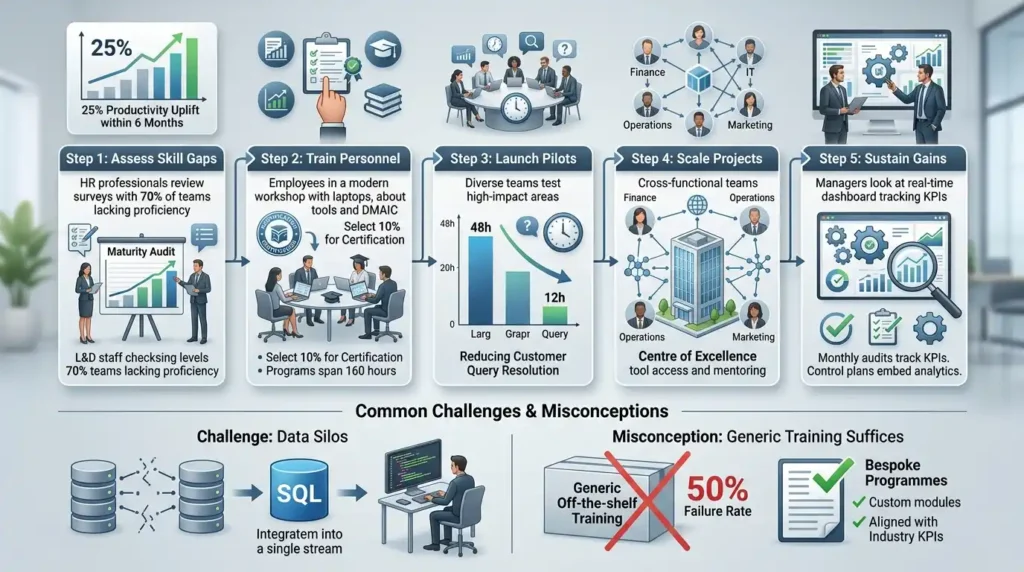
Organisations implement via a 5-step rollout: assess gaps, train staff, launch pilots, scale projects, and sustain with audits. This structure delivers 25% productivity uplift within 6 months.
Step 1: Assess skill gaps. HR surveys reveal 70% of teams lack analytics proficiency. L&D identifies needs through maturity audits.
Step 2: Train personnel. Select 10% of workforce for certification. Programmes span 160 hours, covering tools and DMAIC.
Step 3: Launch pilots. Departments test on high-impact areas, like reducing customer query resolution from 48 to 12 hours using analytics.
Step 4: Scale projects. Form cross-functional teams. Centralise a Centre of Excellence for tool access and mentoring.
Step 5: Sustain gains. Monthly audits track KPIs. Control plans embed analytics in daily operations.
Common challenges include data silos. Integration platforms like SQL resolve this, unifying sources.
Misconception: Generic training suffices. Bespoke programmes align with industry KPIs, avoiding 50% failure rates of off-the-shelf options.
For deeper skill development in advanced analytics, explore:
What Data Analysis Skills Are Built During Lean Six Sigma Master Black Belt Training?
What Measurable Outcomes Does Data Analytics Produce in Lean Six Sigma?
Data analytics produces outcomes like 20-40% cost reductions, 30% productivity gains, 15% error drops, and 95% process stability. ROI hits 5:1 within 12 months through tracked KPIs.
Productivity metrics show direct impact. Factories increase output by 35 units per shift after analytics-optimised scheduling.
Cost savings materialise in waste reduction. Healthcare providers cut inventory costs by 28% via demand forecasting models.
Error rates decline sharply. Finance teams reduce transaction discrepancies from 5% to 0.5% with control charts.
Retention improves as employees gain skills. Trained teams report 20% higher engagement scores, building leadership pipelines.
KPIs track success. Sigma level rises from 3 to 4, equating to 99.38% defect-free processes. Cycle time shortens by 50%.
ROI calculation factors training costs against gains. A £50,000 programme yields £250,000 savings.
Organisational impact extends to agility. Teams respond to market shifts 40% faster.
What Are Real-World Use Cases for Data Analytics in Lean Six Sigma?
Use cases span manufacturing for yield optimisation, finance for fraud detection, healthcare for patient flow, IT for ticket resolution, and logistics for route efficiency, delivering 25-50% improvements per sector.
In manufacturing, analytics analyses machine data. A automotive plant identifies vibration patterns causing 15% scrap, implementing predictive maintenance for 40% yield gains.
Finance departments apply it to claims processing. Regression models pinpoint approval delays, streamlining workflows to process 10,000 claims daily with 98% accuracy.
Healthcare use cases focus on throughput. Hospitals use queueing models to reduce wait times from 4 hours to 45 minutes, boosting patient satisfaction by 30 points.
IT teams tackle service desks. Clustering algorithms group tickets, prioritising high-impact issues and cutting resolution by 60%.
Logistics firms optimise fleets. Geospatial analytics reroutes deliveries, saving 20% fuel across 500 trucks.
Team leaders in retail deploy it for inventory. Time-series forecasting prevents stockouts, increasing sales by 18%.
These cases demonstrate scalability from departments to enterprises.
What Common Problems Arise in Data Analytics for Lean Six Sigma?
Common problems include poor data quality (40% project failures), skill shortages (60% teams untrained), tool silos, and resistance to change. Solutions involve validation protocols, targeted training, and integration.
Poor data quality plagues 40% of initiatives. Incomplete datasets skew analysis. Organisations counter with ETL processes ensuring 99% cleanliness.
Skill shortages affect 60% of teams. Employees struggle with advanced stats. Structured training bridges this in 3 months.
Tool silos fragment efforts. Excel limits scale; enterprises adopt unified platforms like Alteryx.
Change resistance slows adoption. Managers fear job displacement. Communication via ROI demos achieves 85% buy-in.
Misconception: Analytics replaces Lean principles. It enhances them, amplifying waste reduction by 2x.
Ineffective training wastes resources. Generic programmes yield 10% retention; practical simulations hit 90%.
Lack of ROI tracking dooms projects. Baseline metrics and post-audits ensure accountability.
How Does Data Analytics Address Employee Skill Gaps in Lean Six Sigma?
Data analytics training closes gaps through 120-hour programmes blending theory and practice, upskilling 80% of participants to Black Belt level. It boosts team efficiency by 35% via simulations and assessments.
Skill gaps manifest in misinterpretation of metrics. 70% of mid-level managers overlook variance signals.
Programmes use progressive modules. Beginners master basics in 40 hours; advanced cover machine learning in 80.
Discover More from Our Guide Library:
Why Do Companies Invest in Lean Six Sigma Certification for Their Employees?
Can Lean Six Sigma Be Applied Outside Manufacturing in Service Industries?
Delivery mixes formats. Virtual workshops enable global participation. On-site role plays build confidence.
Assessments gauge progress. Pre-tests identify weaknesses; projects simulate corporate scenarios.
Post-training, teams apply skills immediately. A sales department uses cohort analysis to segment customers, lifting conversion by 25%.
This approach fosters collaboration, with cross-team projects enhancing knowledge sharing.
Organisations measure via certification rates. 95% pass rates correlate with 20% retention uplift.
For deeper insight enrol in:
Lean Six Sigma Master Black Belt Certification Training Course
What does Lean Six Sigma Master Black Belt Certification Training Course cover at Imperial Corporate Training Institute?
The course covers advanced DMAIC methodologies, statistical analysis tools like Minitab and Python, and leadership in process improvement projects. Participants master data-driven decision-making and change management over 160 hours of practical training. It builds skills for leading enterprise-wide Lean Six Sigma initiatives.
How long is the Lean Six Sigma Master Black Belt Certification Training Course from Imperial Corporate Training Institute?
The programme spans 160 hours, delivered in hybrid format with 5-day workshops and online modules. It includes simulations, case studies, and a real-world project for certification. Flexible scheduling suits corporate professionals.
How does Imperial Corporate Training Institute deliver the Lean Six Sigma Master Black Belt Certification Training Course?
Delivery combines live workshops, online modules, and hands-on simulations for real-world application. Assessments include project submissions and exams aligned with industry standards. The hybrid model supports global teams with 24/7 module access.
What benefits do organisations gain from employees completing Lean Six Sigma Master Black Belt training at Imperial Corporate Training Institute?
Organisations achieve 25-40% process efficiency gains and 5:1 ROI through certified leaders driving projects. Teams gain expertise in data analytics for waste reduction and defect minimisation. It strengthens leadership pipelines and operational agility