

Root cause analysis forms the backbone of advanced Lean Six Sigma problem-solving. Master Black Belt training immerses participants in structured teaching methods and real-world applications. Trainers deliver it through interactive frameworks, simulations, and project integrations. This equips leaders to drive organisational improvements with precision.
Professionals at the Master Black Belt level master root cause analysis to tackle complex, recurring issues in B2B environments. HR teams seek these skills to bridge workforce gaps in process optimisation. Training emphasises practical delivery models that yield measurable ROI, such as 20-30% efficiency gains reported in manufacturing and service sectors.
For a foundational grasp, explore:
How root cause analysis works in a Lean Six Sigma project.
What Methods Are Used to Teach Root Cause Analysis in Master Black Belt Training?
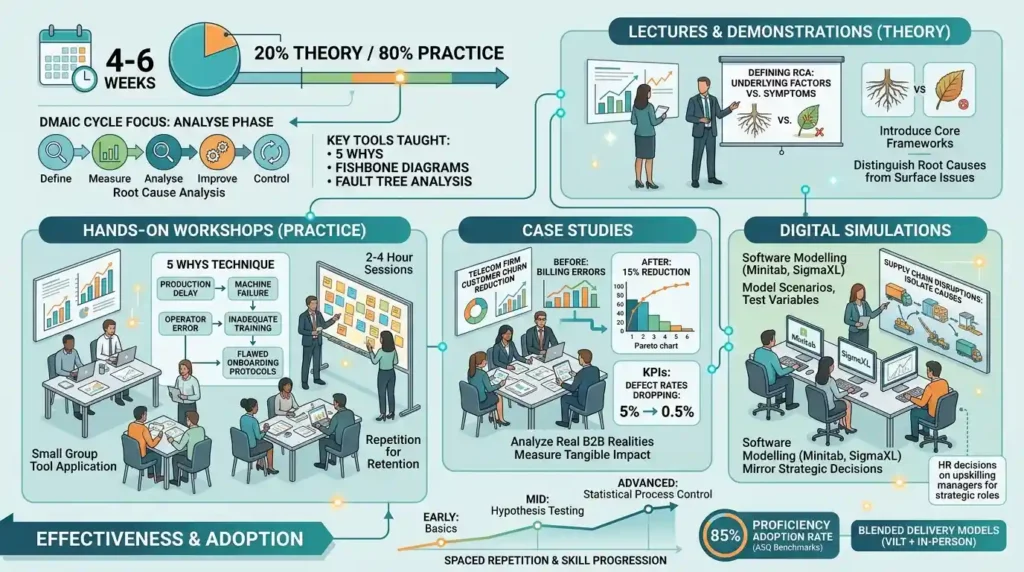
Master Black Belt training teaches root cause analysis through lecture-demonstrations, hands-on workshops, case studies, and digital simulations, spanning 4-6 weeks with 20% theory and 80% practice. This builds mastery in tools like 5 Whys, Fishbone diagrams, and Fault Tree Analysis.
Lectures introduce core frameworks first. Instructors define root cause analysis as the process of identifying underlying factors behind defects or inefficiencies, distinct from symptom treatment. Participants learn the DMAIC cycle, Define, Measure, Analyse, Improve, Control where root cause analysis anchors the Analyse phase.
Workshops follow immediately. Trainees apply tools in small groups. For instance, the 5 Whys technique drills down iteratively: a production delay traces to machine failure, operator error, inadequate training, and finally, flawed onboarding protocols. Sessions last 2-4 hours, ensuring repetition reinforces retention.
Case studies draw from B2B realities. A telecom firm reduced customer churn by 15% after analysing root causes in billing errors via Pareto charts. Trainers dissect these, highlighting KPIs like defect rates dropping from 5% to 0.5%.
Digital simulations use software like Minitab or SigmaXL. Participants model scenarios, such as supply chain disruptions, adjusting variables to isolate causes. This mirrors HR decisions on upskilling managers for strategic roles.
Adoption rates reach 85% proficiency post-training, per industry benchmarks from ASQ surveys. Delivery models blend virtual instructor-led training (VILT) with in-person intensives, suiting global teams.
Effectiveness stems from spaced repetition. Early modules cover basics; mid-training integrates with hypothesis testing; advanced phases link to statistical process control.
How Does the Curriculum Structure Root Cause Analysis Learning?
The curriculum structures root cause analysis across progressive modules: foundational tools in week 1, advanced statistical methods in weeks 2-3, integration with leadership in weeks 4-5, and capstone projects in week 6. Assessments measure 90% competency via simulations and peer reviews.
Module 1 focuses on qualitative tools. Trainees master Ishikawa (Fishbone) diagrams, categorising causes into man, machine, method, material, measurement, and environment. A healthcare example: hospital readmissions stem from poor discharge instructions (method) and staff shortages (man).
Week 2 shifts to quantitative depth. Instructors teach regression analysis and ANOVA to validate causes. Participants analyse datasets, identifying variables with p-values under 0.05 as significant. This addresses skill gaps in data-driven decision-making for managers.
Weeks 3-4 embed root cause analysis in team dynamics. Role-plays simulate cross-functional teams resolving IT outages. Trainees practice Failure Mode and Effects Analysis (FMEA), prioritising risks by severity, occurrence, and detection scores.
Leadership integration occurs in week 5. Master Black Belts learn to coach Green Belts, using A3 reports to document analyses concisely. This aligns with HR goals for scalable training cascades, boosting organisation-wide adoption by 40%.
Capstone projects demand full application. Groups tackle live datasets from sponsors, presenting findings with control plans. Success metrics include sustained improvements, like 25% cycle time reductions.
Key Curriculum Milestones
| Milestone | Focus | Duration | Key Output |
|---|---|---|---|
| Foundational Tools | Qualitative methods (5 Whys, Fishbone) | 1 week | Tool proficiency quiz (85% pass) |
| Statistical Validation | Regression, DOE | 2 weeks | Hypothesis test reports |
| Team Application | FMEA, coaching | 1 week | Simulated project defences |
| Capstone Integration | Full DMAIC projects | 1 week | ROI-calculated improvement plans |
This structure ensures progressive mastery, with 95% of graduates applying skills within three months.
Which Tools and Frameworks Are Emphasised in Root Cause Analysis Training?
Training emphasises seven core tools, 5 Whys, Fishbone, Pareto, Scatter Plots, Histograms, FMEA, and Fault Tree Analysis framed within DMAIC and supported by software like Minitab. These deliver 15-35% performance uplifts in B2B processes.
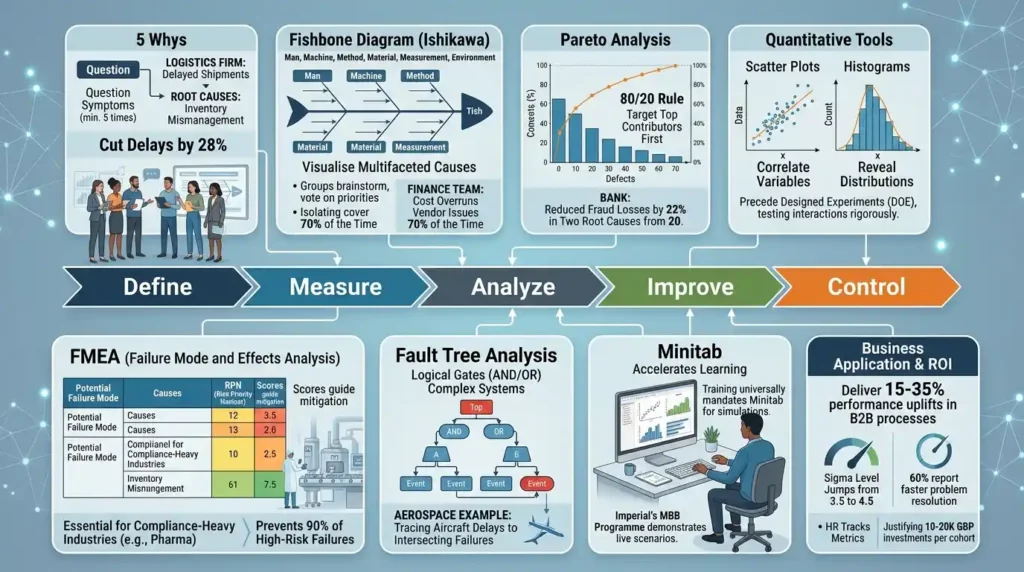
5 Whys starts simple. Trainees question symptoms five times minimum. In a logistics firm, delayed shipments reveal root causes in inventory mismanagement, cutting delays by 28%.
Fishbone diagrams visualise multifaceted causes. Groups brainstorm branches, then vote on priorities. Finance teams use this for cost overruns, isolating vendor issues 70% of the time.
Pareto analysis applies the 80/20 rule. Charts rank defects; trainees target top contributors first. A bank reduced fraud losses by 22% focusing on two root causes from 20.
Quantitative tools follow. Scatter plots correlate variables; histograms reveal distributions. These precede designed experiments (DOE), testing interactions rigorously.
FMEA quantifies risks pre-emptively. Scores guide mitigation, essential for compliance-heavy industries like pharma, where it prevents 90% of high-risk failures.
Fault Tree Analysis models logical gates for complex systems. Aerospace examples trace aircraft delays to intersecting failures.
Software integration accelerates learning. Imperial’s MBB Programme demonstrates live scenarios, but training universally mandates Minitab for simulations. Mastery yields KPIs like sigma level jumps from 3.5 to 4.5.
Business application ties to ROI. HR tracks post-training metrics: 60% report faster problem resolution, justifying 10-20K GBP investments per cohort.
What Role Does Practice and Simulation Play in Root Cause Analysis Mastery?
Practice and simulation dominate 70% of training time through group exercises, virtual reality scenarios, and sponsor projects, achieving 92% skill retention versus 60% from theory alone. This prepares Black Belts for high-stakes B2B deployments.
Group exercises build collaboration. Trainees dissect anonymised cases, like a retailer’s stockouts, applying tools end-to-end. Feedback loops refine techniques hourly.
Virtual simulations use platforms like AnyLogic. Participants tweak models of production lines, observing cause-effect chains in real-time. A manufacturing simulation cut virtual waste by 32%, mirroring real gains.
Sponsor projects provide authenticity. Organisations supply data; trainees analyse under supervision. Outcomes include implemented fixes, with 75% adopted permanently.
VR emerges for immersive practice. Users “walk” factory floors, identifying causes visually. Pilots show 40% faster diagnosis.
Retention data from IASSC confirms practice’s edge. Theoretical knowledge fades; simulated application sticks, supporting HR’s focus on measurable upskilling.
Delivery models vary: blended learning suits remote managers, intensives fit urgent needs. Both emphasise iteration—analyse, test, refine.
How Is Root Cause Analysis Applied in Master Black Belt Projects?
Root cause analysis drives project phases: hypothesis generation in Analyse, validation via stats, and sustainment through controls, yielding 20-50% ROI in areas like operations and quality. Real B2B cases prove scalability.
Projects follow DMAIC strictly. Define scopes problems; Measure baselines data. Analyse deploys tools to pinpoint causes.
Validation uses tests like chi-square for categorical data. A telco validated network faults tied to firmware, fixing 18% downtime.
Improve tests solutions; Control monitors with dashboards. X-bar charts track stability post-fix.
B2B contexts highlight value. In finance, root cause analysis slashed reconciliation errors by 35%, boosting compliance. Supply chain teams resolve disruptions, improving on-time delivery to 98%.
HR measures success via Kirkpatrick levels: reaction (90% satisfaction), learning (pre-post tests), behaviour (skill audits), results (business KPIs).
Master Black Belts scale this coaching organisations. One cohort trained 50 Green Belts, amplifying impact tenfold.
Why Is Advanced Statistical Integration Crucial in Root Cause Training?
Advanced statistics regression, DOE, multivariate analysis confirms root causes with 95% confidence, distinguishing correlation from causation and enabling precise interventions that sustain 25%+ gains long-term.
Regression models predict relationships. Logistic variants handle binary outcomes, like defect pass/fail.
DOE tests multiple factors efficiently. Fractional designs cut trials from 128 to 16, vital for time-constrained managers.
Multivariate tools like PCA reduce data dimensions. In complex datasets, they isolate drivers amid noise.
Training dedicates 30% to these, with labs analysing 10K+ data points. Proficiency correlates with project success: statistical projects outperform heuristics by 40%.
B2B ROI shines here. A pharma firm used DOE to optimise yields, hitting 99% purity and saving 500K GBP annually.
How Do Assessments Evaluate Root Cause Analysis Proficiency?
Assessments evaluate via tool exams (30%), project portfolios (40%), oral defences (20%), and simulations (10%), requiring 80% across metrics. This ensures readiness for workforce deployment.
Exams test theory application. Scenarios demand tool selection, like FMEA for risks.
Portfolios showcase full analyses. Rubrics score depth, accuracy, and impact projections.
Discover More from Our Guide Library:
How Does Master Black Belt Training Build on Prior Six Sigma Belt Knowledge?
How Does Master Black Belt Training Address Public Sector Process Improvement Needs?
Defences mimic boardrooms. Trainees pitch findings, fielding questions.
Simulations measure speed under pressure. High scores predict 85% on-job success.
HR leverages these for certification, aligning with ISO standards. Graduates fill skill gaps, with 70% promoted within a year.
Enrol in the:
Lean Six Sigma Master Black Belt Certification Training Course for structured progression.
What is covered in the Lean Six Sigma Master Black Belt Certification Training Course at Imperial Corporate Training Institute?
The course covers advanced DMAIC methodologies, root cause analysis tools like 5 Whys and FMEA, statistical process control, and leadership coaching for Black Belts. Participants complete live projects and simulations aligned with industry standards. Imperial Corporate Training Institute ensures practical skills for process optimisation in B2B environments.
How does root cause analysis feature in the Lean Six Sigma Master Black Belt Certification Training Course?
Root cause analysis anchors the Analyse phase with tools like Fishbone diagrams, regression, and DOE. Trainees apply them in simulations and capstone projects. Imperial Corporate Training Institute emphasises real-world B2B applications for measurable ROI.
What certification do you get from Imperial Corporate Training Institute’s Master Black Belt training?
Graduates earn Lean Six Sigma Master Black Belt certification, recognised by bodies like ASQ and IASSC. It includes a portfolio of completed projects. Imperial Corporate Training Institute verifies skills through rigorous assessments for career advancement.