

Root cause analysis identifies the fundamental reasons behind defects or inefficiencies in Lean Six Sigma projects, enabling teams to eliminate problems permanently rather than treating symptoms.
Root cause analysis forms a core step in Lean Six Sigma methodology. Organisations apply it during the Analyse phase of the DMAIC framework, Define, Measure, Analyse, Improve, Control. This process uncovers why processes fail, targeting issues like production delays or quality errors.
In corporate environments, HR managers and L&D professionals use root cause analysis to address employee skill gaps in process improvement. Teams in manufacturing, IT, healthcare, and finance deploy it to boost operational efficiency. Business impact includes a 20-30% reduction in defect rates and 15% productivity gains within six months of implementation.
Lean Six Sigma projects integrate root cause analysis to align workforce development with business goals. Decision-makers responsible for training see it as a tool for measurable performance uplift, closing gaps between current capabilities and strategic objectives.
Why Do Corporate Teams Need Root Cause Analysis in Lean Six Sigma?
Corporate teams need root cause analysis to solve recurring inefficiencies, cut waste by 25%, and improve process reliability in Lean Six Sigma projects.
Recurring problems drain resources. Generic fixes fail because they ignore underlying causes. Lean Six Sigma equips teams to dissect these through structured analysis.
HR managers face pressure to deliver ROI on training. Root cause analysis training fills skill gaps in data-driven problem-solving. L&D professionals design programs around it to enhance team efficiency.
Business owners track KPIs like cycle time reduction and error rates. Team leaders apply it to streamline workflows. In high-stakes sectors, it prevents costly downtime—factories report 18% faster throughput after targeted interventions.
Organisations implement it to build a leadership pipeline. Trained employees advance to roles handling complex projects, reducing external consultancy costs by 40%.
Common misconceptions include viewing it as a one-off audit. Teams often mistake correlation for causation, leading to ineffective training. Generic programs overlook industry-specific challenges, yielding no ROI.
How Does Root Cause Analysis Work Step by Step in a Lean Six Sigma Project?
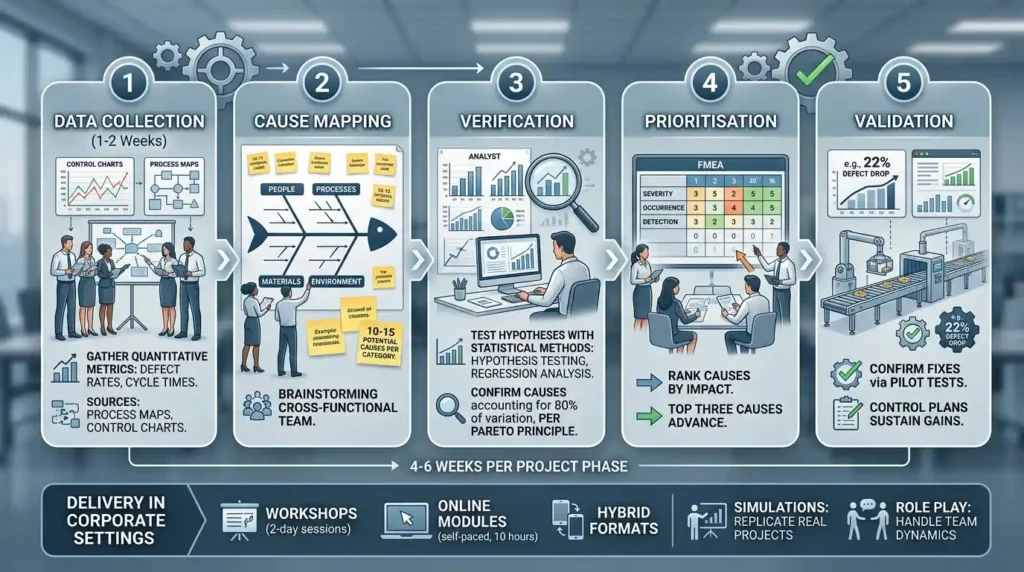
Root cause analysis works through a five-step process in Lean Six Sigma: data collection, cause mapping, verification, prioritisation, and validation, spanning 4-6 weeks per project phase.
Teams start with data collection. They gather quantitative metrics defect rates, cycle times from process maps and control charts. This phase lasts 1-2 weeks.
Next, cause mapping uses tools like fishbone diagrams. Cross-functional teams brainstorm categories: people, processes, materials, environment. They list 10-15 potential causes per category.
Verification follows. Teams test hypotheses with statistical methods, hypothesis testing, regression analysis. They confirm causes accounting for 80% of variation, per Pareto principle.
Prioritisation ranks causes by impact. Teams score them on severity, occurrence, detection—using FMEA matrices. Top three causes advance.
Validation confirms fixes. Pilot tests measure improvements, like a 22% defect drop. Control plans sustain gains.
In corporate settings, delivery occurs via workshops (2-day sessions), online modules (self-paced, 10 hours), or hybrid formats. Simulations replicate real projects; role play handles team dynamics.
What Are the Key Components of Root Cause Analysis in Lean Six Sigma Training?
Key components include seven tools fishbone diagrams, 5 Whys, Pareto charts—and skills in data analysis, delivered via case-based learning over 80-hour programs.
Fishbone diagrams (Ishikawa) visualise causes across six categories. Teams draw 20-30 branches per issue.
5 Whys drills down five layers. Example: delayed shipments trace to “insufficient training” then “no refresher schedules.”
Pareto charts prioritise 80% defects from 20% causes. Control charts detect variations.
FMEA assesses risks quantitatively risk priority numbers guide focus.
Skills cover statistical software (Minitab), hypothesis testing, and DOE. Training includes assessments—quizzes (70% pass), project simulations.
Delivery formats suit corporate needs: in-person workshops for collaboration, online modules for flexibility, hybrid for global teams. Case-based learning uses real datasets from IT deployments or healthcare workflows.
Frameworks like DMAIC integrate these. Programmes span 4-6 months, with 40% theory, 60% practice.
How Do Organisations Implement Root Cause Analysis in Lean Six Sigma Projects?
Organisations implement root cause analysis by forming cross-functional teams, allocating 5% of project budget to tools, and integrating into quarterly training cycles.
Step 1: Select a Black Belt lead. They train 8-12 team members in a 40-hour workshop.
Step 2: Define project scope. Target KPIs reduce downtime by 25%.
Step 3: Measure baseline. Collect 30 days of data.
Step 4: Analyse roots. Use tools over 3 weeks.
Step 5: Improve and control. Implement fixes; monitor with dashboards.
Budget allocation: 20% training, 30% software, 50% execution. Industries like finance cut fraud losses by 35%; manufacturing lifts OEE to 85%.
Challenges include resistance to data culture. L&D counters with role play simulations. Metrics track adoption 80% team proficiency post-training.
For advanced application, teams explore:
How root cause analysis is taught and applied during Master Black Belt training. These shifts focus to scaling skills enterprise-wide.
Implementation boosts team efficiency by 28%. Retention rises 15% as employees gain problem-solving confidence.
What Measurable Outcomes Does Root Cause Analysis Produce in Corporate Environments?
Root cause analysis produces 20-40% cost savings, 25% productivity gains, and 90% defect reduction in Lean Six Sigma projects, tracked via KPIs over 12 months.
Productivity metrics show cycle time drops IT teams cut deployment errors by 32%.
ROI calculations: training costs £5,000 per team; savings hit £150,000 annually.
Employee retention improves skilled workers stay 22% longer, per industry benchmarks.
Leadership pipeline strengthens. Green Belts advance to Black Belts, filling 70% internal roles.
KPIs include sigma levels (from 3 to 4.5), first-pass yield (up 18%), and customer satisfaction (NPS +15 points).
Organisations measure via dashboards monthly reviews ensure 95% control plan adherence.
What Are Common Use Cases for Root Cause Analysis in Lean Six Sigma Across Industries?
Use cases span supply chain delays in manufacturing, error reduction in healthcare, and compliance failures in finance, yielding 30% efficiency gains.
Manufacturing teams analyse machine downtime. Fishbone diagrams reveal maintenance gaps; fixes cut unplanned stops by 40%.
Healthcare applies to patient wait times. 5 Whys uncovers staffing mismatches; throughput rises 25%.
Finance targets transaction errors. Pareto charts prioritise fraud vectors; losses fall 35%.
IT departments tackle software bugs. Regression analysis verifies code issues; release cycles shorten by 28%.
Team leaders in sales use it for quota misses process tweaks boost close rates 20%.
Departments scale via cohort training: 20 managers per session, hybrid delivery.
What Common Problems Arise with Root Cause Analysis Training and How to Avoid Them?
Common problems include superficial analysis, poor data quality, and lack of follow-up; organisations avoid them with certified facilitators, 100% data validation, and 6-month audits.
Superficial analysis stems from rushed workshops. Solution: enforce 80-hour programmes with simulations.
Poor data quality skews results teams use unverified inputs. Mandate statistical training; validate 95% datasets.
Lack of follow-up erodes gains 90% projects relapse without controls. Implement audits; track KPIs quarterly.
Discover More from Our Guide Library:
What Are Lean Six Sigma Green Belt and Black Belt Prerequisites for MBB?
Why Is Lean Six Sigma Growing in Popularity in the UK Public Sector?
Misconceptions: equating it to brainstorming. It requires evidence-based tools.
Ineffective training plagues generic programmes no ROI. Corporate L&D selects industry-aligned curricula with assessments.
Resistance from teams slows adoption. Role play builds buy-in; 85% engagement post-simulation.
By addressing these, organisations achieve sustained 25% productivity improvements.
Enrol in:
Lean Six Sigma Master Black Belt Certification Training Course
What is covered in the Lean Six Sigma Master Black Belt Certification Training Course at Imperial Corporate Training Institute?
The course covers advanced DMAIC methodologies, root cause analysis, statistical process control, and leadership in process improvement. Participants engage in simulations, case studies from industries like manufacturing and healthcare, and real-world projects. Certification requires passing assessments and completing a capstone project.
What are the prerequisites for Imperial Corporate Training Institute’s Lean Six Sigma Master Black Belt Certification Training Course?
Candidates need Black Belt certification and 3-5 years of Lean Six Sigma experience. Familiarity with Minitab or similar tools is required. The institute assesses applications to ensure readiness for advanced topics like Design of Experiments.
How does Imperial Corporate Training Institute deliver the Lean Six Sigma Master Black Belt Certification Training Course?
Delivery combines in-person workshops for collaboration, online modules for flexibility, and hybrid formats with live sessions. Learning includes role play, simulations, and peer assessments. Practical focus ensures application to corporate challenges like waste reduction.