

Master Black Belt (MBB) training systematically extends the foundational and intermediate skills from Yellow Belt, Green Belt, and Black Belt levels. It integrates advanced statistical analysis, strategic deployment, and coaching expertise to drive enterprise-wide process excellence.
What Foundations Do Prior Six Sigma Belts Provide for Master Black Belt Training?
Prior belts deliver core DMAIC methodology, basic statistical tools, and project execution skills that MBB training amplifies into strategic leadership capabilities.
Yellow Belt training introduces Lean Six Sigma basics. Participants grasp key concepts like waste reduction and process mapping. They support projects without leading them.
Green Belt training builds execution proficiency. Trainees lead small-scale DMAIC projects. They apply tools such as SIPOC diagrams, fishbone analysis, and basic hypothesis testing. Green Belts achieve measurable improvements, often targeting 20-30% efficiency gains in departmental processes.
Black Belt training elevates to complex project management. Black Belts master advanced statistics, including regression analysis, design of experiments (DOE), and control charts. They deliver projects yielding 50-100% ROI through sustained cost savings or quality enhancements.
These levels create a skill pyramid. MBB training sits at the apex. It assumes proficiency in all prior tools. HR leaders in B2B firms rely on this progression to address workforce skill gaps. Organisations with certified belts report 15-25% higher project success rates, per industry benchmarks from the American Society for Quality (ASQ).
For deeper insight into entry requirements across belts, explore:
What Are Lean Six Sigma Green Belt and Black Belt Prerequisites for MBB?
How Does MBB Training Expand DMAIC Application Beyond Black Belt Proficiency?
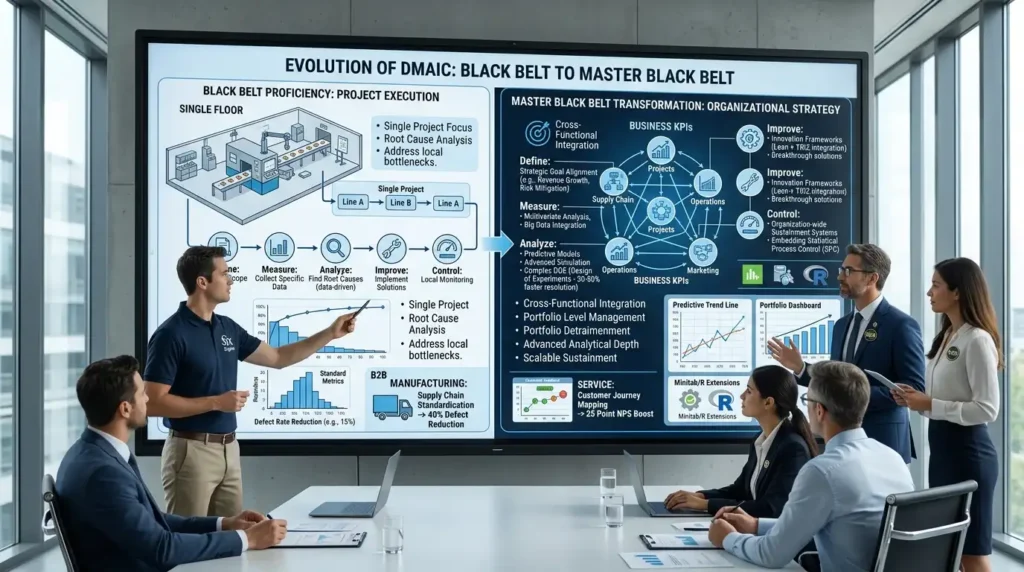
MBB training transforms DMAIC from project-specific execution into scalable, organisation-wide strategy, incorporating advanced tollgates and cross-functional integration.
DMAIC forms the Six Sigma backbone: Define, Measure, Analyse, Improve, Control. Black Belts apply it to single projects, focusing on data-driven root cause analysis.
MBB candidates deploy DMAIC at portfolio levels. They design tollgate reviews that align multiple projects with business KPIs. Training emphasises strategic Define phases, linking processes to organisational goals like revenue growth or risk mitigation.
In Measure and Analyse, MBBs advance to multivariate analysis and simulation modelling. Black Belts handle univariate data; MBBs integrate big data sets for predictive insights. Training covers Minitab or R software extensions for complex DOE, enabling 30-50% faster problem resolution.
Improve phases shift to innovation frameworks. MBBs blend Lean principles with TRIZ (Theory of Inventive Problem Solving), fostering breakthrough solutions. Control phases evolve into sustainment systems, training leaders to embed statistical process control (SPC) into daily operations.
B2B contexts highlight this evolution. Manufacturing firms use MBB-led DMAIC to standardise supply chains, reducing defects by 40%. Service sectors apply it to customer journey mapping, boosting Net Promoter Scores by 25 points.
What Advanced Statistical Tools Does MBB Introduce Over Black Belt Knowledge?
MBB training layers sophisticated techniques like discrete event simulation and advanced regression onto Black Belt stats, enabling predictive enterprise modelling.
Black Belts master parametric tests, ANOVA, and logistic regression for project optimisation.
MBB curriculum introduces non-parametric advancements. Training covers bootstrapping for robust inference and Bayesian methods for uncertainty quantification. These tools handle real-world data variability in B2B environments, where datasets often skew due to market fluctuations.
Simulation modelling marks a key escalation. MBBs learn Arena or Simul8 software to model dynamic systems. Black Belts simulate static processes; MBBs forecast scenarios like production bottlenecks under demand surges, improving throughput by 35%.
Advanced DOE expands Black Belt factorial designs. MBBs tackle response surface methodology (RSM) and Taguchi methods, optimising multiple variables simultaneously. This yields 20-40% parameter efficiency gains.
HR decision-makers evaluate these tools for ROI. Certified MBBs drive projects with 3-5x higher financial impact than Black Belts, according to IASSC data. Training durations span 120-160 hours, blending virtual instructor-led sessions with hands-on simulations.
How Does MBB Training Develop Coaching and Mentoring Skills Absent in Lower Belts?
MBB training instils structured coaching frameworks, turning Black Belts into multipliers who train Green and Black Belts for organisation-wide adoption.
Lower belts prioritise personal project delivery. Yellow and Green Belts execute; Black Belts lead teams but rarely coach systematically.
MBB programs dedicate 30-40% of curriculum to human performance. Trainees master the GROW model (Goals, Reality, Options, Will) adapted for Six Sigma. They conduct belt progression assessments, identifying skill gaps in real-time.
Training includes facilitation techniques for workshops. MBBs design kaizen events that accelerate Lean adoption, contrasting Black Belt’s solo project focus. Role-playing scenarios simulate mentoring resistant stakeholders, common in B2B change initiatives.
Business application shines in workforce development. Organisations with MBB coaches achieve 70% belt certification retention rates, versus 45% without. HR teams measure success via KPIs like training hours per employee and project pipeline velocity.
This builds internal capability. MBBs create belt academies, reducing external training costs by 50% over three years.
In What Ways Does MBB Emphasise Strategic Deployment Differing from Tactical Black Belt Focus?
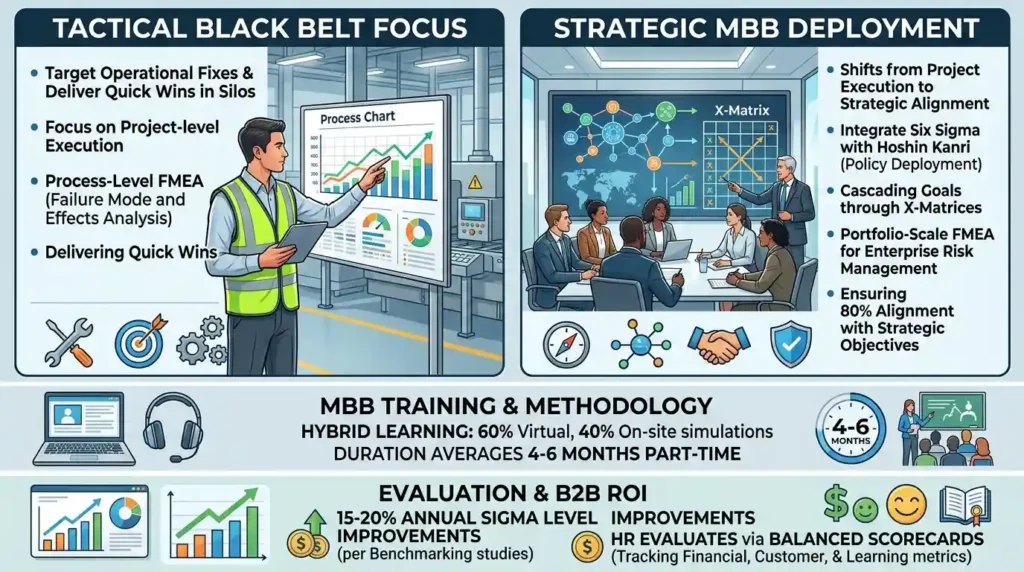
MBB training shifts from Black Belt’s tactical project execution to strategic alignment, integrating Six Sigma with Hoshin Kanri for policy deployment.
Black Belts target operational fixes, delivering quick wins in silos.
MBB leaders align initiatives with executive vision. Training covers Hoshin Kanri, cascading goals through X-matrices. MBBs prioritise projects via prioritisation matrices, ensuring 80% alignment with strategic objectives.
Enterprise risk management integrates here. MBBs apply Failure Mode and Effects Analysis (FMEA) at portfolio scales, mitigating risks across functions. This contrasts Black Belt’s process-level FMEA.
Delivery models adapt to scale. MBB training promotes hybrid learning: 60% virtual, 40% on-site for strategic simulations. Duration averages 4-6 months part-time, suiting managers.
B2B ROI data supports this. Firms deploying MBB strategy report 15-20% annual sigma level improvements, per Benchmarking studies. HR evaluates via balanced scorecards tracking financial, customer, and learning metrics.
How Do Real-World Use Cases Illustrate MBB Building on Prior Belt Knowledge?
MBB leverages prior belt tools in enterprise transformations, as seen in telecom firms reducing churn by 28% and banks streamlining compliance.
A global telecom provider started with Green Belt projects on call centre efficiency. Black Belts scaled to network optimisation, cutting downtime 35%.
MBB intervention integrated these into a digital transformation roadmap. Using advanced simulation, the MBB forecasted 5G rollout impacts, aligning 50+ projects. Result: 28% churn reduction, £12M annual savings.
In banking, Black Belts tackled loan processing defects. MBB training enabled regulatory compliance deployment. Advanced Bayesian analysis predicted fraud patterns, integrating with AI systems for 40% risk mitigation.
Healthcare examples abound. An NHS trust used MBB-led coaching to upskill 200 staff. Prior belts handled ward-level DMAIC; MBB orchestrated trust-wide Lean, slashing patient wait times by 45%.
These cases underscore measurable outcomes. Adoption rates hit 85% in trained organisations, with KPIs like sigma levels rising from 3.5 to 4.5.
What Performance Metrics Quantify MBB’s Advancement Over Prior Belts?
MBB drives 3-5x ROI multipliers through metrics like sigma level uplift, project velocity, and sustainment rates exceeding Black Belt benchmarks by 50%.
Black Belt projects average 1.5-3.0 sigma gains per effort.
MBB portfolios achieve 4.0-5.0 sigma enterprise-wide. Training quantifies via dashboards tracking defect rates (DPMO) and process capability (CpK >1.67).
Coaching impact shows in belt throughput: MBBs certify 20-30 belts yearly, accelerating workforce upskilling.
Sustainment metrics excel. Black Belt controls fade 30% post-project; MBB systems maintain 85% adherence via audit protocols.
Key Metrics Comparison
| Metric | Yellow/Green Belt | Black Belt | Master Black Belt |
|---|---|---|---|
| Sigma Level Gain | 1.0-2.0 | 2.0-3.5 | 3.5-5.0 |
| Project ROI Multiple | 1-1.5x | 2-3x | 4-6x |
| Annual Projects Led | 1-2 | 4-6 | 10-20 (portfolio) |
| Sustainment Rate | 50-60% | 65-75% | 85-95% |
| Training Multiplier | N/A | 1-2 belts/year | 20-30 belts/year |
This table highlights natural progression. HR teams use it for budget justification, linking to 20-30% productivity lifts.
How Does Imperial’s Lean Six Sigma Master Black Belt Certification Training Course Exemplify This Build?
Imperial’s Lean Six Sigma Master Black Belt Certification Training Course structures modules to directly scaffold prior belt knowledge into MBB mastery.
The course assumes Green/Black Belt prerequisites. It starts with diagnostic assessments, reinforcing DMAIC gaps.
Discover More from Our Guide Library:
How Does Master Black Belt Training Address Public Sector Process Improvement Needs?
How Is Process Capability Analysis Taught in Lean Six Sigma Master Black Belt Training?
Modules progress logically: statistical mastery (40 hours), coaching (30 hours), strategy (50 hours). Practical simulations mirror B2B scenarios, like supply chain overhauls.
Alignment with IASSC standards ensures global recognition. Participants complete a capstone portfolio, demonstrating 4+ sigma impact.
For those evaluating readiness:
Does Imperial Accept Candidates Without Prior Belt Certification for Its MBB Course? addresses entry flexibility.
What are the prerequisites for Imperial Corporate Training Institute’s Lean Six Sigma Master Black Belt Certification Training Course?
Candidates need prior Yellow Belt, Green Belt, or Black Belt certification, plus practical project experience in DMAIC processes. Imperial Corporate Training Institute assesses readiness through diagnostic tools to ensure foundational Six Sigma knowledge. This builds directly on belt-level skills for advanced mastery.
How does Master Black Belt training differ from Black Belt in Lean Six Sigma?
Master Black Belt extends Black Belt’s project execution with strategic deployment, advanced statistical modelling like DOE and simulation, and coaching frameworks. Imperial Corporate Training Institute’s Lean Six Sigma Master Black Belt Certification Training Course emphasises enterprise-wide application and team leadership. Black Belts focus tactically; MBBs drive organisational transformation.
What is covered in Imperial’s Lean Six Sigma Master Black Belt Certification Training Course?
The course includes advanced DMAIC tollgates, Bayesian analysis, Hoshin Kanri strategy, and coaching via GROW models. Imperial Corporate Training Institute delivers 120-160 hours of hybrid training with simulations and capstone projects. Participants gain IASSC-aligned certification for measurable business outcomes.
What career benefits come from Imperial’s Master Black Belt certification?
Graduates lead enterprise Six Sigma deployments, coach belts, and achieve 3-5x ROI on projects, boosting sigma levels to 4.5+. Imperial Corporate Training Institute’s Lean Six Sigma Master Black Belt Certification Training Course equips for roles like process excellence directors. Certified MBBs report 20-30% higher project success rates in B2B firms.