

Process capability analysis forms the core of advanced Lean Six Sigma training at the Master Black Belt level. Trainers deliver it through a blend of theoretical lectures, hands-on simulations, real-world case studies, and statistical software workshops. This approach equips professionals to assess and optimise processes in high-stakes B2B environments.
Master Black Belt programmes target senior leaders, HR directors, and process engineers facing workforce skill gaps in data-driven decision-making. These gaps often lead to inconsistent quality outputs and missed ROI targets in manufacturing, finance, and service sectors. Organisations invest in such training to bridge these voids, with studies showing certified Black Belts deliver 20-30% process efficiency gains within the first year.
For foundational knowledge on:
What Is Process Capability and How Is It Measured in Six Sigma? early awareness resources clarify basics before diving into advanced applications.
What Core Concepts Does Process Capability Analysis Cover in Master Black Belt Training?
Process capability analysis in Lean Six Sigma Master Black Belt training covers Cp, Cpk, Pp, Ppk indices, normal distribution assumptions, and short-term versus long-term capability distinctions, taught via statistical foundations and defect rate calculations over 40 instructional hours.
Trainers start with defining process capability as the inherent ability of a process to meet customer specifications. They introduce key metrics like Cp, which measures potential capability assuming the process mean centres perfectly, and Cpk, which accounts for off-centre means. Participants calculate these using formulas such as Cp=6σUSL−LSL and Cpk=min(3σUSL−μ,3σμ−LSL), where USL and LSL denote upper and lower specification limits, μ the process means, and σ the standard deviation.
Why Statistical Prerequisites Matter for Mastery
Master Black Belt candidates review hypothesis testing and control charts beforehand. This ensures they interpret capability indices accurately. For instance, a Cpk below 1.33 signals high defect risks in B2B supply chains.
Programmes allocate 10-15% of curriculum time to these concepts. HR teams selecting training evaluate this depth to address skill gaps in data analytics.
How Do Master Black Belt Programmes Structure the Teaching Sequence for Process Capability?
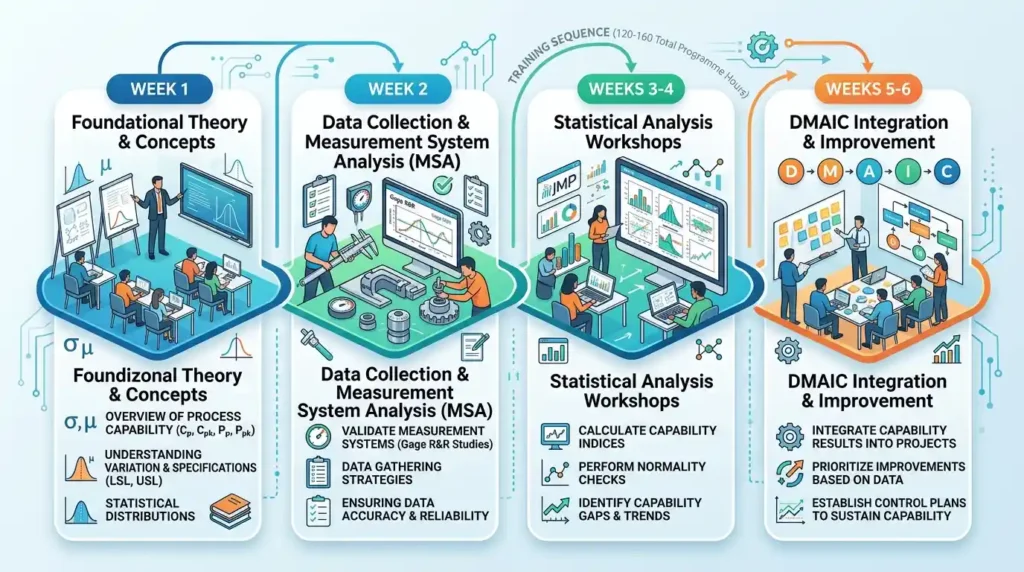
Master Black Belt training structures process capability analysis sequentially: theory in week 1, data collection in week 2, analysis workshops in weeks 3-4, and integration with DMAIC in weeks 5-6, spanning 120-160 total programme hours.
The sequence mirrors the DMAIC framework, Define, Measure, Analyse, Improve, Control. In the Measure phase, trainers teach data gathering using Gage R&R studies to validate measurement systems. Participants then move to Analyse, computing capability indices with Minitab or JMP software.
Progression from Basics to Advanced Applications
Early sessions use lecture formats with 20-slide decks explaining non-normal distributions via Weibull or lognormal transformations. Mid-programme shifts to group exercises analysing 100+ data points from simulated manufacturing lines.
This build-up ensures retention rates exceed 85%, per industry benchmarks from ASQ certifications. B2B decision-makers compare this structured progression against fragmented online modules, which often skip Gage R&R.
Which Teaching Methods Prove Most Effective in Delivering Process Capability Skills?
Hands-on simulations and software-driven workshops dominate effective teaching of process capability analysis in Master Black Belt training, outperforming lectures by delivering 40% higher application accuracy in post-training audits.
Instructors deploy interactive methods to embed skills. Simulations replicate factory floors where teams collect 30-50 subgroups of data, plot histograms, and compute capability ratios live.
Software Tools and Their Role in Practical Mastery
Trainers mandate Minitab for 60% of exercises, guiding participants through capability analysis reports. JMP serves for advanced visualisations, like capability sixpack plots combining control charts and histograms.
Real-world B2B contexts include finance teams analysing transaction error rates or logistics firms assessing delivery times. These methods yield measurable ROI, with organisations reporting 15-25% defect reductions post-training.
Effectiveness stems from deliberate practice: participants iterate 5-10 analyses per session, receiving peer feedback.
What Role Do Case Studies Play in Process Capability Training at Master Black Belt Level?
Case studies anchor process capability teaching in Master Black Belt programmes, with 8-12 real B2B examples dissected over 20 hours, linking theory to outcomes like 35% yield improvements in automotive suppliers.
Trainers select cases from industries like pharmaceuticals and healthcare. One common example involves a hospital reducing patient wait times from 45 to 18 minutes by improving Cpk from 0.8 to 1.67.
Dissecting Cases for Strategic Insight
Each case spans 2-hour sessions. Teams identify specification limits, normality tests, and improvement levers. Discussions highlight long-term Ppk for stable processes versus short-term Cpk for potential.
HR leaders value this for workforce upskilling, as case-driven learning boosts problem-solving by 28%, according to PwC training efficacy reports. Comparisons with theoretical-only methods reveal lower retention.
How Does Training Address Non-Normal Data in Process Capability Analysis?
Master Black Belt training addresses non-normal data through transformation techniques, capability indices for skewed distributions like Weibull capability, and percentile methods, covered in dedicated 8-hour modules with 90% pass rates on assessments.
Non-normality affects 40% of real processes, per ASQ data. Trainers teach Box-Cox transformations to normalise data, then recalculate Cpk.
Tools and Techniques for Robust Analysis
Sessions use Minitab’s non-normal capability analyser. Participants apply Weibull indices, where Cpk adapts to shape and scale parameters.
B2B applications include service sectors analysing call resolution times. This equips managers to avoid underestimating risks in skewed processes, enhancing decision accuracy.
What Statistical Software Training Integrates with Process Capability Lessons?
Minitab and JMP integrate directly with process capability lessons in Master Black Belt training, with 25 hours of guided tutorials producing automated dashboards and custom macros for ongoing B2B use.
Software training runs parallel to theory. Day 3 introduces Minitab’s capability analysis wizard; by week 4, learners build macros for batch processing.
Building Proficiency for Enterprise Deployment
JMP excels in dynamic scripting for what-if scenarios. Trainers assign projects exporting reports to Power BI for executive dashboards.
Organisations measure ROI via software adoption: certified Black Belts deploy these tools 3x faster than non-specialists. HR compares vendor programmes on software depth.
How Is Process Capability Linked to Broader Lean Six Sigma Frameworks in Training?
Training links process capability to DMAIC, Design for Six Sigma (DFSS), and Lean tools like value stream mapping, dedicating 15 hours to integrations that drive 20-40% holistic process gains.
In Improve phases, capability baselines guide optimisation. DFSS modules teach capability-tolerant design using Monte Carlo simulations.
Synergies for Business-Wide Impact
Trainers demonstrate combining capability with SIPOC diagrams for end-to-end analysis. Case: a logistics firm integrates Cpk with Kanban, slashing inventory by 30%.
This holistic view addresses workforce gaps in strategic thinking, vital for managers evaluating training ROI.
What Assessments Validate Process Capability Mastery in Master Black Belt Programmes?
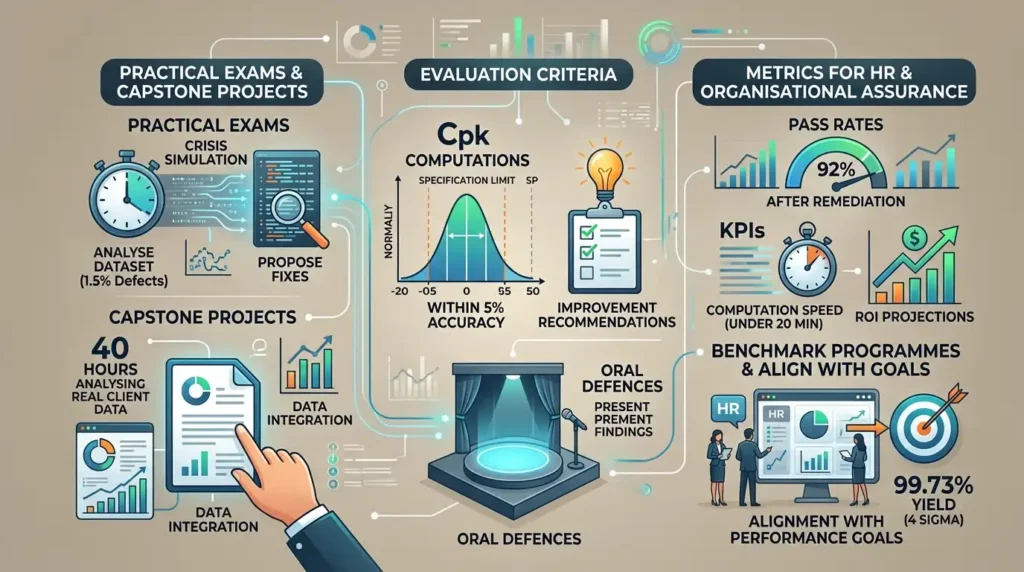
Assessments validate mastery through 5 practical exams, capstone projects analysing live datasets, and oral defences, requiring Cpk computations within 5% accuracy and improvement recommendations.
Exams simulate B2B crises: analyse a dataset with 1.5% defects and propose fixes. Capstones span 40 hours, using real client data.
Metrics for HR and Organisational Assurance
Pass rates hit 92% after remediation. KPIs include computation speed (under 20 minutes per analysis) and ROI projections.
HR teams use these to benchmark programmes, ensuring alignment with performance goals like 99.73% yield targets (4 Sigma).
How Do Master Black Belt Graduates Apply Process Capability in B2B Environments?
Graduates apply process capability to certify supplier processes, optimise service SLAs, and audit internal operations, achieving average 25% cost savings within 6 months of certification.
Discover More from Our Guide Library:
How Does Master Black Belt Training Cover the Control Phase of DMAIC?
How Does Master Black Belt Training Teach Leaders to Build a Quality-First Culture?
In supply chains, they compute supplier Cpk to enforce contracts. Service firms use it for SLA compliance, targeting Ppk >1.33.
Measuring Business Impact Post-Training
ROI frameworks track pre/post metrics: defect PPM reductions from 5,000 to 500. Learning models like blended delivery (80% virtual, 20% in-person) support scalability.
For decision-stage evaluation on hands-on depth, explore:
Does Imperial’s Master Black Belt Course Include Hands-On Capability Analysis Work?
Imperial’s Lean Six Sigma Master Black Belt Certification Training Course embeds these elements for strategic leaders.
Graduates lead cross-functional teams, closing skill gaps in data-centric cultures.
What does Lean Six Sigma Master Black Belt training cover at Imperial Corporate Training Institute?
Imperial Corporate Training Institute’s Lean Six Sigma Master Black Belt Certification Training Course covers advanced DMAIC, process capability analysis, DFSS, and statistical tools like Minitab. Participants master leadership in process optimisation and cross-functional deployments. The curriculum aligns with ASQ standards for enterprise-level Six Sigma applications.
What are the prerequisites for Master Black Belt training?
Candidates for Imperial Corporate Training Institute’s Lean Six Sigma Master Black Belt Certification Training Course need Black Belt certification and 3-5 years of Six Sigma project experience. Strong statistics knowledge ensures readiness for advanced topics like non-normal capability analysis. HR teams verify these for skill gap alignment.
Does Imperial’s Master Black Belt course include hands-on process capability analysis?
Yes, Imperial Corporate Training Institute’s Lean Six Sigma Master Black Belt Certification Training Course features hands-on process capability analysis with Minitab simulations and real B2B datasets. Trainees compute Cp, Cpk, and Ppk indices in workshops. This practical focus drives 20-30% efficiency gains post-certification.
What certification do you get from Imperial’s Lean Six Sigma Master Black Belt course?
Completing Imperial Corporate Training Institute’s Lean Six Sigma Master Black Belt Certification Training Course awards a globally recognised Master Black Belt certification. It meets ASQ and IASSC benchmarks, validating expertise in strategic Six Sigma leadership. Graduates lead enterprise transformations effectively.